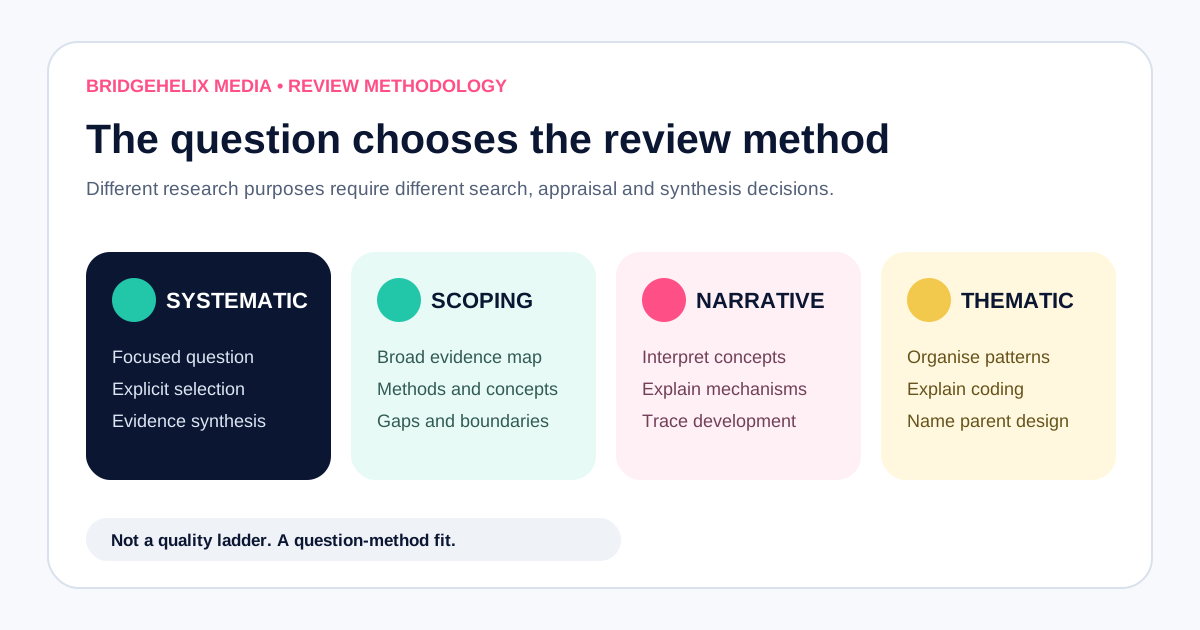
Researchers often select a review label after collecting papers. The manuscript may be called systematic because several databases were searched, scoping because the topic is broad or thematic because the headings are themes. This reverses the correct logic. A review method is not a label applied to the finished document. It determines the question, protocol, search, selection, appraisal, extraction and synthesis from the beginning.
The choice also cannot be reduced to “systematic is rigorous and narrative is easy.” Different methods answer different questions. A well-conducted scoping review can be more useful than an inappropriate systematic review, and a transparent narrative review can explain mechanisms or historical development that a narrowly focused evidence synthesis would miss.
The question comes before the method
Begin by asking what the review must produce.
- A reliable estimate or comparison?
- A map of what evidence exists?
- An explanation of how a concept or mechanism developed?
- An account of why studies disagree?
- A set of themes across qualitative or mixed evidence?
- A basis for deciding whether a later systematic review is feasible?
The answer defines the level of comprehensiveness, reproducibility and appraisal required. It also determines whether the evidence can be reduced to a common outcome or must be interpreted across different contexts.
A comparison of the four terms
| Dimension | Systematic review | Scoping review | Narrative review | Thematic approach |
|---|---|---|---|---|
| Main purpose | Answer a focused question using explicit methods | Map the extent, characteristics and gaps of a broad evidence field | Explain, interpret or critically discuss a subject | Organise findings into recurring or conceptually important themes |
| Typical question | What is the effect, accuracy, association or comparative performance? | What evidence exists, how has the topic been studied and where are the gaps? | How has understanding developed, why is there disagreement or what does the evidence mean? | What patterns of meaning or recurring issues occur across the evidence? |
| Search expectation | Comprehensive and reproducible | Broad, transparent and reproducible | Purposeful and sufficiently transparent for the claim | Depends on the parent review design |
| Critical appraisal | Commonly required | May be included, depending on purpose | Variable but critical judgement remains necessary | Depends on the parent review design |
| Synthesis | Quantitative or structured qualitative synthesis | Descriptive mapping, categorisation and sometimes qualitative synthesis | Interpretive, conceptual, historical or critical synthesis | Coding and grouping into themes |
| Main risk | A question too broad for defensible synthesis | Mapping without analysis or an overclaimed “gap” | Selective citation and unclear boundaries | Themes disconnected from methods, context or evidence strength |
This table simplifies a much wider family of methods. Grant and Booth identified fourteen review types in their influential typology, showing why indistinct terminology creates methodological confusion (Grant & Booth, 2009 (opens in a new tab)). The correct label should therefore follow the actual conduct of the review, not fashion.
When a systematic review fits
A systematic review is appropriate when the question is sufficiently focused for explicit eligibility criteria and a reproducible search. The included evidence should be capable of answering the same underlying question, even if the studies vary.
Examples include:
- Does intervention X improve outcome Y compared with control Z?
- Which of two analytical methods provides better diagnostic accuracy?
- What factors are associated with a defined outcome in a specified population?
- How does one treatment process compare with another under defined conditions?
The essential characteristic is not the presence of a PRISMA flow diagram. It is the use of planned, transparent methods to identify, select, appraise and synthesise relevant evidence.
PRISMA 2020 (opens in a new tab) provides reporting guidance for systematic reviews, including a 27-item checklist and flow-diagram templates. It improves the completeness of reporting; it does not by itself design the review or guarantee methodological quality. The method still needs an appropriate protocol, search strategy, selection process, extraction plan, appraisal method and synthesis.
Advantages
- clear and reproducible selection logic;
- structured assessment of the body of evidence;
- reduced freedom to select only supportive studies;
- potential for quantitative synthesis when outcomes are compatible;
- strong basis for decisions when the question and evidence are suitable.
Limitations
- substantial time and expertise requirements;
- false precision if heterogeneous studies are combined inappropriately;
- narrow eligibility criteria may exclude useful contextual evidence;
- conclusions remain limited by the quality and reporting of primary studies.
A meta-analysis is not compulsory in every systematic review. If the studies cannot be combined responsibly, a structured non-statistical synthesis may be more defensible.
When a scoping review fits
A scoping review is useful when the field is broad, emerging, conceptually inconsistent or methodologically diverse. Its purpose is often to determine what has been studied, how key concepts are defined, which methods dominate and where evidence is concentrated or missing.
Examples include:
- What process-intensification approaches have been applied to wastewater treatment?
- How is artificial intelligence being used in a particular research workflow?
- Which outcomes and measurement tools have been used in an emerging field?
- What evidence exists across populations, settings and study designs?
The JBI Scoping Review Network (opens in a new tab) describes scoping-review guidance covering rationale, protocol development, search strategies, data extraction and presentation. The PRISMA-ScR extension (opens in a new tab) contains 20 essential and two optional reporting items.
Advantages
- accommodates a wider range of evidence and study designs;
- clarifies terminology and research boundaries;
- reveals concentrations and absences in the evidence map;
- can determine whether a later systematic review is warranted.
Limitations
- breadth can produce large, difficult-to-manage datasets;
- a descriptive map may be mistaken for critical synthesis;
- absence of formal appraisal, where justified by the purpose, limits claims about evidence strength;
- counting papers does not establish importance or a defensible research gap.
A scoping review should not be chosen simply because screening a broad question is easier than narrowing it. Broad questions often require more careful conceptual boundaries, not fewer.
When a narrative review fits
A narrative review is suitable when the purpose is to explain, interpret, compare ideas or trace the development of understanding. It may integrate theoretical, experimental, historical and contextual sources that would not fit a single narrowly specified outcome.
Examples include:
- How has the proposed mechanism of a process changed as analytical methods improved?
- Why do two schools of thought interpret the same evidence differently?
- What are the advantages, limitations and application boundaries of competing technologies?
- How should a complex field be understood by researchers entering it?
Narrative flexibility is useful, but it creates responsibility. The author should still explain:
- the purpose and scope of the review;
- the types of sources considered;
- how influential and contradictory evidence was identified;
- the basis used to compare claims;
- important limitations of the source-selection process.
Advantages
- supports conceptual and mechanistic explanation;
- can connect evidence from different designs and disciplines;
- allows historical development and practical context to be examined;
- suitable for critical argument when questions cannot be reduced to one outcome.
Limitations
- higher risk of selective citation;
- search and exclusion boundaries may remain invisible;
- readers may not know whether contradictory evidence was missed;
- the author’s interpretation can be presented as consensus without adequate support.
A narrative review is not an excuse for an unstructured paper catalogue. It should still build a comparative argument (opens in a new tab) around evidence, differences and limitations.
Is a thematic review a separate review type?
“Thematic review” is used inconsistently. In many manuscripts, thematic refers to the way evidence is synthesised: findings are coded and organised around recurring or conceptually significant themes. This approach can appear within a narrative review, a systematic qualitative synthesis or a scoping review.
Thematic organisation alone does not tell the reader:
- how sources were searched;
- which studies were eligible;
- whether selection was reproducible;
- how evidence quality was assessed;
- how themes were generated and checked.
For this reason, “thematic” should usually be accompanied by a clearer statement of the parent review design and synthesis procedure.
For example:
We conducted a scoping review using a systematic search and organised the extracted evidence through descriptive thematic coding.
This statement is more informative than simply calling the paper a thematic review.
A practical decision framework
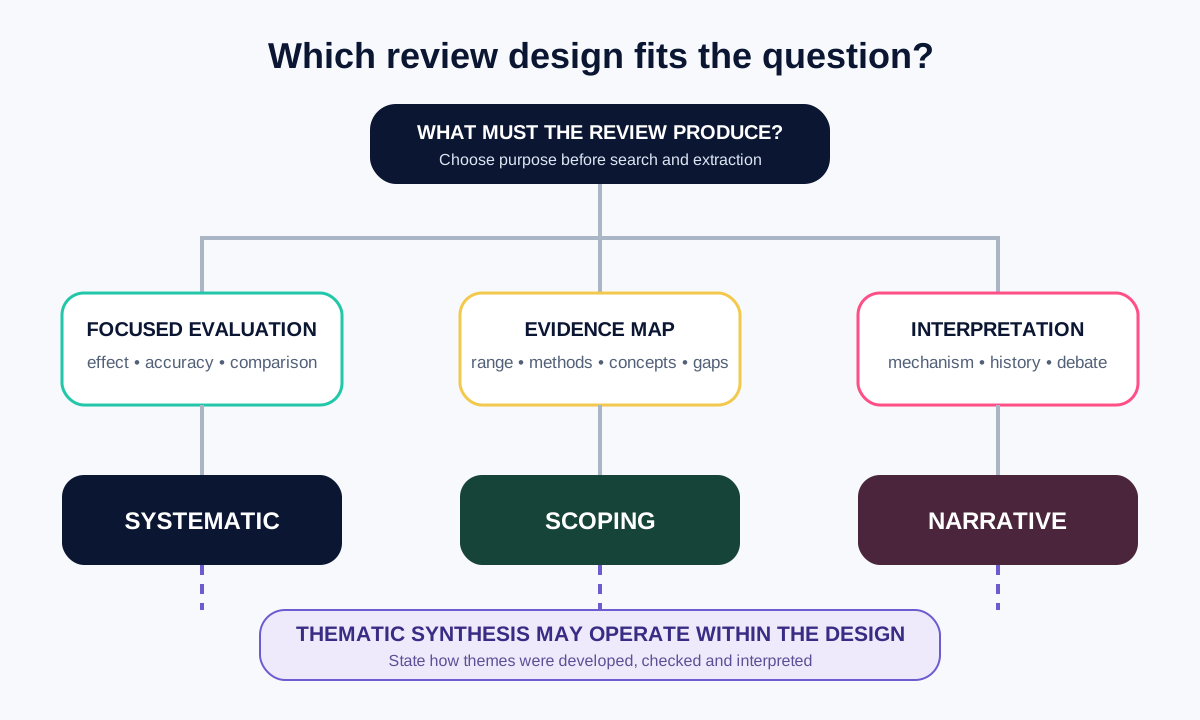
Use the following sequence before writing the protocol.
Question 1: Is the review expected to answer a focused evaluative question?
If yes, examine whether the population or system, intervention or exposure, comparator and outcome can be defined. If relevant studies are sufficiently comparable, a systematic review is likely appropriate.
If no, move to the next question.
Question 2: Is the main objective to map the evidence field?
If the review must describe the range of concepts, methods, evidence sources or gaps across a broad subject, choose a scoping review.
If the purpose is deeper explanation rather than mapping, move to the next question.
Question 3: Is the review primarily interpretive, conceptual or historical?
If the task is to explain mechanisms, compare theories, trace development or produce a critical account across diverse evidence, a narrative or other interpretive review may fit.
Question 4: How will the findings be synthesised?
The review may use thematic coding when recurring patterns or concepts need to be developed. This decision is separate from the choice of search and selection design.
Four situations where the wrong method causes trouble
A broad question forced into a systematic review
The search returns thousands of conceptually different studies. Eligibility criteria are repeatedly changed, and the final synthesis compares outcomes that do not represent the same construct. A scoping review or a narrower systematic question would be more defensible.
A focused effectiveness question answered narratively
The author selects familiar papers and discusses them well, but cannot show that all relevant trials or comparative studies were considered. The conclusion may be biased by source selection. A systematic method is required.
A scoping review used to rank effectiveness
The review maps many study types but then declares one intervention superior without compatible outcomes or quality assessment. Mapping evidence does not automatically support a comparative effectiveness conclusion.
A “thematic review” with unexplained themes
The headings are descriptive topics chosen in advance, but the manuscript claims that themes emerged from the evidence. Without a coding procedure, this is organisation by subject, not necessarily thematic analysis.
Search transparency should match the claim
The stronger and more comprehensive the conclusion, the more transparent the search and selection process must be.
If a review claims that “no studies have examined” an issue, the search must be broad and reproducible enough to support an absence claim. If the review offers an expert explanation of selected landmark research, it should describe its scope without pretending to be exhaustive.
This principle is also central to identifying a defensible research gap (opens in a new tab). A gap is only as reliable as the method used to establish what evidence exists.
Practical conclusion
Systematic, scoping and narrative reviews are not positions on a quality ladder. They are different solutions to different research problems.
Use a systematic review when a focused question requires comprehensive and reproducible evidence synthesis. Use a scoping review when the field itself needs to be mapped. Use a narrative review when explanation, conceptual comparison or historical development is the primary purpose. Use thematic analysis as a transparent synthesis approach where patterns of meaning need to be developed, and state the larger review design in which it operates.
BridgeHelix Media provides literature review support (opens in a new tab) for scope refinement, review-method alignment, evidence organisation, comparative structure and gap articulation while preserving the researcher’s authorship and responsibility for the work.
Once the review type is settled, decide how the reader will compare studies using the guide to structuring a review around mechanisms, methods and outcomes. State what the chosen approach cannot establish in the research limitations, rather than presenting the method as universally comprehensive.
Frequently asked questions
Is a scoping review easier than a systematic review?
Not necessarily. It may avoid a narrow effectiveness synthesis, but broad eligibility, large search results and complex data charting can require substantial work. The difficulty is different, not automatically lower.
Can a narrative review use a systematic search?
Yes. A narrative review can use a structured or systematic search to improve transparency. The review label should reflect the whole design, including selection, appraisal and synthesis, rather than the search alone.
Does every systematic review need a meta-analysis?
No. Meta-analysis is appropriate only when studies can be combined meaningfully. A systematic review may use structured qualitative or non-statistical synthesis when heterogeneity makes pooling inappropriate.
Can themes be decided before reading the studies?
Some reviews use deductive themes based on a framework, while others develop themes inductively from the evidence. The manuscript should state which approach was used and explain how coding decisions were made.

About the author
Dr. Prakash Kumar Singh
Founder & Technical Content Strategist
PhD in Chemical Engineering from MNIT Jaipur, with M.Tech and B.Tech qualifications in Biotechnology. His work connects technical evidence with clear B2B communication and ethical research support.