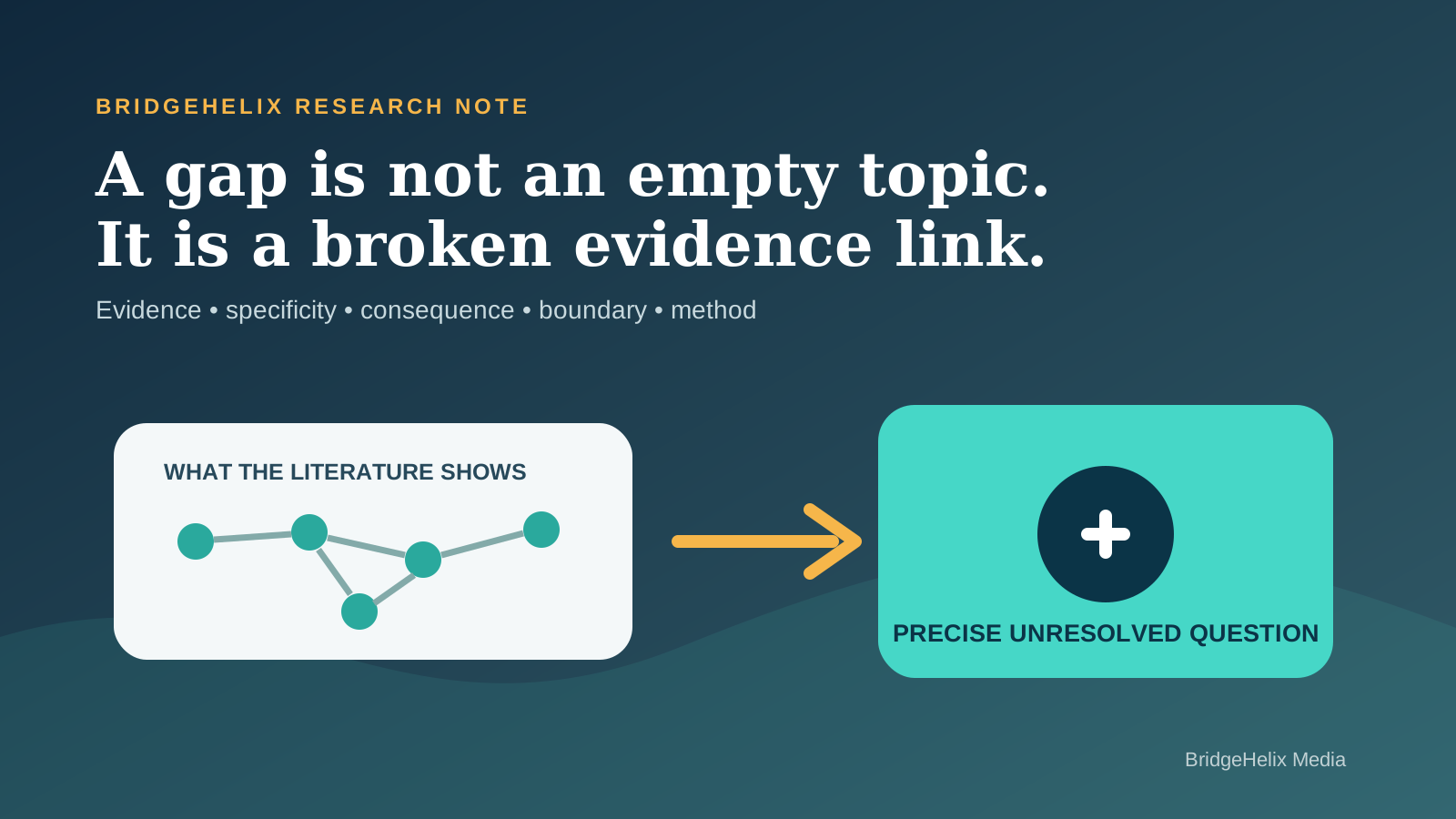
“Very few studies have examined this topic” is one of the most common sentences in research proposals and literature reviews.
It is also one of the weakest gap statements.
The sentence may be factually correct, but scarcity alone does not establish a worthwhile research problem. A topic can have few studies because it is new, difficult, narrowly relevant, poorly defined or simply not important. The researcher still has to explain what is missing from current knowledge and what becomes possible when that absence is addressed.
A defensible research gap is a specific, evidence-supported limitation in what existing studies can explain, compare, predict or apply. It identifies where the limitation occurs, shows why current evidence cannot resolve it, and explains the scientific or practical consequence. The proposed research must then be capable of addressing that gap within a clear population, system, method or context.
This article provides a practical way to test a gap before it becomes the foundation of a thesis, proposal or review paper.
A research gap is not the same as an under-researched topic
An under-researched topic describes quantity. A research gap describes an unresolved knowledge problem.
Suppose only five papers have examined a new adsorbent for nitrate removal. That fact does not tell us what the sixth paper should do.
A useful gap might instead be:
- performance has only been tested in single-solute water, so selectivity under competing ions is unknown;
- all studies used batch equilibrium tests, so continuous-flow behaviour has not been established;
- removal has been reported, but regeneration, leaching or residual water quality has not been evaluated;
- studies use different conditions, preventing a defensible comparison; or
- the proposed mechanism is based on indirect evidence and has not been tested using suitable surface characterisation.
Each statement identifies a limitation in the available evidence. It also suggests what kind of research would reduce the uncertainty.
Frameworks developed for identifying research gaps make the same distinction. They characterise not only why evidence is insufficient but also where the gap exists, such as in a population, intervention, outcome, setting or research method. More recent gap frameworks have expanded the vocabulary further, but adding labels is not the main objective. The useful question remains: what can the present evidence not establish?
Start with the claim the field wants to make
A gap becomes easier to see when the expected conclusion is stated explicitly.
Ask:
What would a researcher, practitioner or decision-maker reasonably want to conclude from this body of literature?
Examples include:
- this treatment is effective under realistic water conditions;
- this mechanism explains the observed reaction;
- this intervention works for a defined population;
- this model predicts performance outside the calibration dataset;
- this material can be regenerated without unacceptable loss; or
- this process is economically preferable at a relevant scale.
Now test whether the available evidence supports that conclusion.
If the literature reports high removal in synthetic water but the intended claim concerns groundwater application, the gap is not merely “few field studies.” The gap is that matrix effects, competing ions and operational variability prevent transfer of the laboratory conclusion to the intended application.
That wording is stronger because the reader can see the broken connection.
Five tests for a defensible research gap
BridgeHelix uses a five-part test when reviewing gap statements.
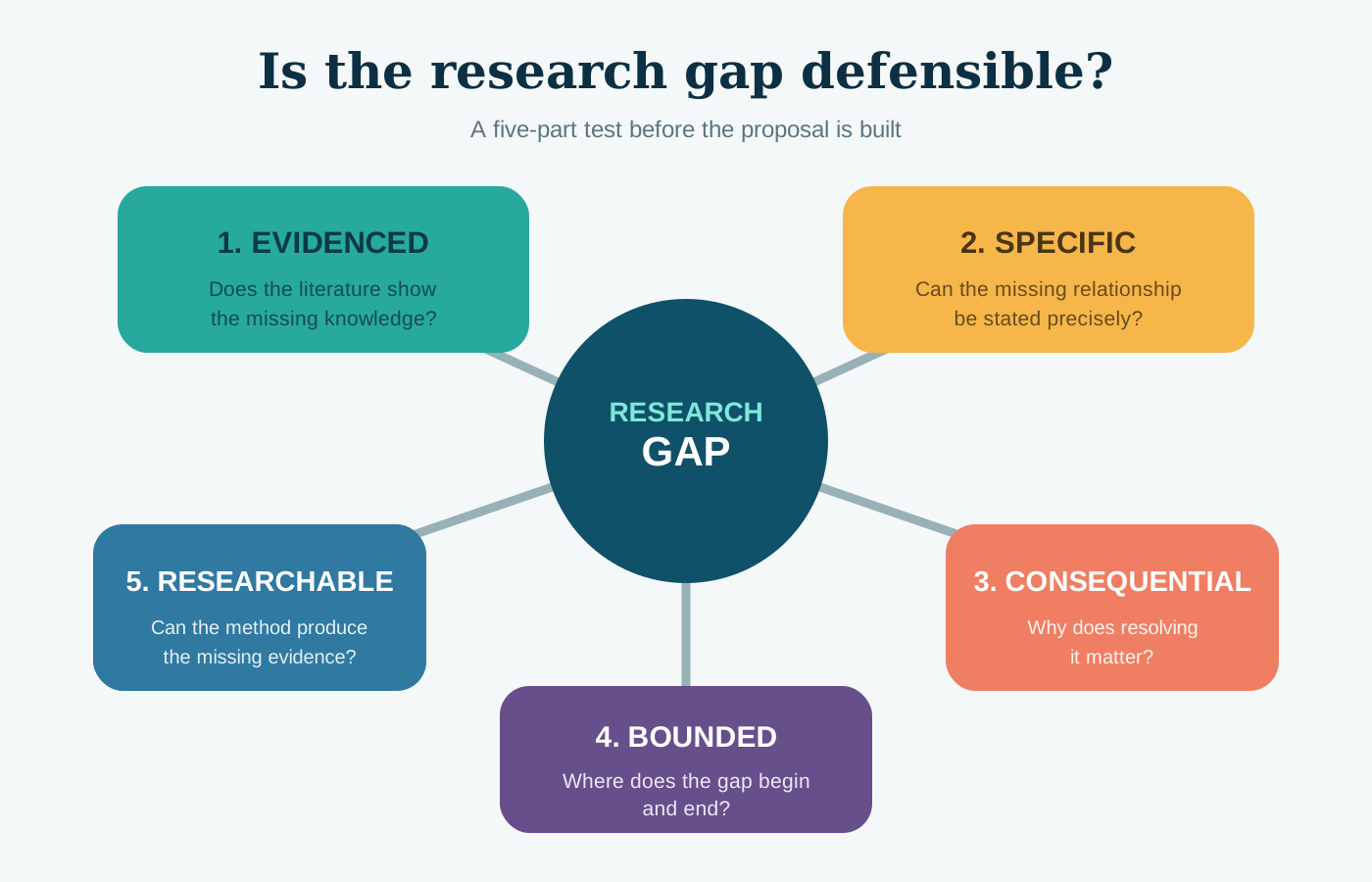
1. Is the gap evidenced?
A gap cannot be established by assertion.
Show the pattern in the literature. This may involve a systematic search, a structured review, an evidence matrix or a transparent narrative synthesis. The appropriate method depends on the research question, but the reader must be able to see how the conclusion was reached.
Evidence may show that:
- studies repeatedly exclude a relevant population;
- available experiments use one narrow operating range;
- conclusions conflict under comparable conditions;
- a theory has not been tested against an alternative explanation;
- outcomes important to application are not reported; or
- reviews repeatedly call for work but do not characterise what work is needed.
Do not rely only on a sentence from one paper saying “future studies are required.” That statement is a lead, not proof. Authors may recommend work beyond their own scope without showing that it is the most important unresolved problem in the field.
2. Is the gap specific?
“There is limited research on scale-up” is too broad.
Which part of scale-up is unresolved? Hydrodynamics? Heat transfer? Feed variability? Energy demand? Material durability? Process control? Economics?
A specific gap names the missing relationship or evidence:
Existing batch studies quantify equilibrium adsorption, but they do not show how flow rate and bed depth affect breakthrough under continuous operation.
The sentence provides variables, a system and a missing outcome. A reviewer can understand what the proposed study will examine.
3. Is the gap consequential?
Explain what is prevented by the missing evidence.
Does the gap stop a mechanism from being distinguished from a competing explanation? Does it create uncertainty in design? Does it make a policy conclusion unreliable? Does it prevent findings from being applied to an important population?
Without consequence, a gap can become an exercise in filling an empty box.
Consider these two statements:
No study has tested the adsorbent at 27°C.
Available studies report performance at different temperatures but do not quantify the temperature dependence of equilibrium capacity, limiting comparison across seasonal operating conditions.
The first identifies an untested condition. The second explains why the missing relationship affects interpretation and application.
4. Is the gap bounded?
A defensible gap has edges.
Define the relevant population, process, material, geography, time period, outcome or evidence type. A bounded gap avoids pretending that one study will solve the entire subject.
For example:
The gap concerns continuous nitrate removal from groundwater containing sulphate and bicarbonate using regenerable anion-exchange materials at near-neutral pH.
This does not claim that all nitrate-treatment questions are unresolved. It states the context in which uncertainty remains.
Boundaries also protect the eventual conclusion. When the study is complete, the author can say exactly where the finding applies.
5. Is the gap researchable?
The proposed design must be capable of producing the missing evidence.
If the gap concerns long-term durability, a short batch test will not resolve it. If the gap concerns causation, a cross-sectional description may be insufficient. If the gap concerns commercial feasibility, another maximum-removal experiment without energy, material or regeneration data will add little.
The methods should connect directly to the gap:
missing knowledge → required evidence → suitable method → interpretable outcome
When this chain breaks, research objectives may sound related to the topic but still fail to address the stated problem.
Common types of research gaps and their limits
Gap labels can help researchers examine the literature from several angles, but they should not be treated as a checklist that guarantees novelty.
| Gap type | What may be missing | Weak formulation | Stronger direction |
|---|---|---|---|
| Evidence gap | Sufficient or conclusive findings | “Few studies exist” | Existing studies do not measure the outcome required for the conclusion |
| Methodological gap | A design capable of testing the claim | “No one used method X” | Current methods cannot separate two plausible explanations |
| Context gap | Evidence in a relevant setting or population | “Not studied in India” | Conditions in the target setting change exposure, operation or applicability |
| Theoretical gap | An unexplained relationship or competing theory | “Theory needs more work” | Existing theory predicts A, but repeated observations show B under defined conditions |
| Consistency gap | Findings that conflict without an adequate explanation | “Results are mixed” | Variation tracks a specific method, sample or operating condition |
| Application gap | Missing evidence for implementation or scale | “More pilot work is needed” | Laboratory metrics do not capture durability, control or cost at continuous scale |
The strongest gap statements often combine types. A context gap may also reveal a methodological gap because the measurement approach used in one setting is unsuitable in another.
How to write the gap as a short argument
A defensible research gap usually requires four moves.
Move 1: Establish what is known
State the supported conclusion, not a long history of the topic.
Modified alumina materials have shown fluoride affinity under controlled batch conditions.
Move 2: Define the boundary of that knowledge
Most studies use synthetic single-solute water and report equilibrium removal over short contact periods.
Move 3: Identify the unresolved consequence
These designs do not establish selectivity, breakthrough behaviour or material stability in groundwater containing competing ions.
Move 4: Show how the proposed research addresses it
A continuous-column study using characterised groundwater and repeated regeneration cycles is therefore needed to determine whether the reported affinity supports practical treatment.
The four sentences move from evidence to limitation to consequence to method. The word “therefore” is earned because the proposed study follows logically from the gap.
A worked example: from vague novelty to a defensible problem
Weak version
Marble waste has received limited attention for water treatment. Therefore, this study will prepare a novel marble-based adsorbent for fluoride removal.
The statement depends on novelty and scarcity. It does not explain why a new material is needed, what is insufficient in the current evidence or which decision the study will improve.
Stronger version
Many fluoride adsorbents show high laboratory removal but depend on costly precursors or provide limited evidence on regeneration and residual water quality. Waste marble offers a calcium-rich feedstock, yet its use in a shaped, regenerable medium has not been evaluated under conditions needed for drinking-water application. The unresolved issue is therefore not whether marble can contact fluoride, but whether a stable composite can combine adsorption performance, safe treated-water quality and lower material cost. The study should evaluate these outcomes together rather than report removal percentage alone.
The stronger version still needs citations. However, it identifies the existing problem, the missing combination of evidence and the criteria by which the study should be judged.
This form of reasoning reflects the wider BridgeHelix method: define the practical problem, examine the evidence, compare the possibilities, acknowledge the boundary and make the conclusion useful.
What does not count as a gap?
Several statements often appear in gap sections but require more work.
“No study has combined X and Y.” A new combination is not automatically useful. Explain why the combination should reveal a mechanism, solve a limitation or improve an outcome.
“The results are contradictory.” Identify whether the studies are genuinely comparable and what variable may explain the disagreement.
“The topic has not been studied in this location.” Geography matters only when the local population, environment, regulation, resources or implementation conditions affect the research question.
“The newest method has not been applied.” Method novelty is not a research contribution unless it produces evidence that existing methods cannot.
“More research is needed.” Specify what evidence is needed, why it matters and what design could produce it.
Test the gap against the objectives
Once the gap is written, place it beside the research objectives.
Every objective should reduce one part of the stated uncertainty. Every method should produce evidence needed by an objective. Every result section should answer that objective. The conclusion should return to the gap without expanding beyond the study boundary.
This alignment is also central to academic editing and research support (opens in a new tab), where unclear connections among the problem, objectives, methods and conclusions can be flagged while the researcher retains authorship and all intellectual decisions.
If the gap was developed through synthesis rather than paper-by-paper summary, the companion guide on writing a critical literature review (opens in a new tab) provides a framework for organising that evidence.
Conclusion: the gap must change a decision
A research gap is defensible when the reader can see the missing knowledge, the evidence for its absence, the consequence of leaving it unresolved and the method capable of addressing it.
The practical recommendation is to remove the phrase “few studies exist” from the first draft and replace it with three questions:
- What conclusion can the current evidence not support?
- Why does that limitation matter?
- What evidence would reduce the uncertainty?
If those questions cannot be answered, the research topic may be interesting, but the gap is not ready.
If you have collected the literature but cannot turn it into a precise gap and aligned section structure, discuss your literature review with BridgeHelix Media (opens in a new tab).
Sources
- Wong, E.C. et al. (2021). Methods for identifying health research gaps, needs, and priorities: a scoping review (opens in a new tab).
- Nyanchoka, L. et al. (2020). Key stakeholders' perspectives and experiences with defining, identifying and displaying gaps in health research (opens in a new tab).
- Naqvi, W.M. and Gabr, M. (2024). The Naqvi–Gabr research gap framework (opens in a new tab).

About the author
Dr. Prakash Kumar Singh
Founder & Technical Content Strategist
PhD in Chemical Engineering from MNIT Jaipur, with M.Tech and B.Tech qualifications in Biotechnology. His work connects technical evidence with clear B2B communication and ethical research support.