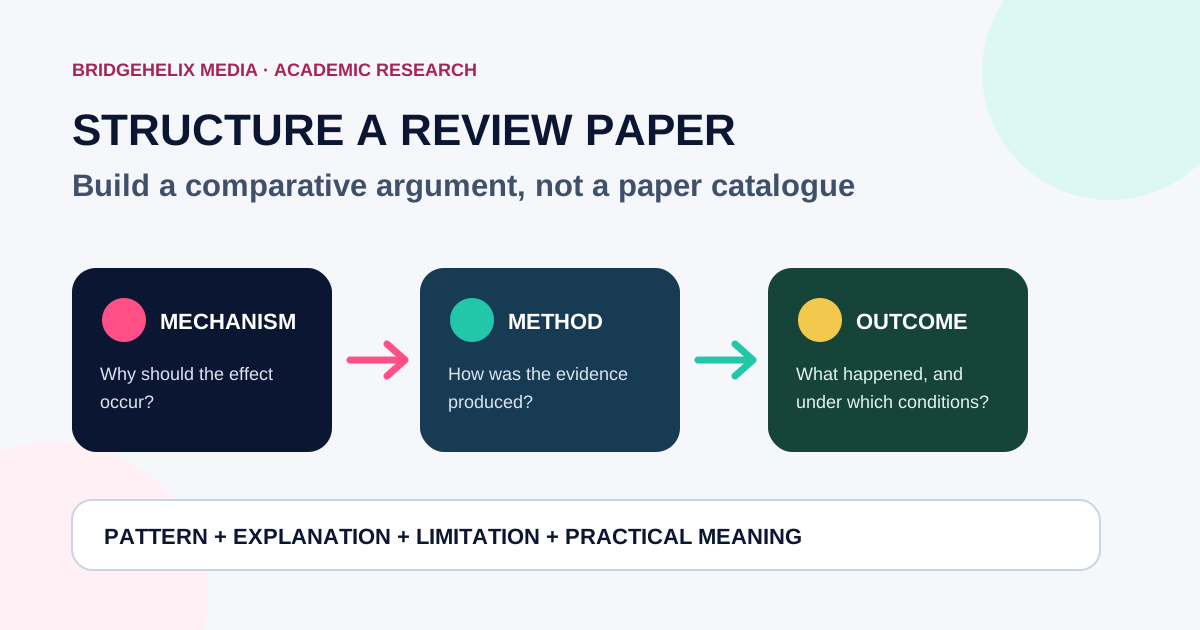
The difficulty is that published studies arrive as complete papers. Each has its own objective, method, results and conclusion. A reviewer therefore tends to preserve that unit during note-taking and writing: one paragraph for Study A, another for Study B and a third for Study C.
That structure is easy to draft but difficult to read. It transfers the comparison work to the reader. The reviewer has reported what each paper says without explaining how the studies fit together.
A comparative review paper does something different. It breaks each study into evidence components and reorganises those components around the review question. This is why a useful literature review matrix is more than a storage table. It is the bridge between reading papers and building sections.
Begin with the problem the review must resolve
A topic is not yet a review architecture. “Adsorbents for fluoride removal,” “AI in medical imaging” or “leadership in remote teams” may define a field, but each field can support several very different reviews.
The structure becomes clearer when the topic is converted into a decision:
- Which mechanisms are sufficiently supported by direct evidence?
- Why do studies report different performance?
- Which methods produce results that can be compared?
- Under what conditions does the proposed approach remain effective?
- Which limitation prevents laboratory evidence from becoming practice?
These questions identify the comparisons the paper must perform. They also prevent the review from expanding until it becomes a catalogue of everything published in the field.
For example, a review of adsorbents may aim to identify materials suitable for field-scale fluoride treatment. In that case, maximum adsorption capacity alone is not enough. The paper must also examine water matrix, pH, dose, regeneration, contact time, competing ions, column behaviour, material safety and cost. The structure should reflect this practical decision.
Why a conventional topic-by-topic structure often fails
Thematic organisation is usually better than author-by-author writing, but themes can still be superficial. A paper may contain sections on activated carbon, metal oxides, biochar and composites. Each section may again become a list of materials and removal percentages.
The headings have changed, but the reasoning has not.
A useful theme must perform analytical work. “Metal oxides” is a material category. “Surface charge and ligand-exchange mechanisms across metal oxides” is an analytical theme. “Batch adsorption studies” is a method category. “How batch conditions inflate apparent treatment performance” is an analytical theme.
The second form tells the reader why the evidence has been grouped. It also creates space for comparison, limitation and interpretation.
The three-lens review architecture
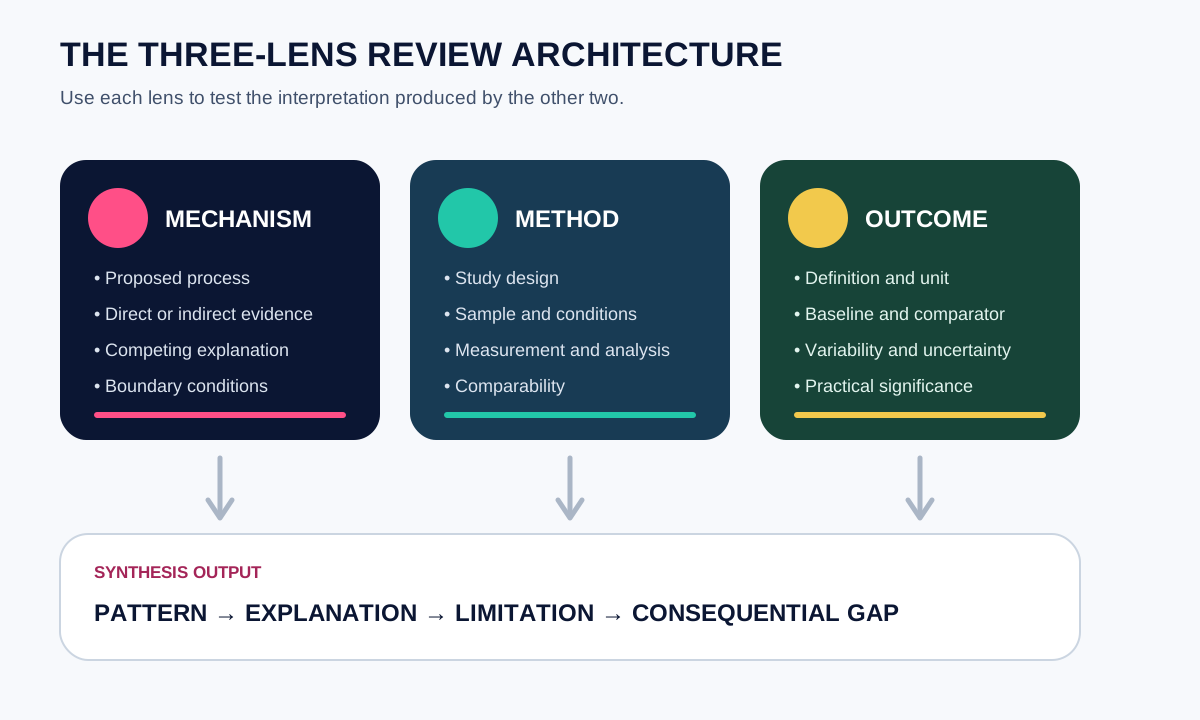
The BridgeHelix three-lens architecture uses mechanisms, methods and outcomes as connected layers. It is not a fixed table of contents. The order can change according to the review question, but all three lenses should remain visible.
Lens 1: mechanism
The mechanism section asks why the reported effect should occur.
In experimental sciences, this may include reaction pathways, transport phenomena, surface interactions, biological processes or structure–property relationships. In social research, it may include behavioural pathways, institutional processes or causal explanations.
A mechanism claim should be separated from mechanism evidence. Researchers often infer a mechanism because an observation is consistent with it. That is not the same as directly demonstrating the process.
A useful comparison may distinguish among:
- mechanism proposed by the authors;
- evidence used to support it;
- competing explanations;
- variables expected to influence the mechanism;
- conditions under which it may not operate.
For adsorption research, a change in infrared peaks may support the involvement of a functional group, but it may not independently prove the complete adsorption mechanism. Surface charge, speciation, kinetics, thermodynamics and post-treatment characterisation may provide additional evidence. The review should show how strong the combined case is rather than repeating the authors’ conclusion.
Lens 2: method
The method section asks how the evidence was generated and whether studies are genuinely comparable.
Methods are not a procedural interruption between theory and findings. They determine what the findings can mean. Two studies may examine the same material and contaminant but use different initial concentrations, pH ranges, equilibrium times, analytical methods or mathematical models. A numerical comparison without these differences can be false precision.
Compare methods at the level relevant to the review question:
| Review problem | Method features that may control interpretation |
|---|---|
| Treatment performance | Feed composition, dose, contact time, pH, temperature and process mode |
| Diagnostic accuracy | Population, reference standard, threshold and validation design |
| Intervention effectiveness | Comparator, allocation, follow-up, outcome definition and attrition |
| Qualitative experience | Sampling, interview context, coding process and researcher position |
| Model performance | Dataset, leakage controls, baseline, external validation and metric choice |
The purpose is not to declare one method universally superior. It is to explain what each design can establish and where its conclusions stop.
Reporting guidelines can help identify information that should be present. PRISMA 2020 (opens in a new tab), for example, asks systematic-review authors to report selection, appraisal and synthesis methods transparently. It does not replace critical judgement, but it helps the reviewer see when necessary information is missing.
Lens 3: outcome
The outcome section asks what changed, how it was measured and under which conditions the result holds.
Outcomes should not be reduced to the most convenient headline number. A treatment study may report removal percentage, adsorption capacity, final concentration, energy demand, residual generation and regeneration performance. A clinical study may distinguish surrogate outcomes from outcomes that matter directly to patients. A model may achieve strong accuracy while performing poorly for a minority class.
The reviewer should therefore record:
- definition of the outcome;
- unit and calculation;
- measurement time or endpoint;
- baseline and comparator;
- operating conditions;
- uncertainty or variability;
- practical significance;
- adverse or unintended outcomes.
This is especially important when the literature uses different outcome definitions. Apparent disagreement can disappear after outcomes are harmonised. Apparent agreement can also disappear when one paper reports a short-term proxy and another reports a long-term effect.
Connect the lenses instead of creating three isolated chapters
A review can have separate sections on mechanisms, methods and outcomes and still remain fragmented. The real value appears when the lenses are connected.
Consider a simplified example:
Several calcium-based adsorbents show high fluoride removal at near-neutral pH. Studies attribute this behaviour to electrostatic attraction, ion exchange and surface precipitation. However, the highest reported capacities generally come from batch tests using simple fluoride solutions and extended contact times. In multi-ion water and continuous columns, competition and shorter residence time reduce performance. The evidence therefore supports calcium–fluoride interaction, but it does not establish that the highest batch capacities will be maintained under field conditions.
This paragraph performs four tasks:
- identifies a pattern in outcomes;
- explains the proposed mechanisms;
- shows how the methods limit comparison;
- states the practical implication.
That is synthesis. It neither dismisses the laboratory evidence nor extends it beyond what the studies can support.
Four possible section patterns
The same three lenses can produce different paper structures.
Mechanism-led structure
Use this when competing explanations are central. Each major section examines one mechanism, then compares the methods and outcomes used to support it.
Suitable for:
- reaction or degradation pathways;
- disease mechanisms;
- behavioural mechanisms;
- material–property relationships.
Method-led structure
Use this when variation in study design explains much of the disagreement. Each section examines a method family and its influence on reported outcomes.
Suitable for:
- laboratory versus pilot evidence;
- qualitative versus quantitative approaches;
- model-validation strategies;
- different analytical techniques.
Outcome-led structure
Use this when readers need to compare practical endpoints. Each section examines one outcome and then traces the mechanisms and methods behind it.
Suitable for:
- clinical outcomes;
- treatment efficiency and resource demand;
- environmental impacts;
- organisational performance measures.
Decision-led hybrid structure
Use this when the review supports a practical choice. Sections follow the decision sequence: performance, reliability, safety, scale-up, cost and evidence gaps. Mechanism and method analysis appears inside every section.
This form is particularly useful for engineering and applied research because it does not assume that the highest reported performance determines the best option.
Plan each section as a claim, not a container
Before drafting, write one provisional claim for every major section.
Weak section plan:
- 3.1 Physical methods
- 3.2 Chemical methods
- 3.3 Biological methods
Stronger section plan:
- 3.1 Physical separation is reliable for defined particle ranges but transfers rather than destroys the contaminant.
- 3.2 Chemical treatment achieves rapid removal, although reagent demand and residual management increase with matrix complexity.
- 3.3 Biological treatment can reduce energy demand but remains sensitive to loading, temperature and inhibitory compounds.
The provisional claims may change as the evidence is assessed. Their function is to make the writer compare evidence from the beginning.
Within a section, a reliable paragraph sequence is:
- state the pattern or point of disagreement;
- present representative evidence;
- compare conditions and methods;
- explain the mechanism or plausible reason;
- state the limitation and implication.
This sequence closely follows the evidence-led approach used in critical literature review writing.
Do not confuse reporting structure with review method
The paper’s architecture and the review method are related but different.
A systematic review can use a mechanism-led narrative synthesis. A scoping review can map methods and outcomes. A narrative review can still use explicit search boundaries and a comparative structure. Choosing among systematic, scoping, narrative and thematic review approaches determines how evidence is identified and handled; it does not automatically determine the most useful order for presenting the synthesis.
PRISMA’s emphasis on transparently reporting why the review was conducted, what was done and what was found is important here. A creative synthesis structure should not hide the search, selection and appraisal process.
Use gaps as the result of synthesis
A gap should emerge from the comparison rather than appear as a ceremonial final paragraph.
The three-lens structure can reveal different types of gaps:
- mechanism gap: an effect is repeatedly observed, but its explanation remains indirect or contested;
- method gap: evidence relies on one design that cannot answer the practical question;
- condition gap: performance is known only under a narrow range of conditions;
- outcome gap: studies measure convenient proxies rather than consequential endpoints;
- translation gap: laboratory or small-sample evidence has not been tested in the intended setting.
This produces a defensible research gap because the missing evidence has a stated consequence. It changes what can be concluded, predicted or applied.
A final structural audit
Before submission, test the draft with six questions:
- Does each major heading represent an analytical question or claim?
- Are studies compared under sufficiently similar conditions?
- Does the paper distinguish proposed mechanisms from demonstrated evidence?
- Are method limitations connected to outcome interpretation?
- Does every section end with meaning, not merely another citation?
- Do the research gaps follow logically from the synthesis?
If removing the author names causes a paragraph to collapse, it may still be a paper catalogue. If the paragraph retains a clear claim, comparison and limitation, the synthesis is doing its work.
Practical conclusion
The best review paper structure is not the most fashionable table of contents. It is the structure that allows the reader to understand why findings occur, how the evidence was produced, when outcomes can be compared and where uncertainty remains.
Mechanisms, methods and outcomes provide a practical architecture because they keep explanation, evidence quality and observed results connected. The three lenses should be adapted to the review question, not applied mechanically.
BridgeHelix Media provides literature review support for researchers who need help turning a large evidence base into a clear thematic and comparative argument while retaining authorship and academic responsibility.
Sources

About the author
Dr. Prakash Kumar Singh
Founder & Technical Content Strategist
PhD in Chemical Engineering from MNIT Jaipur, with M.Tech and B.Tech qualifications in Biotechnology. His work connects technical evidence with clear B2B communication and ethical research support.