Technical companies often have no shortage of features.
The product may use a new catalyst, a modified adsorbent, an automated analytical workflow, a modular reactor, a proprietary model or an integration that removes manual steps. The difficulty begins when the website has to answer a simpler question:
Why should the right buyer care?
Many teams respond by making the language bigger. “Advanced” becomes “revolutionary.” “High performance” becomes “unmatched efficiency.” The words become more commercial, but the reasoning becomes less defensible.
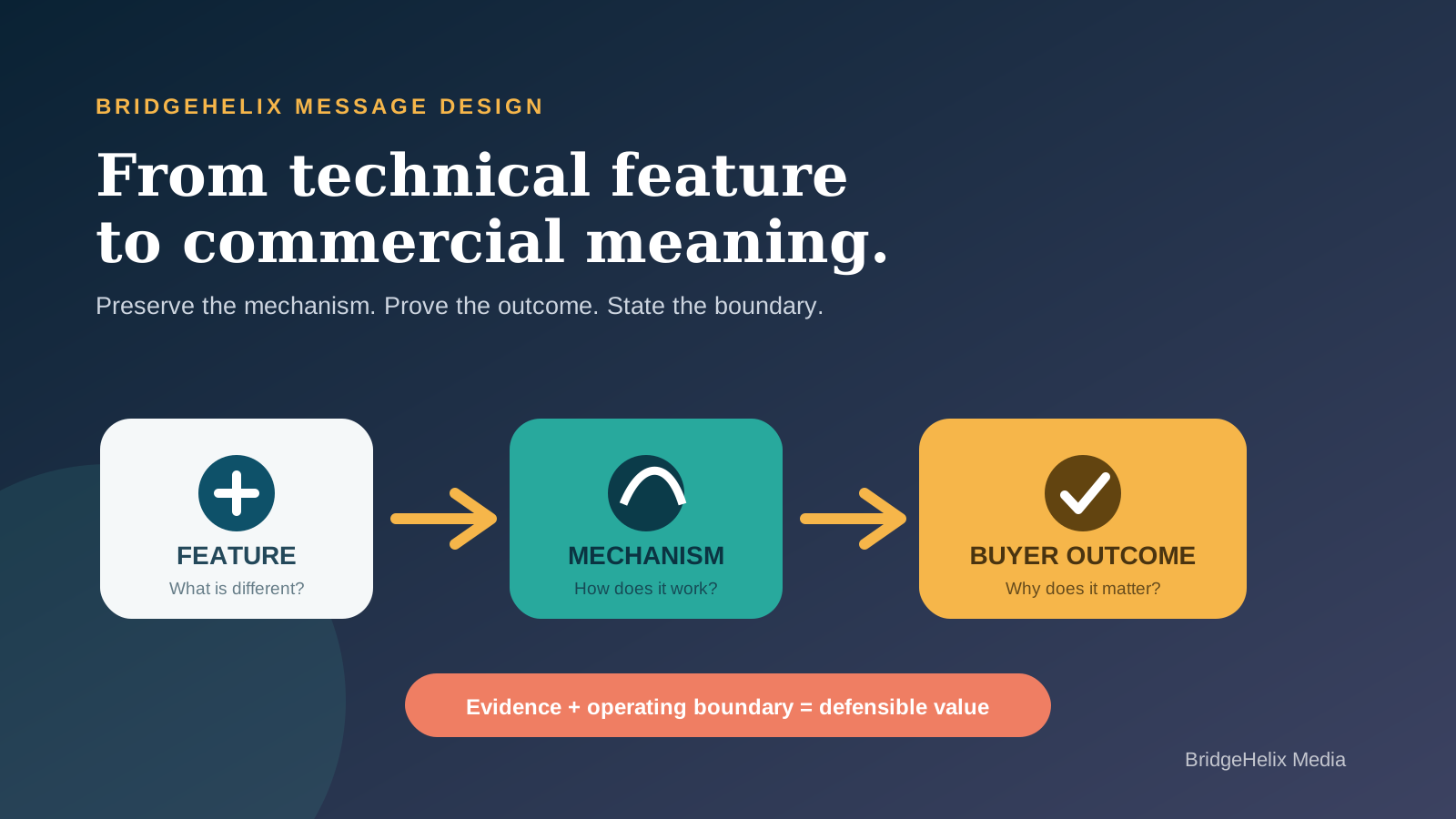
A technical value proposition connects a verified feature to a relevant buyer outcome through an understandable mechanism. It identifies who experiences the value, the problem being reduced, the evidence supporting the claim and the conditions under which it applies. It should make the commercial meaning clear without removing the technical basis or promising more than the data can support.
The purpose is not to simplify the technology until it becomes generic. It is to show the causal path from technical difference to buyer decision.
Features, benefits and value are not interchangeable
These three ideas are often placed in one column of a messaging worksheet, but they perform different jobs.
Feature: what the product has or does.
Technical outcome: what changes because the feature works.
Commercial or operating value: why that change matters to a defined buyer.
Consider an adsorbent with a higher surface area.
- Higher surface area is a material property.
- Greater adsorption capacity may be a technical outcome, if evidence shows that relationship under relevant conditions.
- Lower adsorbent consumption, longer bed life or fewer replacement cycles may be operating value, if the system-level evidence supports those consequences.
The connection cannot be assumed.
A material can show higher equilibrium capacity while suffering poor mechanical stability. A faster analytical method can still require expert interpretation. A modular reactor can reduce installation time but create maintenance or integration requirements. Value appears only when the whole operating context is considered.
Why feature-to-benefit translation often fails
Three shortcuts cause most problems.
Shortcut 1: jumping directly from feature to financial value
Automated workflow → lower operating cost.
Automation may reduce manual work, but it may also require validation, integration, supervision and exception handling. A credible claim identifies which task is reduced, by how much, under which workflow and with what new requirement.
Shortcut 2: treating a laboratory metric as a buyer outcome
99% removal → clean water at lower cost.
Removal percentage does not establish cost. It may not even establish compliance after treatment unless the initial concentration, final concentration, detection method and relevant limit are known.
Shortcut 3: using a universal benefit for different buyers
An engineering manager, procurement lead and finance director may care about the same feature for different reasons. The technical truth should remain consistent, but the decision relevance changes.
The engineering manager may examine control and reliability. Procurement may examine supply, qualification and service. Finance may examine total cost and risk. A single slogan cannot carry all three discussions.
The five-layer technical value proposition
A defensible value proposition can be built in five layers.
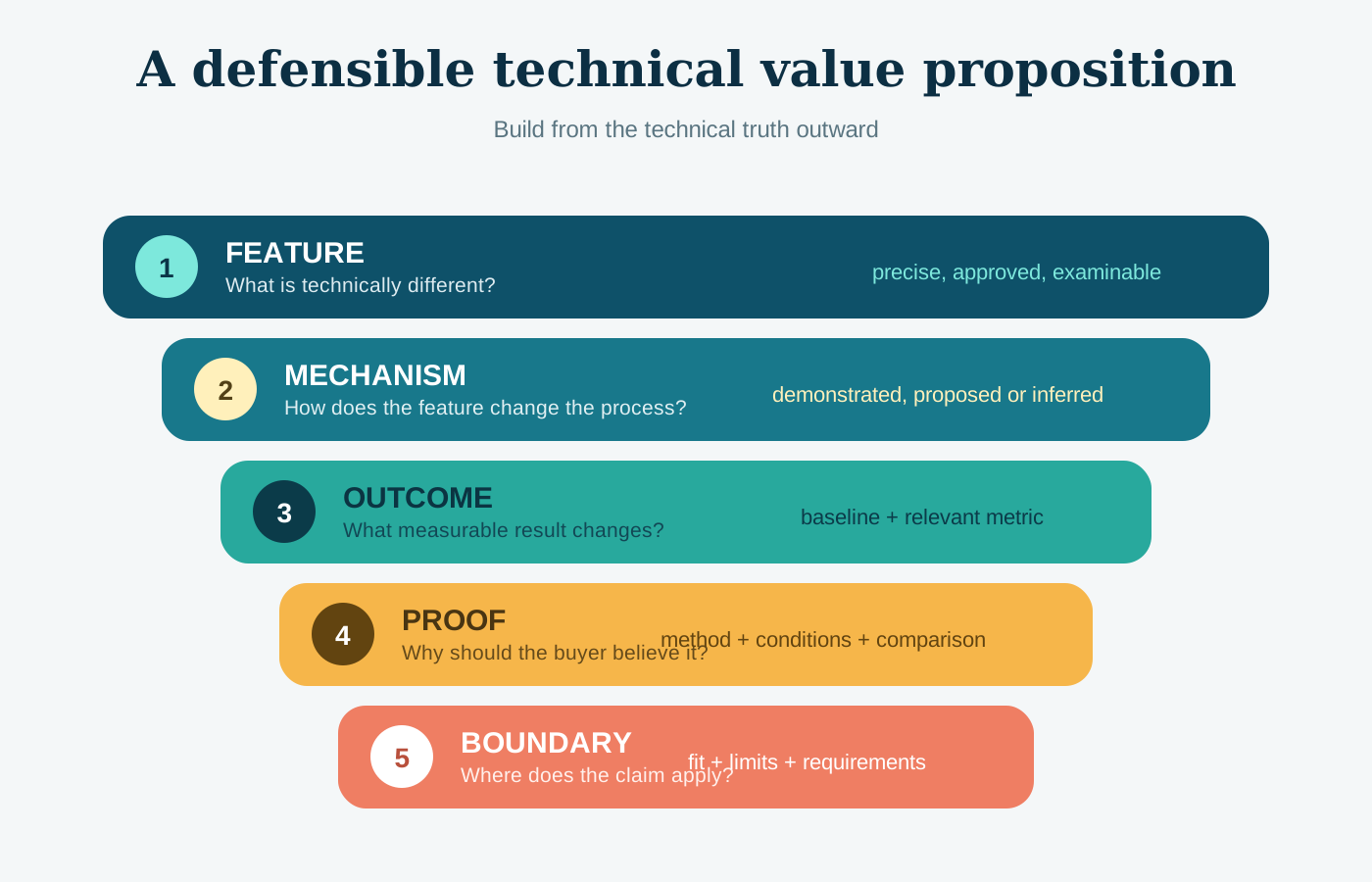
Layer 1: Feature
State the technical difference precisely.
Avoid adjectives until the difference is named. “Advanced membrane” is an evaluation. “A composite membrane with a hydrophilic surface modification” is a feature that can be examined.
Questions:
- What is technically different?
- Is the term understood by the intended reader?
- Is the difference approved for public communication?
Layer 2: Mechanism
Explain how the feature changes the process.
The mechanism may involve increased affinity, reduced resistance, earlier detection, fewer handoffs, better selectivity or a different control path. This layer protects the message from becoming empty.
Questions:
- What action links the feature to the outcome?
- Is the mechanism demonstrated, proposed or inferred?
- Does the wording reflect that level of certainty?
Layer 3: Outcome
Name the measurable technical or operational change.
Outcomes may include throughput, recovery, detection time, energy demand, material use, reproducibility, error rate or maintenance interval.
Questions:
- What changes for the user or system?
- Is the result absolute or comparative?
- What is the relevant baseline?
Layer 4: Proof
Show why the claim should be believed.
Proof may come from controlled experiments, field data, validation reports, customer evidence, certifications, published research or a clearly described demonstration.
Questions:
- What was measured?
- Under which conditions?
- How large and representative was the evidence base?
- Can the public wording be traced to an approved source?
Layer 5: Boundary
State where the value proposition applies.
Boundaries include sample type, feed composition, scale, integration environment, user capability, regulatory status and implementation requirements.
This layer is often treated as a weakness. It is actually a confidence signal. A company that explains its operating boundary appears more credible than one making a universal claim that an informed buyer can easily challenge.
A value proposition is an argument, not a tagline
The full reasoning may require several sentences:
The modified surface increases fluoride affinity under near-neutral conditions. In controlled tests, the material achieved higher adsorption capacity than the unmodified reference, reducing the mass required for the same treatment objective. Performance must still be evaluated against groundwater composition, regeneration behaviour and continuous-flow operation before the material requirement is translated into a full-scale cost claim.
A shorter website version could be:
Treat fluoride across a wider near-neutral pH range with a modified adsorbent designed for higher capacity. Compare performance under your water conditions before estimating media use and operating cost.
The shorter version retains mechanism, outcome and boundary. It does not turn one laboratory result into an unsupported promise.
Build the value proposition from evidence outward
Many messaging exercises begin with a desired market claim and then search for supporting data. Technical companies should reverse the order.
Create an evidence table:
| Evidence item | Supported conclusion | Relevant buyer | Boundary | Public wording approved? |
|---|---|---|---|---|
| Laboratory comparison | Higher capacity than reference material | Process engineer | Synthetic water, defined pH and concentration | Yes/No |
| Pilot data | Stable performance over defined operating period | Operations lead | One site and feed range | Yes/No |
| Integration test | Data transfer completed without manual export | Technical buyer | Named systems and versions | Yes/No |
| Cost model | Lower estimated media cost | Finance/procurement | Assumptions on life, dose and disposal | Yes/No |
Now write only what the evidence supports.
This discipline also improves internal review. Technical experts can approve the relationship between feature, outcome and boundary without being asked to approve vague language such as “industry-leading transformation.”
Use the “so what, because, under” test
For every feature, complete three phrases:
- So what? What changes for the defined buyer?
- Because? What mechanism or evidence connects the feature to that change?
- Under what conditions? Where is the conclusion valid?
Example:
The platform flags deviations earlier, so process teams can investigate before the next batch decision, because live measurements are compared with validated operating ranges, under workflows where the required sensor data are complete and correctly integrated.
If the “because” phrase cannot be completed, the benefit may be marketing inference rather than demonstrated value.
If the “under” phrase cannot be completed, the claim is probably too broad.
Adapt one technical truth for different buyers
Different audiences should not receive contradictory value propositions. A scientific platform that standardises analysis may help a scientist retain a repeatable sequence, help a laboratory manager reduce avoidable variation and help quality teams document an approved workflow. The context changes, but the technical truth does not.
This is why a technical messaging audit (opens in a new tab) should examine consistency across product pages, application pages, sales decks and proposals. A strong value proposition cannot survive if each asset describes a different product.
A worked example: water-treatment technology
Original feature statement
Our proprietary calcium- and magnesium-amended composite has a highly porous structure and advanced adsorption properties.
The wording identifies a material but not a buyer, problem, outcome or proof.
First translation
The calcium- and magnesium-amended surface improves fluoride adsorption.
This adds a mechanism and outcome, but it still lacks conditions and comparison.
Evidence-aware version
The calcium- and magnesium-amended material showed higher fluoride adsorption capacity than the unmodified alumina reference under the tested near-neutral batch conditions.
Now the statement is traceable and bounded.
Commercially useful version
Increase fluoride uptake without moving the treatment process away from near-neutral conditions. The amended material outperformed the unmodified reference in controlled tests; groundwater composition, column behaviour and regeneration should be assessed before full-scale media use is estimated.
The final version reaches operating relevance while keeping the evidence boundary visible.
It is not as short as a slogan. Complex decisions sometimes require two sentences.
Value is not always maximum performance
The highest number does not always create the strongest proposition. A buyer may prefer slightly lower maximum performance if it comes with greater stability, safer residuals, easier regeneration, lower integration burden or better reproducibility. The value proposition should reflect the buyer's real constraint, not only the metric that looks best in a chart.
In complex B2B purchases, self-service information and human advice both have roles. The website should explain the common technical truth clearly, while a qualified conversation addresses site-specific application.
Common signs that the value proposition is not defensible
Review the message when the benefit contains no measurable change, the claim cannot be traced to an approved source, the comparative baseline is missing or a laboratory result is presented as commercial performance. The same applies when different pages use unrelated value claims or technical reviewers approve the data but reject the marketing sentence.
These signs do not always require a new strategy. Sometimes the evidence is strong and only the reasoning chain is hidden.
Put the value in the correct page order
Even a sound value proposition can fail if the page presents it badly. Begin with the audience, practical problem and principal value. Follow with mechanism, evidence, operating boundary, implementation detail and the next action. Technical readers can move deeper while non-specialist decision-makers receive the main meaning first.
Google's people-first guidance also asks whether content demonstrates first-hand expertise and leaves the reader with enough information to achieve their goal. A technically defensible value proposition contributes to that experience because it replaces generic adjectives with useful explanation. It is not, by itself, a promise of ranking.
When approved evidence needs to become a complete website or product explanation, BridgeHelix technical content writing (opens in a new tab) provides a structured route from source material to reader-ready content.
Conclusion: preserve the causal chain
A technical value proposition should not choose between scientific accuracy and commercial clarity. It should connect them.
The practical recommendation is to take the most important feature on the product page and write five lines: feature, mechanism, outcome, proof and boundary. If one line is missing, do not hide the gap with stronger adjectives. Find the evidence, narrow the claim or change the value proposition.
If your team can explain the technology but the website still does not show why it matters, discuss your technical messaging with BridgeHelix Media (opens in a new tab).
If the feature is clear but the market category remains uncertain, work through deep-tech positioning and category choice before rewriting the headline. A technical messaging audit can then trace the chosen promise back to evidence and buyer questions.
Sources
- Gartner (2026). Gartner Sales Survey Finds 67% of B2B Buyers Prefer a Rep-Free Experience (opens in a new tab).
- Edelman and LinkedIn (2025). B2B Thought Leadership Impact Report (opens in a new tab).
- Google Search Central. Creating helpful, reliable, people-first content (opens in a new tab).

About the author
Dr. Prakash Kumar Singh
Founder & Technical Content Strategist
PhD in Chemical Engineering from MNIT Jaipur, with M.Tech and B.Tech qualifications in Biotechnology. His work connects technical evidence with clear B2B communication and ethical research support.