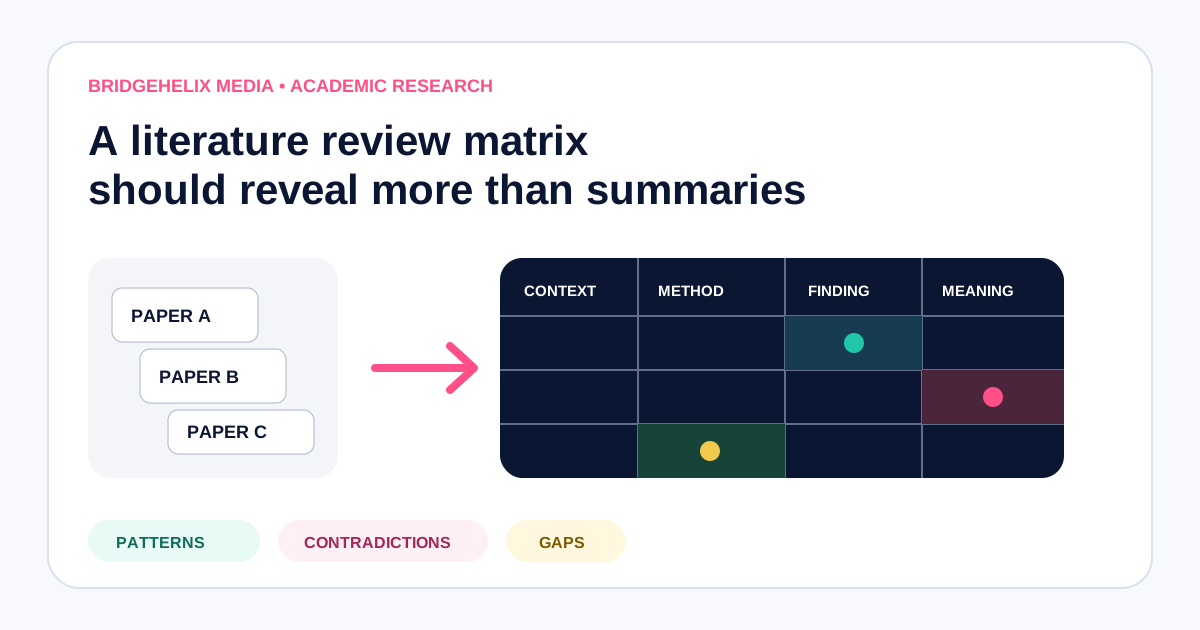
Many researchers read twenty, fifty or even one hundred papers and still find it difficult to write the review. The problem is usually not lack of reading. The information has been collected paper by paper, but the final review must be written issue by issue. If notes remain organised by author, the writing naturally becomes a catalogue:
Study A reported this. Study B reported that. Study C obtained a higher value.
This sequence may be factually correct, but it does not explain whether the results are comparable, why they differ, which finding is more reliable or what remains unknown. A well-designed evidence matrix helps convert a folder of papers into a comparative argument.
What is an evidence matrix in a literature review?
An evidence matrix is a table that compares research studies against the same review question. Each row records a study; the columns preserve its context, methods, findings and limitations. Unlike a reading log, it helps you decide which results are comparable and how they support a synthesis. A literature matrix or RRL matrix (review of related literature) often serves the same purpose, although required fields vary by institution and review type.
A literature review evidence matrix template you can copy
Copy this table into your working document and replace the prompts with information from the papers you actually read. Start with three studies to check whether the fields suit your review question before extracting the full evidence set.
| Study and source | Review question or objective | Context and conditions | Method and comparison | Reported finding | Limitations and confidence | Your synthesis note |
|---|---|---|---|---|---|---|
| Author, year, DOI; page or table | Which part of your question does this study address? | Population or material; scale; operating conditions | Design, measurement and comparator | Outcome, units and uncertainty as reported | Missing controls, measurement limits or transferability concerns | Agreement, contradiction or unresolved question; distinguish your interpretation |
Keep a traceable page, figure or table reference beside extracted results. Write “not reported” when a source omits information instead of filling gaps with assumptions. For a systematic review, adapt the fields to the review protocol and use an appropriate appraisal method; the matrix itself does not replace risk-of-bias assessment.
The worked water-treatment example below shows how these fields change the comparison. Once patterns emerge, use them to identify a defensible research gap and develop a critical literature review argument.
A summary table and an evidence matrix are not the same
A basic literature review table often contains four columns: author, year, objective and main finding. This is useful for remembering what each paper did. It is not sufficient for critical synthesis because it removes the conditions under which the finding was produced.
Consider three studies reporting removal efficiencies of 72%, 91% and 96%. The highest number appears to represent the best treatment. But the studies may have used different initial concentrations, pH values, adsorbent doses, contact times and water matrices. One may have used distilled water, another synthetic multi-ion water and the third actual groundwater. Comparing percentages without these conditions creates a misleading conclusion.
An evidence matrix therefore has to preserve the variables that control interpretation. The matrix is not simply a larger summary table. It is a model of the comparison you intend to make.
Start with the review question
The most common mistake is downloading a generic matrix template before defining what the review must decide. A matrix for treatment performance requires different fields from a matrix for research methodology, policy implementation or patient outcomes.
Start by completing this sentence:
By comparing the included studies, this review needs to determine ______.
Examples include:
- which process conditions most strongly influence treatment performance;
- whether a proposed mechanism is supported by direct evidence or only inferred;
- why reported outcomes differ across populations or experimental systems;
- which methods are sufficiently mature for scale-up;
- where evidence is absent, inconsistent or restricted to one context.
Every important word in the completed sentence should be represented by one or more matrix columns. If scale-up is central, record study scale, process mode, duration, throughput and operational limitations. If mechanism is central, record characterisation method, proposed interaction, direct evidence and alternative explanations.
The six-layer BridgeHelix evidence matrix
A practical matrix can be organised into six layers. The exact fields may change, but the logic remains useful across disciplines.
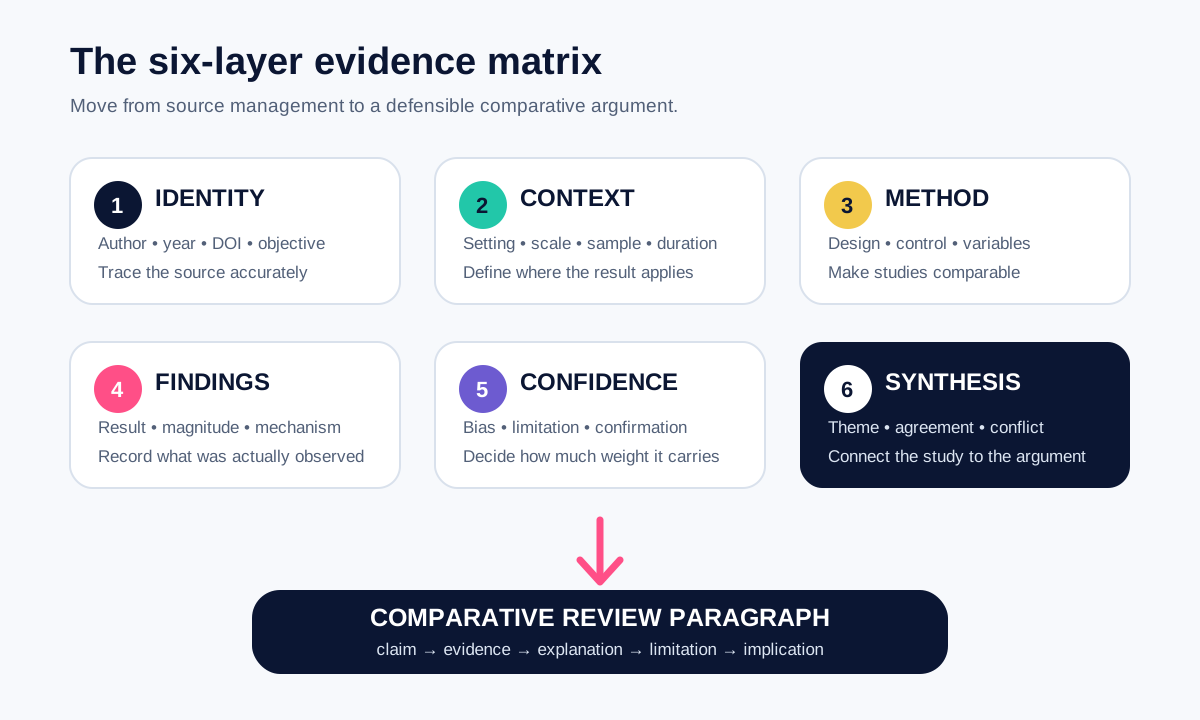
1. Study identity
Record information needed to trace the source:
- author and year;
- title or short study ID;
- journal or source type;
- country or institutional context;
- persistent identifier, preferably a DOI;
- study objective.
Identity fields prevent citation errors, but they should occupy only a small part of the matrix. They tell you where the evidence came from, not what it means.
2. Context and boundary conditions
Record the conditions that define where the result may apply. Depending on the subject, these may include:
- population, material, system or setting;
- sample source and sample size;
- initial condition or baseline;
- laboratory, pilot or full-scale status;
- geographic and regulatory context;
- inclusion and exclusion criteria;
- duration of observation.
Boundary conditions are particularly important in technical research. A result obtained in a controlled batch experiment cannot automatically be transferred to a continuous treatment system. Similarly, an outcome from one age group, country or institutional setting may not represent another.
3. Method and comparison basis
This layer records how the evidence was produced:
- study design;
- experimental or analytical method;
- control or comparator;
- operating variables;
- outcome definition;
- statistical or modelling approach;
- quality-control procedure.
The Cochrane Handbook’s data-collection guidance (opens in a new tab) similarly emphasises collecting study design, participants, interventions, comparators and outcomes in sufficient detail. The particular fields will differ outside intervention research, but the principle is transferable: a result cannot be interpreted independently of the method that produced it.
4. Findings
Separate the authors’ reported observations from your later interpretation. Useful columns include:
- principal qualitative finding;
- numerical outcome and unit;
- uncertainty or variability;
- direction and magnitude of effect;
- secondary finding;
- mechanism proposed by the authors.
Do not enter “good performance” or “significant improvement” without the actual comparison. Record what changed, by how much, relative to what and under which condition.
5. Evidence confidence and limitations
This is where a summary matrix becomes a critical evidence matrix. Record:
- study limitation reported by the authors;
- limitation identified by the reviewer;
- risk of bias or quality assessment, where appropriate;
- evidence supporting the proposed mechanism;
- reproducibility or independent confirmation;
- conflict of interest or funding concern, where relevant;
- applicability to the review question.
Not every review requires a formal risk-of-bias tool. However, every critical review requires some transparent basis for deciding how much confidence to place in a finding. A large value in a weakly controlled study should not outweigh a smaller but well-supported result merely because the number is more impressive.
6. Synthesis code
The final layer connects each paper to the argument you will write:
- theme or mechanism;
- agrees with;
- contradicts;
- possible reason for disagreement;
- evidence gap;
- section of the review;
- quotation or figure worth revisiting;
- reviewer’s synthesis note.
These are analytical fields. They should be completed after the factual extraction fields so that observation and interpretation do not become confused.
A worked example: comparing water-treatment studies
Suppose a review asks whether modified adsorbents provide a practically meaningful improvement over unmodified materials.
| Study | Material | Water matrix | Key conditions | Reported outcome | Limitation | Synthesis meaning |
|---|---|---|---|---|---|---|
| A | Modified alumina | Synthetic single-ion water | pH 6.5; high dose; 180 min | High removal percentage | No competing ions or regeneration study | Shows potential under controlled conditions |
| B | Modified alumina | Synthetic multi-ion water | Variable pH; lower dose | Moderate capacity with interference | Batch system only | Better evidence of selectivity |
| C | Composite material | Real groundwater | Continuous column | Lower initial removal but stable breakthrough | Short operating period | Stronger evidence of practical relevance |
The matrix prevents an easy but weak conclusion that Study A is “best.” It shows that each study answers a different part of the problem. Study A establishes potential, Study B tests interference and Study C provides evidence closer to application. The comparative paragraph can now explain the progression of evidence rather than rank three percentages.
How patterns become visible
A pattern is not simply a finding that appears more than once. It is a repeated relationship that remains meaningful after differences in method and context are considered.
Useful pattern checks include:
- Direction: Do most studies report an increase, decrease or no change?
- Condition: Does the direction change under particular conditions?
- Method: Is the pattern restricted to one method or measurement technique?
- Scale: Does it persist from controlled to realistic settings?
- Independence: Has the result been reproduced by different groups?
Colour coding can help during analysis, but colour should not replace explicit text. A green cell meaning “positive” may hide whether the result is statistically strong, practically useful or merely reported by the authors.
How contradictions should be analysed
Contradictory findings are often treated as a problem to be hidden. They are usually one of the most valuable parts of a review because they reveal the boundary of current understanding.
When two studies disagree, compare them in this order:
- Were they asking the same question?
- Were the materials, populations or systems equivalent?
- Were outcomes defined in the same way?
- Were the operating conditions comparable?
- Did one study control an important confounder?
- Were the analytical techniques equally sensitive?
- Is the disagreement numerical, mechanistic or interpretive?
Sometimes the contradiction disappears after normalising units or separating two contexts. At other times it remains genuine. The review should state which explanation is supported and which remains speculative.
How an evidence gap should be identified
An empty cell is not automatically a research gap. It may indicate that the field does not consider the variable relevant, that reporting is poor or that the reviewer selected the wrong column.
A more defensible gap appears when three conditions are met:
- the missing evidence is necessary to answer an important question;
- the current studies cannot provide that evidence because of a clear methodological or contextual limitation;
- obtaining the evidence would change interpretation, design, policy or application.
This distinction connects the matrix to the wider task of identifying a defensible research gap (opens in a new tab). The matrix supplies the comparison; the gap argument explains why the missing evidence matters.
Common matrix failures
Too many descriptive columns
A matrix with forty columns may look rigorous but become impossible to use. Remove fields that do not affect the review question. Retain source details in a reference manager instead of duplicating all bibliographic information.
Cells filled with copied abstracts
Long copied text makes comparison slower and increases the risk of carrying an author’s framing into your own synthesis. Use short factual entries and preserve page numbers for statements that may need verification.
Changing definitions halfway through
If “pilot scale,” “high efficiency” or “long-term” means different things across rows, the matrix will create false patterns. Define analytical codes before full extraction and keep a coding note.
Extracting before piloting
Test the matrix on three to five papers representing different study designs. This usually reveals missing units, ambiguous fields and columns that cannot be completed consistently. For formal evidence syntheses, extraction may also require duplicate checking. A methodological study on data-extraction forms reports that piloting and extractor training are important parts of reliable extraction practice (Büchter et al., 2020 (opens in a new tab)).
Treating the matrix as the final review
The table supports the reasoning; it does not replace it. Readers still need an explanation of the comparison, causes of disagreement, strength of evidence and implications.
Turning the matrix into paragraphs
Once extraction is complete, do not write row by row. Filter or sort by the synthesis columns and build a paragraph around one relationship.
A useful paragraph sequence is:
- Claim: State the overall pattern or disagreement.
- Evidence: Compare the studies that support or challenge it.
- Explanation: Relate the difference to method, context or operating condition.
- Limitation: State what the available evidence cannot establish.
- Implication: Explain why this matters for the next section, future research or application.
This is the step that converts an evidence matrix into a critical literature review (opens in a new tab).
Practical conclusion
A literature review matrix should be designed backwards from the decision the review must support. Record enough information to make studies genuinely comparable, keep reported evidence separate from reviewer interpretation and add synthesis fields that connect individual papers to themes, contradictions and gaps.
The matrix will not make the judgement for the researcher. It will make the basis of that judgement visible. That is its real value.
If your sources are already collected but the review still reads like a sequence of paper summaries, BridgeHelix Media provides literature review support (opens in a new tab) for evidence organisation, comparative structure, gap articulation and argument flow while preserving the researcher’s authorship.
After comparing the studies, turn the pattern into a defensible research gap and choose a review structure based on mechanisms, methods or outcomes. If the evidence remains difficult to organise, literature-review support can help with the argument while you retain authorship and research decisions.
Frequently asked questions
What is a literature review matrix?
It is a table that organises comparable information from multiple studies. Each row normally represents one study, while the columns capture context, methods, results, limitations and synthesis notes relevant to the review question.
How many columns should an evidence matrix contain?
There is no universal number. Use the smallest set that preserves the variables needed for comparison. A pilot with three to five diverse papers is a practical way to identify missing or unnecessary fields.
Can a literature review matrix be included in the paper?
Yes, a simplified study-characteristics or evidence table may be included. The working matrix is usually more detailed. The published table should support the argument without overwhelming the reader.
Does a matrix identify a research gap automatically?
No. It can reveal missing, inconsistent or context-limited evidence, but the researcher must still explain why that absence matters and how new research would change understanding or practice.

About the author
Dr. Prakash Kumar Singh
Founder & Technical Content Strategist
PhD in Chemical Engineering from MNIT Jaipur, with M.Tech and B.Tech qualifications in Biotechnology. His work connects technical evidence with clear B2B communication and ethical research support.