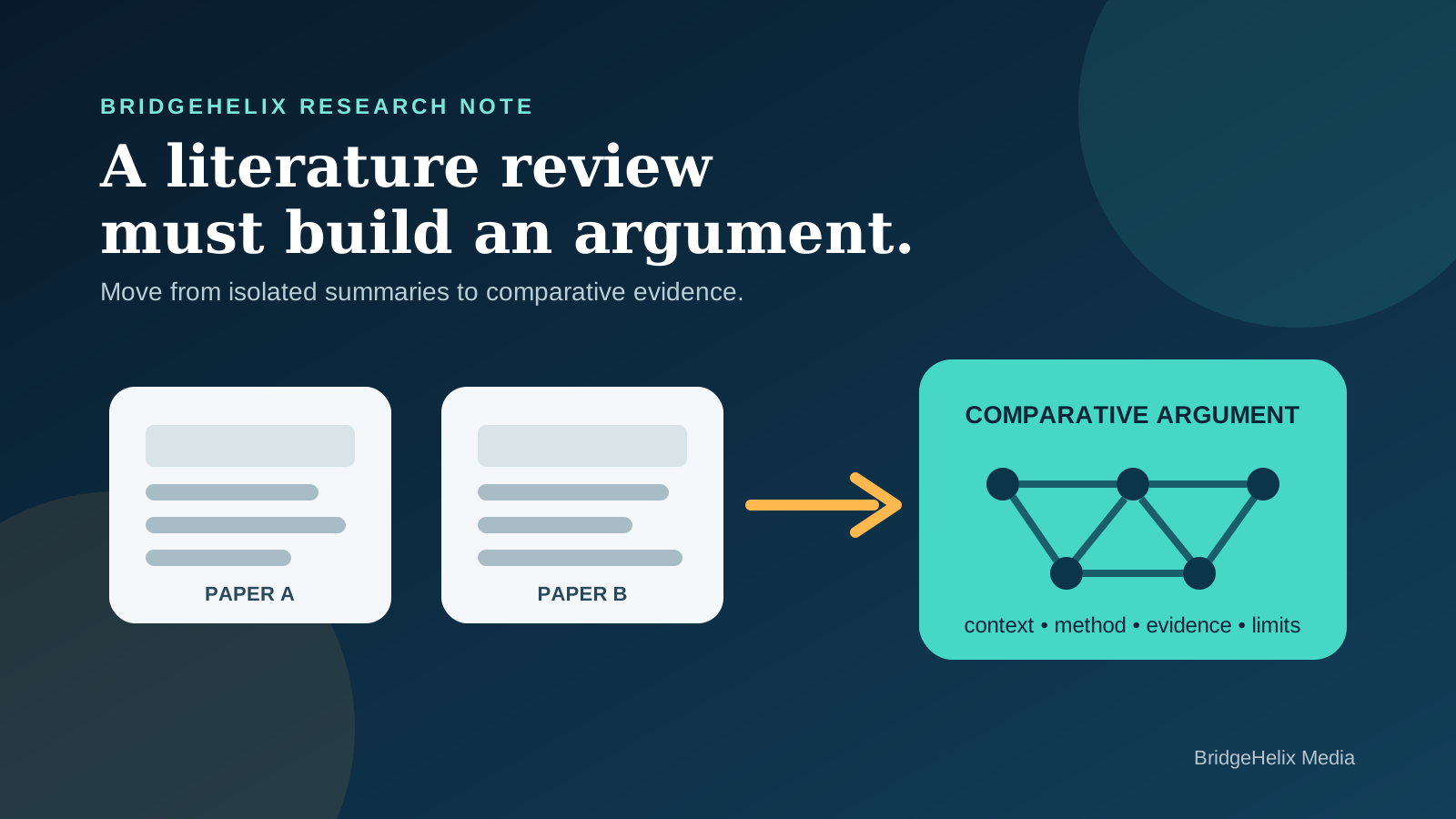
A literature review can contain fifty relevant references and still fail to make an argument.
The problem usually appears in a familiar form. One paragraph describes what Author A did. The next paragraph reports Author B. A third paragraph introduces Author C. Every summary may be accurate, but the reader has to perform the comparison alone.
That is not synthesis. It is a catalogue.
A critical literature review organises studies around a question, comparison or disagreement rather than around author names. It examines how context, method, assumptions and evidence affect the reported findings. The writer then explains what the studies establish collectively, where conclusions remain uncertain and why the unresolved issue matters. Summary is still necessary, but it serves the argument instead of replacing it.
This distinction matters in a thesis chapter, a narrative review and a journal review paper. It is also one of the main areas addressed through BridgeHelix literature review support (opens in a new tab): the researcher remains responsible for selecting and interpreting the literature, while the structure is refined so that the intellectual relationship among studies becomes visible.
Why paper-by-paper writing happens
Researchers rarely decide to write a weak review. The catalogue structure usually develops because it is the easiest way to control a large reading load.
When a researcher opens a paper, records its objective, method and result, and then writes a paragraph from those notes, the final review naturally follows the order in which the papers were read. This workflow is useful for collecting information, but collection order is not an argument.
Four additional causes are common.
First, the review question is too broad. A subject such as “adsorbents for fluoride removal” can accommodate hundreds of studies, but it does not tell the writer what must be compared. Is the review concerned with adsorption mechanism, performance under competing ions, regeneration, cost or field application? Until that decision is made, every paper seems equally important.
Second, the notes contain bibliographic facts but not comparative variables. If the note for each paper records only “material used” and “removal percentage,” the writer has little basis for explaining why performance differed.
Third, writers sometimes treat criticism as finding mistakes. A critical review does not require hostile language. It requires judgement about evidence: what a method can establish, what remains outside its boundary and how strongly a conclusion is supported.
Finally, authors are often afraid to place several citations after one interpretive sentence. They therefore give every paper its own sentence, even when five studies support the same point. The result is repetitive writing with no hierarchy.
Summary, synthesis and critical interpretation are different jobs
These terms are sometimes used as if they mean the same thing. They do not.
Summary reports what an individual study did or found.
Synthesis connects several studies around a shared issue.
Critical interpretation evaluates what the connected evidence allows the reader to conclude.
Consider a simplified water-treatment example.
Study A reported 96% fluoride removal using 10 g/L adsorbent in synthetic water at pH 7.
This is a summary. It may be accurate, but it tells us very little about transferability.
Several calcium-modified adsorbents reported high fluoride removal under near-neutral conditions, although the material dose, initial concentration and water matrix differed substantially across the studies.
This is synthesis because several papers are now connected.
The reported percentages do not establish that one material is superior. A study using a higher dose or simpler synthetic matrix may obtain a higher percentage while showing lower adsorption capacity or weaker performance in groundwater containing competing ions.
This is critical interpretation. It explains why the comparison cannot be made from headline percentages alone.
Methodological guidance on narrative reviews similarly treats a critical review as an interpretive synthesis, not an unstructured collection of citations. A state-of-the-art review goes further by examining how knowledge developed and by identifying the assumptions shaping the field, rather than merely reporting the latest publications.
Begin with a comparison question, not a pile of papers
Before building sections, complete this sentence:
By the end of this section, the reader should understand why ______ differs across ______ and what that means for ______.
For example:
By the end of this section, the reader should understand why adsorption performance differs between batch and continuous systems and what that means for field-scale material selection.
This sentence creates boundaries. A paper becomes relevant because it helps answer the comparison question, not simply because it uses the same keyword.
A good section question may examine:
- why similar methods produce different results;
- which operating conditions control performance;
- where two theoretical explanations compete;
- whether laboratory evidence supports practical application;
- how measurement choices change the apparent outcome; or
- which limitation prevents a confident conclusion.
These questions also produce more useful headings. “Adsorption studies” is a topic label. “Why high batch removal does not guarantee column performance” signals an argument.
Use an evidence matrix that records relationships
A literature review matrix is useful only if its columns support the intended comparison. A generic spreadsheet containing author, year, title and conclusion mainly helps with retrieval. It does not automatically produce synthesis.
For a comparative review, record at least:
| Dimension | What to capture | Why it matters |
|---|---|---|
| Research context | Population, material, system or application | Shows whether apparently similar studies are actually comparable |
| Method | Design, instruments, model or analytical route | Reveals how the evidence was produced |
| Operating boundary | Dose, time, pH, scale, inclusion criteria or assumptions | Prevents results from being detached from their conditions |
| Main result | The finding relevant to the review question | Keeps extraction focused |
| Explanation | Mechanism or interpretation proposed by the authors | Allows theories to be compared |
| Limitation | What the design did not test or cannot establish | Sets the strength of the conclusion |
| Implication | What the finding changes for the review argument | Connects extraction to writing |
The last column is the one most often missing. “Implication” is not copied from the source. It is the review author’s reasoned judgement, which must remain proportionate to the evidence.
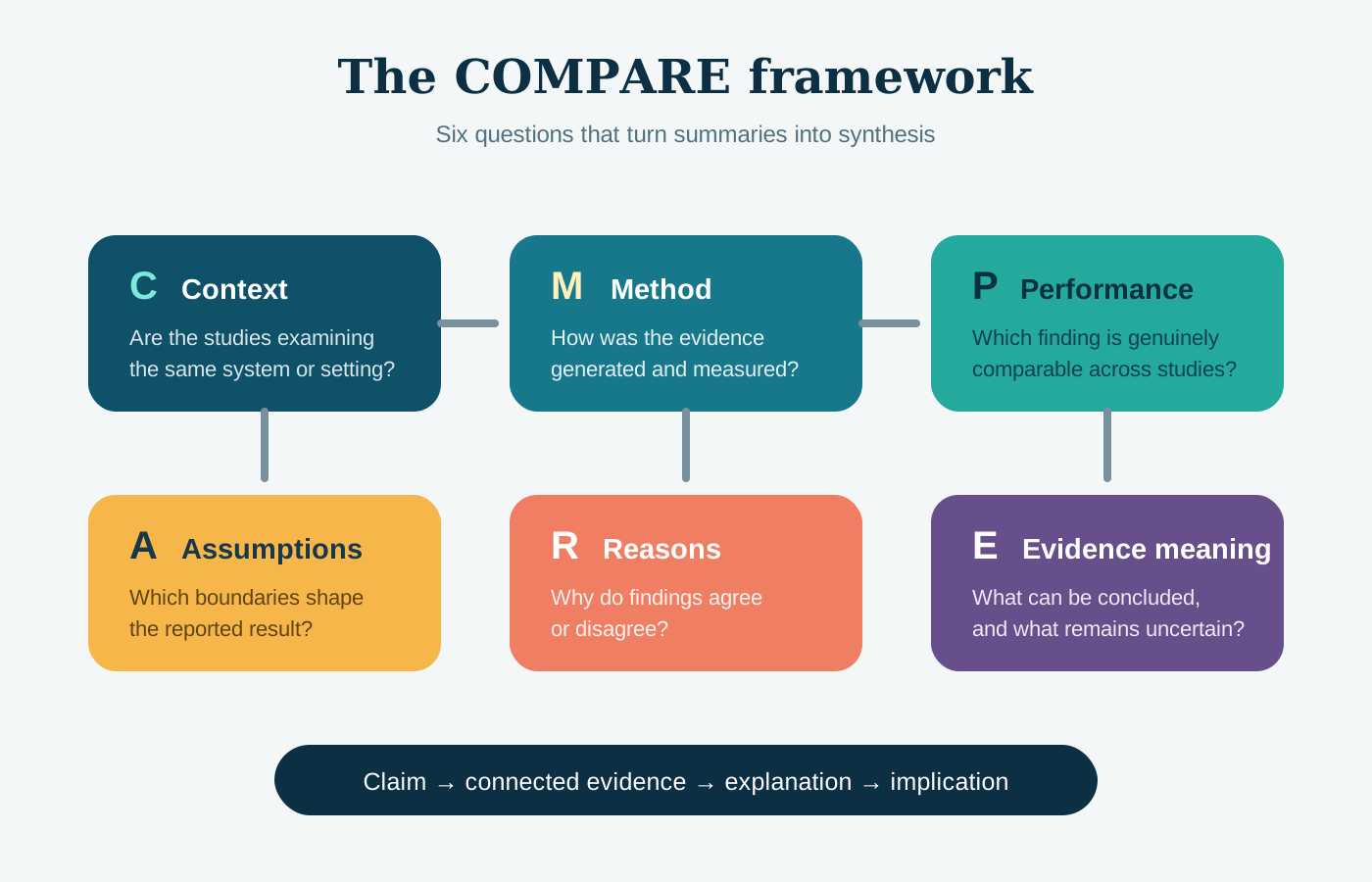
The COMPARE framework for building a critical paragraph
BridgeHelix uses a practical six-part check when a review section feels descriptive:
C: Context
Are the studies examining the same population, material, environment, scale or decision? Two papers may use the same technology while answering different questions.
M: Method
How did each study generate its evidence? A batch equilibrium test, pilot trial, computational model and field survey should not be treated as interchangeable.
P: Performance or principal finding
What result is genuinely comparable? Use a common basis where possible. If no common basis exists, state that limitation instead of forcing a ranking.
A: Assumptions and boundaries
Which operating conditions, exclusions, definitions or model assumptions shape the result? A conclusion is only as transferable as its boundary permits.
R: Reasons for agreement or disagreement
Do studies differ because of material properties, sample characteristics, measurement choices, statistical power, duration or theory? “Mixed results” is not an explanation.
E: Evidence implication
What can now be concluded, how confident is that conclusion and what remains unresolved?
Not every paragraph needs six labelled sentences. The framework is a thinking tool. It helps the writer decide which details are needed for the comparison and which can be removed.
A paragraph should move from claim to evidence to meaning
A reliable critical paragraph often follows four moves.
- Start with the comparative claim. Tell the reader what the group of studies collectively indicates.
- Present the evidence pattern. Combine studies that agree and distinguish those that differ.
- Explain the variation. Connect the difference to methods, context or assumptions.
- State the implication. Explain what the evidence supports and what it does not.
Here is the structure in practice:
Surface modification generally improves fluoride affinity under controlled conditions, but the magnitude of improvement cannot be compared directly across the reported studies. Some experiments used different initial concentrations, material doses and equilibrium times, while others reported removal percentage without adsorption capacity. The apparent disagreement may therefore reflect the basis of calculation rather than a contradictory adsorption mechanism. Current evidence supports further comparison under standardised conditions, but it does not yet justify a universal material ranking.
The citations would be placed after the specific claims they support. The paragraph remains readable because the authors are evidence for the argument, not the organising principle.
Comparison does not mean pretending all studies are equivalent
Some literature cannot be combined responsibly.
A qualitative interview study and a controlled experiment may contribute to the same broad subject but provide different kinds of evidence. A model validated against one dataset should not be ranked directly against a full-scale operational study. A narrative review should not imply systematic completeness unless the search and selection process supports that claim.
When studies are too heterogeneous, the critical decision may be to compare them in separate groups. The writer can still explain how the groups complement one another.
This is where limitations become useful. A limitation is not a ritual sentence added near the end. It tells the reader how far the interpretation can travel.
Revise the review at section level
Sentence-level editing will not repair a paper-catalogue structure by itself. Review the section in this order:
- Write the section question in one sentence.
- Highlight the main claim of every paragraph.
- Remove or combine paragraphs that merely repeat one paper.
- Group evidence by agreement, disagreement, method or boundary.
- Check whether each paragraph explains why the cited evidence matters.
- End the section with the strongest supported conclusion and the unresolved issue.
If the highlighted paragraph claims read like “Smith studied…,” “Kumar found…” and “Lee reported…,” the authors are still controlling the structure.
For researchers who need ethical help with argument flow and presentation after completing their intellectual work, BridgeHelix also provides academic editing and research support (opens in a new tab). The aim is not to replace author judgement, but to make that judgement easier for the reader to follow.
Conclusion: make every citation perform a job
A critical literature review is not created by adding negative comments or more references. It is created by organising evidence around a clear comparison, examining why findings converge or diverge, and stating a conclusion whose strength matches the available evidence.
The practical recommendation is simple: before drafting the next section, build an evidence matrix around the decision you want the reader to make. If the matrix does not record context, method, boundaries and implications, the prose will probably return to paper-by-paper summary.
If your literature has been collected but the review still reads as disconnected summaries, discuss your literature review structure with BridgeHelix Media (opens in a new tab).
Sources
- Barry, E.S. et al. (2022). State-of-the-art literature review methodology: a six-step approach for knowledge synthesis (opens in a new tab).
- Sukhera, J. (2022). Narrative reviews: flexible, rigorous, and practical (opens in a new tab).

About the author
Dr. Prakash Kumar Singh
Founder & Technical Content Strategist
PhD in Chemical Engineering from MNIT Jaipur, with M.Tech and B.Tech qualifications in Biotechnology. His work connects technical evidence with clear B2B communication and ethical research support.