
Researchers often treat the limitations section as a difficult confession. They either write two vague sentences so that the paper does not appear weak, or list every possible problem until the reader begins to doubt the complete study. Neither approach helps evaluation.
The central question is therefore not, “What was imperfect?” It is, “What can the reader conclude safely from the evidence that was actually produced?”
What a research limitation should do
A limitation is a feature of the design, sample, measurement, analysis or context that affects how the findings can be interpreted or transferred. This definition is more useful than calling every difficulty a weakness.
The International Committee of Medical Journal Editors advises authors to state study limitations and consider the implications of the findings. The STROBE reporting guidance goes further for observational studies by asking authors to consider sources of bias or imprecision and, where possible, their direction and magnitude. The exact reporting checklist depends on the study design, but the reasoning is broadly applicable: the reader needs to know how the limitation changes the inference.
A useful limitations section therefore performs four jobs:
- it makes the relevant constraint visible;
- it explains the mechanism through which the constraint matters;
- it qualifies the affected claim; and
- it separates what remains supported from what requires further evidence.
This is part of the Discussion rather than an isolated exercise in self-criticism. Our guide to Results versus Discussion explains why an observation, its interpretation and the boundary of that interpretation should remain connected.
Separate a limitation from an error, excuse or future study
These categories are often mixed together.
An error is a mistake in design, execution, calculation or reporting. Correct it where possible. If it materially affects the findings and cannot be corrected, the paper may require reanalysis, disclosure or reconsideration rather than softer wording.
An excuse describes a difficulty without explaining its scientific consequence. “The study was limited because of time and resources” tells the reader almost nothing. Limited time may have shortened follow-up, reduced sampling frequency or restricted the number of sites. Name the actual consequence.
A future-research recommendation identifies the next useful investigation. It may arise from a limitation, but it does not replace the limitation. Saying that future studies should use more samples does not explain whether the present sample affected precision, representation or subgroup analysis.
A limitation connects the condition to the inference. For example: a short monitoring period prevents evaluation of seasonal performance, although it may still support the reported performance during the observed operating range.
Use the constraint-to-claim framework
Before writing the paragraph, complete the following five-part analysis for each important limitation.
| Element | Question to answer | Purpose |
|---|---|---|
| Constraint | What condition was restricted, absent or uncertain? | Names the real limitation |
| Mechanism | Through what pathway could it affect the study? | Prevents a generic statement |
| Affected inference | Which result, comparison or conclusion changes? | Keeps the limitation relevant |
| Evaluation or mitigation | What check, control or analysis reduced the concern? | Shows what was actually done |
| Evidence boundary | What remains supported, and what cannot be concluded? | Produces a defensible final claim |
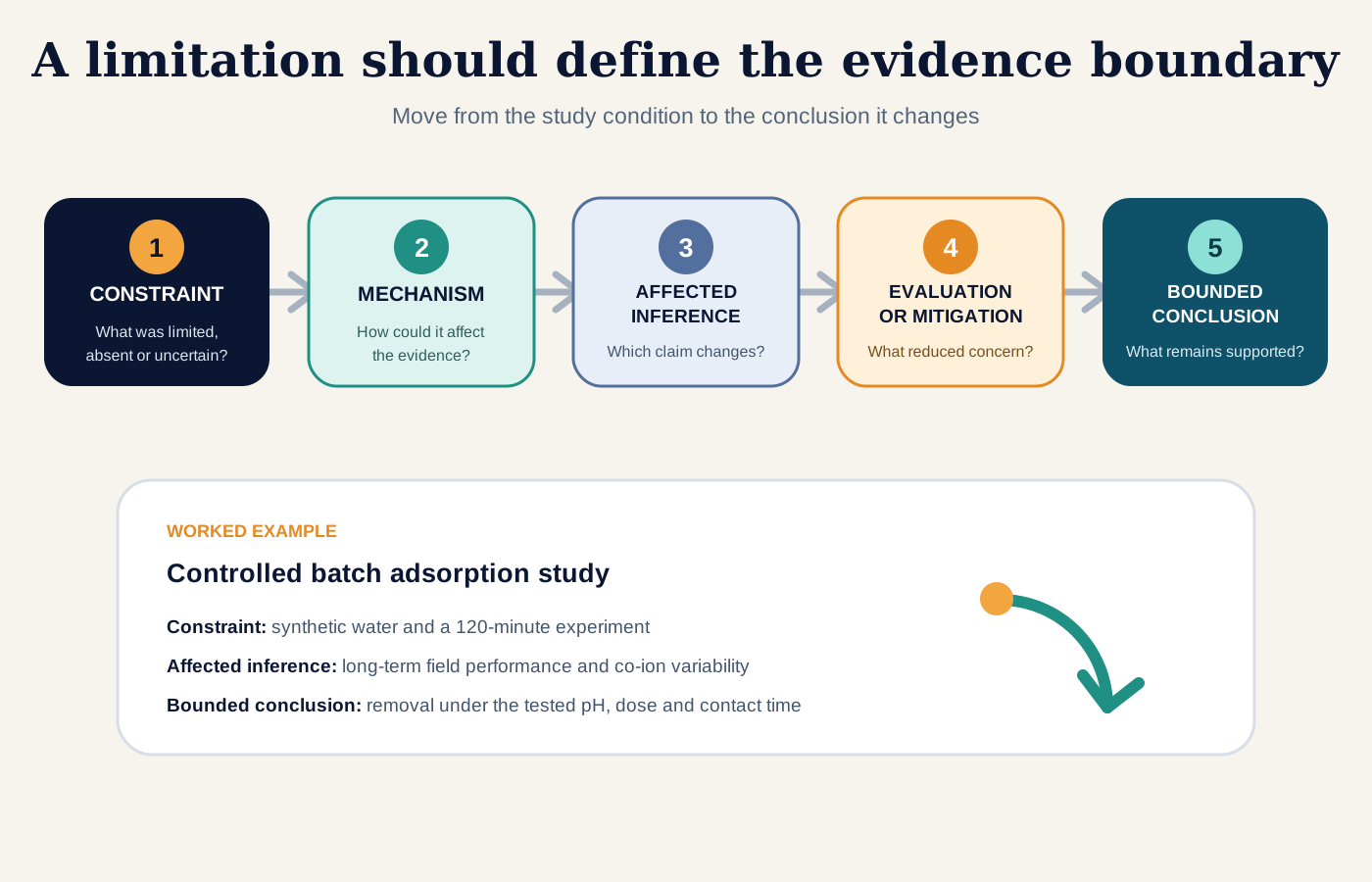
The order matters. If an author jumps from “small sample” directly to “larger studies are needed,” the most important reasoning remains missing: what the sample size changed in this study.
Write the limitation in five sentences or fewer
A practical limitation paragraph can follow this sequence:
- State the limitation specifically.
- Explain how it could influence the result or interpretation.
- Describe any evaluation or mitigation already completed.
- State the conclusion that remains supported.
- Identify the next evidence needed only when it follows directly.
Not every limitation needs five separate sentences. The sequence is a reasoning check, not a requirement to make the section long.
Weak example: generic sample-size statement
This study had a small sample size, which is a limitation. Future studies should use a larger sample.
The statement does not identify the affected estimate or tell the reader whether the concern is precision, representation or statistical power.
Stronger example: connect sample size to the inference
The study included 42 participants from one centre. This sample was sufficient to estimate the primary outcome for the prespecified analysis, but it produced wide confidence intervals for subgroup comparisons and may not represent patients treated in other settings. The main within-sample association can therefore be interpreted, whereas differences between age groups and transfer to other centres require confirmation in a larger, multicentre sample.
The stronger version does not automatically make the design adequate. It tells the reader which inference remains usable and which does not.
Discuss common limitations by their effect
Generic lists of “common limitations” are useful only when they lead to study-specific reasoning.
Sampling and selection
Ask whether the sample represents the population named in the conclusion. Convenience recruitment, one-site data, exclusions and non-response may change who entered the study. The resulting concern may be selection bias, reduced transferability or both.
Do not assume that a larger sample corrects an unrepresentative sampling method. Sample size affects precision; sampling process affects who the results describe.
Measurement and classification
Instrument resolution, detection limits, self-report, observer judgement and proxy measures may introduce uncertainty or misclassification. Explain whether the concern is likely to dilute an association, exaggerate a contrast or simply add uncertainty. If the direction is unknown, say so.
Calibration, duplicate measurement or sensitivity analysis may reduce the concern. They do not justify claiming that measurement error was absent.
Design and causal interpretation
Cross-sectional and observational designs can identify patterns or associations but may not establish temporal order or exclude alternative explanations. The limitation should be placed beside the causal language it affects.
Changing “X caused Y” to “X was associated with Y” is not cosmetic editing. It aligns the conclusion with the study design.
Duration and operating conditions
A short experiment may capture an initial response but not stability, degradation, seasonal change or delayed effects. In engineering research, controlled batch testing may establish performance under defined pH, concentration and contact time without establishing long-term field performance.
For example:
Fluoride removal was evaluated for 120 minutes using laboratory-prepared water under controlled pH. The experiment supports adsorption performance under these conditions but does not establish breakthrough life, regeneration behaviour over repeated cycles or performance in groundwater containing variable competing ions.
The limitation does not cancel the batch result. It prevents a laboratory observation from becoming a field-scale promise.
Context and generalisability
Materials, populations, institutions, climates and operating systems differ. State which contextual variable is likely to control transfer. “The results may not be generalisable” is too broad when the study can identify the actual boundary.
State direction and magnitude only when justified
The most informative limitations explain whether the effect is likely to move an estimate upward, downward or in an uncertain direction. However, authors sometimes create false precision while trying to sound rigorous.
Use a quantitative estimate when a sensitivity analysis, uncertainty analysis, validation dataset or other evidence supports it. Use qualitative wording when the magnitude was not measured:
- likely to underestimate;
- may overestimate because…;
- reduces precision;
- limits subgroup comparison;
- prevents causal attribution; or
- direction and magnitude remain uncertain.
Do not write “this limitation had minimal effect” merely because the main result remained statistically significant. Statistical significance does not measure every form of bias, measurement error or external validity.
Put each limitation near the claim it changes
A separate limitations subsection is useful when the journal expects one, but important qualifications should also appear beside the relevant interpretation. If the conclusion says a treatment is effective across populations, the sampling limitation should not be hidden three pages earlier.
This claim-level consistency is part of a broader manuscript coherence check. The title, abstract, Discussion and Conclusion should not present a stronger inference than the limitations allow.
Prioritise material limitations
The limitations section should not become an inventory of everything the study did not do. Include a limitation when it materially affects at least one of the following:
- validity of a measurement or comparison;
- precision of an estimate;
- causal interpretation;
- transfer to another population or condition;
- reproducibility of the method; or
- practical use of the conclusion.
Minor administrative difficulties that did not affect the study do not need to be promoted into scientific limitations. Conversely, a serious design boundary should not be reduced to one vague closing sentence.
Final review checklist
Before submission, ask:
- Does every limitation identify a specific condition?
- Is the mechanism of effect explained?
- Is the affected result or claim named?
- Are bias, imprecision, causality and transferability distinguished correctly?
- Is mitigation described without pretending the issue disappeared?
- Does the Conclusion remain inside the stated evidence boundary?
- Are future studies recommended for a defined reason rather than added automatically?
Use this together with the broader research paper editing checklist so limitations are checked against the objective, Methods, Results and final claim.
Practical conclusion
A good limitations section does not weaken a research paper. It shows that the author understands what the design can establish and where the inference stops. Name the real constraint, explain its mechanism, identify the affected claim and state the bounded conclusion that remains supported.
The strongest wording is neither defensive nor dramatic. It is specific. It gives reviewers enough information to evaluate the paper without asking them to reconstruct the evidence boundary themselves.
BridgeHelix Media provides PhD-led research manuscript editing for STEM researchers who need to align the Discussion, limitations and Conclusion while preserving the author’s scientific decisions, evidence and responsibility.
Sources

About the author
Dr. Prakash Kumar Singh
Founder & Technical Content Strategist
PhD in Chemical Engineering from MNIT Jaipur, with M.Tech and B.Tech qualifications in Biotechnology. His work connects technical evidence with clear B2B communication and ethical research support.