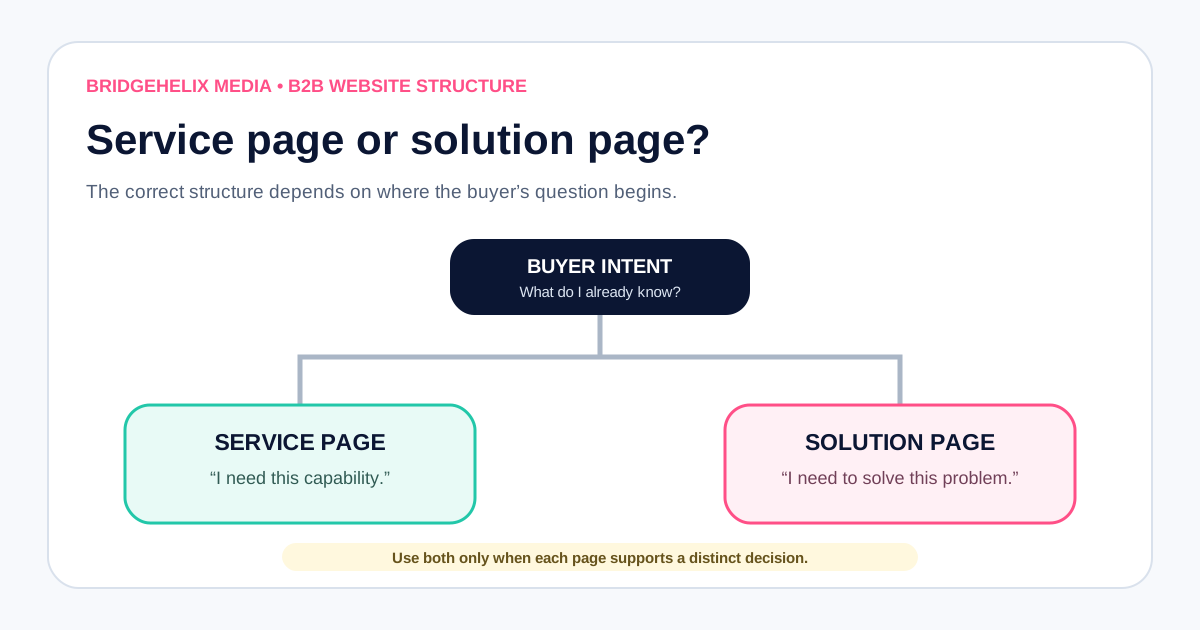
Use a technical service page when the buyer is evaluating a defined capability, deliverable or engagement. Use a solution page when the buyer starts with a problem, application, industry or operating condition that may require several capabilities. Complex technical websites usually need both page types, provided each has a distinct search intent and decision purpose.
The confusion occurs because “service” and “solution” are often treated as interchangeable marketing words. A company may rename every service as a solution without changing the content. The website then contains several pages that repeat the same claims, compete for similar searches and leave the buyer unsure where to begin.
The distinction is not cosmetic. It reflects two different starting points in a buying decision.
A service page begins with capability
A service page answers:
What does this company do, what is included and can it deliver the work?
Examples include:
- research manuscript editing;
- pilot-plant design;
- water-quality testing;
- computational fluid dynamics modelling;
- technical content writing;
- regulatory documentation;
- laboratory method validation.
The buyer may already know the type of expertise required. The page must help them evaluate scope, method, deliverables, evidence, boundaries and next step.
A solution page begins with the buyer’s situation
A solution page answers:
How can this company help us resolve this particular problem or achieve this outcome?
Examples include:
- reducing PFAS in industrial wastewater;
- improving yield during bioprocess scale-up;
- replacing manual quality investigations;
- preparing technical evidence for market entry;
- building authority in a low-search-volume scientific category;
- reducing energy consumption in an aeration process.
One solution may combine several services, products or technical capabilities. The page should explain the problem conditions, decision logic, mechanism, relevant capabilities, proof and implementation path.
The central difference
| Dimension | Service page | Solution page |
|---|---|---|
| Buyer’s starting point | “I need this capability” | “I need to solve this problem” |
| Primary organising idea | Service, deliverable or engagement | Problem, use case, application, industry or outcome |
| Main question | What do you do and how is it delivered? | How does your approach address my situation? |
| Typical search intent | Named service | Problem, application or solution category |
| Evidence emphasis | Expertise and delivery proof | Outcome and fit under relevant conditions |
| Main internal links | Related solutions, process and case studies | Required services, technology and evidence |
| Conversion action | Discuss scope, request quote or assessment | Evaluate fit, discuss application or plan a pilot |
Neither page is automatically closer to conversion. A solution page can serve an early-stage buyer exploring a problem, while a service page can serve someone preparing a supplier shortlist. The relationship depends on the market.
The four-question decision framework
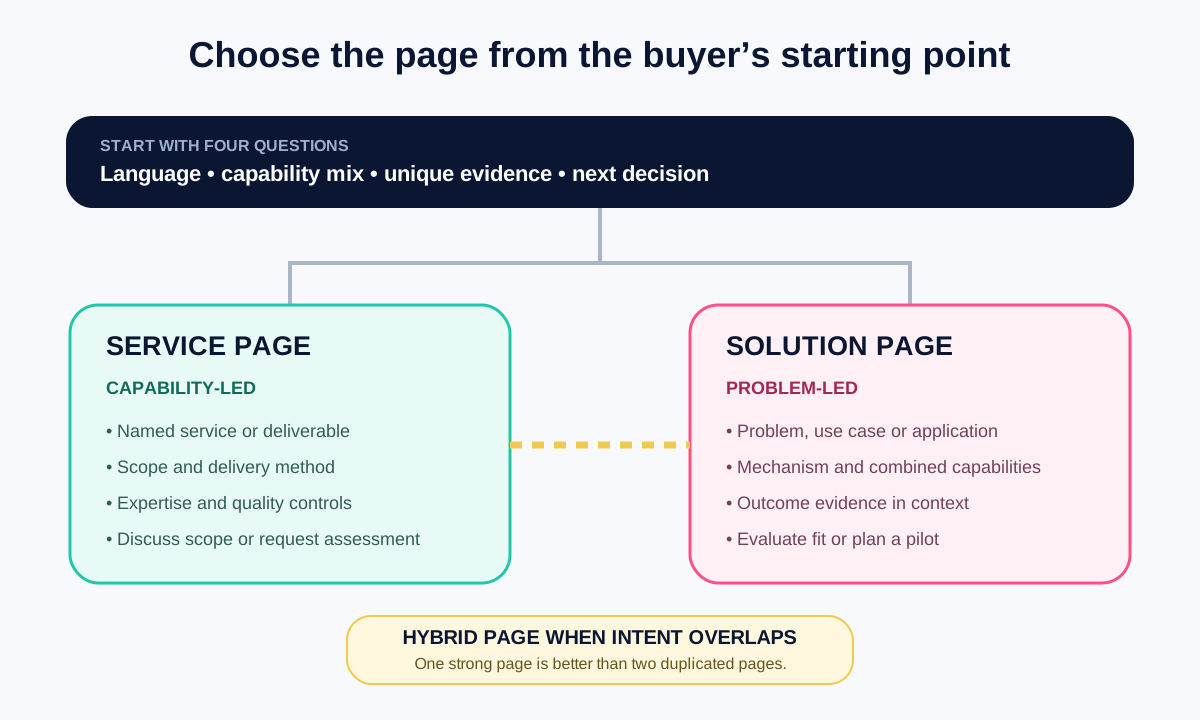
Before creating a page, answer four questions.
1. What language does the buyer use?
If qualified buyers search for a recognised capability, such as “technical report writing” or “HPLC method validation,” a service page is appropriate.
If buyers describe the problem, such as “remove colour from textile wastewater” or “reduce variation in cell-culture yield,” a solution page may match the intent better.
Keyword data helps, but interviews, sales calls, tender documents and inquiry forms often reveal the more accurate language in specialist markets. Low search volume does not mean low business importance.
2. Does one capability solve the problem?
If the engagement has a clear deliverable and method, the service page can explain the complete offer.
If the problem requires diagnosis, several capabilities or a staged implementation, forcing it into one service page may hide the decision process. A solution page can explain how the parts work together.
3. Does the page have unique evidence?
A page should not exist merely because another company has one. Ask whether it can contain distinct:
- operating conditions;
- buyer questions;
- selection criteria;
- mechanism;
- proof;
- limitations;
- next action.
If the proposed solution page repeats 80% of a service page, the distinction may not be useful. Improve the existing page or create a focused section instead.
4. What decision should the reader make?
A service page may help the reader decide whether to request a scope or compare providers. A solution page may help them decide whether the approach fits their problem and whether a technical assessment is justified.
The page structure and call to action should support that decision.
A service page structure for technical offers
A strong service page normally includes the following sections.
1. Clear service definition
State the service, intended client and outcome without beginning with a generic company description.
Example:
CFD modelling for engineering teams that need to understand flow, mixing and heat-transfer limitations before modifying equipment or operating conditions.
2. Problems the service addresses
List situations, not merely industries. This allows a visitor to recognise fit.
3. Scope and deliverables
Explain what is included, what is optional and what the client receives. For a consulting service, this may include data review, model development, validation, scenario analysis and a technical report.
4. Delivery method
Show how work progresses from inputs to assessment, execution, review and final output. A transparent method reduces perceived risk.
5. Evidence of capability
Use relevant expertise, examples, validation procedures, publications or case studies. Do not rely solely on years of experience.
6. Boundaries
State important exclusions, dependencies and client inputs. A technical page becomes more credible when it explains what is required for a reliable result.
7. Specific action
Ask the visitor to share the information needed to determine scope, not simply to “contact us.”
BridgeHelix’s own technical website content service (opens in a new tab) follows this logic by defining the balance between subject depth, search structure and buyer clarity.
A solution page structure for complex problems
A solution page should follow the buyer’s reasoning rather than a list of company capabilities.
1. Define the problem and its boundary
Explain the conditions under which the problem occurs and why usual approaches may fail.
2. Show the consequence
Connect the technical condition to production loss, compliance risk, energy, time, cost, safety or decision delay.
3. Explain the solution logic
Describe the mechanism or staged approach. Do not jump directly from problem to promise.
4. Map the relevant capabilities
Explain which products or services contribute and why each is needed. Link to the corresponding service or technology pages for detailed evaluation.
5. Present proof under relevant conditions
Evidence should resemble the buyer’s situation. Laboratory performance alone may not be enough for a buyer concerned with full-scale operation.
6. State fit and non-fit
Define suitable inputs, application limits, dependencies and cases where another approach may be preferable.
7. Offer a diagnostic next step
For a complex problem, the appropriate conversion may be an assessment, sample review, feasibility discussion or pilot plan rather than an immediate quotation.
Worked example: an environmental engineering company
Assume a company provides jar testing, process modelling, pilot trials and plant optimisation.
Its service pages might be:
- treatability testing;
- process modelling;
- pilot-plant trials;
- treatment-plant optimisation.
Its solution pages might be:
- improving phosphorus removal under variable influent conditions;
- reducing chemical consumption in coagulation;
- preparing an industrial effluent process for capacity expansion.
The “reducing chemical consumption” solution page should not repeat the treatability-testing service. It should explain why overdosing occurs, which data are needed, how testing and modelling interact, which operating constraints matter and what evidence would support a change. It then links to the relevant service pages.
This architecture allows buyers to enter from either side: those who know the capability they require and those who only know the problem.
When one hybrid page is better
Small technical companies may not need separate service and solution libraries. A hybrid page is often better when:
- one service addresses one dominant problem;
- search intent strongly overlaps;
- the same evidence supports both;
- creating two pages would cause duplication;
- the company does not yet have enough proof or content depth for separate pages.
The hybrid page can begin with the problem, define the service and then explain delivery and proof.
The decision should be based on information need, not a desire to increase page count.
SEO risks when both pages exist
Competing titles and headings
If both pages target the same phrase, search systems and users may struggle to understand which page is primary. Give each page a distinct title, H1 and purpose. Google recommends unique, clear and concise titles that accurately describe the page (SEO Starter Guide (opens in a new tab)).
Duplicate explanations
Some repetition is necessary for context, but the evidence and reasoning should differ. The service page explains capability and delivery; the solution page explains problem fit and combined application.
Weak internal linking
Use links that describe the destination. “See our pilot testing service” is more informative than “learn more.” Google advises using descriptive, relevant anchor text because it helps both people and Google understand linked pages (Google Search Central (opens in a new tab)).
Orphan pages
A solution page that is not connected to services, applications, resources or evidence is unlikely to help navigation. Google recommends a logical site structure with important pages linked from relevant pages (sitelinks guidance (opens in a new tab)).
Conversion is not only the button
Technical website conversion occurs when the page reduces enough uncertainty for the visitor to take the next sensible step. That step may be:
- reading validation evidence;
- checking application fit;
- sharing process data;
- requesting a scoped discussion;
- comparing two approaches;
- circulating the page to another stakeholder.
This is why a page can have a bright button and still fail. If the relationship between problem, mechanism, proof and action is unclear, the button asks for commitment before confidence exists.
A technical value proposition (opens in a new tab) helps connect features to operational and commercial consequences. A technical messaging audit (opens in a new tab) can then check whether that logic remains consistent across the homepage, service pages and solution pages.
Practical conclusion
Use a service page when the buyer begins with a named capability and needs to evaluate scope, delivery and expertise. Use a solution page when the buyer begins with a problem, application or operating context and needs to understand how several capabilities produce an outcome.
Create both only when each page supports a distinct question, contains unique evidence and leads to a clear decision. Otherwise, one strong hybrid page is more useful than two thin pages.
BridgeHelix Media creates technical website content (opens in a new tab) that connects technical depth, search intent and buyer decision-making across homepages, services, solutions and evidence pages.
Frequently asked questions
Is a product page the same as a solution page?
No. A product page explains a defined product, its features, specifications and use. A solution page begins with a problem or application and may combine several products and services.
Should every industry have its own solution page?
Only when the industry changes the problem, evidence, terminology, constraints or decision process meaningfully. Replacing the industry name in otherwise identical copy creates weak pages.
Can a service page rank for a problem-based keyword?
Yes, if the service directly addresses that problem and the page explains the relationship clearly. Separate pages are useful only when the intents and information needs are distinct.
Which page should receive the main call to action?
Both should have a next step appropriate to their role. A service page may request a scope discussion, while a solution page may invite an application assessment, data review or pilot conversation.
When buyers need to shortlist alternatives, the technical comparison page guide explains how to compare engineering evidence on a consistent basis.

About the author
Dr. Prakash Kumar Singh
Founder & Technical Content Strategist
PhD in Chemical Engineering from MNIT Jaipur, with M.Tech and B.Tech qualifications in Biotechnology. His work connects technical evidence with clear B2B communication and ethical research support.