
A researcher often reaches the end of a manuscript with a misleading sense of completion. The figures are inserted, the references are formatted and the language has been checked. Yet the paper may still contain a more serious problem: the objective promises one study, the methods describe another, the results report only part of the analysis and the conclusion extends beyond what was measured.
A reliable research paper editing checklist should be completed in five passes: evidence, coherence, reporting completeness, language and submission files. Begin with the journal’s instructions and the reporting guideline for the study design. Then verify that every abstract and conclusion claim is supported by a reported result, every result has a reproducible method and every table or figure answers a stated research question.
Proofreading is the last pass, not the first.
Set the submission target before editing
Do not edit against a general idea of what a research paper should look like. Open the target journal’s current instructions for authors and record:
- article type;
- word limit and what is excluded from it;
- abstract structure and limit;
- number of permitted tables and figures;
- reference style and limit;
- required declarations;
- anonymisation requirements;
- reporting checklist;
- file formats and naming rules; and
- requirements for data, code, supplementary files or graphical abstracts.
The ICMJE recommends using its guidance together with the individual journal’s instructions. EQUATOR defines a reporting guideline as a checklist, flow diagram or structured text developed to guide complete reporting. Therefore, a clinical trial, systematic review, observational study, qualitative study and animal experiment should not all be edited against one generic checklist.
Create a one-page requirement sheet. If the journal changes during editing, update this sheet before reformatting the manuscript.
Use five separate editing passes
Trying to check evidence, logic, language, references and formatting in one reading is inefficient. Each pass needs a different question.
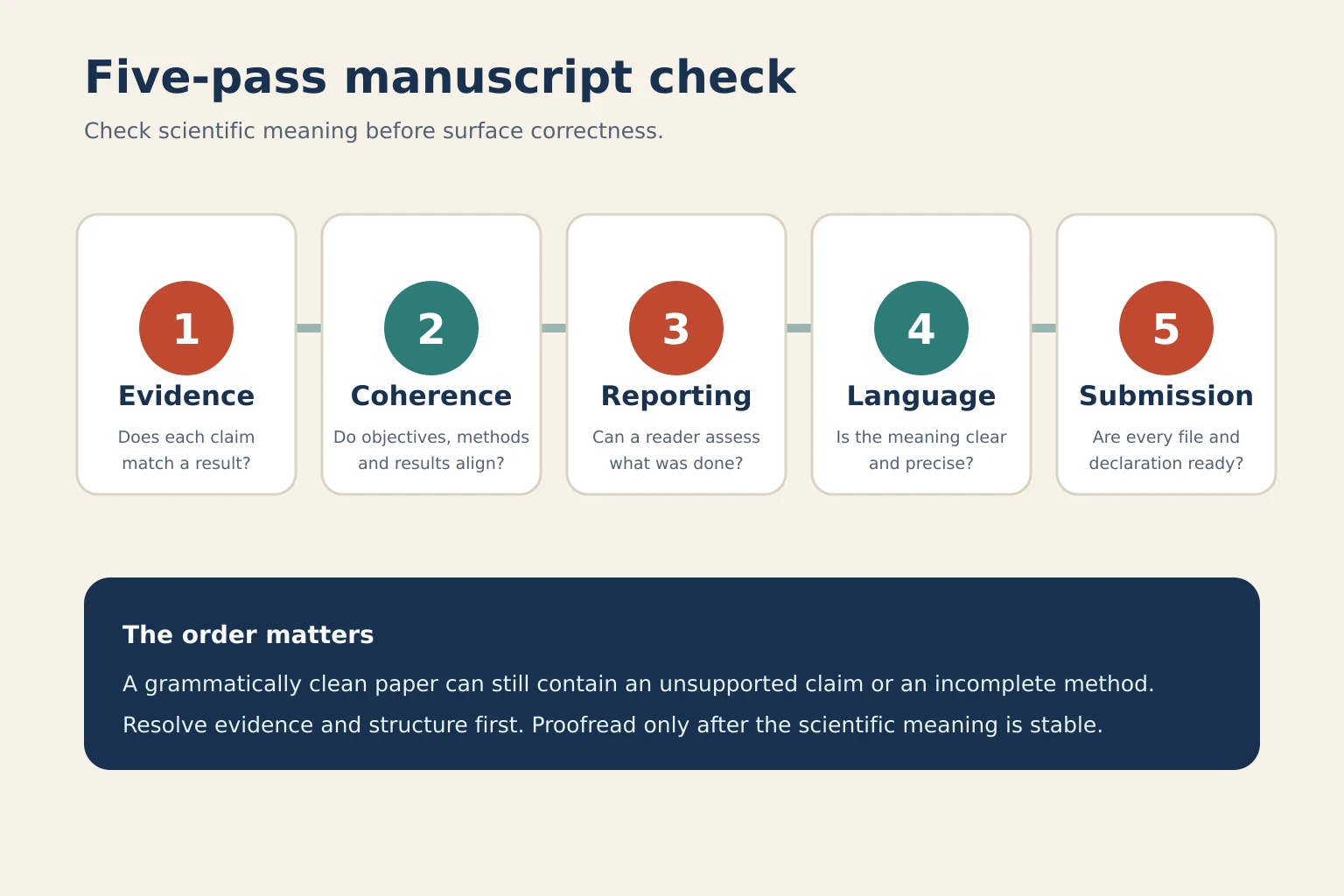
| Pass | Main question | Typical problem found |
|---|---|---|
| Evidence | Does each claim match the data? | Conclusion broader than the tested conditions |
| Coherence | Do sections describe the same study? | Abstract result missing from the Results section |
| Reporting | Can the work be understood and assessed? | Sample selection or analytical procedure omitted |
| Language | Is the meaning clear and precise? | Ambiguous pronouns, inflated verbs or inconsistent terms |
| Submission | Are all required files and declarations ready? | Missing checklist, permission or clean manuscript |
Do not move to the next pass until the high-risk problems in the current pass are resolved.
Pass 1: audit evidence and claim boundaries
Start with the sentences most likely to influence a reader’s interpretation: the title, abstract conclusion, discussion conclusions, final conclusion and highlights.
For every material claim, record:
- the exact sentence;
- the result that supports it;
- the tested population, material or system;
- the operating or experimental conditions;
- the comparator;
- the uncertainty or limitation; and
- whether the wording describes observation, association, mechanism or causation.
Consider this sentence:
The adsorbent is an effective solution for community-scale water treatment.
If the study reports batch experiments using synthetic water, that sentence is not supported. The result may establish adsorption under the tested concentration, pH, temperature, dose and contact time. It does not by itself establish hydraulic performance, longevity, regeneration economics, real-water interference or community-scale suitability.
A supportable version might be:
Under the reported batch conditions, the adsorbent reduced the initial contaminant concentration below the stated threshold. Pilot-scale performance, long-term regeneration and real-water operation were not evaluated.
The revised sentence is not weaker science. It is a more accurate description of the evidence.
Evidence-pass checklist
- Does every number match the source table, figure or analysis output?
- Are percentages accompanied by a clear denominator or baseline?
- Is a comparison based on the same test conditions?
- Are “significant” and similar statistical terms used only when supported?
- Does causal language exceed the study design?
- Are null, adverse or contradictory findings reported where relevant?
- Are important limitations placed near the affected interpretation?
- Does the title avoid claiming a population, outcome or scale not studied?
Pass 2: test coherence across sections
The IMRAD structure reflects the research process: the Introduction defines the question, the Methods describe how it was examined, the Results report what was observed and the Discussion explains what the observation means.
Build a coherence map with one row for each objective.
| Objective | Method | Result | Discussion | Conclusion |
|---|---|---|---|---|
| O1 | Procedure and analysis used | Exact table or figure | Interpretation and comparison | Supported takeaway |
| O2 | Procedure and analysis used | Exact table or figure | Interpretation and limitation | Supported takeaway |
An empty cell identifies a problem. An objective without a result was not answered. A result without a method cannot be evaluated. A conclusion without a result is an unsupported extension. A detailed method that never appears in the results may be irrelevant or underreported.
Title and abstract
- Does the title name the actual study design, system and principal focus?
- Does the abstract include the real objective rather than only background?
- Are key methods necessary to interpret the result stated?
- Do all abstract numbers appear identically in the main manuscript?
- Does the abstract conclusion preserve the limitations of the full discussion?
Introduction
- Is the practical or scientific problem defined with current evidence?
- Does the literature review narrow toward a specific unresolved gap?
- Is the gap different from “few studies exist”?
- Does the final paragraph state the objective, scope and contribution?
- Are methods and results kept out of the introduction unless needed for orientation?
Methods
- Can a competent reader identify materials, instruments, versions and suppliers where relevant?
- Are sampling, inclusion, exclusion, preparation and allocation procedures explained?
- Are units, concentrations, durations, temperatures and operating conditions complete?
- Are controls, replicates and quality checks identified?
- Is the statistical or modelling procedure linked to each research question?
- Are ethics approval, consent, registration and protocol details included when applicable?
The goal is not to include every laboratory action. It is to include the information required to assess and reproduce the reported work.
Results
- Are results presented in the same order as the objectives or methods?
- Does the text explain the main pattern without repeating every table value?
- Are sample sizes and missing observations clear?
- Do tables and figures have self-contained titles, units, legends and notes?
- Are model-fit statistics and uncertainty reported where relevant?
- Is interpretation kept mainly for the Discussion unless the journal uses a combined section?
Discussion and conclusion
- Does the discussion begin with the principal finding rather than repeating the introduction?
- Is each comparison with previous research made under comparable conditions?
- Are differences explained as possible interpretations rather than invented certainty?
- Are limitations connected to the claims they constrain?
- Does the conclusion answer the objective without introducing new results?
- Are practical implications separated from demonstrated outcomes?
Pass 3: check reporting completeness
Select the correct study-design guideline through the EQUATOR Network or the journal. Complete the checklist using page and line numbers. Do not treat it as an administrative form completed after writing. If an item is not applicable, record why. If it is applicable but absent, revise the manuscript.
Also verify:
- author contributions;
- conflicts of interest;
- funding and the funder’s role;
- ethics approval and consent;
- trial or review registration;
- data and code availability;
- use of generative AI if the journal requires disclosure;
- permissions for reproduced material; and
- acknowledgement of non-author contributors.
ICMJE’s January 2026 recommendations emphasise that authors remain responsible for submitted work, including material produced with AI assistance. A tool cannot be accountable for accuracy, originality or disclosure.
Pass 4: edit language without changing the science
Only after the evidence and structure are stable should sentence-level editing begin.
Search for:
- one term used for several different variables;
- several terms used for the same material or outcome;
- “this,” “it” or “they” with an unclear reference;
- long noun strings that hide the action;
- unnecessary passive constructions;
- claims strengthened during polishing;
- undefined abbreviations;
- inconsistent units and significant figures;
- tense changes that distort timing; and
- phrases such as “very significant,” “obviously” or “proved” that exceed the analysis.
Read every revised technical sentence beside the original data. A smoother sentence is not an improvement if its meaning changes.
Pass 5: inspect the submission package
The manuscript is only one part of the submission.
Main files
- clean manuscript;
- marked or tracked manuscript if requested;
- separate title page when required;
- tables and high-resolution figures in the correct formats;
- supplementary files;
- reporting checklist;
- cover letter; and
- response document for a revised submission.
Final verification
- Author names, affiliations and order match the submission system.
- The corresponding author’s contact details are current.
- The title is identical across every file.
- Figure citations, file names and numbering agree.
- Supplementary items are cited in the manuscript.
- References cited in text appear in the list and vice versa.
- Hidden comments, tracked deletions and personal annotations are removed from clean files.
- The PDF generated by the submission system has been opened and checked page by page.
A 30-minute final control
When the complete package is ready, ask one co-author who did not perform the final formatting to check five points:
- What question does the paper answer?
- Which result answers it?
- What is the strongest justified conclusion?
- What condition most limits that conclusion?
- Is every required submission file present?
If the co-author cannot answer the first four from the manuscript, further formatting will not solve the problem.
Practical conclusion
A pre-submission checklist is useful only when it tests scientific meaning before surface correctness. Start with claim-to-evidence alignment. Map objectives through methods, results and conclusions. Complete the relevant reporting guideline. Then edit the language and submission files.
BridgeHelix Media provides PhD-led research manuscript editing (opens in a new tab) and academic editing and research support (opens in a new tab) when a paper needs an independent coherence, reporting and language review before submission. The author remains responsible for the research, journal selection and final submitted version.
Before the final language check, review how to write research-paper limitations. A clear limitation should explain which conclusion is constrained and why, rather than simply listing what the study did not do.
Sources
- ICMJE: Preparing a Manuscript for Submission to a Medical Journal (opens in a new tab)
- ICMJE: Recommendations, updated January 2026 (opens in a new tab)
- EQUATOR Network: What is a reporting guideline? (opens in a new tab)
- EQUATOR Network: Search for reporting guidelines (opens in a new tab)
- Springer Nature: Structuring your manuscript (opens in a new tab)
Before uploading the submission package, check your journal cover letter for a clear contribution, specific journal fit and accurate declarations.

About the author
Dr. Prakash Kumar Singh
Founder & Technical Content Strategist
PhD in Chemical Engineering from MNIT Jaipur, with M.Tech and B.Tech qualifications in Biotechnology. His work connects technical evidence with clear B2B communication and ethical research support.