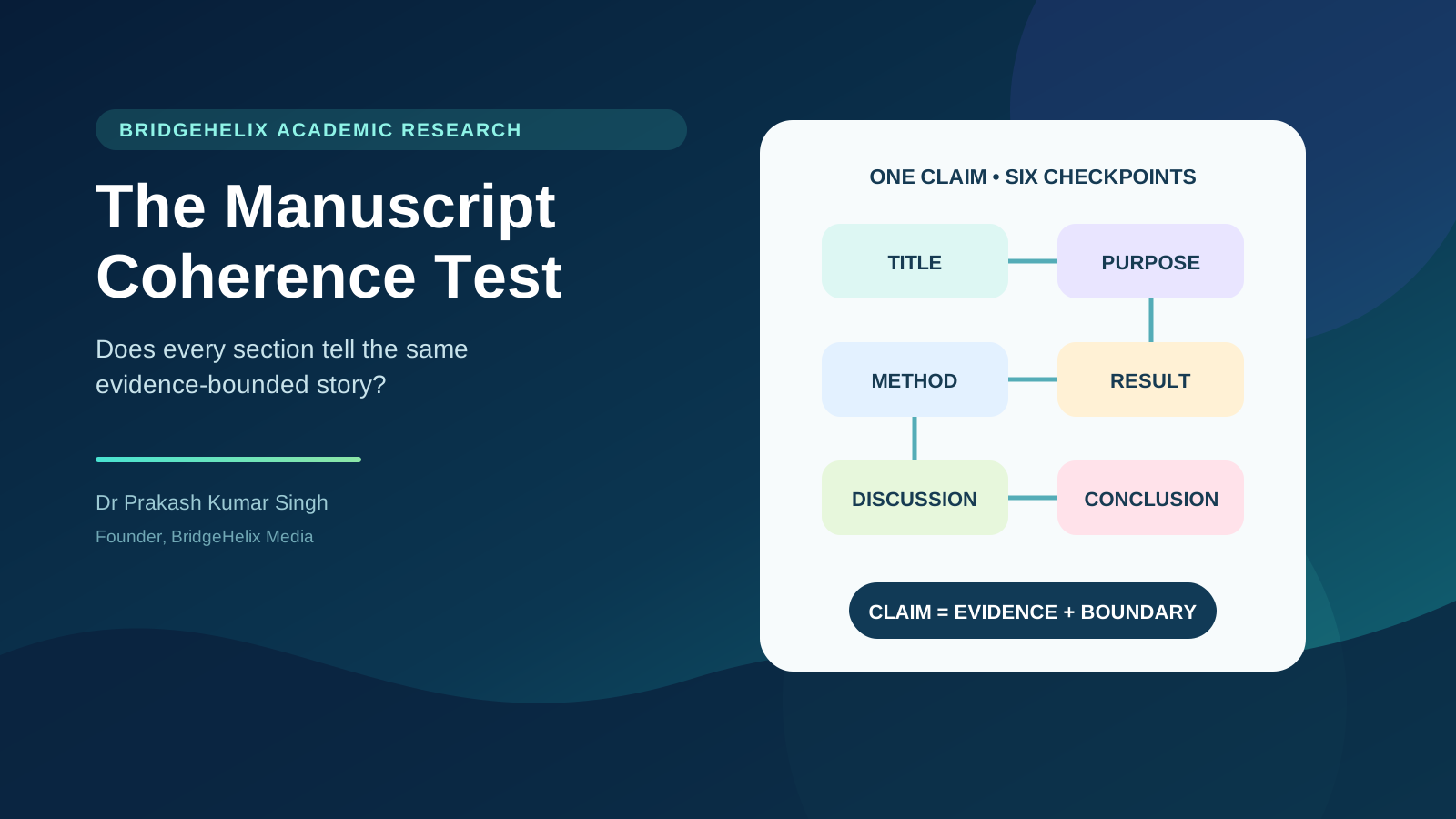
A research paper consistency check asks whether the same bounded study appears in the title, abstract, introduction, methods, results, discussion and conclusion. The wording need not be identical. The purpose, system, comparison, outcome and evidence boundary should remain compatible. If one section promises more than another can support, the manuscript has a coherence problem rather than a language problem.
This problem is easy to miss because every section may look acceptable when read alone. The introduction establishes a large practical challenge. The methods describe valid experiments. The results contain real measurements. The conclusion sounds confident. Yet the complete paper may still move from a narrow laboratory observation to a broad claim about field performance.
Language editing can make such a paper smoother. It cannot repair the evidence chain unless the sections are examined together.
What manuscript coherence actually means
Scientific manuscripts are divided into sections for a practical reason. The introduction explains the problem and purpose. The methods show how evidence was produced. The results report what was observed. The discussion interprets those observations. The conclusion states what can reasonably be learned.
The ICMJE manuscript-preparation recommendations (opens in a new tab) describe the familiar Introduction, Methods, Results and Discussion structure as a reflection of scientific discovery, not an arbitrary publishing format. Although disciplines and article types differ, the underlying logic remains useful: each section performs a different part of one argument.
Coherence therefore does not mean repeating the objective in every section. It means preserving five elements:
- the system, population or material studied;
- the intervention, exposure or condition;
- the comparison, where one was made;
- the outcome actually measured;
- the boundary within which the evidence is valid.
If these elements change silently, the paper tells more than one story.
Why inconsistency enters a manuscript
Many manuscripts are written over months or years. The initial proposal may describe a broad objective. Available instruments, samples or time may narrow the completed work. A later analysis may reveal an unexpected result. Co-authors may draft different sections from different versions of the study.
The title and abstract are often written last, when the authors want the paper to appear important. This can increase the distance between the evidence and the headline claim.
Common causes include:
- The study changed but the objective did not. A field component was removed, yet the introduction still promises field validation.
- The outcome changed between sections. The methods measure removal efficiency, while the conclusion discusses treatment safety or economic viability.
- A comparison is implied but not performed. The title says “better,” although no equivalent comparator was included.
- The abstract compresses away a critical condition. A result obtained at one pH, dose or time is presented as general performance.
- Discussion language migrates into the results. An interpretation is written as though it were a direct observation.
These are structural inconsistencies. They can affect how editors, reviewers and readers judge the reliability of the paper.
The BridgeHelix claim–evidence coherence map
The coherence test begins with one sentence:
What is the most important claim that this manuscript can support?
Write the claim in bounded form. Then trace it across six checkpoints.
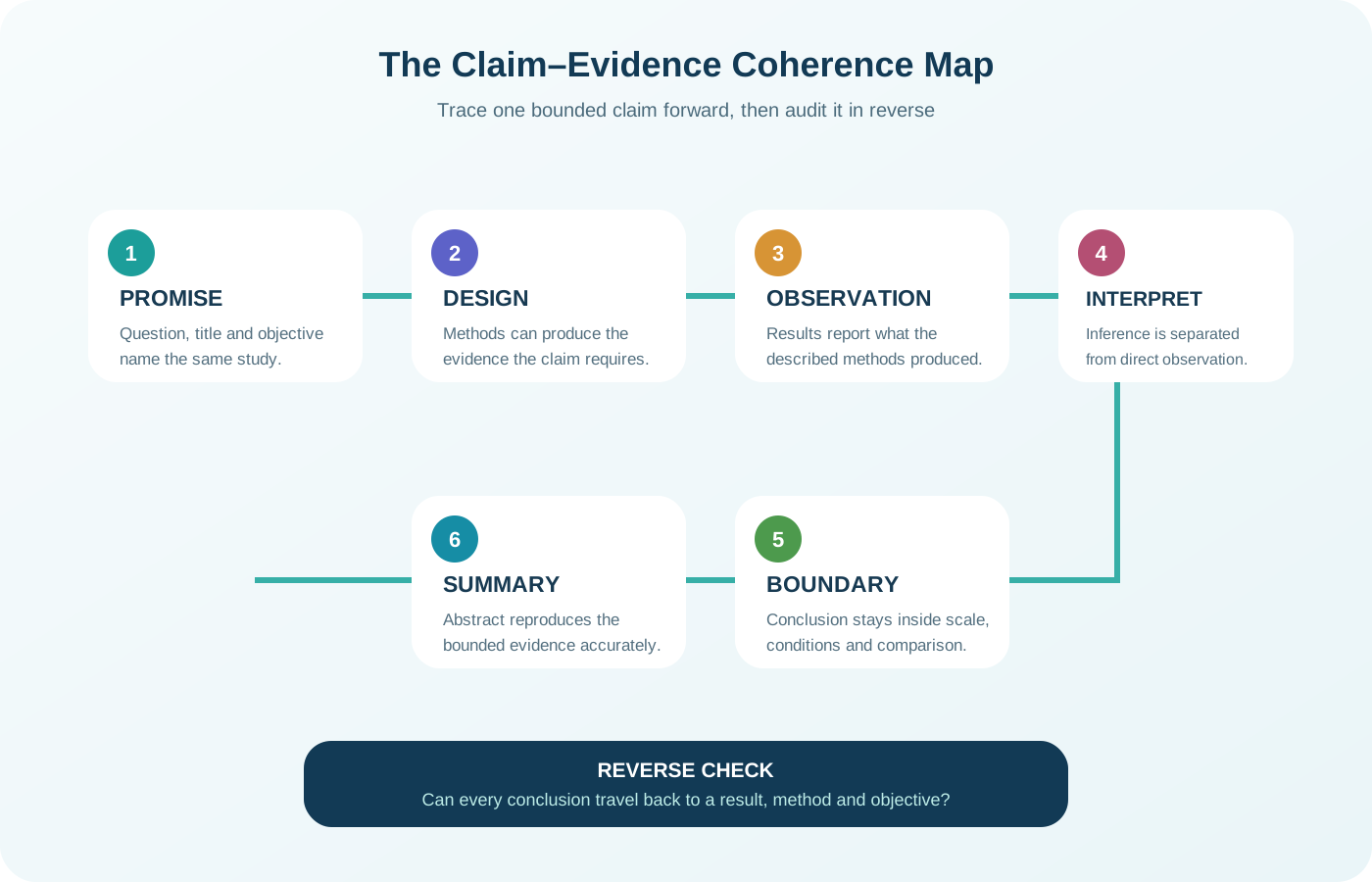
1. Promise: what does the title and introduction say the study will establish?
The title creates the first contract with the reader. The final paragraph of the introduction usually states the purpose, question or objectives.
Compare them directly.
Title:
A marble-powder composite for efficient fluoride removal from drinking water
Objective:
To determine fluoride adsorption under controlled batch conditions using synthetic water.
The title may be too broad because “drinking water” can imply realistic matrices, safety and application, while the objective describes a controlled batch study. A more coherent title would identify the study boundary:
Batch fluoride adsorption by a marble-powder composite under controlled aqueous conditions
The revised title is less promotional, but more informative.
2. Design: can the methods produce the evidence required by the promise?
List each major claim and the evidence it requires.
| Proposed claim | Minimum evidence expected |
|---|---|
| Treatment is effective | Defined outcome under relevant conditions |
| Treatment is better than an alternative | Equivalent comparative testing |
| Mechanism has been established | Evidence capable of distinguishing plausible mechanisms |
| Process is reusable | Performance across defined regeneration cycles |
| Technology is scalable | Hydrodynamic, material, operating and scale evidence |
| Treated water is safe | Relevant leaching and water-quality measurements |
A method may be technically correct but insufficient for the stated claim. A batch adsorption experiment can support a batch-performance conclusion. It cannot independently establish long-term continuous operation.
This is why aligning research questions, objectives and methods must precede stylistic refinement.
3. Observation: do the results report the evidence promised by the method?
Check every method against the results and every result against the methods.
A useful audit uses two questions:
- Where is the result for this method?
- Where is the method for this result?
Unreported methods waste space and can create suspicion about selective reporting. Results without a described method cannot be evaluated or reproduced.
Reporting guidelines can help identify missing information. The EQUATOR Network’s writing toolkit (opens in a new tab) asks whether methods can be scrutinised, experiments replicated and numerical results extracted. The appropriate guideline depends on study design, but the principle is broader: a reader should be able to understand how each reported result was generated.
4. Interpretation: does the discussion explain the result without replacing it?
The results section should establish what happened. The discussion should explain what it may mean, how it compares with previous evidence and where uncertainty remains.
Consider:
Fluoride removal decreased from 88% to 67% in the binary-ion system.
This is an observation if the measurement and calculation are defined.
The decrease confirms that nitrate competitively occupies all fluoride-binding sites.
This is a mechanistic interpretation. It may be plausible, but “confirms” requires evidence that distinguishes this explanation from mass-transfer effects, ionic-strength changes, pH shifts and other possibilities.
The discussion should preserve that difference:
The lower fluoride removal in the binary-ion system is consistent with competitive adsorption, although the present measurements do not independently identify the responsible binding sites.
The second sentence is not hesitant for the sake of sounding cautious. It separates evidence from inference.
5. Boundary: does the conclusion remain inside the tested conditions?
The conclusion should answer the research question at the same scale and under the same conditions as the evidence.
Use a boundary sentence:
Under the tested batch conditions, the composite achieved…
This phrase is useful only when followed by specific information. It should not become a ritual disclaimer placed before an unrestricted recommendation.
Check whether the conclusion silently changes any of these:
- synthetic water to real groundwater;
- single batch to continuous operation;
- laboratory preparation to scalable manufacturing;
- removal performance to overall treatment safety;
- association to causation;
- one sample or location to a general population.
If it does, either add the missing evidence or narrow the claim.
6. Summary: does the abstract reproduce the bounded story?
The abstract is not a separate marketing layer. It is a compressed representation of the paper.
Extract five statements:
- why the study was needed;
- what was investigated;
- how it was investigated;
- what was found, with a specific result;
- what the result supports.
Then compare each statement with the full text. Numbers, sample sizes, conditions and conclusions should agree. If the abstract says “significantly improved,” the paper should identify the comparison and statistical basis. If the abstract says “suitable for field application,” the body should contain relevant field evidence.
A two-direction audit catches more problems
A forward audit follows the paper’s planned logic:
problem → objective → method → result → interpretation → conclusion
A reverse audit begins with the strongest conclusion:
conclusion → supporting result → analysis → method → objective
The forward audit finds missing work. The reverse audit finds unsupported claims.
For example, if the conclusion states that a treatment is economical, move backwards:
- Which result reports cost?
- Which cost model produced it?
- Which inputs and system boundary were defined?
- Which objective required economic evaluation?
If the chain stops, “economical” is not yet a result of the study.
Make the inconsistency visible in one table
When several authors are involved, create a one-page coherence table before editing the prose.
| Manuscript element | Current statement | Evidence actually available | Required action |
|---|---|---|---|
| Title | Demonstrates field-ready treatment | Batch and short column data | Narrow the title |
| Objective | Evaluate performance and cost | Performance measured; preliminary cost inputs | Separate completed and future objectives |
| Main result | Capacity under defined conditions | Direct measurement with uncertainty | Retain conditions |
| Discussion | Suggests competitive adsorption | Indirect model and performance evidence | Present as interpretation |
| Conclusion | Suitable for community deployment | No field, maintenance or adoption study | Replace with a validation pathway |
This table prevents section owners from fixing contradictions independently. It also shows whether the correct action is new analysis, narrower wording, removal of a claim or additional research. Once the logical decisions are agreed, sentence-level editing becomes faster and more consistent.
Section-by-section coherence checklist
Title and keywords
- Does the title identify the actual study rather than the largest possible application?
- Are comparative words supported by a direct comparison?
- Do keywords represent the evidence, method and field?
Abstract
- Are the purpose, method, main result and conclusion present?
- Do important conditions and sample characteristics remain visible?
- Are numerical results identical to the paper?
- Is the conclusion no broader than the study?
Introduction
- Does the literature lead to the precise problem investigated?
- Is the research gap defensible?
- Do the stated objectives match the completed work?
Methods
- Can each method be linked to an objective?
- Are materials, conditions, controls, analysis and exclusions reported?
- Is enough information given for evaluation or replication?
Results
- Is each objective answered?
- Are denominators, units, uncertainty and comparisons clear?
- Are interpretations kept out unless the journal combines sections?
Discussion and conclusion
- Are important findings compared with relevant evidence?
- Are alternative explanations considered?
- Are limitations connected to their effect on interpretation?
- Does the conclusion answer the original question without adding untested claims?
What to do when the study is already complete
Sometimes the coherence audit reveals that a method or comparison is missing and new experiments are not possible. The correct response is not to hide the problem.
Four options remain:
- narrow the objective to the evidence actually produced;
- remove a claim that cannot be supported;
- present the missing validation as future work;
- explain the limitation and its consequence for interpretation.
Retrospectively rewriting an objective should not misrepresent how the study was conducted. If the change affects protocol registration, ethics, primary outcomes or confirmatory analysis, discipline-specific requirements must be followed.
The aim is an honest manuscript, not artificial neatness.
Practical conclusion
A coherent manuscript tells one evidence-bounded story across all sections. Its introduction promises a question the methods can answer. Its results report the evidence those methods produced. Its discussion interprets rather than inflates. Its conclusion stays within the study boundary, and its abstract reproduces that same story accurately.
Do the check before line editing. Structural contradictions become harder to see once every sentence sounds polished.
BridgeHelix Media provides research manuscript editing focused on structure, consistency, evidence boundaries and journal readiness while preserving the author’s research and responsibility.
Sources

About the author
Dr. Prakash Kumar Singh
Founder & Technical Content Strategist
PhD in Chemical Engineering from MNIT Jaipur, with M.Tech and B.Tech qualifications in Biotechnology. His work connects technical evidence with clear B2B communication and ethical research support.