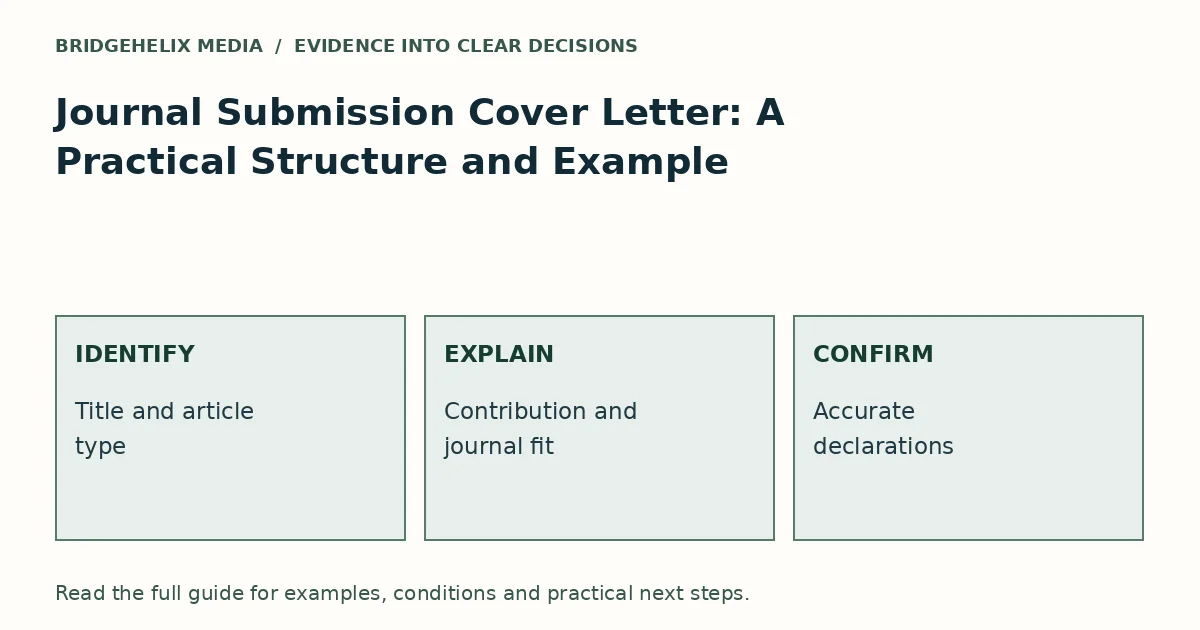
A useful letter makes that case briefly. It identifies the manuscript, explains the contribution in relation to the journal's readers and includes the submission information the journal requests. It does not need to retell the entire study, praise the journal at length or predict acceptance.
Check the journal's instructions before using a template
Cover-letter requirements vary. Some submission systems provide a text box; others ask for a separate file. A journal may request specific declarations or use separate fields for them. Follow the current instructions for your chosen journal rather than treating a generic example as a universal requirement.
Taylor & Francis's cover-letter guidance (opens in a new tab) recommends identifying the manuscript and journal, explaining the work and addressing submission declarations. The practical point is to make the editor's initial assessment easier. It is not an invitation to oversell a result.
Confirm the journal name, article type and editor's name if you use it. When a name cannot be verified, a neutral salutation is preferable to guessing. A letter left over from a previous submission can undermine an otherwise careful package simply because it addresses the wrong journal.
Use four short parts
The opening identifies what you are submitting and the article type. The next paragraph explains the research problem and specific contribution. A third connects that contribution to the journal's scope. The final part covers the requested declarations and corresponding-author details.
These parts can overlap. For a straightforward manuscript, the contribution and journal-fit explanation may fit in one paragraph. Length should follow the journal's requirements and the information needed, not a belief that a full page is automatically more persuasive.
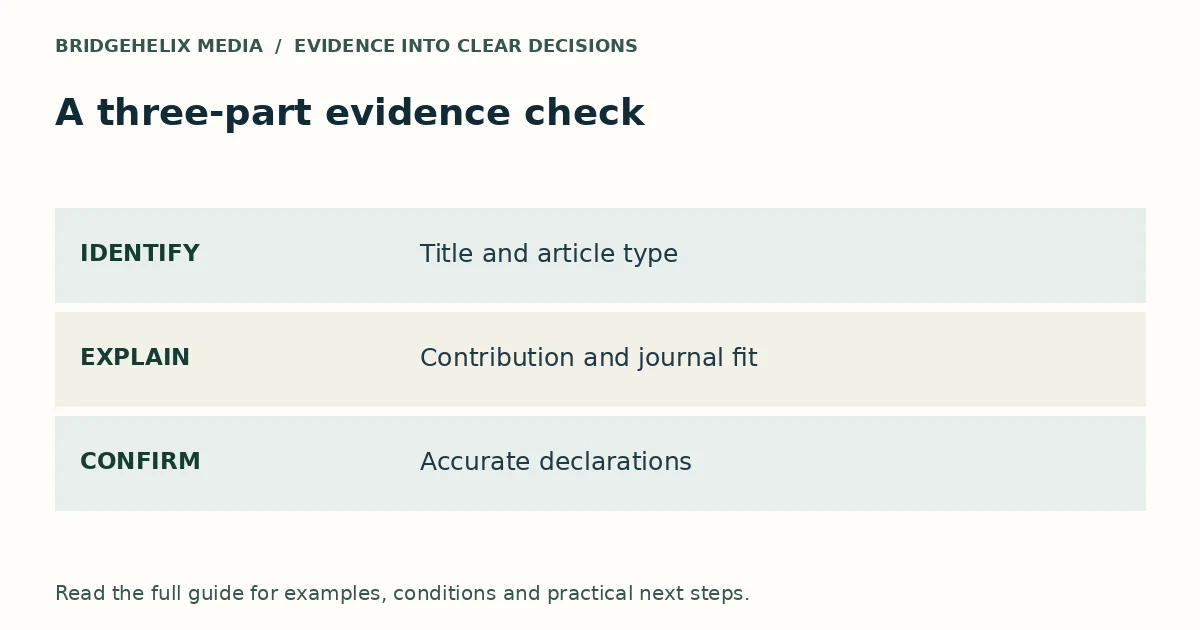
The letter should answer a different question from the abstract. The abstract summarises the research. The cover letter explains why the editor should consider this manuscript for the journal. Reusing a precise result is fine; copying the abstract in full usually wastes the opportunity to explain fit.
Describe the contribution without inflating it
Name the gap the study addresses and the evidence it contributes. “This work studies an important environmental problem” is true of many papers. A stronger sentence identifies the actual comparison, mechanism, dataset or methodological limitation addressed by this manuscript.
For example, an author might explain that a study compares the same material under controlled and variable-feed conditions, allowing readers to see where its observed performance changes. That is a specific contribution. Calling the material a commercially proven solution would add a claim the study may not support.
Use the strongest accurate statement, not the strongest available adjective. Words such as first, unprecedented and breakthrough require evidence of their own. If the literature search does not support a priority claim, describe the contribution directly and let its relevance carry the argument.
Our manuscript coherence guide is useful here: the contribution in the cover letter should agree with the abstract, results and conclusion. The submission package should not contain four different versions of what the paper established.
An adaptable example
The example below is fictional. Replace every bracketed item with verified information from the actual manuscript and journal instructions. The sentences about evidence should be rewritten for your study, not copied as claims about work you did not perform.
Dear Editor,
Please consider our manuscript, “[Manuscript title],” for publication as a [article type] in [Journal name].
The study addresses [specific unresolved question]. Using [study design or approach], we found [principal result, including an essential condition or limitation]. The contribution is [what the result adds to existing understanding], rather than a claim of [unsupported broader outcome, if clarification is necessary].
We believe the manuscript fits the journal's scope because it addresses [specific topic in the journal's stated scope] and provides [relevant insight] for readers working on [research problem].
[Insert only the accurate declarations requested by the journal, including any required information on originality, concurrent consideration, author approval or related material.]
Thank you for considering the manuscript.
[Corresponding author name, affiliation and contact details]
The most important work is inside the contribution paragraph. A polished salutation cannot compensate for a vague statement about what the research adds. Write that paragraph with the manuscript open, then check that every factual statement can be traced to the study or the cited literature.
Handle declarations as facts, not boilerplate
Never insert a declaration simply because it appears in another author's letter. Confirm it with the corresponding author and the submission requirements. Statements about author approval, competing interests, related manuscripts or previous publication must accurately reflect the situation.
If a preprint, conference version or related paper exists, consult the journal's policy and disclose it in the requested place. Do not hide related material, but do not assume that every earlier public version has the same status under every publisher's rules.
Research ethics approval, data availability and funding information may belong in the manuscript or dedicated submission fields. Check consistency across the package. A cover letter should not become the only place where required information appears if the journal asks for it elsewhere.
Explain journal fit with something specific
Read the journal's aims and scope and consider whether the manuscript's central question serves those readers. “Your prestigious journal is internationally renowned” does not establish fit. A sentence connecting the study's subject and contribution to a defined scope area is much more useful.
Recent relevant articles can help you understand the conversation in the journal, but do not force citations into the letter merely to flatter the editor. If you mention a related article, explain the substantive connection. The letter is a brief argument for consideration, not a miniature literature review.
Review the letter alongside the full submission
Before uploading, check the manuscript title, author details, article type and journal name against the submission system. Remove placeholders, stale dates and claims that changed during revision. If the results were narrowed late in drafting, the cover letter must reflect that change too.
Use the pre-submission manuscript checklist to review the package as a whole. A clear letter cannot rescue an unresolved mismatch between the research question, methods and conclusion.
BridgeHelix's research manuscript editing support can help improve clarity and consistency while preserving the authors' decisions and responsibility. A cover letter can present the case for consideration clearly; it cannot promise peer review or publication.

About the author
Dr. Prakash Kumar Singh
Founder & Technical Content Strategist
PhD in Chemical Engineering from MNIT Jaipur, with M.Tech and B.Tech qualifications in Biotechnology. His work connects technical evidence with clear B2B communication and ethical research support.