
A biotech product page can be technically accurate and still produce weak enquiries. The scientist sees a polished diagram but cannot find sample conditions. Procurement sees “easy integration” but no instrument compatibility, lead time or support boundary. A business leader sees technical features but cannot identify which delay, risk or cost the product changes.
Each reader leaves with part of the answer.
A useful biotech product page should maintain one evidence spine: problem, mechanism, proof, implementation, practical value and next step, while giving scientists, procurement and business readers different entry points. Do not write three disconnected sales messages. Present the same approved evidence in layers, state validation boundaries and use a CTA that resolves the reader’s next uncertainty rather than asking everyone to “book a demo.”
The page must help a buying group decide whether further technical evaluation is justified.
Diagnose why the current page is not converting
Before rewriting, inspect evidence from the page and sales process. Conversion failure can mean several different things:
- relevant visitors do not understand the offer;
- scientists cannot verify the technical claim;
- the product fits technically but implementation risk remains unclear;
- the page attracts students or general readers rather than buyers;
- the CTA asks for too much commitment too early;
- important information exists only in a PDF that readers never reach; or
- the page creates enquiries, but from the wrong applications.
Collect page-search queries, analytics, sales questions, support tickets and interview notes. List the questions repeatedly asked after a prospect has read the page. Those questions identify missing decision information.
Do not diagnose conversion only from a low percentage when traffic is very small or poorly matched. A specialised biotech page may have low volume but high decision value. The better question is whether qualified readers reach the appropriate next step.
Map the three readers and their risks
The same organisation may involve more than three people, but these roles expose the main content gaps.
Scientist or technical evaluator
The scientist asks:
- Does the mechanism make sense?
- What sample types and operating ranges were tested?
- Which endpoint was measured?
- What is the comparator?
- Are raw or representative data available?
- Where does performance decrease?
Their risk is scientific failure or an unsupported result.
Procurement, operations or quality reader
This reader asks:
- What equipment, consumables and training are required?
- Is the product compatible with the existing workflow?
- What are the storage, handling and lead-time conditions?
- Which documentation, certificates or quality records are available?
- Who supports implementation and troubleshooting?
Their risk is operational disruption, supplier dependency or an incomplete purchasing specification.
Business or programme leader
This reader asks:
- Which bottleneck changes?
- What evidence supports the claimed time, cost or risk effect?
- How quickly can the team evaluate fit?
- What remains uncertain before adoption?
- Is the next step proportionate to the decision?
Their risk is committing resources without a defensible value case.
A good page does not simplify away these differences. It organises them.
Build one biotech product-page evidence spine
Use six connected blocks.
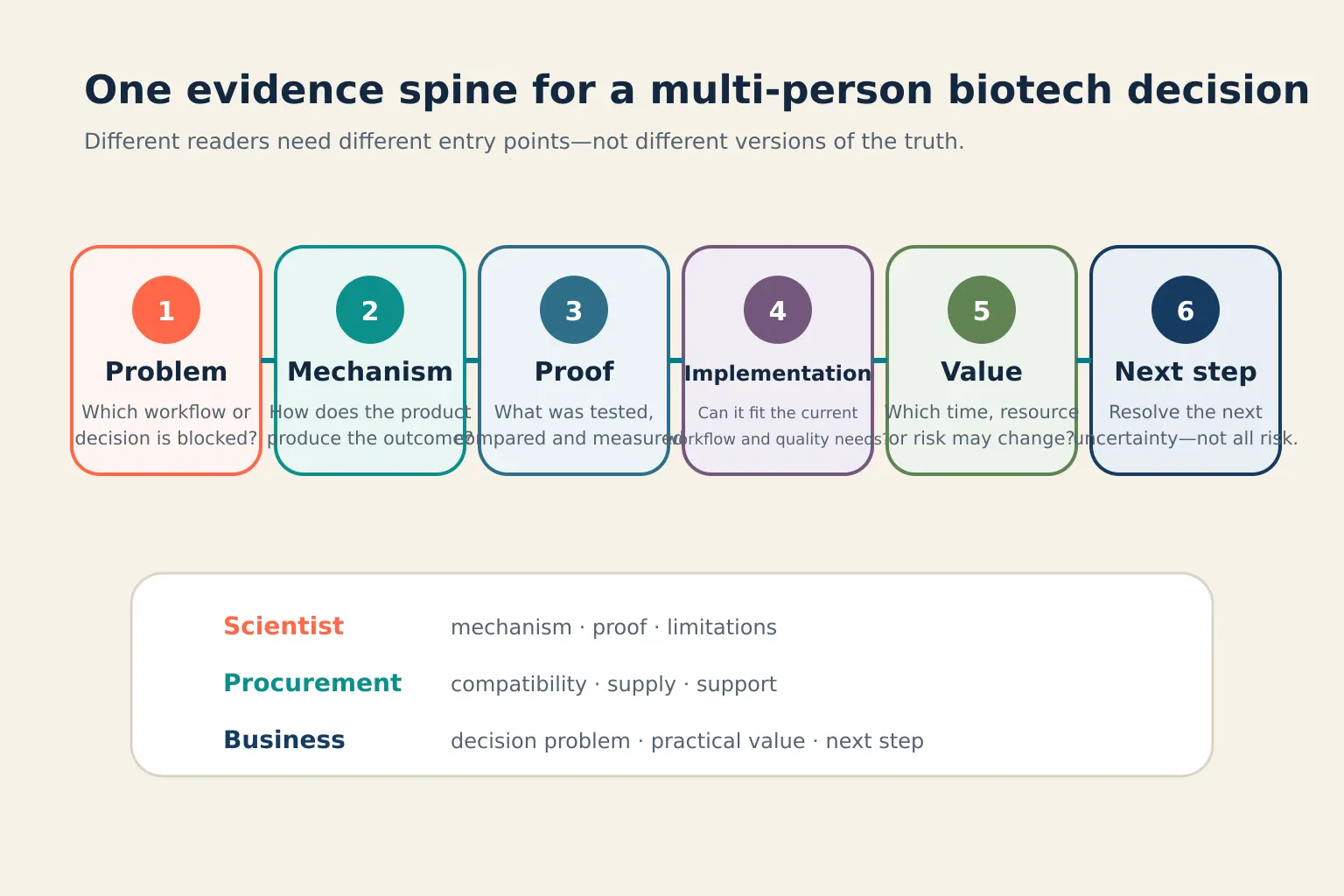
1. Specific decision problem
Begin with the process or research problem, not the company mission.
Weak:
Transforming discovery through next-generation innovation.
Stronger:
Compare low-abundance protein targets across limited-volume samples without adding a separate concentration step.
The stronger version gives the relevant reader a recognisable situation. It is not yet a performance claim; the page must still show what the product does and under which conditions.
2. Product outcome with boundary
State the intended technical outcome and the application boundary in the opening screen.
For example:
A benchtop enrichment workflow designed for 25–100 µL research samples before the specified LC–MS preparation sequence.
“Designed for” should not replace validation evidence. It tells the reader what to evaluate next.
3. Mechanism
Explain how the product produces the outcome at the level necessary for evaluation. Use a labelled diagram and plain technical language. Define proprietary terminology instead of requiring the reader to accept a branded mechanism.
Connect feature to function:
The porous capture matrix increases accessible binding area within the stated flow range, which supports enrichment of the specified target class under the tested buffer conditions.
Avoid jumping from a material property directly to a clinical, productivity or financial outcome.
4. Proof
Evidence should be inspectable. Include:
- test objective;
- sample or model;
- comparator;
- protocol conditions;
- endpoint and units;
- number of replicates or study size where relevant;
- uncertainty or variability;
- observed result; and
- limitation.
If evidence is preliminary, say so. If the result is internal, identify it as internal. If the page cites a publication, verify that the tested version and intended application match the product being described.
5. Implementation
This block prevents an apparently promising product from becoming an operational unknown. State:
- workflow position;
- compatible inputs and outputs;
- instrument, software or facility dependencies;
- protocol duration and hands-on steps;
- training and validation support;
- storage and handling;
- deliverables or supplied components; and
- known exclusions.
Procurement should not need a sales call merely to learn whether an existing instrument is compatible.
6. Decision-specific next step
Choose a CTA based on the unresolved risk:
- Check sample compatibility when input fit is uncertain.
- Request the validation note when evidence depth is the barrier.
- Review the workflow with a technical specialist when integration is complex.
- Discuss a pilot protocol when site-specific performance must be tested.
The CTA should continue the evaluation, not interrupt it.
Page structure that supports layered reading
Use this order for a complex biotech product.
| Page section | Primary question answered | Main reader |
|---|---|---|
| Problem and bounded outcome | Is this relevant to our workflow? | All readers |
| Evidence summary | Is there credible performance evidence? | Scientist, business |
| Mechanism | Why might it work? | Scientist |
| Validation detail | Under what conditions was it tested? | Scientist, quality |
| Workflow and compatibility | Can we implement it? | Procurement, operations |
| Practical value | Which delay, resource or risk may change? | Business |
| Limitations and fit | When should we not use it? | All readers |
| Next step | What is the smallest useful evaluation action? | All readers |
Place a concise proof summary near the top and deeper data later. Do not force a senior reader through a long mechanism explanation before establishing relevance, but do not hide the technical basis behind vague benefit language.
Convert specifications into decision information
A specification is useful when its consequence is clear.
| Specification | Incomplete presentation | Decision-oriented presentation |
|---|---|---|
| Sample volume | “Low-volume compatible” | “Validated with 25–100 µL inputs using the stated protocol” |
| Run time | “Fast workflow” | “Protocol time: 70 minutes; hands-on time: approximately 18 minutes under internal test conditions” |
| Compatibility | “Works with standard systems” | “Output is compatible with listed instrument models and software versions” |
| Sensitivity | “High sensitivity” | “Limit of detection under the stated matrix, comparator and analysis method” |
| Support | “Expert support” | “Protocol onboarding, one remote training session and documented troubleshooting route included” |
These examples are structural. Published values must come from approved product and validation records.
Our technical value proposition framework (opens in a new tab) shows how to connect a feature to process effect and commercial relevance without turning an engineering relationship into an unsupported guarantee.
Create a minimum viable evidence pack
Before writing the page, request one controlled source pack:
- current product specification;
- approved naming and version information;
- validation reports or approved summaries;
- protocols and compatibility tables;
- relevant quality or regulatory documents;
- frequently asked technical questions;
- approved claims and prohibited wording;
- known limitations;
- customer evidence cleared for publication; and
- defined CTA and response owner.
If the source pack cannot support an important statement, the writer should flag the gap. The solution may be to narrow the wording, obtain further internal evidence or remove the claim. It is not to make the sentence sound more confident.
Repair common biotech page failures
Failure: the page opens with the technology
Repair it by stating the reader’s workflow or decision problem first, followed by the bounded product outcome.
Failure: all evidence is in a gated PDF
Place a meaningful evidence summary on the page. Use the PDF for deeper methods or data, not as a substitute for answering the core claim.
Failure: the mechanism carries the whole argument
A plausible mechanism does not establish performance. Add measured evidence and its conditions.
Failure: procurement information is absent
Add workflow, compatibility, supply, training and support details. Technical interest often stops when operational questions remain unresolved.
Failure: every reader receives the same “Book a demo” CTA
Offer a smaller, decision-relevant next step. A scientist may want a protocol or evidence review before a commercial meeting.
Failure: the page says nothing about non-fit
State sample, application or operating boundaries. Excluding poor-fit enquiries can improve conversion quality even if total form submissions fall.
Measure whether the repair worked
Track actions that reflect technical evaluation:
- qualified CTA clicks;
- validation-note or protocol requests;
- sample-compatibility enquiries;
- visits to evidence and implementation sections;
- progression from technical review to pilot discussion;
- questions still repeatedly asked by sales; and
- disqualified enquiries caused by obvious non-fit.
Compare enquiry quality as well as quantity. A page is improving when the buying team arrives better informed and the next discussion begins at a deeper level.
Google’s people-first content guidance asks whether a reader leaves feeling they have learned enough to help achieve their goal. For a biotech product page, that goal is not to understand every scientific detail. It is to decide whether the product deserves the next stage of evaluation.
Practical conclusion
A biotech product page should not make one reader decode information written for another. Give scientists the conditions and evidence, procurement the implementation facts, and business readers the defensible practical consequence.
Keep one evidence spine so those explanations do not contradict each other. Then use the CTA to resolve the next uncertainty in the buying process.
BridgeHelix Media provides PhD-led technical website content writing (opens in a new tab) and biotechnology content support (opens in a new tab) for companies that need to turn product records, validation data and expert interviews into clear pages for multi-person B2B decisions.
A product-page rewrite can sit within a wider biotechnology content project. When the audience includes pharmaceutical or life-sciences teams, pharma content writing also needs a clear boundary between supporting evidence and promotional interpretation.
If you want a low-risk first step, request a scoped 1-page technical messaging diagnostic for one existing product page, service page or datasheet.
Sources

About the author
Dr. Prakash Kumar Singh
Founder & Technical Content Strategist
PhD in Chemical Engineering from MNIT Jaipur, with M.Tech and B.Tech qualifications in Biotechnology. His work connects technical evidence with clear B2B communication and ethical research support.