
Receiving a major-revision decision can feel like receiving twenty separate problems at once. One reviewer asks for another experiment. Another questions the statistical analysis. A third says that the novelty is unclear. The editor adds a short instruction that may be more important than all three reports.
The common mistake is to open the manuscript and start changing sentences immediately. After several hours, the authors no longer know which comment has been answered, which change affected another section and which reply still lacks a manuscript location.
A reliable response to reviewers uses one numbered record for every editor and reviewer comment. Under each comment, state the author’s decision, explain the action taken and identify the exact page, line, section, table or figure changed. If a request cannot be followed, disagree respectfully with evidence and clarify the manuscript so the original misunderstanding is less likely to recur.
The response letter is not a defence speech. It is an audit trail for the revision.
Start with the editor’s decision letter
Read the decision letter before analysing individual reviews. The editor determines the decision and may prioritise issues differently from the reviewers. Extract every editorial instruction, including requests about word count, files, ethics statements, reporting checklists, data availability or additional analyses.
Create four groups:
- editor requirements;
- Reviewer 1 comments;
- Reviewer 2 comments; and
- any confidential or technical submission instructions.
Do not merge similar reviewer comments yet. Each reviewer should be able to find a direct response under the original wording.
PLOS advises authors to respond inline to every comment and to indicate where each change appears. PLOS journal guidance also asks authors to address all editor and reviewer points and list the manuscript changes. This is not merely politeness. It makes the revision verifiable.
Build a revision-control table before editing
Copy every comment into a working table.
| ID | Comment | Type | Required action | Affected sections | Status |
|---|---|---|---|---|---|
| E1 | Add data-availability statement | Editorial | Add required statement | Declarations | Open |
| R1.1 | Novelty is not clear | Clarity/positioning | Revise gap and contribution | Introduction, Discussion | Open |
| R1.2 | Explain sample-size basis | Method/reporting | Add basis and limitation | Methods, Limitations | Open |
| R2.1 | Perform six-month field trial | New work | Assess feasibility and necessity | Methods, Discussion | Decision needed |
Classifying the request prevents every comment from becoming a sentence-editing task. A novelty comment may require changes in the introduction, discussion and abstract. A request for new work requires a scientific decision before any drafting begins.
Use the four-part response formula
For most comments, use this structure:
- Acknowledge: show that the concern is understood.
- Decide: state whether you agree, partly agree or disagree.
- Act: explain what was changed or why no requested change was made.
- Locate: give the exact revised location and, when useful, quote the new text.
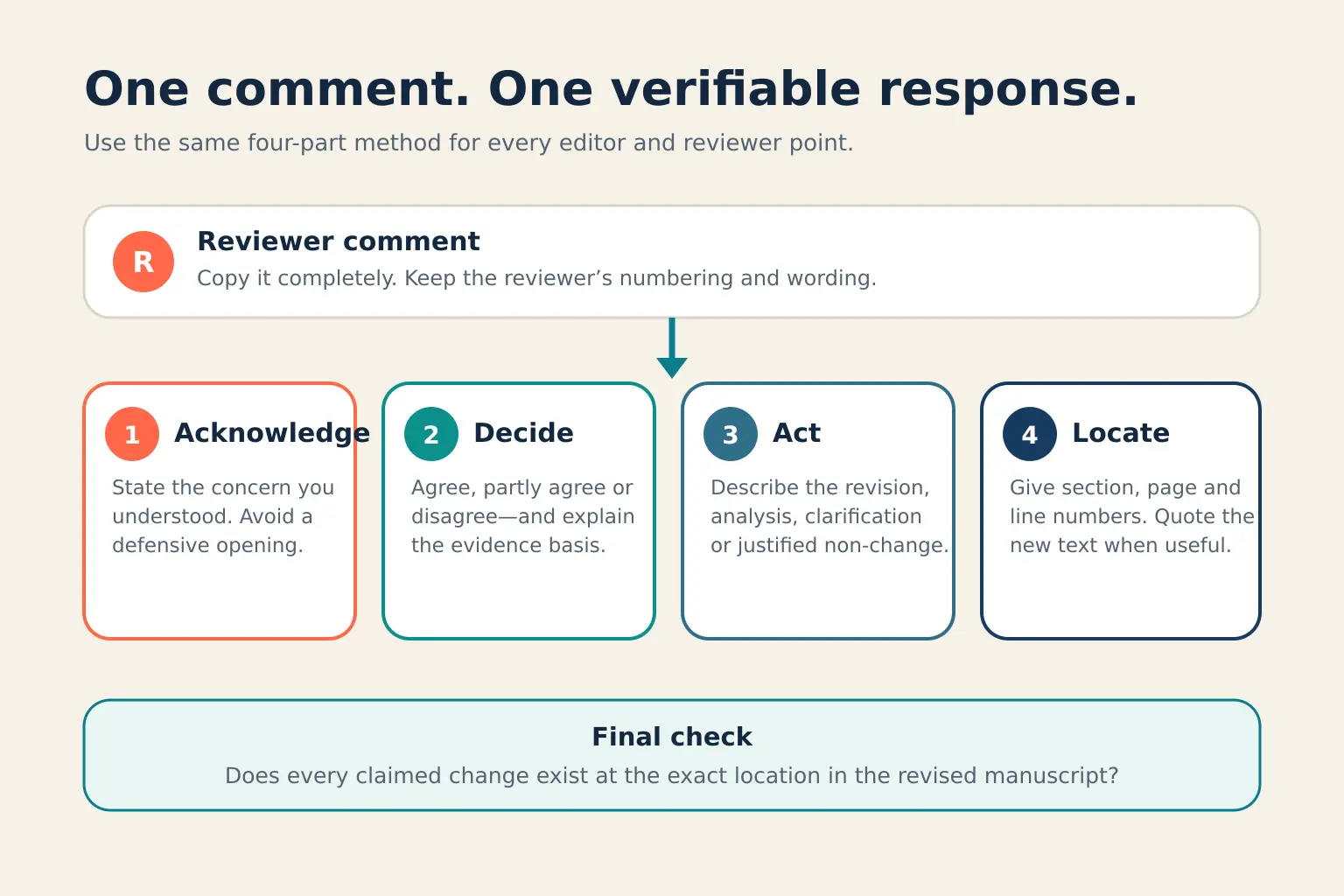
This order is more reliable than beginning every answer with “Done” or “Corrected accordingly.” It tells the editor what the authors understood and what can now be checked.
Copy-and-use response to reviewers template
Dear Editor and Reviewers,

Thank you for evaluating our manuscript, “[TITLE]” ([MANUSCRIPT ID]).
We have revised the manuscript in response to the editor’s and reviewers’
comments. All changes are marked using [TRACKED CHANGES / HIGHLIGHTING],
and page and line references below refer to the revised manuscript.

EDITOR COMMENTS

Comment E1
[Paste the complete comment.]

Response
We [agree / partly agree / respectfully disagree] that [state the concern].
To address this point, we [describe the action and reasoning].
The revised text appears in [section, page, lines]:
“[Quote the revised text when this helps verification.]”

REVIEWER 1

Comment 1.1
[Paste the complete comment.]

Response
[Acknowledgement.] [Decision.] [Action.] [Exact location.]

We appreciate the time and expertise contributed by the editor and reviewers.
We believe the revisions have improved [name the specific aspects improved].

Sincerely,
[Corresponding author on behalf of all authors]
Use the journal’s required file format when it provides one. Some systems request a clean manuscript, a marked manuscript and a separate response letter.
Example 1: agreeing with a reviewer
Reviewer comment:
The introduction describes fluoride contamination broadly, but the unresolved research problem is not stated clearly. Please explain how this study differs from previous adsorption studies.
Weak response:
Corrected as suggested.
Stronger response:
We agree that the previous introduction did not distinguish the present study clearly from batch adsorption reports. We have revised the final two paragraphs of the Introduction to identify the unresolved question: whether the material retains useful performance in the presence of competing ions and under continuous-flow conditions. We now state the study contribution without claiming that the adsorbent is universally applicable. The changes appear on page 4, lines 118–143.
The stronger answer identifies the problem, the action and the claim boundary. The editor does not have to search for the revision.
Example 2: clarifying an apparent omission
Reviewer comment:
The manuscript does not report how equilibrium was established before the adsorption isotherm experiments.
If the method was performed but underreported, do not reply only that the information “was already present.” The reviewer’s inability to find it is itself a communication problem.
Response:
Thank you for identifying this ambiguity. Equilibrium time was established in preliminary contact-time experiments, but the relationship between those experiments and the isotherm procedure was not explicit. We have added the selected equilibrium time and its experimental basis to Section 2.4 (page 7, lines 211–219) and added a cross-reference to the corresponding contact-time result in Section 3.2.
This follows the useful principle in the PLOS article “Ten Simple Rules for Writing a Response to Reviewers”: distinguish material that existed previously from text newly added to the revised manuscript.
Example 3: partly agreeing
Reviewer comment:
Remove the discussion of competing ions because it is outside the main study.
Response:
We agree that the previous discussion was too long relative to the study objective. However, competing ions are relevant to interpreting the difference between synthetic and real-water performance. We have reduced the discussion from three paragraphs to one and retained only the observations directly needed to explain that difference (Discussion, page 15, lines 472–489).
Partial agreement works when the reviewer has identified a genuine presentation problem but the proposed remedy would remove necessary scientific context.
Example 4: disagreeing respectfully
Disagreement is acceptable when the requested change would be methodologically inappropriate, unsupported by the data, outside the stated scope or impossible within a reasonable revision. The response must rely on evidence rather than authority or emotion.
Reviewer comment:
Please state that the treatment system is suitable for community-scale implementation.
Response:
We agree that community-scale relevance is an important question. We have not made the requested suitability claim because the present study evaluated laboratory batch performance and did not assess continuous operation, maintenance requirements, regeneration at scale or site-specific water quality. Instead, we have revised the Conclusion to state that the results support further column and field evaluation. We have also added these untested factors to the Limitations section (page 18, lines 563–578).
This reply does not reject the reviewer. It explains why the requested statement would exceed the evidence and improves the manuscript accordingly.
How to handle a request for a new experiment
Do not accept or reject the request immediately. Ask:
- Does the experiment test the central research question?
- Is the existing conclusion impossible to evaluate without it?
- Can the claim be narrowed instead?
- Is the request technically feasible within the revision period?
- Would the new work require ethical approval, new recruitment or an entirely different study design?
Then choose one of three responses.
Perform the experiment
Report why it was added, the method, the result and every affected section. New evidence often changes the abstract, methods, results, discussion, conclusion, tables and supplementary files.
Address the concern with existing evidence
If the requested question can be answered through an existing analysis or clearer presentation, show that reasoning and revise the relevant text.
Explain why it is outside scope
State the scientific or practical reason, narrow the claim if necessary and add a limitation or future-work statement. “We did not have time” is rarely sufficient by itself.
Prevent one revision from creating another inconsistency
A local change can damage the complete evidence chain. When a result, method or interpretation changes, inspect:
- title and keywords;
- abstract;
- stated objective;
- methods;
- results;
- discussion;
- conclusion;
- tables and figures;
- supplementary files; and
- data or ethics statements.
Use the manuscript coherence check (opens in a new tab) to confirm that the revised version tells one consistent scientific story.
Final response-letter quality check
Before resubmission, confirm that:
- every comment is copied and numbered;
- editor comments are answered before reviewer comments;
- page and line numbers refer to the revised version;
- every claimed change exists in the manuscript;
- quoted revised text matches the manuscript exactly;
- disagreements are evidence-led and calm;
- new analyses are described in all affected sections;
- deleted material is acknowledged when relevant;
- the clean and marked files contain the same scientific content; and
- all co-authors have approved the revision and response.
Also search the response letter for phrases such as “done,” “corrected” and “as suggested.” Replace them where they do not explain the actual change.
Practical conclusion
A response to reviewers succeeds when another person can verify the complete revision without reconstructing the authors’ thought process. Preserve every comment, state the decision, describe the action and identify the exact location.
When you disagree, do it with evidence. When the reviewer misunderstood, improve the manuscript as well as the letter. The purpose is not to win each exchange; it is to make the revised paper easier to evaluate.
BridgeHelix Media provides PhD-led research manuscript editing (opens in a new tab) and ethical reviewer-response support for STEM researchers who need to organise complex comments, test revision consistency and improve clarity while keeping all scientific decisions with the authors.
Sources
- PLOS: Responding to peer review (opens in a new tab)
- PLOS ONE: Revising Your Manuscript (opens in a new tab)
- PLOS Computational Biology: Ten Simple Rules for Writing a Response to Reviewers (opens in a new tab)
- ICMJE: Recommendations for the Conduct, Reporting, Editing, and Publication of Scholarly Work (opens in a new tab)

About the author
Dr. Prakash Kumar Singh
Founder & Technical Content Strategist
PhD in Chemical Engineering from MNIT Jaipur, with M.Tech and B.Tech qualifications in Biotechnology. His work connects technical evidence with clear B2B communication and ethical research support.