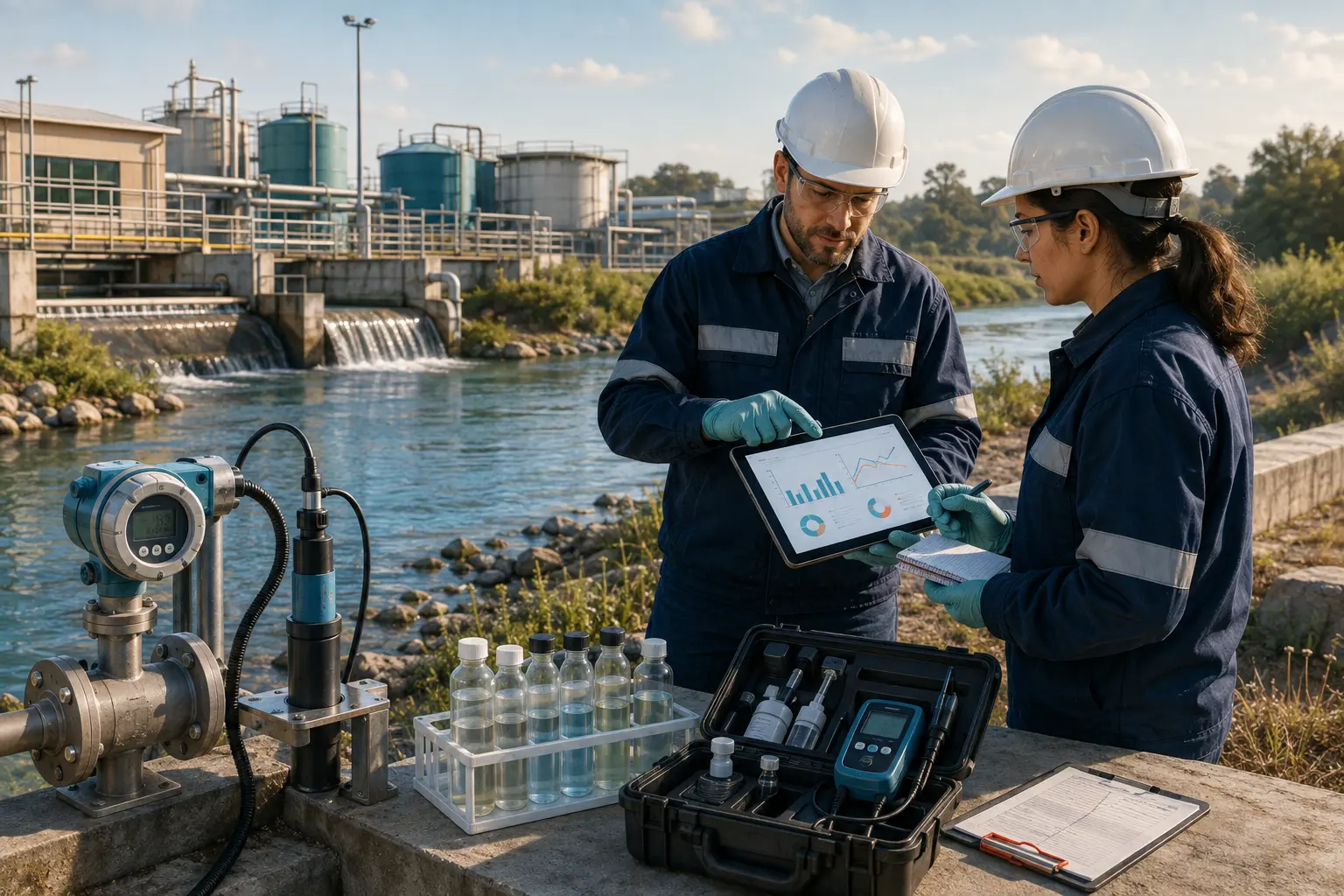
An environmental project has been completed successfully. The treatment unit was installed, the monitoring campaign was conducted and the client is satisfied. The marketing draft then says that the project “delivered a cleaner and more sustainable future.”
That sentence provides no result a technical buyer can evaluate.
A useful environmental engineering case study connects five elements: baseline, intervention, measurement method, outcome and limitation. Report the initial condition, system boundary, operating period, sample or monitoring design, denominator and uncertainty beside each result. Separate installed capacity and treated volume from the environmental outcome, and do not present a laboratory, pilot or short-term operational result as verified long-term impact.
The reader should be able to understand what changed, how it was measured and where the conclusion stops.
Begin with the decision the case study must support
An engineering director, environmental manager, regulator, investor and procurement team do not ask the same question.
Before collecting content, define:
- primary reader;
- decision under consideration;
- site or system type;
- intervention described;
- evidence period;
- commercially sensitive information that cannot be disclosed; and
- claims requiring client, technical or legal approval.
A case study for procurement may need integration requirements, maintenance burden and delivery scope. A case study for a technical reader may require inlet variability, hydraulic loading, analytical method and failure conditions. A single page can serve both if the information is layered, but it must not substitute slogans for evidence.
Build the five-part evidence chain
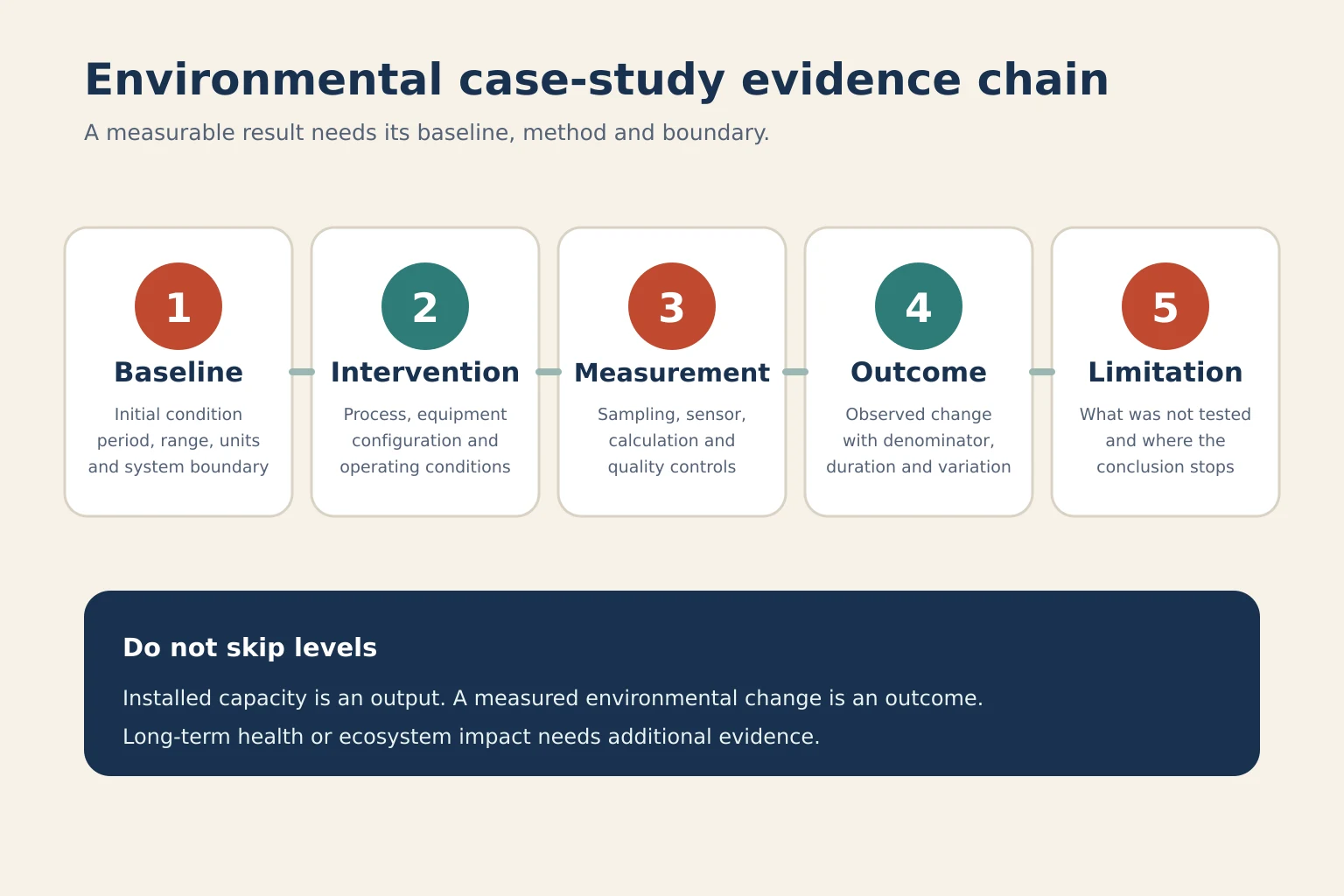
1. Baseline
Describe the condition before intervention.
Record:
- parameter measured;
- unit;
- location and system boundary;
- sampling or monitoring period;
- number and frequency of observations;
- range, central value and relevant variability;
- operating conditions; and
- applicable target, permit or client requirement.
“The water was highly contaminated” is not a baseline. “Influent concentration ranged from 8.2 to 11.4 mg/L across 18 samples collected over six weeks” is reviewable.
2. Intervention
Explain what changed in sufficient technical detail:
- process or equipment installed;
- capacity and configuration;
- pretreatment and post-treatment;
- control logic;
- commissioning steps;
- operator training;
- monitoring plan; and
- conditions excluded from the scope.
Do not describe a complete process as if one product acted alone when pumps, pretreatment, dosing, controls or operational changes materially affected the result.
3. Measurement method
State how the result was measured:
- sampling points;
- analytical or sensor method;
- calibration and quality controls;
- monitoring frequency;
- missing-data rule;
- calculation method;
- comparator or baseline period; and
- person or organisation responsible for measurement.
If the case study uses client-reported data, say so. If the project team performed the analysis, say so. Independent verification and internal monitoring are both useful, but they are not the same evidence category.
4. Outcome
Report the observed change with its denominator and period.
Weak:
The system reduced pollutant levels by 95%.
Stronger:
Across 24 paired samples collected during the 90-day monitored period, median effluent concentration was 0.42 mg/L compared with a median influent concentration of 8.6 mg/L. Flow ranged from 42 to 51 m³/day during the same period.
The stronger version lets the reader see the concentration basis, sample count, duration and loading context.
5. Limitation
State what the result does not establish.
Examples:
- seasonal influent conditions were not represented;
- monitoring covered commissioning and early operation only;
- energy use was estimated rather than directly metered;
- one site was studied;
- the comparator used historical rather than simultaneous data;
- sludge disposal costs were excluded; or
- biodiversity change was not measured.
A limitation protects the meaning of the result. It does not cancel it.
Separate activity, output, outcome and impact
Environmental writing often moves too quickly from what a project did to what it changed.
| Level | Example | What it proves |
|---|---|---|
| Activity | Installed a 50 m³/day treatment unit | Work was completed |
| Output | Treated 4,120 m³ during the monitored period | Service was delivered |
| Outcome | Median effluent concentration remained below the stated target in 22 of 24 samples | A measured environmental or operational change occurred |
| Impact | Reduced long-term exposure or restored ecosystem condition | Requires additional evidence and often a longer study |
EPA performance-measurement guidance distinguishes activities, outputs and short-, intermediate- and long-term outcomes. This is a useful discipline for case studies because installed capacity is not the same as environmental improvement, and a short-term water-quality result is not automatically a long-term health or ecological impact.
Choose metrics that match the project
Water and wastewater
- influent and effluent concentration;
- load removed, not only percentage removal;
- flow and hydraulic loading;
- compliance frequency;
- chemical consumption;
- energy per unit volume;
- residuals or sludge produced;
- downtime and maintenance; and
- performance under variable influent conditions.
Air-emissions control
- inlet and outlet concentration or mass flow;
- capture or destruction efficiency;
- operating temperature and flow;
- pressure drop;
- energy and consumables;
- monitoring method; and
- performance during start-up or load variation.
Remediation
- baseline contaminant distribution;
- treated area or volume;
- concentration change by zone and time;
- rebound monitoring;
- waste removed or stabilised;
- verification method; and
- remaining risk or restricted use.
Resource-efficiency projects
- baseline material, water or energy use;
- production-normalised consumption;
- recovered or avoided quantity;
- quality effects;
- capital and operating assumptions; and
- whether avoided impacts were measured or modelled.
Use absolute and normalised metrics together. A facility may reduce water per tonne of product while total water use rises because production increased. Both results may be true.
Preserve operating conditions beside performance
In environmental engineering, performance depends on conditions.
In my doctoral work on fluoride and nitrate adsorption, for example, a material’s batch capacity in a single-ion system decreased when a competing ion was present, and continuous-column breakthrough capacity was different again. A case study that reported only the highest batch value would hide the evidence most relevant to operation.
For each headline metric, capture:
- scale: laboratory, pilot, demonstration or commercial;
- feed or influent composition;
- concentration range;
- temperature and pH where relevant;
- flow, loading or contact time;
- duration;
- maintenance and regeneration state; and
- deviations or failure periods.
This allows the reader to judge transferability instead of assuming that the result applies universally.
Use a source pack and claim ledger
Do not draft from interviews alone. Build a source pack containing:
- approved project scope;
- process description or P&ID extract where shareable;
- commissioning report;
- monitoring dataset;
- laboratory certificates or sensor records;
- operating log;
- client-approved quotation;
- photographs with dates and permissions; and
- calculation sheet for each reported metric.
Then create a claim ledger.
| Claim | Source | Conditions | Calculation | Limitation | Approval |
|---|---|---|---|---|---|
| Effluent met target in 22/24 samples | Monitoring dataset V3 | 90 days; stated flow range | Count of compliant samples | Early operation only | Technical/client |
| Chemical use decreased by 18% | Procurement and dosing logs | Compared with prior 90-day period | kg per m³ | Historical comparator | Commercial/client |
The same ledger should control the executive summary, chart captions, social excerpt and CTA. Otherwise, a careful body paragraph can become an exaggerated headline.
A practical case-study structure
1. Decision-focused title
Name the problem and measured result without implying an unverified impact.
Reducing Fluoride Concentration Under Variable Flow: A 90-Day Treatment-System Case Study
2. Answer-first summary
In 60–100 words, state the site type, problem, intervention, monitoring period, principal outcome and main limitation.
3. Baseline and objective
Explain why action was needed and define the measurable success criteria.
4. Engineering approach
Describe system configuration, integration and conditions. Include a simple process diagram if permission allows.
5. Measurement plan
Identify parameters, locations, frequency, method and quality controls.
6. Results
Use a small number of interpretable charts. Show baseline and outcome on the same scale. Include units, sample sizes, duration and relevant variation.
7. Operational lessons
Report what changed during commissioning, what operators learned and where performance was sensitive.
8. Limitations and transferability
Explain which aspects may transfer to another site and what must be revalidated.
9. Relevant next step
Invite the reader to share operating conditions or request a technical discussion. Do not promise the same outcome at a different site.
Final technical review
Before publication, ask:
- Does every percentage show its denominator?
- Are baseline and post-intervention periods comparable?
- Are production or flow changes normalised where necessary?
- Is the measurement method stated?
- Are chart axes and units clear?
- Are estimated, modelled and measured values labelled differently?
- Are laboratory, pilot and commercial results separated?
- Are outputs distinguished from outcomes and impacts?
- Are economic claims based on stated assumptions?
- Has the client approved facts, quotations and confidentiality boundaries?
- Does the CTA avoid implying guaranteed replication?
Practical conclusion
An environmental engineering case study should work like a compact technical report. Define the baseline, describe the intervention, explain measurement, report the outcome and state the limitation. If the reader cannot reconstruct that chain, the case study is a testimonial rather than evidence.
BridgeHelix Media provides PhD-led technical report writing (opens in a new tab) and environmental engineering content support (opens in a new tab) for teams that have credible project data but need to turn it into a clear, reviewable case study. Final performance claims remain subject to the client’s technical and legal approval.
Sources

About the author
Dr. Prakash Kumar Singh
Founder & Technical Content Strategist
PhD in Chemical Engineering from MNIT Jaipur, with M.Tech and B.Tech qualifications in Biotechnology. His work connects technical evidence with clear B2B communication and ethical research support.