
A researcher receives comments that the manuscript is “unclear” and immediately asks for proofreading. The document returns with corrected grammar, consistent punctuation and fewer typing errors. However, the introduction still does not lead to the research question, the methods do not fully test the stated objective and the discussion makes claims that the results cannot support.
The wrong problem was solved accurately.
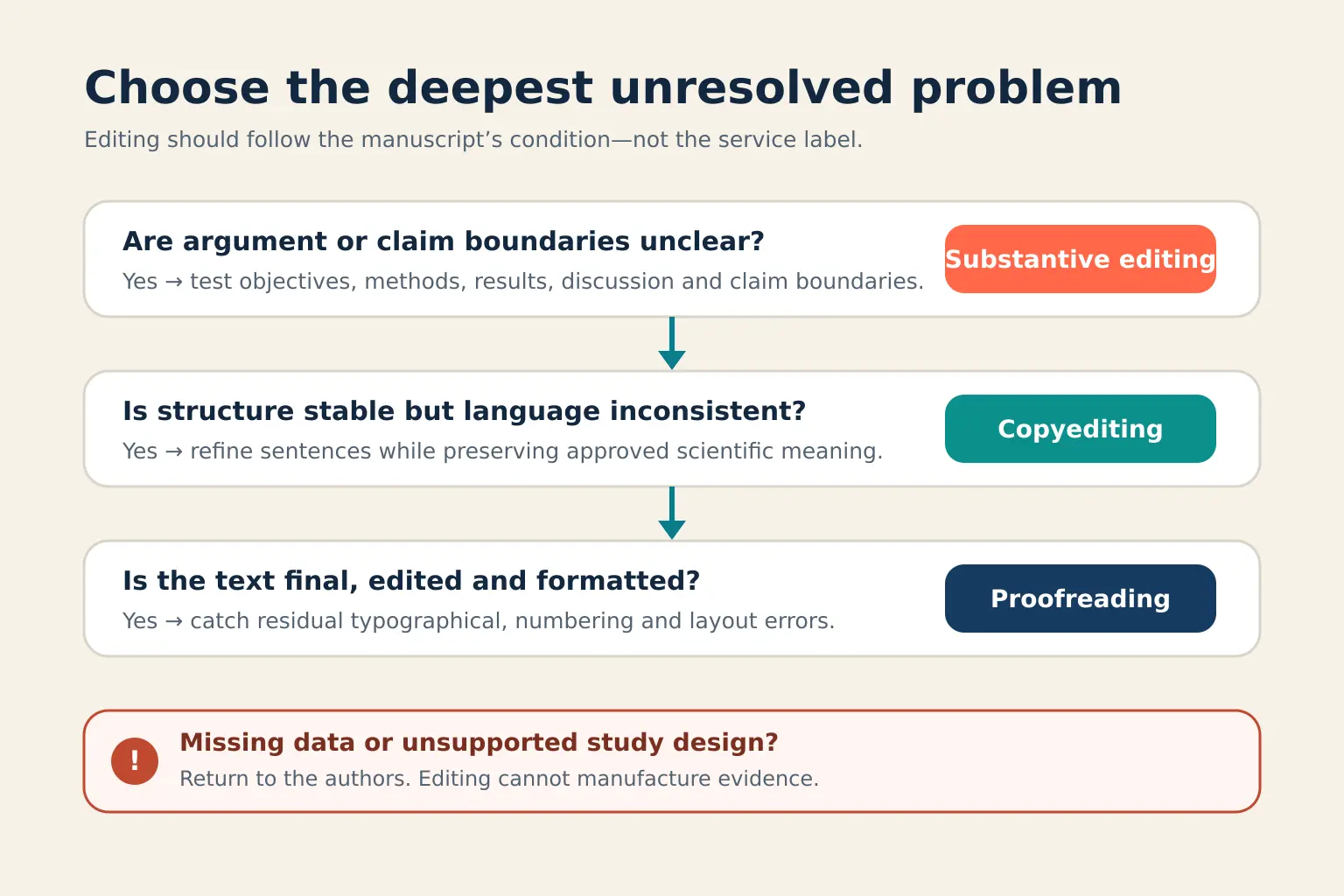
Substantive editing is needed when a research paper has problems with argument, organisation, scientific logic or section alignment. Copyediting is appropriate when the structure is sound but sentences, terminology, grammar and style need correction. Proofreading belongs at the final stage, after editing and formatting, when the task is to catch residual errors without making major changes. Diagnose the manuscript before purchasing or beginning an edit.
The distinction matters because each editing level assumes that an earlier level of work is already stable.
Why researchers often select the wrong editing service
Editing terms are used inconsistently. One provider may call a service “advanced proofreading” while another calls similar work “language editing.” Even professional definitions allow some overlap. The Chartered Institute of Editing and Proofreading explains that copyediting can include querying, rewriting or limited restructuring depending on the quality of the original. This flexibility is useful, but it also means that the service name alone cannot define the scope.
Researchers should therefore ask two questions:
- What is the deepest unresolved problem in the paper?
- At what stage is the manuscript?
If the deepest problem is logical, structural or interpretive, sentence correction is premature. If the manuscript has already been accepted and typeset, substantive rewriting is normally too late. The editing decision must follow the document’s condition, not the attractiveness of a service label.
What substantive editing changes
Substantive editing works above the sentence level. It examines whether the paper forms a defensible path from problem to conclusion.
For a research manuscript, this may include checking whether:
- the introduction establishes a specific unresolved problem;
- the objective follows from that problem;
- the methods can answer the objective;
- the results are organised around the research questions;
- the discussion explains rather than repeats the findings;
- comparisons with previous studies are fair;
- limitations are visible; and
- the conclusion stays within the evidence.
Consider a paper that states an objective to assess the performance of a water-treatment material under realistic conditions. The methods report only batch tests in a single-solute synthetic solution. The language may be excellent, but the objective and evidence do not align. A substantive editor should flag the mismatch. The author may narrow the objective, add justified evidence, or explain the study boundary. An editor should not invent the missing experiment or silently rewrite the claim as if the problem does not exist.
Substantive editing can also move paragraphs, combine repetitive sections, recommend a different argument order and identify places where a claim lacks support. These changes require author judgement because they affect meaning.
What copyediting changes
Copyediting begins when the argument and section structure are substantially stable. Its purpose is to make the existing meaning accurate, clear and consistent at sentence and document level.
A research-paper copyedit commonly addresses:
- grammar, syntax and punctuation;
- unclear or unnecessarily complicated sentences;
- consistent technical terminology;
- abbreviations and symbols;
- units, numbers and nomenclature;
- heading hierarchy;
- table and figure references;
- citation and reference consistency;
- journal style requirements; and
- obvious contradictions that require an author query.
Copyediting is not only about making English “sound better.” A change from “significant” to “statistically significant,” for example, alters scientific meaning unless a statistical test supports it. A responsible copyeditor queries such language rather than improving it cosmetically.
The same applies to cause-and-effect wording. If a study shows association, changing “was related to” into “caused” is not stylistic polishing. It is a new claim. Technical copyediting must preserve that boundary.
What proofreading changes
Proofreading is the last quality-control stage. It should be performed on the near-final manuscript, ideally after the target journal’s formatting and after all substantial editing decisions are complete.
Proofreading checks for residual defects such as:
- typographical errors;
- missing words or duplicated text;
- inconsistent punctuation or capitalisation;
- incorrect cross-references;
- spacing and line-break problems;
- mismatched table or figure numbering;
- formatting inconsistencies; and
- errors introduced during layout or file conversion.
Proofreading does not normally reorganise the discussion, rewrite the abstract or challenge the experimental design. If those actions become necessary, the manuscript has returned to an earlier editing stage.
This is why proofreading an unstable draft often wastes effort. Large revisions made later can introduce new errors and remove many of the corrections already paid for.
Comparison: substantive editing vs copyediting vs proofreading
| Question | Substantive editing | Copyediting | Proofreading |
|---|---|---|---|
| Main focus | Argument, structure and scientific coherence | Sentence clarity, correctness and consistency | Final surface and production errors |
| Best time | After a complete draft, before language polishing | After structure and meaning are stable | After editing and final formatting |
| May move sections? | Yes, with author review | Occasionally, on a limited scale | Normally no |
| May query unsupported claims? | Yes, as a central task | Yes, when noticed | Only if an obvious error remains |
| Handles journal style? | Broad structural fit | Detailed style consistency | Final compliance check |
| Author involvement | High | Moderate | Low, except for queries |
| Cannot solve | Missing research or data | Fundamental design and logic problems | Structural or language problems |
The final row is the most important. No editing service can create evidence that the study did not produce.
A five-minute manuscript diagnosis
Use the following test before requesting a service. Read the paper once without correcting grammar.
Test 1: Can you state the evidence chain in five sentences?
Complete these statements:
- The known problem is …
- This study asked …
- We tested it by …
- The main evidence shows …
- Therefore, within these limits …
If these statements do not connect, begin with substantive editing.
Test 2: Do sections perform different jobs?
If the Results section repeatedly explains why findings occurred, or the Discussion simply repeats numbers, the paper needs structural work. Our guide to Results versus Discussion (opens in a new tab) provides a practical section boundary.
Test 3: Does the paper remain clear when read aloud?
If the logic is sound but sentences are difficult, inconsistent or grammatically distracting, copyediting is likely the main need.
Test 4: Has the text stopped changing?
If co-authors are still adding paragraphs, replacing tables or revising conclusions, do not proofread yet. Complete the revisions and copyedit first.
Test 5: Is the manuscript already accepted or in final proofs?
At this stage, use proofreading and follow the journal’s rules about allowable changes. Do not introduce broad revisions without editorial approval.
When a research paper needs more than one level
Many manuscripts need a sequence rather than one service. A practical workflow is:
- Author revision: complete the study narrative and resolve co-author comments.
- Substantive edit: test problem–objective–method–result–conclusion alignment.
- Author decision: accept, reject or adapt structural recommendations.
- Copyedit: correct and standardise the approved text.
- Journal formatting: apply target instructions and generate the final files.
- Proofread: inspect the submission version and final cross-references.
For a strong draft, steps two and four may be combined in a clearly defined manuscript edit. For a difficult draft, separating them is safer because sentence-level work should follow the author’s structural decisions.
What an ethical editor should and should not do
An editor can identify unclear logic, propose alternative wording, query unsupported statements and explain why a section is not working. The researcher must remain responsible for the study, interpretation, citations and final text.
The editor should not:
- create results;
- add citations without author verification;
- decide what the data mean on the author’s behalf;
- conceal a methodological limitation;
- guarantee acceptance; or
- become an unacknowledged intellectual author.
This boundary protects both the manuscript and the researcher. It also follows the principle behind ethical academic content support (opens in a new tab): assistance may improve communication, but responsibility cannot be outsourced.
Prepare a useful editing brief
Before sending the manuscript, provide:
- the target journal and author guidelines;
- current manuscript stage;
- decision letter or reviewer comments, if applicable;
- the deepest problem you already recognise;
- required English variant and referencing style;
- deadline and planned submission date; and
- any sections that must not be changed without discussion.
Ask the editor to describe the proposed scope using actions, not only labels. “We will examine section alignment, argument flow and claim boundaries” is more informative than “premium editing.” Request a short sample when the scope is uncertain.
Practical conclusion
Choose the editing level according to the deepest unresolved manuscript problem. Use substantive editing for structure and reasoning, copyediting for clear and consistent expression, and proofreading for final error detection. When several levels are required, complete them in that order.
A polished manuscript is useful only when the argument underneath it is stable. Diagnose first, then edit.
BridgeHelix Media provides PhD-led research manuscript editing (opens in a new tab) and academic editing and research support (opens in a new tab) for STEM researchers who need a clear diagnosis, structural guidance and language refinement while retaining full authorship and responsibility for the research.
Sources

About the author
Dr. Prakash Kumar Singh
Founder & Technical Content Strategist
PhD in Chemical Engineering from MNIT Jaipur, with M.Tech and B.Tech qualifications in Biotechnology. His work connects technical evidence with clear B2B communication and ethical research support.