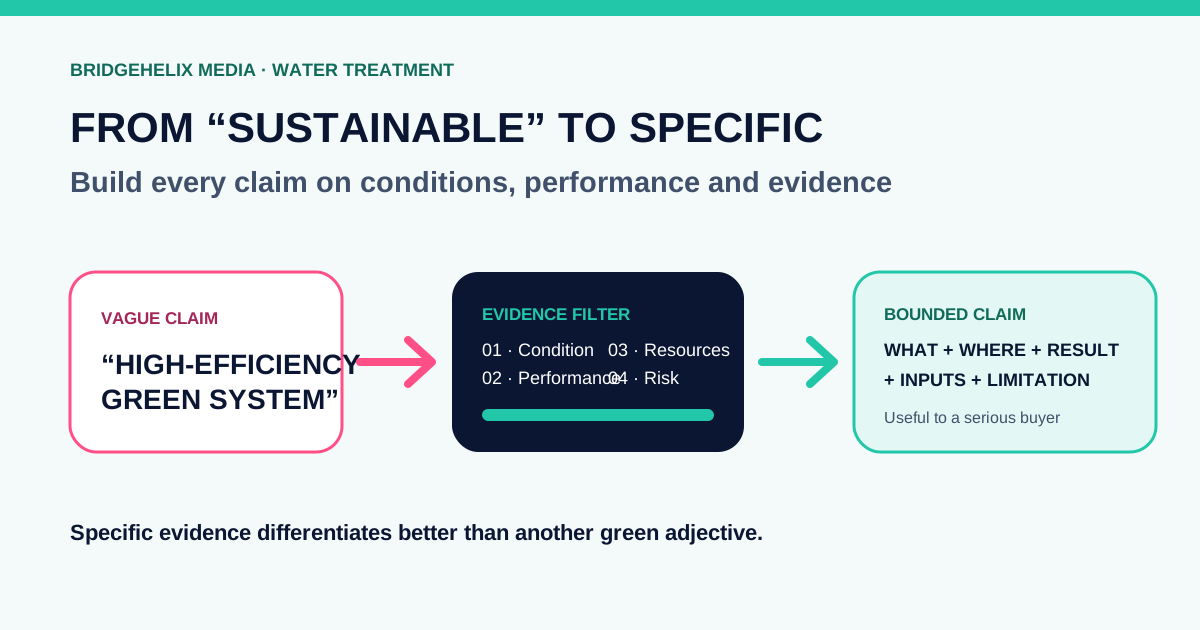
The water sector has a genuine sustainability story. Treatment protects health, supports industrial reuse, reduces pollutant discharge and can recover water, energy or materials. Yet this importance makes vague marketing more common, not less.
Technology pages frequently promise:
- sustainable water treatment;
- zero chemical operation;
- high removal efficiency;
- low-energy performance;
- circular wastewater management;
- scalable and cost-effective treatment.
Each statement may contain a defensible idea. None is sufficiently precise to support a technical buying decision.
Where content fits in digital marketing for water treatment
Digital marketing for water treatment companies can include search, email, paid campaigns and professional networks. Content gives those channels something useful to deliver: an application page that explains treatment conditions, a comparison that acknowledges limitations, or a pilot report that supports a scale-up decision. Increasing traffic to an unclear product page leaves the central buyer question unanswered.
Start with a defined application and audience. A plant engineer may need feed-water characteristics, operating constraints and maintenance implications; a procurement reviewer also needs scope, evidence and a clear route to a technical discussion. Build the water-treatment content around those decisions, then connect articles to the relevant service or application page with descriptive links.
A practical sequence is to clarify the product page, develop an evidence-led comparison, and publish a water treatment pilot test report that records conditions and limitations. Measure qualified enquiries alongside clicks and impressions. Search visibility alone does not establish that the right buyers are finding enough evidence to act.
Why generic green language weakens a serious technology
Broad environmental claims create three problems.
First, they remove the conditions that determine performance. A technology may achieve high removal in synthetic water but respond differently to variable industrial effluent.
Second, they combine different environmental effects into one positive adjective. Lower chemical use does not automatically mean lower energy, lower residual generation or lower life-cycle impact.
Third, they make the company sound similar to every competitor. If every membrane, reactor, adsorbent and monitoring platform is sustainable and innovative, the words stop differentiating anything.
Regulatory guidance also treats broad claims cautiously. The UK Competition and Markets Authority’s guidance on environmental claims (opens in a new tab) states that general terms such as green, sustainable and eco-friendly are more likely to mislead when their meaning and evidence are unclear.
The practical response is not to stop communicating environmental value. It is to make the claim specific enough to test.
Start with the treatment condition
Water-treatment performance has no useful meaning without context.
At minimum, content should identify the relevant condition:
- water or wastewater source;
- target contaminant;
- influent concentration or loading;
- relevant competing constituents;
- pH, temperature or salinity where important;
- batch, continuous or in-line operation;
- flow, residence time or treatment duration;
- target standard or process requirement.
Compare these statements:
Weak:
Removes up to 99% of contaminants.
Stronger:
In pilot tests treating the specified industrial rinse water, the system reduced dissolved metal X from the stated influent range to below the project discharge target at a flow of Y.
The stronger statement is longer, but it answers the questions a technical reader will ask. It can also be shortened responsibly:
Pilot-tested metal removal for variable industrial rinse water.
The supporting page can then provide the complete test condition and result.
The four-part claim–evidence model
The BridgeHelix model tests a water-treatment claim through four connected elements: condition, performance, resources and risk. A publishable marketing claim sits at the centre only after all four have been considered.
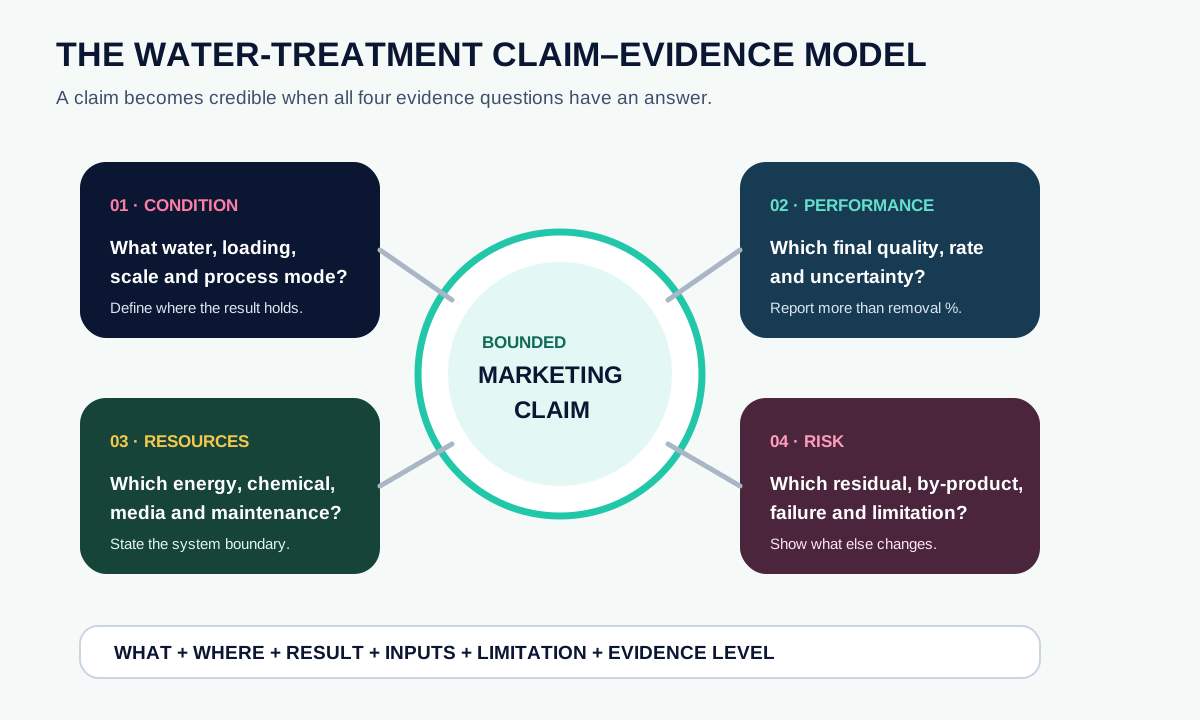
1. Condition: where was the claim demonstrated?
The same technology can behave differently in:
- deionised water;
- synthetic single-contaminant water;
- synthetic multi-ion water;
- groundwater;
- municipal wastewater;
- industrial effluent;
- concentrated reject streams.
The matrix may contain organics, suspended solids, salts, microorganisms and competing ions. Temperature and loading may vary. Content should not allow a result from one matrix to imply proven performance in all others.
This distinction is particularly important for early-stage technologies. Laboratory results are valuable. They demonstrate feasibility and help identify mechanisms. The content should present them as laboratory results, not hide the scale behind the word validated.
2. Performance: which outcome matters?
Removal percentage is easy to understand but can be misleading when used alone.
If influent fluoride decreases from 10 mg/L to 1 mg/L, removal is 90%. If it decreases from 2 mg/L to 0.2 mg/L, removal is also 90%. The operational significance depends on the application, target limit, measurement reliability and water composition.
Depending on the technology, meaningful performance measures may include:
- final contaminant concentration;
- mass removed per unit material or energy;
- recovery percentage;
- flux and rejection;
- breakthrough time;
- log reduction;
- hydraulic capacity;
- selectivity;
- uptime;
- sensor accuracy and detection limit;
- performance after regeneration or repeated cycles.
State both the headline and the decision-relevant metric. “95% removal” attracts attention. “Final concentration below X under Y conditions” helps evaluation.
3. Resources: what does the result require?
A treatment outcome is produced through inputs. Content should identify the ones that materially affect adoption:
- electrical energy;
- chemicals and regenerants;
- replacement media;
- water used for cleaning;
- pressure;
- footprint;
- labour and monitoring;
- pretreatment;
- consumables;
- maintenance frequency.
“Chemical-free” deserves special caution. A process may avoid treatment chemicals during normal operation while requiring chemicals for membrane cleaning, media regeneration, pH control or upstream conditioning. If the claim applies only to one stage, say so.
Likewise, “low energy” needs a basis:
- energy per cubic metre;
- energy per mass removed;
- comparison with which alternative;
- at which recovery, pressure or water quality;
- whether pumping, aeration and ancillary equipment are included.
The content does not need to publish confidential economics. It should avoid a claim that cannot be bounded.
4. Risk: what else changes?
Removing a contaminant does not eliminate matter. It may transfer, concentrate, transform or destroy it.
The practical risk questions include:
- What residual is produced?
- Can the contaminant desorb or leach?
- Are by-products formed?
- How is spent media handled?
- Does treatment change pH, salinity or other water-quality parameters?
- Does biological activity create sensitivity to shock loads?
- What happens during failure or breakthrough?
This is where environmental engineering content becomes more credible than promotional copy. It shows that the company understands the system around the performance number.
Label the evidence level accurately
Water technologies move through different evidence stages.
| Evidence level | What it can support | What it cannot establish alone |
|---|---|---|
| Controlled laboratory test | Mechanism and feasibility under defined conditions | Long-term field reliability |
| Bench continuous test | Flow behaviour and early operational response | Site variability and full-scale economics |
| Pilot in relevant water | Performance under more realistic conditions | Repeatability across every site |
| Independent verification | Performance against a defined protocol and claim | Universal suitability outside the verified scope |
| Full-scale operating record | Reliability and outcomes in a real installation | Identical performance in a different application |
The European Commission describes Environmental Technology Verification (opens in a new tab) as third-party evaluation of performance claims using internationally certified methods. The US EPA’s earlier Environmental Technology Verification programme (opens in a new tab) had a similar purpose: credible performance data for buyers, permitters and technology users.
Verification is not a decorative badge. Its value comes from the defined claim, protocol, conditions and result.
Turn technical evidence into useful content types
One dataset can support several assets, but each should answer a different reader question.
Application page
Question:
Does this technology apply to my water, contaminant and operating situation?
Include:
- target application;
- input conditions;
- process role;
- integration needs;
- performance range;
- next evaluation step.
Technical article
Question:
Why does performance change under different conditions?
Explain mechanism, variables, comparisons and limitations. This is where scientific content writing can translate evidence without flattening it.
Case study
Question:
What happened at one site or during one project?
State baseline, intervention, period, result, operational learning and site-specific limits.
White paper
Question:
How should a technically informed buyer understand the problem, alternatives and evidence?
Provide context, comparison, methods, complete reasoning and implementation considerations.
SEO article
Question:
What is the reader already trying to understand or compare?
Answer the query directly, then connect it to conditions and evidence. Water-treatment SEO should not force a commercial page into an educational keyword. The article must remain useful even before the reader considers the service.
Write for a buying group, not one imaginary reader
Water-treatment decisions involve several perspectives.
| Reader | Main question |
|---|---|
| Process engineer | Will it work with this feed and flow? |
| Plant operator | How stable and maintainable is it? |
| Environmental manager | Will it meet the required limit and reporting need? |
| Finance or procurement | What resources, replacements and risks affect cost? |
| Executive | Does it reduce a material operational or compliance problem? |
| Regulator or consultant | Is the performance claim adequately demonstrated? |
The message should not change the facts for each audience. It should change the order and depth.
An executive summary may lead with avoided discharge risk. The technical page explains operating conditions. The evidence document provides methods and results. All three should describe the same evidence boundary.
Compare technologies fairly
A comparison page can attract valuable search intent, but oversimplified winner tables damage credibility.
Compare technologies using a shared basis:
- target contaminant and concentration;
- final water-quality requirement;
- flow and recovery;
- pretreatment;
- chemical and energy boundary;
- residual management;
- maturity and evidence level;
- site constraints.
For example, adsorption may be attractive for a specific dissolved contaminant at moderate concentration, but spent-media management and competition can become important. Membrane treatment may achieve broad separation, while concentrate handling and energy affect the system boundary. Biological treatment may reduce chemical demand, while sensitivity and start-up time matter.
The purpose is not to make every alternative look equal. It is to show why one option fits a particular condition.
Replace adjectives with claim records
Before approving a marketing statement, create a short claim record:
| Field | Question |
|---|---|
| Claim | What exactly are we saying? |
| Scope | Which product, process stage or application does it cover? |
| Evidence | Which test, dataset or source supports it? |
| Condition | Under what operating conditions? |
| Comparison | What is the baseline, if a comparative term is used? |
| Limitation | Where should the claim not be extended? |
| Owner | Who can verify the technical accuracy? |
| Review date | When should the claim be checked again? |
This simple record helps marketing, technical and legal reviewers discuss the same statement. It also makes future content updates easier when new pilot or full-scale evidence becomes available.
An example of responsible claim development
Initial claim:
A sustainable, chemical-free system that eliminates nitrate from water.
Questions reveal that the system:
- uses electrically driven separation;
- requires no dosing chemical during the separation step;
- was tested on defined synthetic and groundwater samples;
- concentrates nitrate in a reject stream;
- has pilot energy measurements but no completed life-cycle assessment.
Revised claim:
Electrically driven nitrate separation without chemical dosing during normal treatment, demonstrated on defined groundwater samples. Pilot evaluation includes energy demand and reject-stream management.
The revised statement is less dramatic. It is also more informative, defensible and useful to a serious buyer.
It does not call the entire system chemical-free. It does not imply destruction when nitrate is concentrated. It distinguishes demonstration from ongoing pilot evaluation.
Practical conclusion
Water-treatment marketing becomes stronger when environmental value is connected to conditions, performance, resources and risk. The resulting content may use fewer broad adjectives, but it gives technical and commercial readers more reasons to trust the company.
The objective is not to place every experimental detail in the headline. It is to maintain a traceable path from the headline claim to the evidence, boundary and next validation step.
BridgeHelix Media develops scientific content for water-treatment and environmental-engineering companies that need to explain performance, mechanisms and environmental value without generic sustainability language or unsupported claims.
When a prospect asks whether laboratory findings transfer to their plant, use a water-treatment pilot test report to organise operating conditions, sampling and scale-up questions. The resulting evidence can support water-treatment content writing without turning a pilot result into a universal performance claim.
If you want a low-risk first step, request a scoped 1-page technical messaging diagnostic for one existing product page, service page or datasheet.
Sources

About the author
Dr. Prakash Kumar Singh
Founder & Technical Content Strategist
PhD in Chemical Engineering from MNIT Jaipur, with M.Tech and B.Tech qualifications in Biotechnology. His work connects technical evidence with clear B2B communication and ethical research support.