
Industrial water treatment companies often have a strong technical story. They may have a new adsorbent, membrane configuration, oxidation process, biological system or monitoring platform supported by years of development. Still, their website may not create serious buyer interest.
The usual explanation is that the market does not understand the technology. This is only partly correct.
In many cases, the website explains the technology but does not explain the decision. It reports removal efficiency, flux, residence time, adsorption capacity or reactor conditions without showing what these results mean for an operating plant. A technical buyer can see the data but still cannot judge whether the proposed system is suitable, economical or safe to adopt.
This is where industrial water treatment marketing differs from general marketing. The message has to connect process performance with the water matrix, plant objective, operating cost, compliance requirement and risk of implementation. If any of these links is missing, more technical detail may increase the length of the page without increasing buyer confidence.
Why a technically correct website can still fail
A treatment-technology page may state that a process achieves 95% contaminant removal. The number looks impressive, but its decision value depends on several conditions:
- What was the initial contaminant concentration?
- Was the test conducted in synthetic water or actual industrial wastewater?
- Which competing ions, suspended solids or organic compounds were present?
- What dose, pressure, pH, temperature and contact time were required?
- Was the result obtained in a batch test, a continuous pilot or a full-scale installation?
- What happened to the contaminant after separation?
- How stable was the performance over repeated cycles?
Without this context, the buyer is left to interpret the strongest result as though it applies universally. Experienced technical readers will not normally accept that assumption. They may also become more cautious about the other claims on the page.
The opposite problem also occurs. Some websites provide a complete process description before establishing why the process matters. The visitor encounters media chemistry, reactor design and instrumentation details before learning whether the system addresses discharge compliance, water reuse, product quality, chemical consumption or an unstable existing treatment step.
The technology is being described from the developer's point of view. The buyer, however, begins with an operating consequence.
Industrial water treatment buyers are not one audience
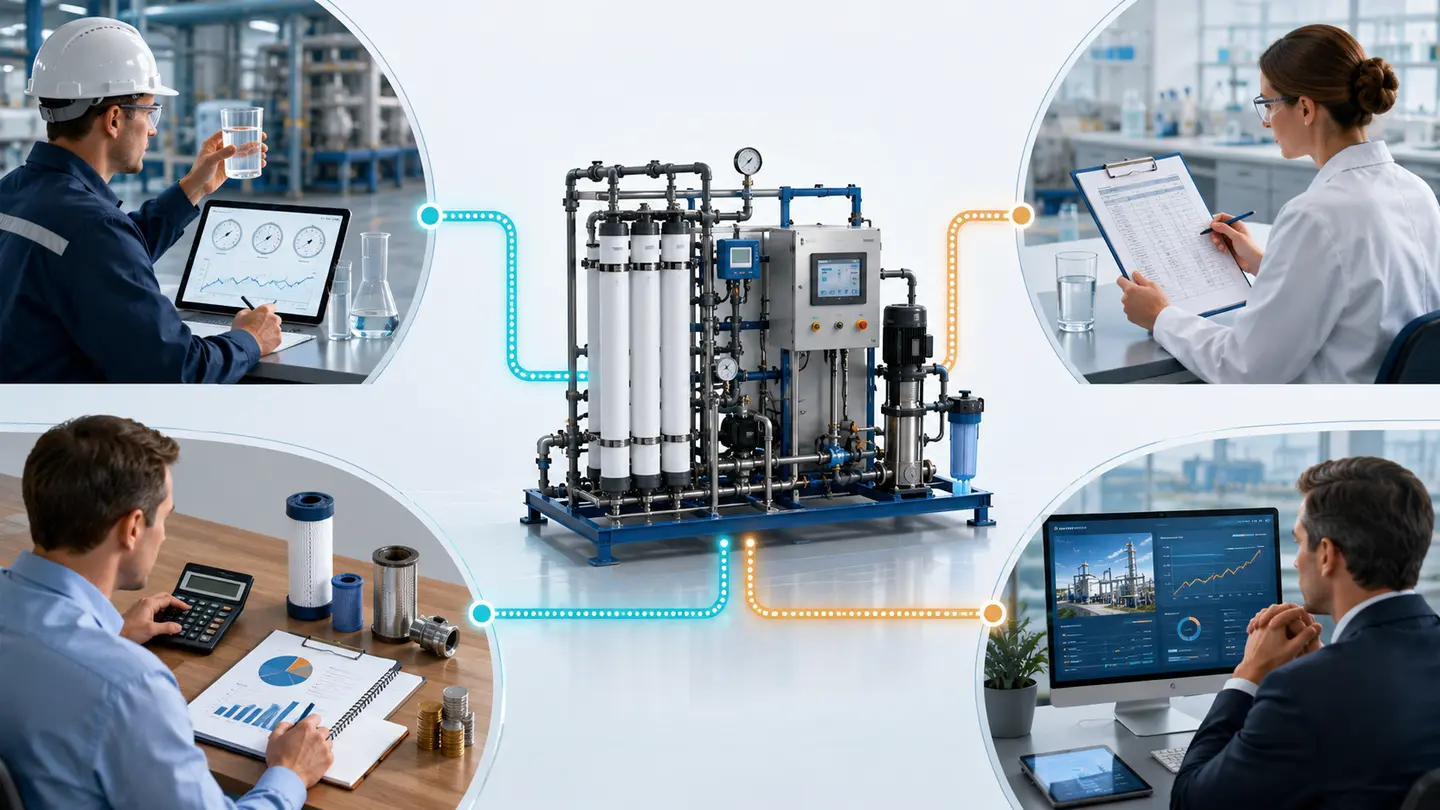
A B2B water treatment decision is rarely made by one person. The same project may be examined by a plant engineer, environmental or EHS manager, procurement officer, finance team and senior management. They are connected to the same treatment problem, but they do not evaluate it in the same way.
The plant engineer may ask whether the system can handle flow variation, shock load, fouling and integration with the existing treatment train. The environmental team may focus on discharge limits, monitoring, residuals and reporting. Procurement may compare consumables, supplier reliability, service support and replacement frequency. Management may want to know the cost of delay, effect on production and probability of avoiding a compliance or capacity problem.
This does not mean that a company needs five unrelated versions of the truth. It needs a layered explanation.
The first layer establishes the problem, application and practical value. The next layer explains the mechanism and operating basis. Evidence, limitations, comparison and detailed data follow where specialist readers can inspect them. This structure allows commercial readers to understand why the system matters without preventing engineers from examining how it works.
Translate process parameters into decision evidence
Technical data should not be removed. It should be interpreted. A useful page explains the relationship between a result and the decision the result can support.
| Technical information | What must be added | Why the buyer needs it |
|---|---|---|
| Removal percentage | Initial and final concentration, water matrix and endpoint | To determine whether the result reaches the required discharge or reuse target |
| Adsorption capacity | Test system, equilibrium conditions, competing ions and regeneration basis | To estimate whether laboratory capacity is relevant to field operation |
| Membrane flux | Pressure, temperature, recovery, fouling behaviour and cleaning requirement | To judge energy demand, productivity and maintenance burden |
| Reactor residence time | Flow range, loading variation and scale | To understand footprint, throughput and process stability |
| Chemical dose | Chemical identity, feed variability, residuals and sludge generation | To estimate operating cost and downstream handling |
| Pilot result | Duration, feed characteristics, control strategy and unresolved risks | To judge how much scale-up evidence already exists |
This interpretation is particularly important in water treatment because performance changes with the feed. A material that performs well in a single-solute laboratory solution may behave differently in actual wastewater containing several ions, suspended matter and organic compounds. A buyer who has experienced fouling, breakthrough or variable influent quality will look for this distinction immediately.
A water treatment content writing (opens in a new tab) strategy should therefore treat operating conditions as part of the message, not as technical material that belongs only in a data sheet.
Explain commercial ROI without inventing a savings claim
Many water treatment websites move from process performance to a broad promise such as lower cost, improved sustainability or rapid payback. The problem is not the commercial language itself. The problem is that the calculation basis is absent.
A credible economic argument begins with the current process and defines what will change. Depending on the application, the relevant cost categories may include:
- capital equipment and installation;
- energy consumption;
- treatment chemicals;
- membrane, media or catalyst replacement;
- cleaning and regeneration;
- sludge, brine or spent-media handling;
- operator time and maintenance;
- laboratory analysis and monitoring;
- sewer or discharge charges;
- freshwater purchase and reuse value;
- downtime, rejected production or restricted plant capacity.
The company does not need to publish a universal payback period. In fact, it should not do so when influent conditions, local energy prices, disposal routes and production constraints vary significantly.
A better approach is to show the calculation framework. For example:
At the stated flow and contaminant load, the process is expected to reduce chemical consumption by X under the defined operating assumptions. The final operating cost will also depend on energy, residual handling, maintenance and local disposal charges. A site-specific assessment is required before estimating payback.
This wording is commercially useful because it shows where value may arise while preserving the conditions needed to verify it. It also gives the buyer a sensible next step: provide site data for an application review.
The older assumption that technical buyers are interested only in performance and commercial buyers only in price is not helpful. A technically unsuitable process is expensive at any price, while a technically strong process with an unclear cost basis is difficult to approve.
Make regulatory relevance specific
Compliance is often included in water treatment marketing as one sentence: “helps customers meet regulatory requirements.” This statement is too broad to create confidence.
The applicable requirement depends on the industry, pollutant, discharge route, location and permit. In the United States, for example, the Environmental Protection Agency explains that industrial effluent guidelines are national, technology-based standards for wastewater discharges and are developed for specific industrial categories. Pretreatment standards also apply to defined indirect discharges to publicly owned treatment works. The details therefore cannot be reduced to one general compliance claim. See the EPA overview of industrial effluent guidelines (opens in a new tab) and its explanation of categorical pretreatment standards (opens in a new tab).
A useful page should identify the regulatory job the treatment step is intended to support. It may be designed to reduce a particular pollutant, stabilise effluent quality, support water reuse, improve monitoring or help an existing treatment train operate within a permit condition.
The wording should also preserve responsibility. A technology provider can explain relevant treatment performance and supply evidence, but site compliance depends on the complete process, operating control, sampling method and applicable legal requirements. Final regulatory claims should be reviewed by the responsible environmental or legal professional.
Specificity builds more trust than a universal promise.
Separate laboratory potential from field performance
New water-treatment technologies often begin with strong laboratory results. These results matter, but they answer a different question from a pilot or full-scale study.
A clear evidence ladder can be presented as follows:
- Mechanism evidence: Why the treatment interaction is expected to occur.
- Controlled laboratory evidence: Performance under defined batch or bench conditions.
- Relevant-matrix evidence: Performance with actual or representative industrial water.
- Continuous or pilot evidence: Behaviour over time under realistic flow, loading and control conditions.
- Full-scale evidence: Reliability, operating cost, maintenance and compliance performance at site level.
Each level adds something that the previous level cannot prove. A high equilibrium adsorption capacity does not by itself establish column breakthrough time. A successful short pilot does not establish years of media life. A full-scale installation in one water matrix may not transfer directly to another.
Stating these limits does not weaken the technology. It shows the buyer that the company understands scale-up. This is particularly valuable for newer cleantech companies, where a serious buyer is already trying to determine which risks have been resolved and which remain open.
Build the page around the buyer's decision sequence
A practical industrial water treatment page can follow this order:
1. Define the application problem
Name the industry, water source, target contaminant or operating constraint. “Advanced water treatment” is not a sufficient problem definition.
2. State the relevant outcome
Explain whether the objective is discharge control, reuse, recovery, process-water quality, capacity expansion or stabilisation of an existing treatment step.
3. Explain the treatment mechanism
Describe how the process works at the level needed to establish technical difference. Avoid beginning with every design detail.
4. Present evidence with its conditions
Report the water matrix, scale, operating range, measurement basis, duration and important limitations. Separate laboratory, pilot and field results.
5. Connect performance to operating economics
Show which cost categories are expected to change and which site data is needed for an estimate.
6. Explain compliance relevance carefully
Identify the pollutant or treatment objective without promising universal compliance.
7. Offer a proportionate next step
For a complex system, “buy now” is rarely appropriate. A better step may be a water analysis, application review, pilot discussion, process audit or total-cost assessment.
This sequence can be applied across product pages, technical articles, case studies and white papers. A technical messaging audit (opens in a new tab) can identify where the current website breaks this sequence and where evidence is present but not connected to buyer value.
A practical audit for water treatment content
Before publishing or revising a page, ask the following questions:
- Can the intended industry and water problem be identified in the first screen?
- Does each performance number include the conditions needed to interpret it?
- Is the evidence labelled as laboratory, relevant-matrix, pilot or full scale?
- Are competing ions, fouling, residuals, regeneration and waste handling discussed where relevant?
- Can the plant engineer understand integration and operating requirements?
- Can procurement identify the major consumables, service needs and supplier dependencies?
- Is the economic claim based on a visible calculation framework?
- Is regulatory relevance stated without giving an unsupported guarantee?
- Does the page compare the technology with the current approach on consistent criteria?
- Is the next step appropriate to the evidence and buying stage?
If several answers are no, the problem is not simply copywriting. The technical and commercial logic of the page has not yet been connected.
Practical conclusion
Industrial water treatment marketing should not choose between technical depth and commercial relevance. A serious buyer needs both.
Reactor parameters, removal percentages and material properties establish how a technology behaves. Operating cost, residual handling, compliance relevance and implementation risk establish whether the technology belongs in a plant. The website has to connect these two levels without overstating what the evidence can support.
This is the main correction many technically strong water-treatment companies need. Do not remove the science. Put it in the order of the buyer's decision and explain what each result means under real operating conditions.
BridgeHelix Media provides PhD-led technical content writing (opens in a new tab) and technical messaging support for water-treatment and process-driven companies that need to connect performance evidence with practical buyer value.
If you want a low-risk first step, request a scoped 1-page technical messaging diagnostic for one existing product page, service page or datasheet.
Frequently asked questions
What is industrial water treatment marketing?
Industrial water treatment marketing explains treatment technologies, equipment and services to business buyers such as manufacturers, utilities, engineering teams and environmental managers. Unlike residential water marketing, it must address process conditions, integration, compliance, operating cost and evidence maturity.
Why do water treatment websites fail to generate qualified leads?
Many pages describe the technology but do not help a buyer evaluate fit. They may omit the water matrix, evidence scale, operating requirements, cost basis or compliance relevance. The visitor therefore has information but not enough decision confidence to start a serious conversation.
Should a water treatment company publish detailed technical data?
Yes, when the data is presented with the conditions needed to interpret it. Important context may include influent concentration, pH, flow, temperature, competing ions, test scale, duration and measurement method. Sensitive proprietary details can remain protected while still providing a defensible evidence basis.
How can a company discuss ROI before receiving site data?
It can publish a transparent cost framework and explain which inputs determine the result. Energy, chemicals, consumables, sludge disposal, maintenance, monitoring, water reuse and downtime may all be relevant. A site-specific estimate should follow once actual operating data is available.
What content works best for B2B water treatment buyers?
Application pages, process comparisons, technical case studies, operating guides and evidence-led white papers are particularly useful. The right format depends on whether the buyer is discovering a problem, comparing approaches, validating performance or preparing a procurement decision.
Sources

About the author
Dr. Prakash Kumar Singh
Founder & Technical Content Strategist
PhD in Chemical Engineering from MNIT Jaipur, with M.Tech and B.Tech qualifications in Biotechnology. His work connects technical evidence with clear B2B communication and ethical research support.