
Simplification changes the route, not the conclusion
A scientific explanation can be difficult for two very different reasons. The subject itself may be complex, or the explanation may make the reader carry more information than is needed at that moment. Simplification should solve the second problem. It should not pretend that the first problem does not exist.
Consider a visit to a doctor. A patient usually does not need a complete biochemical pathway before understanding what is wrong and what the treatment is expected to do. However, the doctor still needs to explain the diagnosis, the purpose of the medicine, the important risks and the conditions under which the advice applies. Removing the biochemical detail can improve communication. Removing the risk or changing a probability into a certainty would change the meaning.
The same rule applies to scientific content writing. A writer can change the order, explain a technical term and move specialist detail into a second layer. The scientific conclusion should remain the same strength before and after editing.
Start with the question the reader is trying to answer
Specialists often introduce a subject through its theory, history and terminology. That sequence makes sense inside a paper or technical report because the reader has already chosen to study the subject. A website visitor may first need to know why the subject matters.
For example, an engineer reading about a new adsorbent may want to know which contaminant it targets, under what water conditions it was tested and whether the reported capacity came from a batch or continuous system. Starting with those questions does not weaken the science. It gives the later explanation a clear purpose.
This is also why a simple definition is often not enough. Saying that adsorption is the accumulation of a substance on a surface is correct, but it does not yet explain why pH, competing ions, contact time or surface chemistry can change performance. The writer needs to show the relationship between the term and the result the reader is evaluating.
Decide which details control interpretation
Some technical details can be shortened without affecting the conclusion. A complete instrument model number may be unnecessary in a general article. The sample type, comparison, concentration range or test environment may be essential because these details determine what the result can support.
A useful editorial test is straightforward: if removing a detail could make a careful reader reach a different conclusion, keep the detail. It may be moved into a note, caption, table or deeper section, but it should not disappear.
The distinction is especially important when commercial content is built from research. A laboratory result under controlled conditions is evidence of laboratory performance. It is not automatically evidence of field reliability, scale-up economics or universal effectiveness. A shorter explanation must preserve that boundary.
Use a four-part meaning check
Before publishing, check whether the simpler explanation still contains four connected parts: the main idea, the mechanism needed to understand it, the conditions of the evidence and the limitations that affect use.
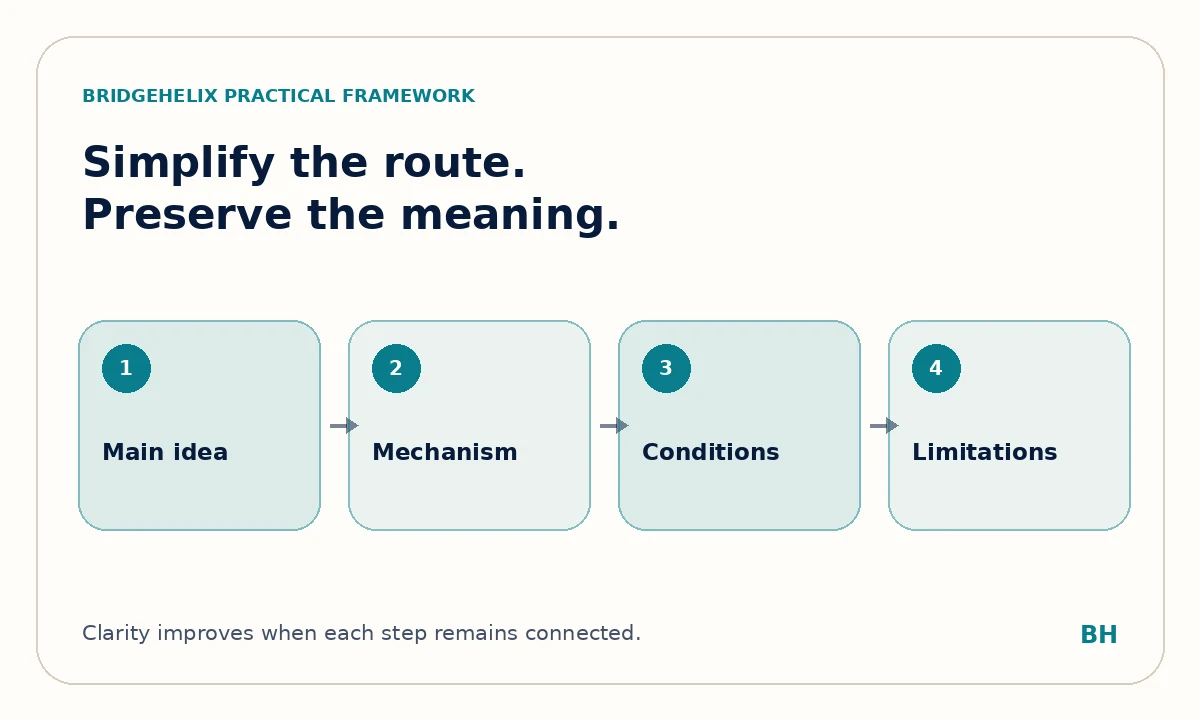
The main idea tells the reader what happened or what the technology is intended to change. The mechanism explains why that result is plausible. The conditions show where the evidence came from. The limitation prevents a useful observation from becoming a claim that the evidence cannot defend.
Not every sentence needs all four parts. The page as a whole should make them available in a logical sequence. A reader may first see the main idea, then open the mechanism section and finally check the evidence note. This is layered communication, not hidden qualification.
Analogies should open the subject, not replace it
An analogy gives the reader an initial mental model. It becomes risky when the convenient image is treated as the complete mechanism.
Adsorption may be compared with material collecting on a surface. That can help someone distinguish adsorption from absorption. But the analogy does not explain surface charge, chemical interaction, equilibrium or competition between ions. A responsible explanation uses the analogy as an entry point and then states where the real process becomes more specific.
The same applies to software, biotechnology and process engineering. A cybersecurity control may be compared with a gate, but a gate does not explain identity, authorisation, session behaviour or logic flaws. The analogy is useful only while its boundary remains visible.
Build layers for different levels of reader knowledge
Mixed audiences do not require one vague middle-level explanation. They require a structure in which readers can choose depth.
The opening can state the practical problem and central conclusion. The next section can explain the mechanism in plain but accurate language. A diagram can show the relationship between variables. A data table, method note or linked report can provide the detail a technical reviewer needs.
This approach avoids two common failures. The first is a simple page that a specialist cannot trust. The second is a detailed page that a non-specialist cannot enter. The goal is not to choose one audience and ignore the other. It is to make the reading path clear.
Our guide to scientific blog writing explains how the same sequence can be applied to a complete article.
Check whether the claim became stronger during editing
Oversimplification often appears through small changes in claim strength. “Improved removal under the tested conditions” becomes “delivers superior performance.” “Was associated with” becomes “causes.” “May support” becomes “will transform.” The new sentence may sound clearer, but it no longer reports the same evidence.
After editing, compare every important public statement with the source and ask:
- What was measured?
- Under which conditions?
- Compared with what?
- How much uncertainty or variation was present?
- Does the shorter sentence still answer those questions honestly?
This check matters on product pages as much as in academic communication. Turning a technical datasheet into a product page requires interpretation, but the interpretation must remain traceable to the specification or evidence.
A practical editing sequence
First, write the accurate technical statement without worrying about elegance. Second, identify the reader's immediate question. Third, move the practical meaning forward. Fourth, explain the minimum mechanism needed to understand the result. Fifth, restore every condition or limitation that changes interpretation. Finally, ask a specialist whether the simpler version remains defensible.
If the reader can understand the main point and a subject-matter expert would not consider it misleading, the simplification has probably done its job. The science has not been made smaller. The route into it has been made clearer.

About the author
Dr. Prakash Kumar Singh
Founder & Technical Content Strategist
PhD in Chemical Engineering from MNIT Jaipur, with M.Tech and B.Tech qualifications in Biotechnology. His work connects technical evidence with clear B2B communication and ethical research support.