Readable science is not shallow science
Scientific writing becomes difficult when the reader has to identify the main question, decode the terminology and determine the practical meaning at the same time. A good scientific blog reduces this load. It does not remove the information that controls interpretation.
The aim is similar to a good technical explanation from a doctor or engineer. The listener may not need every biochemical pathway or calculation in the first minute, but they need an accurate picture of the problem, the proposed mechanism, the evidence and the important boundary.
This is the central job of scientific content writing: make the route clearer while keeping the science defensible.
Identify one reader and one main question
“General audience” is usually too broad to guide a useful article. A student trying to understand a concept, a technical buyer comparing approaches and a policymaker examining implications need different entry points.
Define the primary reader and the question that brings that person to the page. An article about membrane fouling might explain the basic mechanism to a student. A buyer-focused version may compare how feed composition, cleaning requirements and operating pressure affect process selection. The subject is related, but the communication job is different.
One article can serve adjacent readers through layered detail. It still needs one primary question to control the order.
Answer early, then earn the detail
Research papers often spend considerable space establishing context before presenting the central result. A web article usually needs to show the relevance earlier.
State the short answer or central relationship near the beginning. Then explain why it is true, which evidence supports it and under what conditions it should be read. This does not mean revealing a conclusion without context. It means giving the reader a reason to process the context.
For example, instead of opening with a long history of adsorption, an article may begin by explaining that pH can change surface charge and ion availability, which in turn changes adsorption performance. The following sections can then examine the chemistry and evidence.
Explain terms through relationships
A glossary definition is sometimes necessary, but it rarely completes the explanation. Readers understand a scientific term when they can see what it affects and how it connects to the question.
Saying that concentration polarisation is an accumulation of rejected solute near a membrane surface is a start. Explaining that the local concentration can increase transport resistance and influence flux gives the term a practical relationship.
Do not remove specialist vocabulary simply because it is technical. Introduce the term when it becomes useful, explain it in plain language and use it consistently afterwards. The separate guide on simplifying versus oversimplifying science provides a practical test for deciding which details must remain.
Build the explanation around evidence
Scientific blog writing should distinguish what was measured from what is inferred. A study may observe a difference between two groups. The discussion may propose a mechanism. The article should not present the proposed mechanism as if it was measured directly.
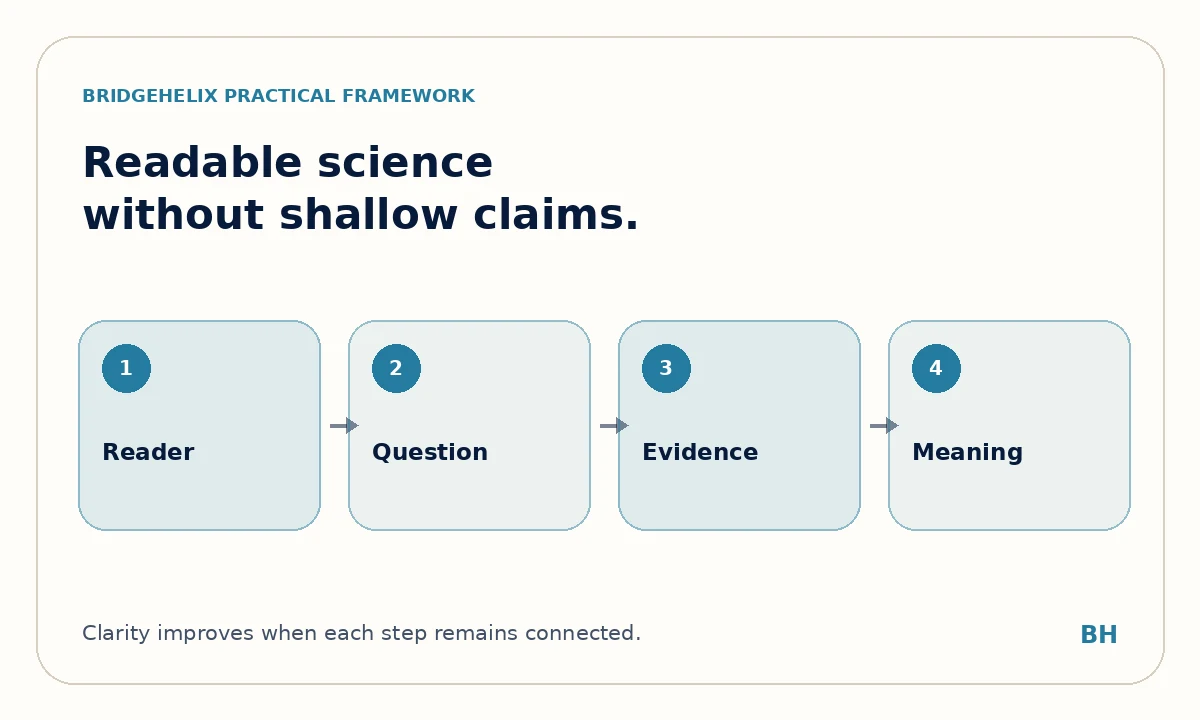
A useful structure connects four elements. The reader defines the level and context. The question controls the scope. The evidence establishes what can be stated. Interpretation explains why the result matters without exceeding it.
Where possible, identify the type of evidence. Was it a laboratory experiment, field observation, simulation, systematic review or internal dataset? The category helps the reader judge the conclusion.
Keep conditions beside the result
Numbers can look precise while hiding important differences. An adsorption capacity, conversion efficiency or biological response is meaningful only with the relevant conditions.
The article does not need to reproduce the complete methods section. It should retain the variables that change interpretation: sample, concentration, temperature, duration, comparison, scale and measurement method where relevant.
A sentence such as “The material achieved 3.2 mg/g at pH 6.5 in a batch test using the stated starting concentration” is more useful than “The material showed excellent capacity.” The first gives the reader something that can be examined. The second gives only emphasis.
Use analogies with an exit point
Analogies can help a new reader form an initial mental model. They become misleading when the image replaces the mechanism.
Adsorption may be compared with particles collecting on a surface. The analogy helps distinguish surface attachment from uptake into a bulk material. It does not explain equilibrium, surface charge, chemical bonding or competition between ions.
Use the analogy, state what it helps explain and then return to the real process. Every analogy needs an exit point where the article says, in effect, “the actual mechanism is more specific here.”
Treat uncertainty as information
Words such as may, suggests and under the tested conditions are not signs of weak writing when they match the evidence. They show the difference between observation, interpretation and prediction.
Uncertainty can come from sample size, measurement variation, model assumptions, uncontrolled factors or limited scale. The reader does not need a statistical lecture in every paragraph. The article should disclose the uncertainty that would materially change the conclusion.
This is particularly important in an abstract or short summary, where a few strong words can make the claim broader than the study. The guide to writing scientific abstracts without exaggeration explains how to control that risk.
Use visuals to explain, not decorate
A process diagram can show sequence. A comparison chart can reveal a relationship. A table can organise repeated criteria. Each visual should answer a specific question that would be harder to answer through prose alone.
Avoid putting essential evidence only inside an image. Search systems and assistive technologies need meaningful text, and readers may be using a small screen. Provide an informative caption and alternative text that describes the purpose of the visual rather than repeating “chart” or “diagram.”
Decorative laboratory photographs may establish atmosphere, but they do not substitute for an explanatory figure when the mechanism is the difficult part.
End with the meaning the evidence supports
The conclusion should return to the question raised at the beginning. It can explain the practical implication, the next research need or the decision the evidence informs. It should not transform a laboratory result into a field guarantee or a correlation into a cause.
Before publication, ask two people to review the article from different positions. A subject-matter expert should check whether the explanation is defensible. A representative reader should identify where the article assumes knowledge that was never introduced.
The article succeeds when the reader leaves with a more accurate mental model, not merely a shorter description. Readability is valuable because it makes the scientific meaning usable.

About the author
Dr. Prakash Kumar Singh
Founder & Technical Content Strategist
PhD in Chemical Engineering from MNIT Jaipur, with M.Tech and B.Tech qualifications in Biotechnology. His work connects technical evidence with clear B2B communication and ethical research support.