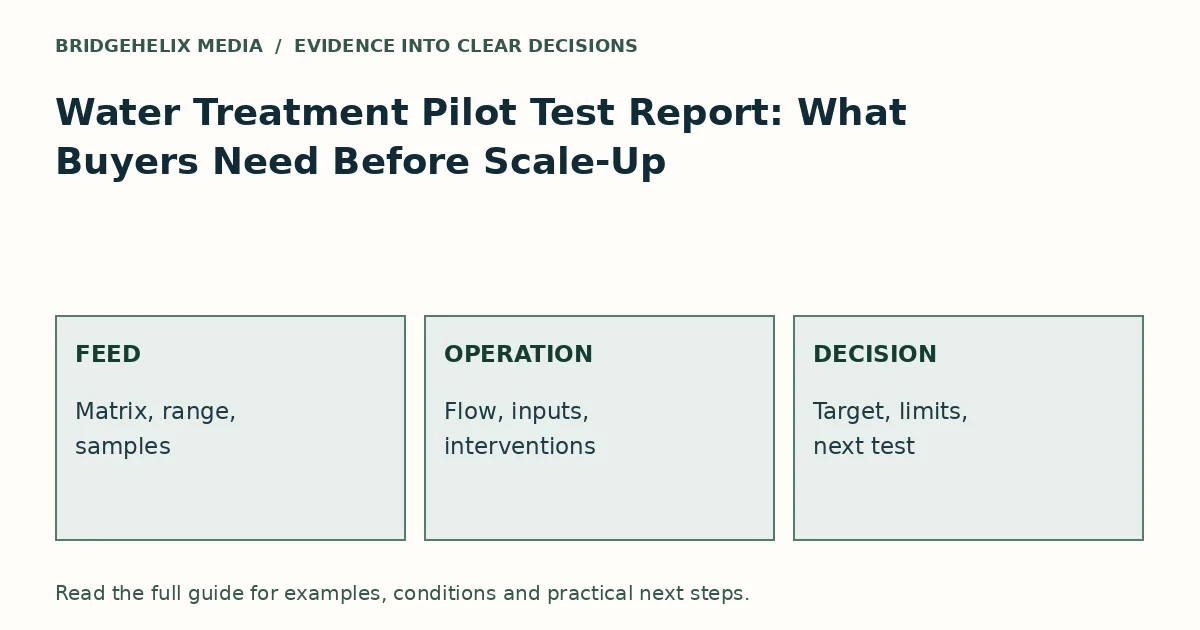
This template is for communicating a completed trial to technical and commercial readers. It is not a substitute for a pilot protocol, a process design or a compliance assessment. Its purpose is to connect the evidence collected with the next decision, while keeping the limits of that evidence visible.
Start with the decision, then describe the trial
The first page should say what the pilot was intended to establish. “Evaluate treatment performance” is too broad. “Assess whether this process can maintain the agreed outlet target across the sampled feed conditions” gives the reader something testable. A second objective might concern media consumption, maintenance frequency or suitability for a longer demonstration.
Record the agreed acceptance criteria before discussing whether the trial succeeded. If criteria were changed after testing began, show what changed and why. Otherwise, a report can quietly turn an exploratory result into a pass against a target that did not originally exist.
Explain the trial boundary in normal language: where the feed came from, the treatment stages included, the operating period and any upstream conditioning. A buyer should not have to search the methods appendix to discover that the process only treated a pre-filtered stream.
Describe the water that actually entered the system
A mean inlet concentration alone can hide the difficult part of the trial. Describe the observed concentration range, sampling frequency and relevant changes in the feed. Depending on the process, useful context may include pH, temperature, suspended solids, competing substances and variations between production batches.
Make clear whether the feed was synthetic water, a prepared mixture or water collected from the intended application. None of these is automatically inappropriate, but they support different conclusions. A controlled mixture can help explain behaviour; it does not reproduce every feature of a variable industrial stream.
For adsorption, the US EPA's overview of treatment technologies (opens in a new tab) provides useful background on granular activated carbon and its applications. That overview concerns drinking water. Use it for process context, not as evidence that a particular industrial wastewater pilot will achieve the same performance.
Keep results and operating inputs together
A headline removal percentage becomes more useful when paired with inlet and outlet concentrations, flow, contact conditions and the period represented. Identify whether a value is an average, a single observation or a best result. Do not let “up to” quietly replace the full operating record.
The same table should identify interruptions, maintenance and departures from the intended settings. If an operator adjusted pH repeatedly, that intervention belongs in the report. If a filter was replaced, include the replacement and the reason. Operational effort is part of the result a buyer needs to interpret.
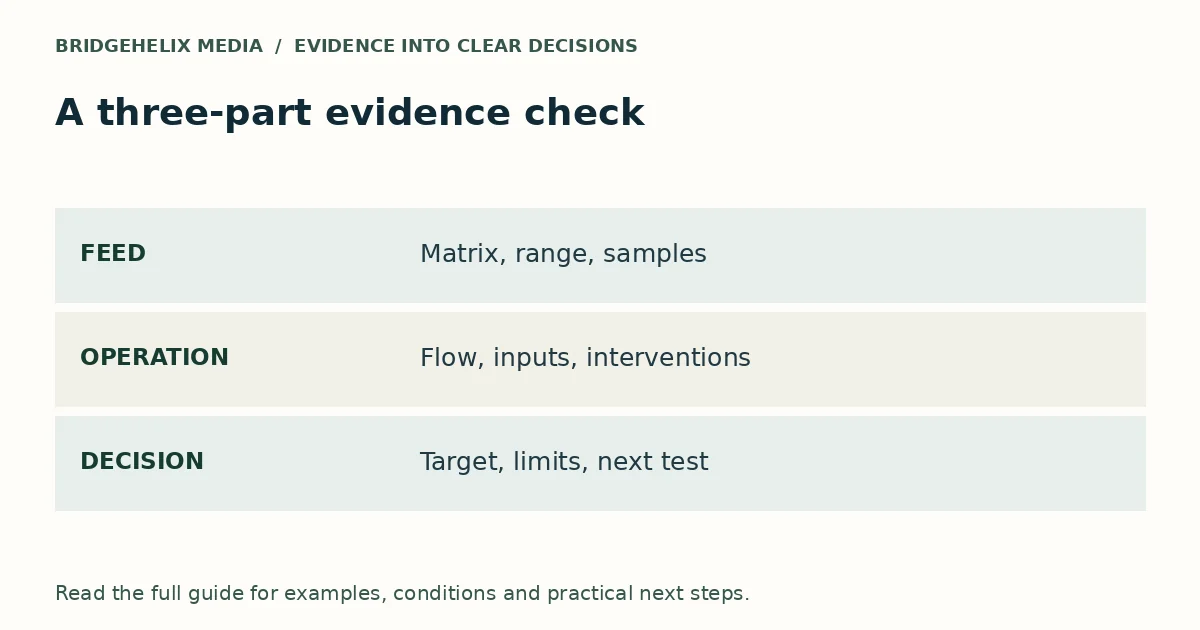
A compact report can use the following evidence structure. Add the actual units, methods and sample identifiers from the trial rather than relying on these broad labels.
| Report section | Evidence to include | Decision it supports |
|---|---|---|
| Feed envelope | Observed range, matrix and sampling plan | Does the trial represent the application? |
| Operating window | Flow, settings, runtime and interventions | Can the process be operated consistently? |
| Treatment result | Inlet and outlet data, method and variability | Was the agreed target demonstrated? |
| Resource demand | Energy, chemicals, media and labour basis | What must be included in the cost estimate? |
| Residuals | Spent media, sludge or concentrate pathway | What handling obligations remain? |
| Open questions | Untested conditions and proposed checks | What evidence is needed next? |
Worked example: the percentage is not the whole finding
Consider an illustrative trial in which a contaminant enters at 20 mg/L and leaves at 2 mg/L. The calculated removal is 90%. If the agreed outlet target were 1 mg/L, the same result would miss that target. The percentage is mathematically correct, but it cannot answer the acceptance question by itself.
Now imagine a second operating period with 5 mg/L at the inlet and 0.8 mg/L at the outlet. Removal is 84%, yet the outlet is below that hypothetical target. These numbers are invented to demonstrate reporting logic; they are not BridgeHelix client results or a recommended treatment limit.
This is why a report should show both concentration and percentage, together with the relevant target. Where mass loading matters, include the flow basis as well. Equal concentrations at different flows can represent very different loads, so avoid comparing them as if concentration were the only operating variable.
Make the cost basis reproducible
Separate measured consumption from estimated full-scale costs. State the energy period and treated volume used in an energy-per-volume calculation. Identify whether a chemical figure refers to active ingredient or delivered product. State whether labour includes continuous supervision or only recorded interventions.
Do not present a short trial's media cost as a demonstrated annual replacement cost. If the media did not reach the chosen replacement criterion, its useful operating life remains an estimate. Record the assumption and explain how a longer run would test it.
The distinction between measured evidence and scale-up inference is developed in our guide to lab, pilot and commercial-scale claims. Keeping those levels separate helps a promising trial remain credible when procurement asks harder questions.
End with a bounded recommendation
The conclusion should state what was demonstrated, under which conditions, and what remains unresolved. A useful recommendation might be to extend operation across a wider feed range, investigate a recurring interruption or collect more representative samples before design work proceeds.
Avoid ending with “ready for commercial deployment” unless the available evidence supports that exact decision. A pilot report can justify the next investment without claiming to resolve every engineering and operational question.
When the report later becomes a public case study, preserve those boundaries. Our technical case study template explains how to retain the evidence while giving a wider audience a readable account. For a pilot report that needs clearer structure, BridgeHelix's technical report writing support can help organise the material around the decision it must support.

About the author
Dr. Prakash Kumar Singh
Founder & Technical Content Strategist
PhD in Chemical Engineering from MNIT Jaipur, with M.Tech and B.Tech qualifications in Biotechnology. His work connects technical evidence with clear B2B communication and ethical research support.