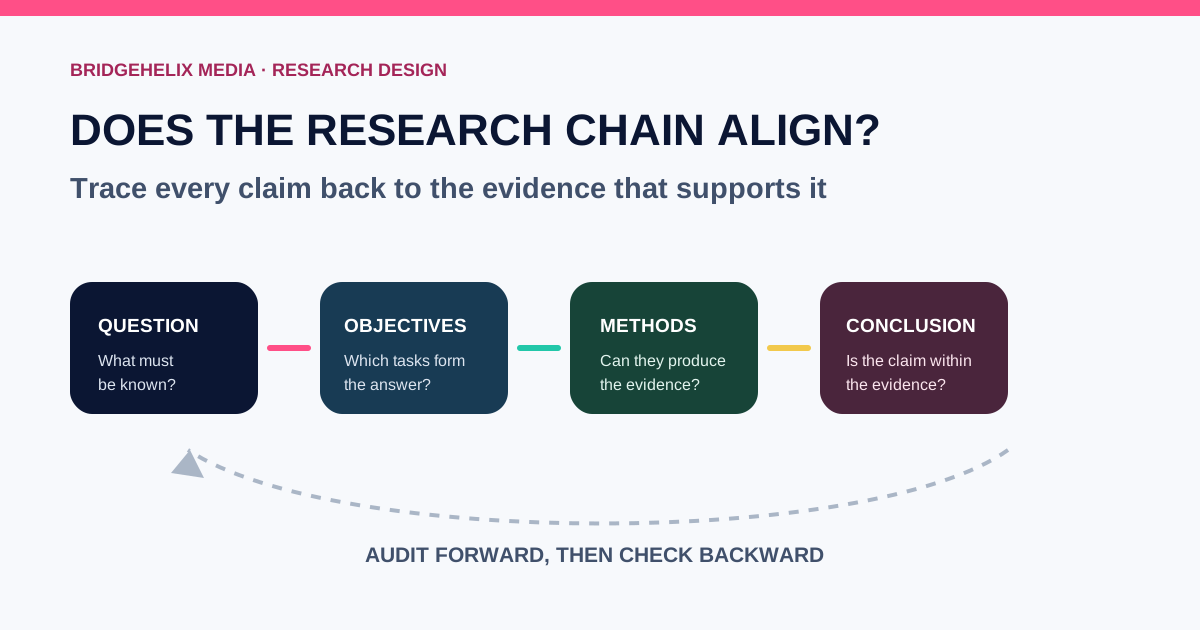
Many research manuscripts look coherent at first sight. The title mentions treatment performance. The objectives mention removal. The methods describe batch experiments. The results report percentages. Yet the conclusion claims that the technology is suitable for full-scale application.
The problem is not grammar. It is a mismatch between the question asked, the evidence generated and the claim made.
Such mismatches can enter a study at the proposal stage, during experimental changes or while writing the manuscript. They are easier to correct before data collection, but even a completed study can be reported more honestly when its boundaries are recognised.
What alignment actually means
Research alignment is a chain of dependence:
problem → question → objectives → evidence needed → method → analysis → answer
Each link constrains the next one. The problem establishes why the research matters. The question defines what must be known. Objectives divide that question into manageable tasks. Methods generate observations. Analysis converts observations into evidence. The conclusion answers the question only to the extent supported by that evidence.
The US National Institutes of Health teaching material on research design decisions (opens in a new tab) makes the same underlying point: study design and methods are determined by the problem, purpose and questions to be answered.
Alignment therefore concerns function, not identical wording.
The difference between an aim, a question and an objective
These elements are often treated as interchangeable, which creates confusion.
Research aim
The aim states the broad purpose of the study.
To evaluate a marble-powder composite for fluoride removal from drinking water.
The aim gives direction, but it is usually too broad to determine the complete method.
Research question
The question identifies the uncertainty the study intends to resolve.
Under which operating conditions can the composite reduce fluoride below the relevant drinking-water limit, and how is its performance affected by competing nitrate?
This version identifies the outcome, boundary and comparison more clearly.
Research objectives
Objectives define the work required to answer the question.
- Characterise the composite before and after fluoride exposure.
- Determine the effect of pH, dose, contact time and initial concentration on fluoride removal.
- Compare fluoride performance in single-ion and fluoride–nitrate systems.
- Evaluate whether treated-water parameters remain within specified limits.
Each objective performs a different function. Together they form an evidence plan.
An objective such as “to study fluoride removal” is too vague because it does not indicate what evidence will demonstrate that the study has been completed.
The BridgeHelix research alignment evidence chain
The evidence-chain test examines five transitions. A manuscript is coherent only when each transition can be defended.
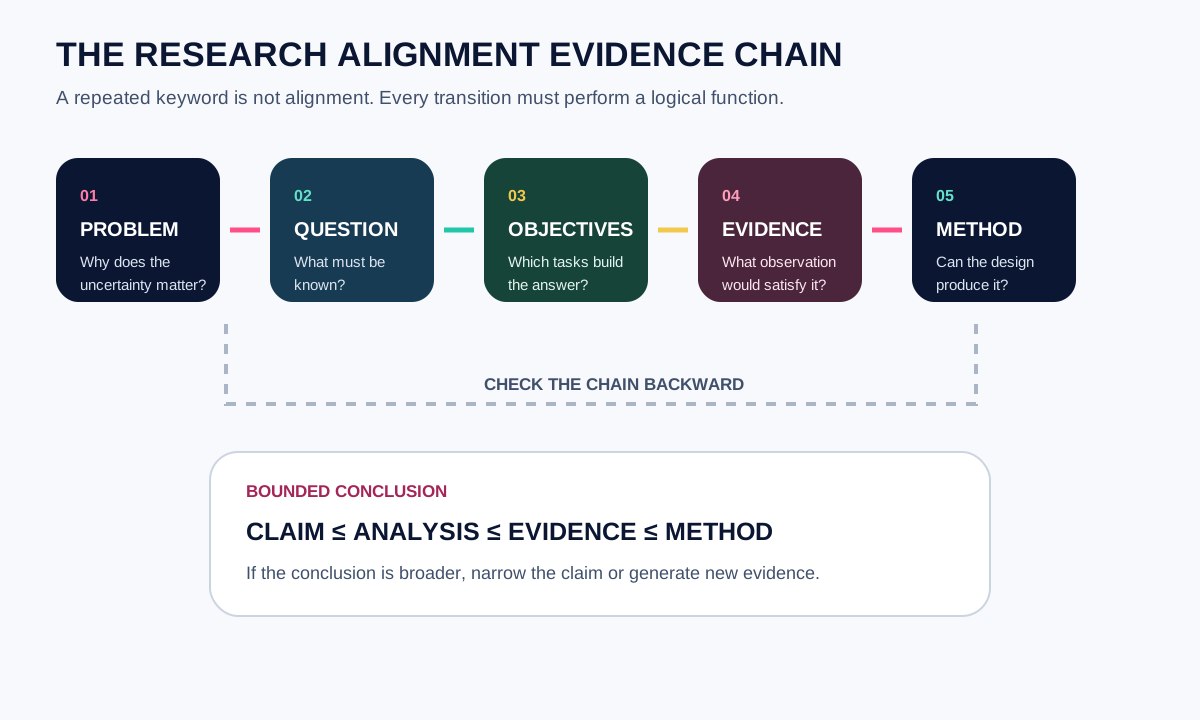
1. Question to objective: is every part of the question covered?
Break the question into components:
- population, material or system;
- intervention, exposure or phenomenon;
- comparison, where relevant;
- outcome;
- condition, setting or time;
- type of explanation required.
Then map every component to at least one objective. If the question asks about long-term stability but no objective assesses time-dependent performance, the gap is visible before the method is selected.
The opposite problem also occurs. A researcher may include an objective because an instrument is available or because the analysis is common in the field. If the result does not help answer the research question, it adds activity without adding coherence.
2. Objective to evidence: what observation would satisfy the objective?
Before choosing a method, state the evidence required.
| Objective | Evidence required |
|---|---|
| Compare two treatments | Outcomes measured under equivalent conditions with a defined comparison |
| Explain a mechanism | Observations capable of distinguishing the proposed mechanism from alternatives |
| Assess stability | Repeated performance over a relevant duration or cycle count |
| Explore experience | Accounts from an appropriate sample with transparent interpretation |
| Predict an outcome | Validated model performance on data not used to fit the model |
This step prevents a common mistake: choosing a familiar method and then redefining the objective around whatever the method produces.
3. Evidence to method: can the design generate the required observation?
The method should be selected after the evidence requirement is clear.
A cross-sectional survey may identify an association at one time point. It cannot independently establish how the relationship changes over time. A batch adsorption experiment can estimate equilibrium behaviour under controlled conditions. It does not directly demonstrate hydraulic performance in a continuous treatment unit.
This does not make either method weak. It makes each method suitable for a particular question.
Frameworks for research questions can help define relevant components, but they should not be used mechanically. The NIH-hosted guidance on formulating research questions (opens in a new tab) discusses feasibility, relevance and structure. Those considerations still require subject-specific judgement.
4. Method to analysis: does the analysis answer the objective?
Collecting the right type of data is not enough. The analysis must match the comparison or explanation.
Examples of misalignment include:
- an objective says “compare,” but results are reported for each group without a comparative analysis;
- an objective says “optimise,” but only one-factor-at-a-time experiments are presented without an optimisation criterion;
- an objective says “determine the effect,” but only correlation is reported without considering confounding or design limitations;
- an objective says “explore experiences,” but responses are counted without qualitative interpretation;
- an objective says “validate,” but performance is reported on the same data used to develop the model.
The action verb in the objective matters because it implies an analytical demand. “Describe,” “compare,” “estimate,” “test,” “explain,” “optimise” and “validate” are not interchangeable.
5. Analysis to conclusion: is the answer no broader than the evidence?
The final link is where many otherwise careful studies overreach.
If a material removes fluoride in synthetic water during a two-hour batch test, the conclusion may state that it showed promising batch performance under the tested conditions. It should not automatically state that the material is a safe, economical and scalable solution for community drinking-water treatment.
Those additional claims require additional evidence:
- safety and leaching analysis;
- realistic water matrices;
- continuous operation;
- regeneration or disposal;
- reproducibility;
- material supply and preparation;
- cost and energy assessment;
- field validation.
A bounded conclusion is not a weak conclusion. It tells the reader what has actually been learned and what remains to be tested.
Common alignment failures
The broad-question, narrow-method failure
Question:
Is technology X sustainable for industrial wastewater treatment?
Method:
Laboratory removal tests under one set of conditions.
The word “sustainable” may imply energy, chemical use, residuals, cost, durability, safety and life-cycle effects. Removal tests answer only one part. Either the question must become narrower or the study must become broader.
The objective-list failure
Some proposals contain ten or fifteen objectives that represent every possible experiment. The objectives do not form a logical sequence and cannot be completed within the available time.
Good objectives are not a wish list. Each should be necessary, feasible and connected to the central question.
The method-first failure
A laboratory has access to an instrument, dataset or software package, so the study is designed around its use. The research question is added later.
Instrument availability is a real feasibility constraint, but it should not be presented as the intellectual reason for the study. A meaningful question must still determine what the measurement contributes.
The changed-study failure
Research rarely proceeds exactly as planned. Samples become unavailable, experiments fail, equipment changes or an intended comparison cannot be completed. The manuscript may nevertheless retain the original objectives.
When the study changes, the alignment must be rebuilt. Objectives, title, abstract and conclusions should describe the research that was actually conducted, with transparent acknowledgement of deviations where required.
The conclusion-creep failure
The results section is appropriately cautious, but the abstract and conclusion gradually expand the claim. “Associated with” becomes “caused.” “Potential” becomes “effective.” “Laboratory feasibility” becomes “industrial applicability.”
A manuscript consistency check should compare the strongest claim in the title, abstract and conclusion with the strongest evidence in the methods and results.
A worked alignment table
Consider a study of a new adsorbent for nitrate removal.
| Element | Aligned version |
|---|---|
| Problem | Nitrate contamination requires treatment materials that work in chemically complex water |
| Question | How do pH and competing ions affect nitrate removal by material X under batch conditions? |
| Objective 1 | Characterise material X and identify properties relevant to nitrate interaction |
| Objective 2 | Quantify nitrate removal across a defined pH range |
| Objective 3 | Compare nitrate removal with and without selected competing ions |
| Evidence | Characterisation results and removal data under matched, replicated conditions |
| Methods | Relevant surface analyses, controlled batch tests and prespecified comparisons |
| Conclusion | Material X retained a stated level of batch performance under the tested pH and ion conditions |
This study does not answer every question about the material. It does answer one bounded question coherently.
If the intended conclusion concerns drinking-water application, new objectives are needed for treated-water quality, leaching, relevant concentration ranges, continuous operation and other application-specific requirements.
Align hypotheses without forcing every study to have one
A hypothesis is useful when the study tests a specific predicted relationship or difference.
Increasing solution pH above the material’s point of zero charge will reduce fluoride adsorption because the surface becomes less positively charged.
This hypothesis links a condition, direction and proposed explanation. It can guide measurement and analysis.
Not every study requires a formal hypothesis. Exploratory qualitative research, descriptive mapping and some early-stage investigations may be better guided by questions and objectives. Adding a weak hypothesis merely to satisfy a template does not improve the design.
The correct choice depends on what the study seeks to establish. The key requirement is still alignment between the claim, evidence and method.
Use reporting guidelines as an audit, not a repair
The EQUATOR Network reporting-guideline database (opens in a new tab) helps authors identify guidance for different study types. Reporting checklists improve completeness and transparency, but they cannot repair a design that was incapable of answering the question.
They are most useful at three stages:
- during planning, to anticipate information and procedures that must be documented;
- during writing, to check that essential details have been reported;
- before submission, to locate omissions across the manuscript.
The guideline should match the actual study design. Selecting a checklist because its name appears close to the topic can create another form of misalignment.
Perform a two-direction audit
Read the study forward:
Does the problem justify the question? Does each objective help answer it? Can the methods produce the necessary evidence?
Then read it backward:
Is each conclusion supported by a result? Does each result arise from a stated method? Does each method serve an objective? Does every objective contribute to the question?
The backward audit is particularly effective because unsupported claims and unused analyses become easy to see.
Also compare five high-visibility locations:
- title;
- last paragraph of the introduction;
- methods overview;
- first paragraph of the discussion;
- conclusion.
The same study should be recognisable in all five.
Practical conclusion
Research alignment is not a formatting requirement. It determines whether a study can produce a defensible answer.
The most reliable approach is to specify the evidence needed before selecting the method, then limit the conclusion to what the completed analysis supports. When circumstances change, revise the research chain rather than preserving an outdated objective.
BridgeHelix Media provides ethical academic editing and research support for researchers who need to test argument flow, objective–method alignment and manuscript coherence without transferring authorship or research decisions.
Sources

About the author
Dr. Prakash Kumar Singh
Founder & Technical Content Strategist
PhD in Chemical Engineering from MNIT Jaipur, with M.Tech and B.Tech qualifications in Biotechnology. His work connects technical evidence with clear B2B communication and ethical research support.