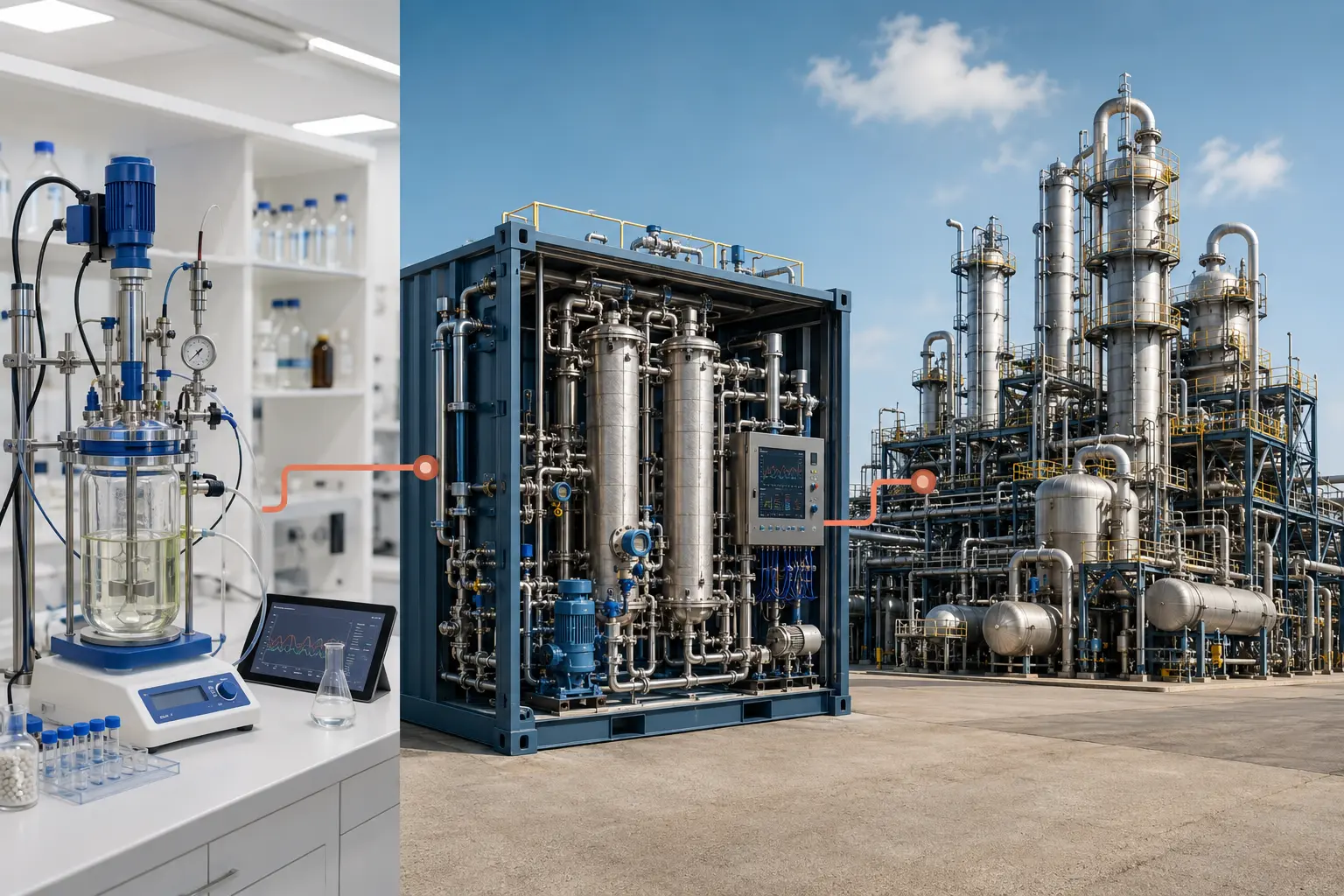
A laboratory result may be scientifically strong and still be insufficient for a commercial claim. This is not because the experiment has failed. It is because laboratory, pilot and commercial operation expose a technology to different questions.
The distinction is especially important in water treatment, biotechnology, chemical processing, materials, cleantech and other sectors where a favourable result is often converted too quickly into words such as “scalable,” “proven” or “commercially ready.”
Lab scale, pilot scale and commercial scale are not universal sizes
There is no single litre, kilogram-per-hour or megawatt boundary that applies to every technology. A 100-litre biological system may be a substantial pilot for one process and a small laboratory unit for another. Scale should therefore be defined by purpose, integration and operating environment, not volume alone.
Laboratory scale
Laboratory work isolates variables and creates controlled conditions. It can identify a mechanism, compare formulations, determine kinetic behaviour, establish equilibrium, screen operating ranges and provide an early mass or energy balance.
The equipment may contain the critical process step without all the supporting systems required in practice. Feed may be synthetic or purified. Experiments may last hours or days. Operators can intervene frequently. These controls are valuable because they make cause-and-effect relationships easier to examine.
Pilot scale
A pilot is an integrated representation of the proposed process operated in a relevant or operationally realistic environment. It should contain the critical equipment, interfaces, controls and recycle or waste streams needed to investigate scale-up risk.
Pilot-scale testing often introduces real or representative feed, longer campaigns, start-up and shutdown, fouling, cleaning, control response, operator interaction and variability that a laboratory experiment cannot reproduce fully.
The pilot is not merely a larger beaker. Its purpose is to test whether the connected process behaves as expected when the simplifications of laboratory work are reduced.
Commercial scale
Commercial scale is the actual system delivering its intended output within an operating and economic context. The plant or product must manage routine variability, safety, maintenance, supply, quality, compliance, workforce and customer requirements.
Commercial evidence should still state the site, capacity, duty, feed range, operating period and system boundary. One successful installation does not prove identical performance for every application.
What each evidence level can support
| Evidence level | Strong conclusions it can support | Important questions it usually cannot settle |
|---|---|---|
| Laboratory | Mechanism, proof of concept, material ranking, sensitivity to selected variables, controlled performance | Long-term reliability, real-feed variability, full integration, site cost, routine maintenance |
| Pilot | Integrated process behaviour, relevant-environment performance, control response, fouling or degradation trends, early operating requirements | Multi-year life, every site condition, mature supply chain, fully optimised commercial cost |
| Commercial | Actual output, reliability, maintenance, quality, resource use and cost for the stated site and period | Automatic transfer to different feed, climate, duty, design or operating practice |
This table should be used as a claim boundary, not as a rigid rule. A long-duration laboratory study may answer one durability question better than a short pilot. A commercial demonstration may still be poorly instrumented. Evidence quality depends on study design as well as scale.
Scale-up changes more than equipment size
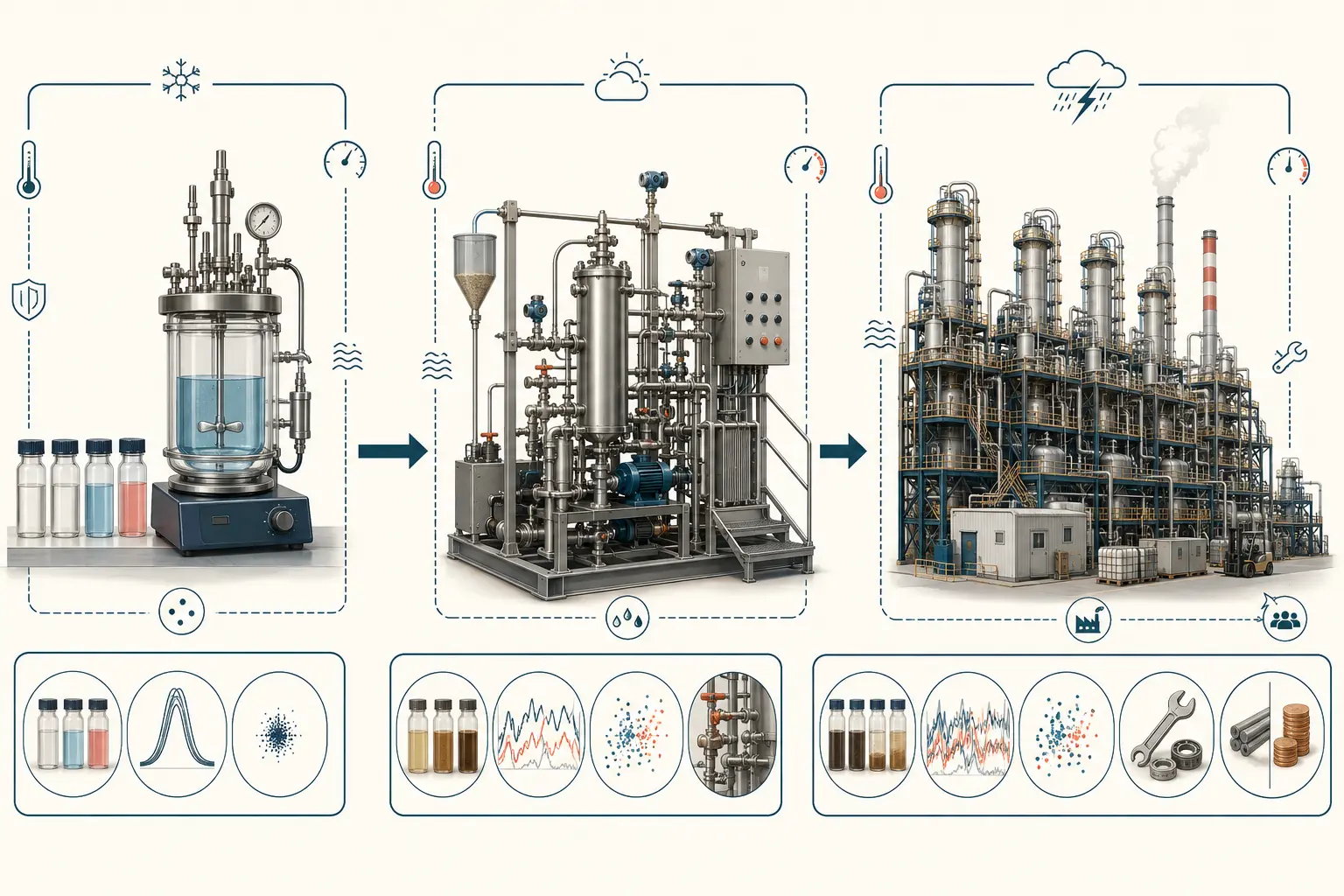
When a process becomes larger, several effects appear together.
Transport behaviour changes
Mixing, heat transfer and mass transfer do not normally increase in direct proportion to vessel volume. Surface-area-to-volume ratio changes. Flow patterns and residence-time distributions may change. Gradients that were negligible in a small vessel can become important.
Therefore, geometrically similar equipment is not necessarily dynamically or thermally similar. A scale-up basis must identify which variables are held constant and why: power per unit volume, tip speed, superficial velocity, Reynolds number, heat-transfer area, residence time or another process-specific parameter.
Feed variability becomes real
Laboratory feed is often prepared to a defined composition. A pilot may receive seasonal water, variable biomass, different raw-material lots or fluctuating contaminant load. Competing components can change selectivity, inhibition, fouling or product quality.
The correct pilot question is not only “Does it still work?” It is “Which variation controls performance, and can the system detect and respond to it?”
Interfaces become part of the technology
A laboratory unit may examine one reactor or separation step. A pilot must often connect pretreatment, pumping, dosing, controls, product recovery, cleaning and waste handling. Failure may occur at an interface even when the core mechanism remains sound.
This is why U.S. Department of Energy TRL guidance (opens in a new tab) distinguishes laboratory validation from validation and prototype demonstration in a relevant environment. Its TRL descriptions move from component or process validation in the laboratory to integrated systems and demonstrations in increasingly operational conditions.
Time reveals different failure modes
A six-hour test may show conversion or removal efficiency. A six-month campaign may reveal corrosion, catalyst deactivation, biofouling, seal failure, media attrition, sensor drift, cleaning difficulty or operator burden.
Test duration should therefore be justified against the expected failure mechanism. “Continuous operation” is not meaningful without the duration, interruptions and maintenance events.
Economics changes with the system boundary
Laboratory cost often considers materials used in one experiment. Commercial cost includes capital equipment, utilities, labour, consumables, replacement, waste treatment, downtime, compliance and financing. A low-cost material can produce an expensive process if it needs frequent regeneration, complex separation or hazardous disposal.
The Department of Energy's Adoption Readiness Levels framework (opens in a new tab) makes this wider point directly: solving the technical challenge is necessary but not sufficient for scale and commercialisation. Value proposition, market acceptance, resource maturity and licence to operate create additional adoption risks.
A real research example: why the evidence changes between batch and column studies
My doctoral research examined calcium- and magnesium-based adsorbents for fluoride and nitrate removal from drinking water. The progression from controlled batch experiments to continuous columns provides a useful example of evidence boundaries.
In batch testing, a marble powder composite achieved a fluoride adsorption capacity of 3.22 mg/g in a single-ion system under the selected conditions. When fluoride and nitrate were present together, fluoride capacity decreased to 2.42 mg/g. The change showed that a favourable single-solute result did not represent the complete competitive environment.
Continuous column experiments added another layer. The fluoride breakthrough capacity of the composite pellets was 1.65 mg/g under the optimised column conditions. This was not a contradiction of the batch result. The two experiments measured performance under different hydrodynamic, contact and endpoint conditions.
The lesson is important for technical communication. A company should not choose the largest capacity from a controlled experiment and use it as the commercial design value. Batch equilibrium, continuous breakthrough and site-level media requirement answer related but different questions.
The associated published work on amended alumina also examined batch and continuous-column behaviour rather than depending on removal percentage alone. That progression is visible in Singh, Saharan and George's study in the Journal of Environmental Chemical Engineering (opens in a new tab).
The claim-strength checklist
Before using a performance statement, record the following evidence.
| Claim element | What to state |
|---|---|
| Evidence scale | Laboratory, bench continuous, pilot, demonstration or commercial |
| Configuration | Critical equipment and supporting systems included |
| Feed or input | Synthetic, representative, real and relevant range |
| Operating conditions | Flow, load, temperature, pressure, composition and control basis |
| Duration | Total run time, stable period, interruptions and cycles |
| Replication | Number of tests, runs, sites or process trains |
| Comparison | Baseline or reference using a comparable basis |
| Result | Actual values, variability and measurement method |
| Unresolved risk | What remains untested or uncertain |
| Transfer condition | What must be similar before the result is applied elsewhere |
If this record cannot be completed, the claim is probably ahead of the evidence.
Claims that are safe at each scale
Laboratory claim
Under the stated laboratory conditions, the modified material achieved higher fluoride uptake than the unmodified reference. Performance in real water, continuous flow and repeated regeneration requires further evaluation.
This claim is useful because it identifies the comparison and preserves the next evidence boundary.
Pilot claim
The integrated pilot maintained the target product quality across the tested feed range during a 90-day campaign. Cleaning frequency increased at the upper solids load, and long-term component life has not yet been established.
This states what the pilot achieved and which operating risk remained.
Commercial claim
At the reported site, the full-scale system met the agreed output specification during the 12-month evaluation period across the recorded operating range. Performance at sites with different feed composition or climate should be validated separately.
Commercial operation supports a stronger claim, but the site and period still matter.
Warning signs in a scale-up claim
“Proven technology” without a named environment
Proven where, at what scale and against which acceptance criterion? The word has little value without those details.
“Commercially ready” based only on TRL
Technology readiness is useful, but it does not settle manufacturing, supply, permitting, adoption or market risk. NASA's nine Technology Readiness Levels (opens in a new tab) describe increasing technical maturity; they are not a complete commercial business case.
A pilot result without duration
A pilot that operated for one shift and a pilot that completed a seasonal campaign provide different evidence. State active operating time and interruptions.
Comparing unlike conditions
Do not compare a new technology's best laboratory result with the incumbent's routine commercial average. Use a comparable feed, endpoint and measurement basis.
Hiding the balance of plant
Pumps, pretreatment, control, cleaning, product recovery and waste handling affect both performance and cost. A core unit does not operate alone at commercial scale.
How to communicate scale-up evidence without weakening the offer
Some companies remove limitations because they fear that buyers will see uncertainty. In practice, a serious technical buyer already knows that scale-up creates uncertainty. Hiding it makes the message less credible.
A better structure is:
- State the strongest verified result.
- Name the scale and relevant conditions.
- Explain what the result means for the application.
- Identify the unresolved risk.
- Show the next test or engineering step that addresses it.
This approach turns uncertainty into a development plan. It also helps marketing, engineering and commercial teams use the same language. A technical messaging audit (opens in a new tab) can identify where website claims have moved further than the underlying test record.
Practical conclusion
The difference between lab scale, pilot scale and commercial scale is not simply the size of the equipment. Each level introduces new interactions, variability, duration, integration and decision risk.
Laboratory work can establish that a mechanism or concept deserves further development. A pilot can show how the integrated process behaves under relevant conditions. Commercial operation can demonstrate actual site performance and operating consequences. Even then, the conclusion remains linked to the site, duty, period and system tested.
Technical communication becomes stronger when it states these boundaries openly. BridgeHelix Media helps chemical engineering (opens in a new tab) and sustainability and cleantech (opens in a new tab) companies connect scale-up evidence with buyer-facing claims that remain clear, useful and defensible.
Sources
- NASA: Technology Readiness Levels (opens in a new tab)
- U.S. Department of Energy: Technology Readiness Levels (opens in a new tab)
- U.S. Department of Energy: Adoption Readiness Levels framework (opens in a new tab)
- NIST: Reporting measurement uncertainty (opens in a new tab)
- Singh, Saharan and George: Performance of calcium- and magnesium-amended alumina (opens in a new tab)
For the next reporting step, use the water treatment pilot test report framework to connect observed performance, operating inputs and the remaining scale-up questions.

About the author
Dr. Prakash Kumar Singh
Founder & Technical Content Strategist
PhD in Chemical Engineering from MNIT Jaipur, with M.Tech and B.Tech qualifications in Biotechnology. His work connects technical evidence with clear B2B communication and ethical research support.