The practical answer to results vs discussion in research paper is to begin with the decision the reader must make, then organise the article or manuscript around the evidence needed for that decision. For researchers struggling with manuscript structure, the central test is which statements belong in the results section and which require the interpretive work of the discussion. The work becomes reliable when each claim remains connected to its conditions, comparison basis and limitation.
The recurring problem is easy to recognise: repeating the same numerical result in the discussion without explaining competition, mechanism, prior evidence or practical significance. The statement or display may look complete, yet it does not give the reader a secure basis for interpretation. More words rarely solve this. The missing work is a controlled connection between the question, the evidence, the comparison and the boundary.
This issue usually appears late. A team has already collected information, completed experiments or produced several drafts, yet the reader still cannot see the decision logic. The missing element is not more material. It is control over the relationship between observed result, meaning, context and boundary. When those relationships remain implicit, even technically correct content feels harder to trust.
Why technically correct material can still fail
Technical communication fails when correctness is treated as the only requirement. A sentence can contain accurate terminology and still leave out the condition that controls the result. A comparison can use real numbers and still be unfair because the baseline has changed. A conclusion can follow the general direction of the evidence and still travel beyond the study scale.
For this topic, the useful question is not “Have we included enough information?” It is “Can the intended reader follow the decision from evidence to implication?” That is the difference between a document that stores information and one that supports judgement.
The remedy is to make the chain inspectable. A reviewer, buyer or informed non-specialist should be able to identify where an important statement came from, which condition governs it and what would make it inapplicable. This is especially important in a measured decrease in fluoride adsorption capacity when nitrate is introduced into a binary-ion system. The example contains enough technical detail to sound convincing, but that detail becomes useful only when it is organised around the question the reader is trying to answer.
Another common failure is inherited structure. Authors copy the sequence of laboratory work, marketers copy a familiar funnel, and content teams copy headings from highly ranked pages. Those structures may be convenient, but they do not necessarily match the reader's decision. The result is often a long introduction, scattered proof and a strong conclusion that appears before its basis has been established.
The BridgeHelix Observation–Interpretation Boundary
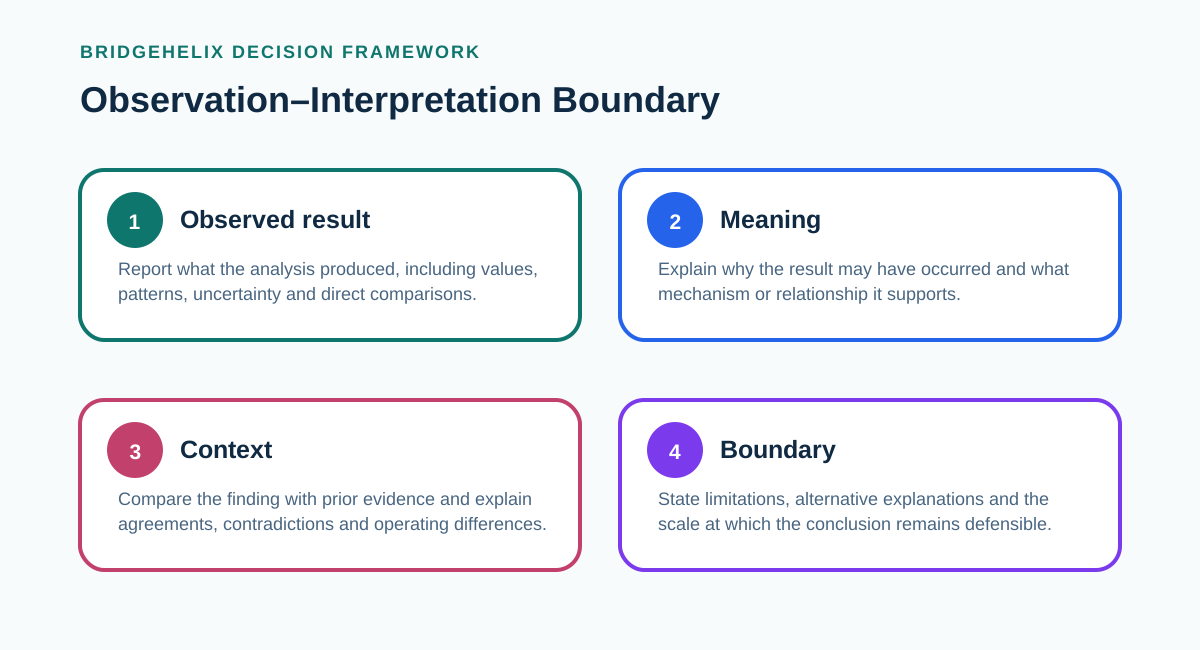
The Observation–Interpretation Boundary turns the problem into four reviewable stages. It can be applied during planning, drafting or a final audit.
1. Observed result
Report what the analysis produced, including values, patterns, uncertainty and direct comparisons.
“Removal decreased when the competing ion was introduced” reports an observed pattern if the data support it. Include the relevant comparison and uncertainty, then point to the table or figure. Avoid placing a mechanistic explanation in the same sentence unless the journal’s combined-section format calls for it.
2. Meaning
Explain why the result may have occurred and what mechanism or relationship it supports.
“This decrease may reflect competition for adsorption sites” interprets the observation. Explain which additional measurements support that interpretation and whether another mechanism could produce the same pattern. A model fit alone should not be presented as conclusive evidence of a particular mechanism.
3. Context
Compare the finding with prior evidence and explain agreements, contradictions and operating differences.
Compare studies only after checking differences in water matrix, dose, contact time and endpoint. A higher reported capacity does not necessarily establish a better material under different conditions. The discussion should explain why an agreement or contradiction is meaningful, rather than merely placing results side by side.
4. Boundary
State limitations, alternative explanations and the scale at which the conclusion remains defensible.
State what the experiment cannot establish. For example, batch findings do not alone establish continuous-column performance or regeneration across repeated cycles. Tie each limitation to the affected conclusion and explain what additional evidence would be needed to extend it.
Compare the available approaches before choosing one
There is rarely one format that is correct in every situation. The choice should follow the reader's task, the evidence available and the risk created by misunderstanding.
| Approach | Where it works | Main limitation |
|---|---|---|
| Separate sections | Clear distinction between evidence and interpretation | Can create repetition if cross-references are weak |
| Combined section | Useful for studies with many linked experiments | Interpretation can interrupt the evidence sequence |
| Results with brief interpretation | Works for short formats and direct findings | May leave comparison and limitations underdeveloped |
This comparison should not be converted into a universal ranking. An approach that is weak for one purpose may be the most efficient option for another. State the decision criteria first, then explain why the selected route fits those criteria.
A worked example
Consider a measured decrease in fluoride adsorption capacity when nitrate is introduced into a binary-ion system. A weak treatment would reproduce familiar claims and present the favourable result first. It might sound authoritative because it uses specialist language, but the reader would still not know the comparison basis, the controlling condition or how far the conclusion can travel.
A stronger version begins by fixing the exact question. It then records the tested condition, the measured or documented outcome, the comparator and any uncertainty that changes interpretation. Only after that does it explain the mechanism or practical meaning. This sequence is slower at the start, but it prevents expensive correction later because the claim is built on an evidence trail.
The example also shows why repeating the same numerical result in the discussion without explaining competition, mechanism, prior evidence or practical significance. The error is not merely stylistic. It changes what a reader believes has been demonstrated. Repair therefore requires more than a softer adjective. The missing condition, baseline or evidence must be restored.
The limitation must change the conclusion
Some journals use a combined Results and Discussion section. The intellectual separation still matters even when the headings are merged.
A limitation is useful only when its consequence is explained. “More research is needed” says very little. A stronger limitation identifies what remains uncertain, why the current design cannot resolve it and which next test would change the decision. This keeps the article honest without making the completed work sound meaningless.
Use three questions:
- Which claim becomes weaker because of this limitation?
- Which conclusion remains supported despite it?
- What specific evidence would reduce the uncertainty?
A second difficulty is approval. Subject experts often receive a polished draft and are asked whether it is “correct.” That question is too broad. Review should instead test the high-risk elements separately: definitions, numerical evidence, mechanism, comparison, commercial or scientific implication, and the final boundary. Smaller approval decisions produce clearer corrections and a better record of why the wording is defensible.
A practical workflow
1. Freeze the evidence set
Use the final tables, figures, methods, protocol and journal instructions. Remove superseded drafts from the active review folder so an earlier number cannot return during revision.
2. Map claims to manuscript locations
For every central claim, record where the supporting method and result appear. A claim with no traceable location is either premature or under-reported.
3. Check section function
Review observation, interpretation, comparison and limitation separately. This prevents evidence from being buried inside commentary or interpretation from being presented as a measured result.
4. Run a numerical consistency pass
Check sample sizes, units, treatment names, statistics and figure references across abstract, main text, tables and supplements.
5. Apply journal requirements
Use the current author instructions and the relevant reporting checklist only after the scientific content is stable.
6. Complete an independent read
Read the manuscript from the position of a researcher who did not perform the work. Mark every place where private laboratory knowledge is required.
Search visibility and readability come after this work, not before it. A precise title, direct answer, useful headings and internal links help readers find and navigate the explanation. They do not replace original judgement. The durable asset is the controlled argument: what was observed, how it was interpreted, why alternatives were rejected and where the conclusion stops.
Final quality-control questions
Before publication or submission, check:
- Does the opening answer address results vs discussion in research paper directly?
- Can the reader identify the evidence behind every strong statement?
- Are compared alternatives evaluated under a common basis?
- Does the worked example include the condition that controls interpretation?
- Is uncertainty described specifically rather than hidden in cautious language?
- Does the conclusion remain inside the demonstrated scale?
- Are the title, metadata, image alt text and internal links consistent with the article?
Practical conclusion
The central task is which statements belong in the results section and which require the interpretive work of the discussion. The BridgeHelix Observation–Interpretation Boundary makes that task visible by separating observed result, meaning, context, boundary. It also prevents a common mistake: increasing confidence in the wording while leaving confidence in the evidence unchanged.
If you need an independent evidence, structure and clarity review, BridgeHelix Media's research manuscript editing service can help refine the material while preserving author responsibility, technical meaning and appropriate limitations. You may also compare this approach with our guides to manuscript coherence and technical messaging confidence.
Sources

About the author
Dr. Prakash Kumar Singh
Founder & Technical Content Strategist
PhD in Chemical Engineering from MNIT Jaipur, with M.Tech and B.Tech qualifications in Biotechnology. His work connects technical evidence with clear B2B communication and ethical research support.