The simplest boundary is responsibility
A researcher may complete a sound study and still struggle to present it clearly. A chapter may repeat the same point, a sentence may hide the actual result or the conclusion may not connect back to the objective. Academic editing can help with these problems.
The ethical boundary becomes clearer when responsibility is considered. The editor can identify that a result is difficult to interpret. The editor should not invent the interpretation. The editor can show that two sections contradict each other. The researcher must decide which statement represents the work and whether the analysis needs to change.
This is the basis of ethical academic editing and research support: improve the communication without taking over the researcher's intellectual role.
Editing is not authorship
Language editing may correct grammar, improve transitions, remove repetition and make long sentences easier to follow. It can standardise terminology and help the reader distinguish methods, observations and interpretation.
Structural editing can go further. It may show that the introduction does not lead to the stated objective, that the discussion repeats the results or that the conclusion makes a broader claim than the evidence supports. These are important observations, but the editor still does not own the scientific decision.
Think of the difference between checking a measuring instrument and choosing what should be measured. A reliable instrument can improve the quality of the observation. It does not decide the research question. In the same way, good editing can make an argument visible and consistent without becoming the source of that argument.
What an ethical editor can reasonably improve
The exact scope depends on the service agreed with the researcher. A language-focused edit may cover grammar, sentence structure, terminology and consistency. A substantive edit may also review section logic, paragraph order, repetition, argument flow and the relationship between objectives, methods, results and conclusions.
An editor can also check whether figures are introduced in the text, whether abbreviations are defined, whether citations follow the required style and whether a journal's formatting instructions have been applied consistently.
These changes should remain visible. Tracked revisions and comments allow the author to examine how wording has changed and reject an edit that no longer represents the intended meaning. A clean final file is useful for submission, but it should be produced only after the researcher has had the opportunity to review substantive changes.
What must remain with the researcher
The researcher remains responsible for the data, analysis, interpretation, references and originality of the work. If a method is not described, an editor can ask for the missing information. The editor should not create a plausible method. If a result does not support the proposed conclusion, the editor can flag the mismatch. The editor should not manufacture a stronger result.
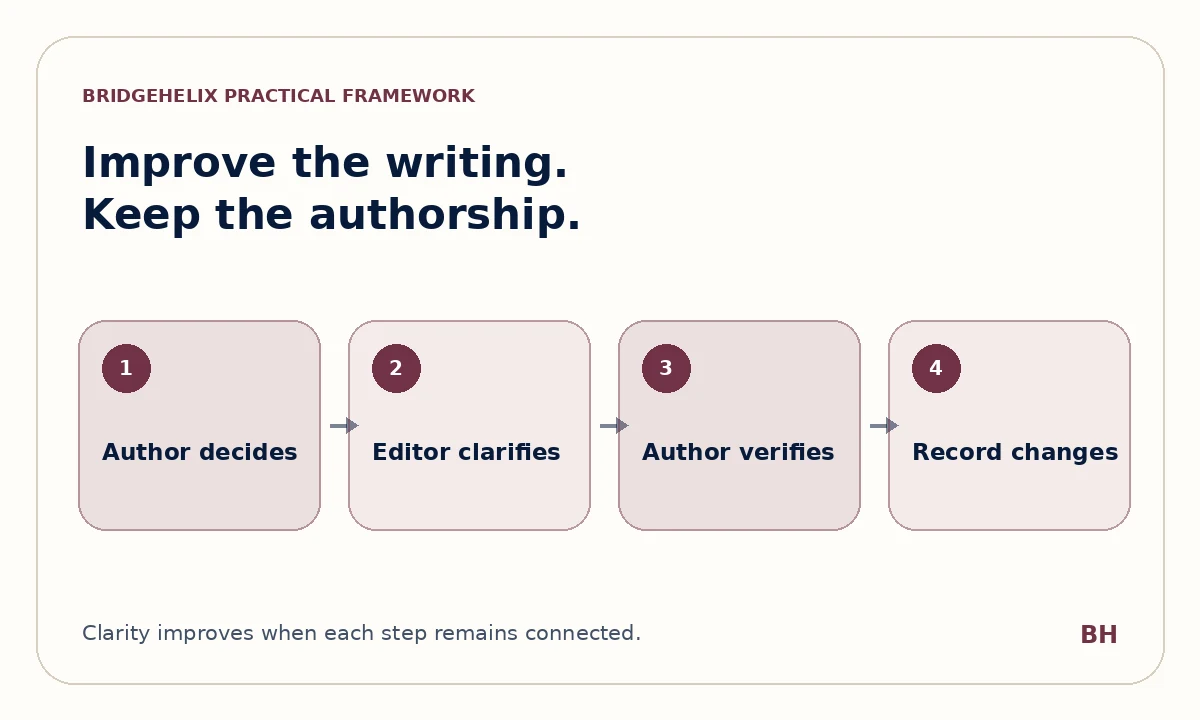
This responsibility boundary applies when AI tools are used as well. Our guide to AI-assisted academic editing and authorship explains why faster rewriting does not remove the need for verification and author control.
Structure is part of research clarity
A manuscript can be grammatically correct and still be difficult to evaluate. The introduction may describe a broad problem but never identify the gap addressed by the study. The methods may include procedures that are not connected to an objective. The discussion may introduce a new claim that was not examined in the results.
Structural editing makes these relationships visible. For example, the editor can map each research objective to the method used, the result produced and the conclusion drawn. If one part of the chain is missing, the researcher can decide whether the text needs clarification or the work itself needs further analysis.
This kind of support does not replace scientific judgement. It helps the author see where the scientific judgement is not yet clear to the reader.
Reviewer-response support has a clear limit
Reviewer comments can be grouped into required revisions, requests for clarification and points where the author may reasonably disagree. A response letter can be made direct, professional and easy to verify against the revised manuscript.
However, the scientific response belongs to the author. An editor can ask, “Which result supports this answer?” or “Has this change been made in the manuscript?” The editor should not fabricate an experiment, reference or technical reason simply to make a response sound complete.
A practical response to reviewers template can improve organisation without changing who is responsible for the answer.
Publication guarantees are not credible
Journal decisions depend on scope, novelty, methodology, evidence, editorial priorities and peer review. Clear writing can help an editor or reviewer understand the work. It cannot control these factors.
This is why “guaranteed publication” is a warning sign. The promise may encourage the researcher to believe that language alone can overcome a weak fit, insufficient evidence or a methodological problem. In some cases, it may also indicate practices that the researcher would not want associated with the work.
A credible service defines the deliverable instead. It may promise a complete language edit, a structural review, a formatting check, comments on unclear reasoning and a final quality-control pass. These are improvements that can be demonstrated. Acceptance cannot be promised honestly.
How to brief an editor without losing control
Provide the manuscript, the target journal or institutional guidelines, the required level of editing and the issues that concern you most. If terminology must remain unchanged, identify it. If a supervisor has already approved the structure, explain which parts should not be reorganised without discussion.
Ask how changes will be shown, whether questions will be placed at the relevant location and what is excluded from the scope. A good editor should be able to explain the process before the document is changed.
The final test is simple. After support, the manuscript should communicate the research more clearly, and the researcher should still be able to explain and defend every important statement. That is not a limitation of ethical editing. It is what keeps the work genuinely yours.

About the author
Dr. Prakash Kumar Singh
Founder & Technical Content Strategist
PhD in Chemical Engineering from MNIT Jaipur, with M.Tech and B.Tech qualifications in Biotechnology. His work connects technical evidence with clear B2B communication and ethical research support.