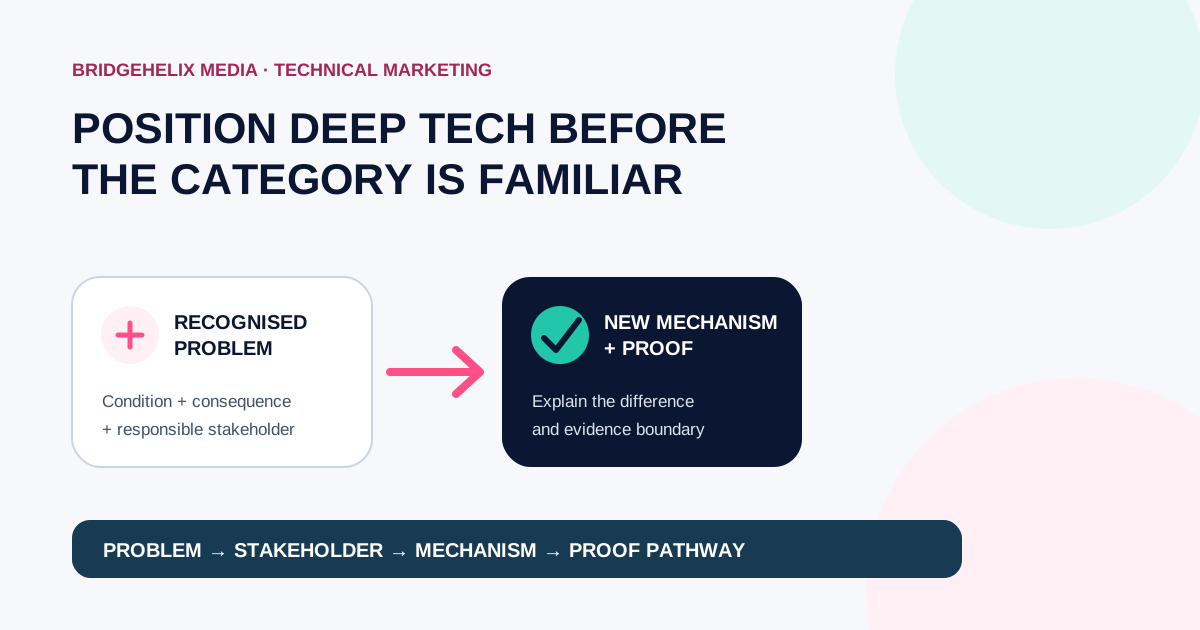
This is a difficult balance. A deep-tech team may have spent years developing a new material, reactor, sensing architecture, biological platform or computational method. The novelty matters. It may support intellectual property, funding and technical advantage.
But the buyer rarely wakes up looking for a category that does not yet have a stable name.
The buyer looks for a way to reduce contamination, improve yield, shorten validation time, meet a regulatory limit, avoid process failure or make an existing system economical. Positioning succeeds when the new technology becomes relevant to that established problem.
Why deep-tech positioning is unusually difficult
Deep-tech companies face several communication constraints at the same time.
First, the technology often has a long path from laboratory proof to commercial operation. Performance may depend on scale, integration, regulation, manufacturing and operating conditions.
Second, the buying decision involves multiple audiences:
- scientists and engineers evaluating mechanism;
- operational leaders evaluating reliability;
- compliance teams evaluating risk;
- finance teams evaluating cost and time;
- investors evaluating defensibility and market size;
- partners evaluating integration and route to market.
Third, the company may be trying to define a category while still learning which application is most commercially useful.
European innovation programmes reflect this gap between scientific promise and market adoption. The European Innovation Council’s Tech to Market Programme (opens in a new tab) explicitly combines business validation, stakeholder connection and venture-building support to help research become a viable deep-tech venture. Technical maturity and market clarity are connected, but they are not the same achievement.
Category creation is not permission to become vague
When no familiar category exists, companies often move toward broad language:
We are building a revolutionary AI-powered platform for a sustainable future.
The sentence signals ambition but provides little information. It does not identify the user, application, mechanism, evidence or practical change.
Another company may move in the opposite direction:
Our proprietary hierarchical mesoporous heterojunction photocatalytic architecture uses bandgap-engineered charge separation.
This may be technically meaningful to a narrow specialist, but it still does not establish why a buyer should continue reading.
The solution is not a compromise sentence that is half vague and half dense. The message needs an order.
- establish the problem and consequence;
- identify the stakeholder and setting;
- explain the mechanism at the level needed to understand the difference;
- present the current proof and the next validation step.
The company can then provide deeper scientific detail for readers who need it.
The four-anchor positioning model
The BridgeHelix four-anchor model positions an unfamiliar technology through problem, stakeholder, mechanism and proof. Category language is added after these anchors are clear.
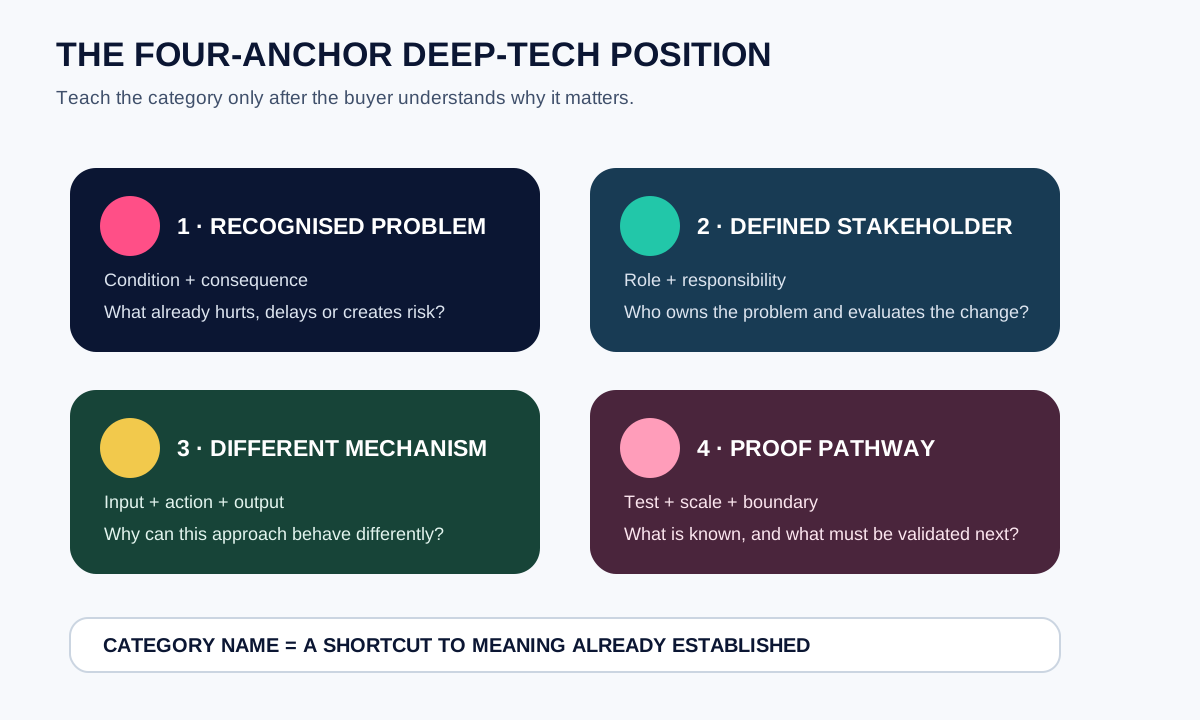
Anchor 1: a recognised problem
The problem should already exist in the buyer’s world, even when the solution category does not.
Weak:
Industrial separation needs innovation.
Stronger:
Battery recyclers lose valuable lithium when conventional separation steps cannot maintain selectivity across variable feed streams.
The stronger version creates an operating context, affected stakeholder and consequence. It also gives the technology something specific to improve.
A useful problem statement contains three elements:
- the condition in which failure occurs;
- the practical consequence;
- the group responsible for dealing with it.
This prevents a common positioning mistake: describing a global challenge so broadly that no individual buyer feels responsible for acting.
Anchor 2: a defined stakeholder
“The market” does not make a decision. People with different responsibilities do.
For the same technology, the primary stakeholder may be:
- a process engineer trying to stabilise performance;
- a plant manager trying to reduce downtime;
- a laboratory director trying to shorten analysis time;
- a sustainability lead trying to verify an environmental claim;
- a product-development team trying to pass a regulatory milestone.
Positioning becomes stronger when it reflects the job, risk and evidence threshold of the first serious adopter.
This does not mean the company must ignore other buyers. It means the central message should not attempt to serve every possible reader with equal weight.
Anchor 3: a differentiating mechanism
Deep-tech buyers need to know why the approach is different. If the mechanism is completely removed, the company sounds like a general software or consulting brand.
The explanation should answer:
- what enters the system;
- what the technology does differently;
- what output or change it produces;
- why that difference matters under the target condition.
For example:
The membrane uses a charge-selective layer to retain lithium ions while allowing competing monovalent ions to pass, reducing the number of downstream purification steps.
The statement is not a complete scientific explanation. It is enough mechanism to connect technical difference with commercial relevance.
Detailed chemistry, modelling, manufacturing and validation can appear on technology, application and evidence pages. A clear technical value proposition controls the order in which those details are introduced.
Anchor 4: a proof pathway
Proof should reflect the company’s actual maturity.
An early-stage startup may have:
- peer-reviewed mechanism evidence;
- laboratory performance;
- reproducibility across batches;
- a prototype;
- pilot results;
- testing in a relevant environment;
- customer validation;
- regulatory or third-party verification;
- full-scale operating data.
These are not interchangeable.
The EIC Transition programme (opens in a new tab) distinguishes experimental proof in a laboratory from maturation and validation in relevant application environments. Marketing should preserve the same distinction.
“Validated technology” is too broad if validation only covers a bench experiment. A more credible statement names:
- what was tested;
- under which conditions;
- against which baseline;
- at what scale;
- with what result;
- what remains untested.
Stating the next validation step can increase confidence because it demonstrates that the company understands the route to adoption.
Choose a category strategy deliberately
An unfamiliar technology does not always need a completely new category. Three strategies are available.
| Strategy | Best used when | Main risk |
|---|---|---|
| Enter an existing category | Buyers already use a budget and evaluation process for similar solutions | The technology may appear only incrementally different |
| Modify an existing category | The buyer recognises the category, but the mechanism or application materially changes it | The modifier may become jargon |
| Create a new category | Existing categories misrepresent both the solution and buying decision | Education cost becomes very high |
Enter an existing category
A novel sensing technology may still be positioned as industrial water monitoring if that is how buyers search, budget and procure. The message then explains why its detection method improves speed, specificity or maintenance.
Modify an existing category
Terms such as “continuous biosensing” or “electrochemical nutrient recovery” may connect novelty with a recognised category. The modifier is useful only if it changes what the buyer should expect.
Create a new category
Category creation may be justified when the solution changes the problem definition, combines previously separate buying processes or produces an outcome unavailable through current approaches.
Even then, the new name should come after the problem is clear. A category label is a compression device. It cannot carry meaning that has never been established.
Build the message at three depths
Deep-tech communication fails when every page uses the same level of detail.
Level 1: orientation
Used on the homepage, pitch introduction and social profile.
Answer:
- who;
- which problem;
- what different approach;
- which practical outcome;
- what proof exists.
Level 2: evaluation
Used on application, solution and product pages.
Explain:
- operating conditions;
- integration;
- performance measures;
- comparison with alternatives;
- implementation requirements;
- limitations.
Level 3: verification
Used in white papers, technical reports, data rooms and scientific publications.
Provide:
- methods;
- datasets;
- statistical treatment;
- test protocols;
- complete results;
- uncertainty;
- references;
- assumptions.
The three levels should agree. Simpler pages may omit detail, but they should not make a claim contradicted by deeper evidence.
Position against the current alternative
An unfamiliar technology becomes easier to understand when compared with what the buyer does today.
The current alternative may be:
- an incumbent technology;
- a manual process;
- outsourced analysis;
- overdesign;
- repeated monitoring;
- accepting loss or risk;
- doing nothing until failure.
Comparison should be fair. Avoid selecting one weakness of the incumbent while ignoring a corresponding limitation of the new technology.
A practical comparison includes:
| Dimension | Current approach | New approach | Evidence status |
|---|---|---|---|
| Performance | What it achieves now | Proposed or demonstrated improvement | Laboratory, pilot or full scale |
| Integration | Existing infrastructure | Changes required | Tested or assumed |
| Time | Current cycle | Expected cycle | Measured or projected |
| Cost | Current cost basis | Expected cost basis | Actual, modelled or unknown |
| Risk | Known operational risk | New technical or adoption risk | Mitigation evidence |
This format prevents the technology from being positioned only through adjectives such as faster, smarter or sustainable.
Match the story to the adoption stage
At an early research stage, the strongest story may be mechanism and potential application. At pilot stage, it may be performance under relevant conditions. At commercial stage, reliability, integration, economics and customer evidence become more important.
A startup should not freeze its positioning at the moment the technology was invented.
As evidence develops, the message should change:
- scientific possibility;
- reproducible technical effect;
- application-specific performance;
- operational reliability;
- commercial and regulatory fit;
- repeatable customer outcome.
The company may also discover that the original target market is not the best one. Positioning should reflect validated learning, not founder attachment to the first use case.
Audit where buyer confidence disappears
Review the current website, pitch and sales material as one sequence.
Ask:
- Does the first message identify a specific problem?
- Can the intended buyer recognise their operating context?
- Is the technology’s mechanism clear enough to establish difference?
- Are proof claims labelled by scale and condition?
- Is the category name defined in plain language?
- Are comparison claims fair and measurable?
- Does the next step match the buyer’s readiness?
If the message moves directly from a global problem to a revolutionary platform, the middle of the argument is missing. A technical messaging audit can locate the exact break rather than merely polishing the headline.
Practical conclusion
Positioning a deep-tech startup before category adoption is not primarily a naming exercise. It is the disciplined work of connecting an unfamiliar mechanism to a recognised problem, responsible stakeholder and credible proof pathway.
The category may evolve as the technology and market mature. The four anchors should remain stable enough that a buyer can understand why the technology matters today and what evidence will be required tomorrow.
BridgeHelix Media provides technical messaging audits for deep-tech, engineering and science-driven companies that need to clarify positioning without removing the mechanism, evidence or limitations that create trust.
Sources

About the author
Dr. Prakash Kumar Singh
Founder & Technical Content Strategist
PhD in Chemical Engineering from MNIT Jaipur, with M.Tech and B.Tech qualifications in Biotechnology. His work connects technical evidence with clear B2B communication and ethical research support.