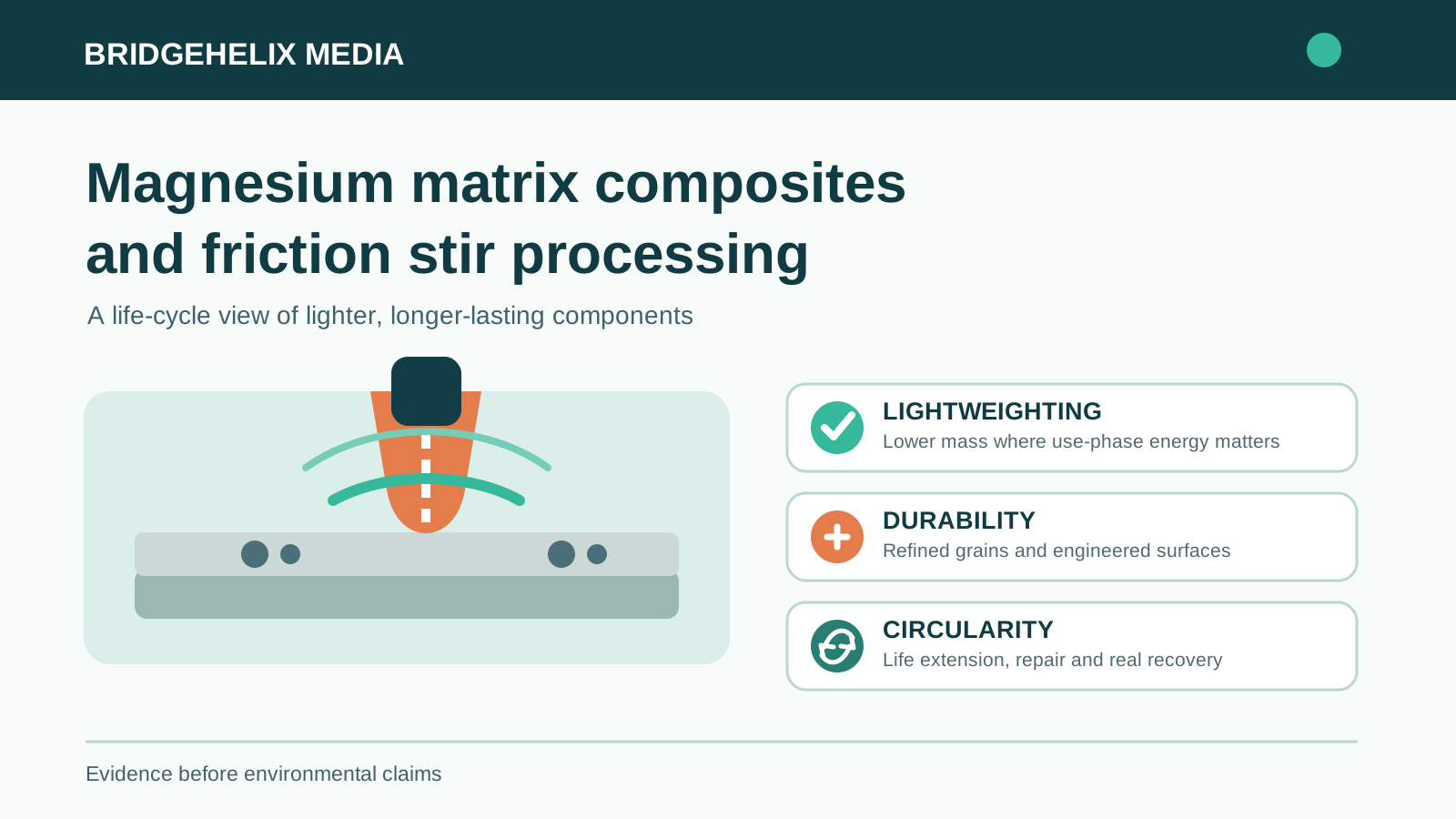
Climate change, resource constraints and the need to reduce industrial energy use have increased interest in materials that can deliver the same function with less mass and a longer service life. This requirement is particularly important in road transportation and aerospace, where the mass of a vehicle influences the energy required during operation.
Magnesium is often presented as an obvious answer. With a density of approximately 1.7–1.8 g/cm³, it is substantially lighter than aluminium and steel. It also has a useful strength-to-weight ratio and can be cast into complex shapes. These properties explain why magnesium alloys are being investigated for vehicle, aerospace, electronics and biomedical components.
However, low density alone does not make a material sustainable. Primary magnesium production can be energy- and emissions-intensive. Magnesium alloys also face limitations involving corrosion, wear, room-temperature formability and high-temperature strength. A lightweight component that fails early, requires protective treatments or cannot be recovered at the end of its life may shift environmental burdens rather than reduce them.
This is where magnesium matrix composites and friction stir processing (FSP) become important. Reinforcement particles can improve selected properties of a magnesium matrix, while FSP provides a solid-state route for refining the alloy and producing surface composites without melting the complete component. The combination is technically promising, but its contribution to a sustainable economy must be assessed across the full product life cycle.
Why lightweighting matters
A moving vehicle requires energy to accelerate its mass. Reducing that mass can lower energy demand, although the exact benefit depends on vehicle type, powertrain, duty cycle and whether secondary systems are resized. The U.S. Department of Energy reports that a 10% reduction in conventional vehicle weight can produce approximately a 6–8% improvement in fuel economy (opens in a new tab). This is a more defensible general estimate than the much larger figures sometimes repeated without conditions.
The benefit is not limited to internal-combustion vehicles. Lower mass can also support electric-vehicle range or allow a smaller battery to provide a required range. In aircraft, every kilogram remains in service across many flights, so a modest mass reduction can create a cumulative operational benefit.
Magnesium has a clear advantage at the material-density level:
| Material group | Approximate density | Lightweighting relevance | Important qualification |
|---|---|---|---|
| Magnesium alloys | 1.7–1.8 g/cm³ | Lowest-density common structural metal | Corrosion, joining, creep and processing must be managed |
| Aluminium alloys | 2.6–2.8 g/cm³ | Established transport lightweighting option | Higher density than magnesium but mature supply and recycling systems |
| Steels | 7.7–7.9 g/cm³ | High strength, stiffness and mature manufacturing | Advanced grades can reduce section thickness, limiting direct density comparison |
| Polymer composites | Varies widely | Very low mass and tailorable properties | Repair, cost and end-of-life separation can be difficult |
This comparison also shows why density cannot be used as the only selection criterion. Components are designed for stiffness, fatigue resistance, crash performance, temperature, corrosion, manufacturability and cost. A magnesium part may need a different geometry from a steel part. The meaningful question is therefore not, “Which material is lightest?” It is, “Which design provides the required function with the lowest life-cycle burden?”
Why conventional magnesium alloys need modification
Commercial magnesium alloys provide useful castability and specific strength, but their wider structural use is constrained by several linked properties.
First, magnesium has a hexagonal close-packed crystal structure. At room temperature, the limited number of easily activated slip systems restricts ductility and formability compared with many cubic metals. Second, some alloys lose strength when exposed to elevated temperatures. Third, inadequate surface protection can allow rapid corrosion in aggressive environments. Wear resistance can also be insufficient for surfaces subjected to repeated sliding or abrasion.
These weaknesses do not apply equally to every alloy or application. They depend on composition, microstructure, processing route, environment and loading. Nevertheless, they explain why researchers have investigated grain refinement, alloying, thermomechanical processing, coatings and particle reinforcement.
In a magnesium metal matrix composite, particles such as SiC, TiC, Al₂O₃, ZrO₂, graphite or other engineered phases are introduced into the magnesium matrix. Their purpose may include:
- restricting grain growth;
- increasing hardness and wear resistance;
- improving high-temperature stability;
- modifying frictional behaviour;
- changing corrosion response;
- improving strength through load transfer and dislocation interactions.
The improvement is not automatic. Hard particles can become crack-initiation sites if they form clusters or bond poorly with the matrix. A reinforcement that improves hardness may reduce ductility. Some particles can also create galvanic interactions that worsen corrosion. The optimum composite therefore depends on the function of the component rather than on maximising reinforcement content.
What friction stir processing changes
Friction stir processing was developed from the principles of friction stir welding. A rotating, non-consumable tool is plunged into the material and moved along the selected region. Frictional heating and intense plastic deformation soften the material below its melting temperature. The tool then stirs and redistributes the material within the processed zone.
The process produces several interacting effects:
- Severe plastic deformation breaks down the original cast or worked microstructure.
- Frictional and deformation heating enables material flow without bulk melting.
- Dynamic recrystallisation generates fine, often equiaxed grains.
- Material stirring can close some casting defects and redistribute secondary phases.
- Particle incorporation can create a local surface composite where improved performance is needed.
The review by Sagar and Handa (opens in a new tab) describes FSP as an increasingly important route for fabricating magnesium-based composites and modifying their microstructure and tribological behaviour. More recent work has continued to examine processing windows, reinforcement systems and the relation between microstructure and performance.
The main distinction is that FSP does not require the entire workpiece to be melted. This can avoid several problems associated with fusion processing, including solidification defects, extensive phase reactions and loss of volatile alloying elements. It also allows modification to be concentrated at a surface or local region rather than replacing the complete component with a more expensive composite.
Is friction stir processing a green process?
FSP is often described as green or environmentally friendly. That description has a reasonable basis, but it requires careful wording.
Compared with bulk melting routes, FSP can offer:
- lower processing temperatures;
- no requirement for filler wire;
- limited process fumes under normal operating conditions;
- no arc radiation;
- little spatter or direct material loss;
- local treatment of the region that requires improved properties;
- opportunities to repair or remanufacture an existing surface.
These are real advantages. They do not make the process emission-free. The machine consumes electricity. Tool production and tool wear have environmental costs. Multiple passes increase energy and time. Reinforcement powders require extraction, synthesis, classification and transport. Surface preparation and post-processing may also be required.
The correct claim is therefore comparative: FSP can reduce some thermal, material and emissions burdens associated with melt-based processing, particularly when it provides a local improvement or extends the life of an existing component. The magnitude of the benefit must be demonstrated for the actual processing route.
Microstructure refinement and performance
The performance of an alloy is strongly influenced by its grain structure, phase distribution, texture and defects. During FSP, dynamic recrystallisation can transform a coarse and heterogeneous cast structure into a fine-grained processed zone. Finer grains commonly increase strength through grain-boundary strengthening, although the final result also depends on texture, precipitate evolution and thermal exposure.
When reinforcement particles are introduced, the stirring action can distribute them through the processed zone. Well-dispersed particles may pin grain boundaries and restrict grain growth. They can also carry part of an applied load and impede dislocation motion.
This combination can improve hardness, wear resistance and selected mechanical properties. For example, studies of AZ31-based surface composites have reported useful changes after incorporating ceramic particles through FSP. However, apparently contradictory results are common because the studies use different:
- alloy compositions and starting microstructures;
- particle materials, shapes and sizes;
- reinforcement fractions;
- groove or hole arrangements used to hold powder;
- tool profiles and shoulder dimensions;
- rotational and traverse speeds;
- numbers of passes and cooling conditions;
- test methods and environmental conditions.
A high hardness value obtained with a large particle fraction cannot be interpreted independently of ductility, porosity, particle clustering and corrosion. This is why a critical literature review (opens in a new tab) must compare operating conditions and evidence quality rather than simply list improvements.
Process parameters decide whether the composite succeeds
FSP depends on a workable balance between heat generation and material flow. Tool rotational speed, traverse speed, plunge depth, tilt angle and tool geometry affect this balance.
If heat input is too low, the material may not flow adequately around the tool. Tunnels, voids or incomplete consolidation can develop. Reinforcement particles may remain concentrated near the original groove. If heat input is excessive, grain growth, undesirable phase changes or surface defects may occur. Very high rotation can also increase tool wear and reduce the economic or environmental advantage.
The important parameters include:
Tool rotational speed
A higher rotational speed generally increases frictional heating and stirring intensity. It may improve flow and particle distribution up to a point. Beyond the appropriate range, excess heat can coarsen the recrystallised structure or produce unstable flow.
Traverse speed
Traverse speed controls how long a region is exposed to the rotating tool. A slower traverse speed generally increases heat input per unit length. A speed that is too high may provide insufficient time for consolidation and distribution.
Tool profile
Threaded, tapered, square and other pin profiles generate different flow patterns. The tool must move material vertically and horizontally while containing it beneath the shoulder. A profile suitable for one alloy, plate thickness or particle system may not be suitable for another.
Number and direction of passes
Additional passes can break up particle clusters and improve homogeneity. They can also add energy, increase processing time and alter the microstructure produced during the first pass. The best number of passes is the lowest number that delivers the required structure and performance.
Reinforcement introduction
Particles are commonly placed in grooves or drilled holes before processing. Poor containment can allow powder loss. Initial placement also influences the distance over which the tool must redistribute the reinforcement.
Optimisation should therefore use several responses at the same time: defect formation, particle distribution, grain size, hardness, tensile behaviour, wear, corrosion, energy consumption and tool condition.
Durability and the circular economy
One of the strongest sustainability arguments for FSP is not the processing temperature itself. It is the possibility of extending service life.
A worn or corrosion-prone surface may cause a complete component to be replaced even when most of its volume remains functional. If local FSP creates a wear-resistant surface or restores a damaged region, the process can preserve the material and manufacturing effort already embodied in the component.
Longer life can reduce:
- demand for replacement parts;
- repeated primary material production;
- machining and assembly;
- transport and inventory;
- downtime associated with failure;
- waste generated by premature disposal.
The benefit must still be measured. Laboratory wear tests are useful, but they do not automatically predict field life. A composite should be tested under representative loads, temperatures, lubricants, contaminants and contact conditions. Corrosion–wear interaction is particularly important for magnesium because mechanical damage can remove protective surface films.
Biomedical applications require a different sustainability argument
Magnesium-based materials are also investigated for biodegradable orthopaedic and cardiovascular devices. In this case, degradation can be a desired function rather than a failure. A temporary implant that provides mechanical support and then safely degrades may reduce or eliminate the need for a second removal operation.
This possibility could reduce patient burden, medical resources and waste. Yet the technical requirements are demanding. The degradation rate must match healing. Hydrogen evolution, local chemistry, mechanical integrity, biological response and the effects of reinforcement particles must be understood.
It is therefore inappropriate to treat every magnesium matrix composite as suitable for biomedical use. Reinforcement selection and processing history must be evaluated specifically for biocompatibility and controlled degradation. The sustainability case depends on clinical performance, not merely biodegradability.
The four-gate sustainability test
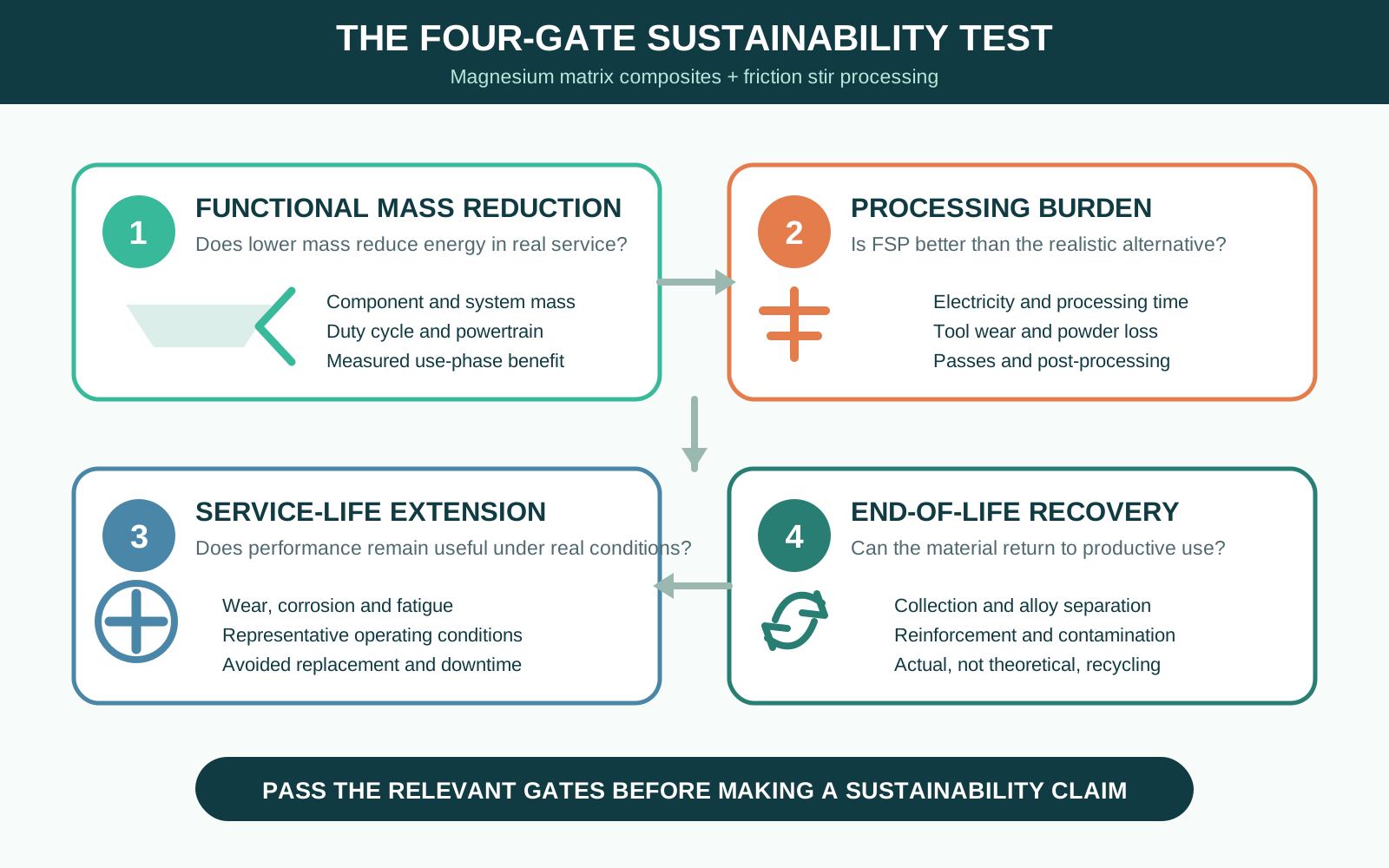
Magnesium, reinforcement and FSP should be assessed as a connected system. A useful evaluation can be organised into four gates.
Gate 1: Does lightweighting reduce the functional burden?
Calculate the mass saved at component and system level. Then estimate the use-phase benefit under the actual duty cycle. A stationary component may gain little environmental value from low mass, while an aircraft or frequently accelerated vehicle can gain much more.
Gate 2: Is the processing burden lower?
Measure electricity, processing time, number of passes, powder loss, tool wear and post-processing. Compare FSP with the realistic alternative, not with an undefined “conventional process.” The alternative may be stir casting, coating, heat treatment, component replacement or no modification.
Gate 3: Does the component last longer?
Demonstrate improvement under conditions that represent service. Record not only hardness or short-duration wear but also fatigue, corrosion, thermal stability and failure mode. A modest performance improvement that doubles service life may be more valuable than a very high laboratory value that is not stable.
Gate 4: Can the material be recovered?
Identify how the alloy and reinforcement affect sorting, remelting and recycled-metal quality. Magnesium is recyclable, but actual recovery depends on collection infrastructure, contamination, alloy separation, oxidation control and economic demand. A technically recyclable material is not necessarily recycled in practice.
The material should be called a sustainable option only when it passes the gates relevant to its intended application. This prevents low density or solid-state processing from being used as a substitute for life-cycle evidence.
Remaining challenges
Several issues must be addressed before FSP magnesium composites become routine high-volume solutions.
Scale and productivity: Laboratory studies often process small plates at low traverse speeds. Industrial adoption requires consistent results across larger surfaces, complex geometries and realistic production rates.
Tool life: Hard ceramic particles can accelerate wear. Tool material, geometry, cooling and replacement frequency influence cost, contamination and environmental performance.
Process monitoring: Temperature, force, torque and acoustic or vibration signals could help detect unstable flow and defects. Closed-loop control would reduce rejected parts and make processing more reproducible.
Property balance: Research frequently highlights hardness or wear while providing limited information on ductility, fatigue and corrosion. Industrial decisions require a complete property profile.
Life-cycle inventory: Many studies call FSP green without reporting energy use, tool consumption, powder loss or avoided component replacement. Comparable inventory data are needed.
Recycling: The influence of ceramic and hybrid reinforcements on remelting, melt cleanliness and secondary alloy properties requires greater attention.
Future research should combine process optimisation with life-cycle and techno-economic assessment. The best rotational speed is not only the speed that produces the highest hardness. It is the setting that reliably produces the required performance with acceptable energy, time, tool wear and scrap.
Practical implications for researchers and manufacturers
For researchers, the central requirement is to connect microstructure to function and function to environmental value. A strong study should report the starting material, tool geometry, complete parameters, thermal history, particle distribution, defects and a balanced set of properties. Claims of sustainability should identify the comparison basis and boundary.
For manufacturers, FSP is particularly attractive when performance is limited at a surface or local region. Local processing may avoid producing the complete component from a costly composite. It can also support repair, remanufacture or life extension. Pilot studies should include production rate, repeatability, inspection, tool cost and integration with existing manufacturing steps.
For technical communicators, this subject shows why sustainability claims require scientific discipline. “Lightweight,” “recyclable” and “solid-state” are useful characteristics, but they do not prove a lower total impact. Scientific content writing (opens in a new tab) should explain the mechanism, comparison and boundary behind each claim.
Conclusion
Magnesium matrix composites and friction stir processing offer a credible pathway towards lighter and more durable components. Magnesium provides the mass-reduction opportunity. Reinforcement particles can address wear, strength and stability limitations. FSP can refine the microstructure and create a local composite without melting the complete workpiece.
These characteristics support sustainable manufacturing only under defined conditions. Primary material production, reinforcement manufacture, machine electricity, tool wear, component performance and end-of-life recovery all contribute to the final result. The process should therefore be described as potentially lower-burden and resource-efficient, not automatically emission-free.
The strongest opportunity lies in matching the technology to applications where low mass has a measurable use-phase benefit and local surface improvement produces a substantial life extension. When those gains are demonstrated across the four sustainability gates, namely functional mass reduction, processing burden, service life and recovery, magnesium–FSP systems can contribute meaningfully to a more circular and lower-emission economy.
References
Asadi, P., Besharati Givi, M.K. and Faraji, G. (2010). Producing ultrafine-grained AZ91 from as-cast AZ91 by friction stir processing. Materials and Manufacturing Processes, 25(11), 1219–1226.
Darras, B.M. (2012). A model to predict the resulting grain size of friction-stir-processed AZ31 magnesium alloy. Journal of Materials Engineering and Performance, 21(7), 1243–1248.
Dinaharan, I., Zhang, S., Chen, G. and Shi, Q. (2020). Titanium particulate reinforced AZ31 magnesium matrix composites with improved ductility prepared using friction stir processing. Materials Science and Engineering: A, 772, 138793.
Kandpal, B.C., Johri, N., Kumar, L., Tyagi, A., Joshi, V. and Gupta, U. (2022). Stir casting technology for magnesium-based metal matrix composites for bio-implants: A review. Materials Today: Proceedings, 62, 4519–4525.
Marode, R.V., Lemma, T.A., Sallih, N., Pedapati, S.R., Awang, M. and Hassan, A. (2024). Research progress in friction stir processing of magnesium alloys and their metal matrix surface composites: Evolution in the 21st century (opens in a new tab). Journal of Magnesium and Alloys, 12, 2091–2146.
Mazaheri, Y., Jalilvand, M.M., Heidarpour, A. and Jahani, A.R. (2019). Tribological behavior of AZ31/ZrO₂ surface nanocomposites developed by friction stir processing. Tribology International, 143, 106062.
Rezaeian-Delouei, M., Abdollah-Pour, H., Tajally, M. and Mousavizadeh, S.M. (2019). An investigation of microstructure, wear and corrosion resistance of AZ31B–SiO₂–graphite hybrid surface composite produced by friction stir processing. Materials Research Express, 6(11), 1250a7.
Sagar, P. and Handa, A. (2020). A comprehensive review of recent progress in fabrication of magnesium base composites by friction stir processing technique (opens in a new tab). AIMS Materials Science, 7(5), 684–704.
Frequently asked questions
Why is magnesium useful for sustainable transportation?
Magnesium is the lowest-density common structural metal. Replacing a heavier component with a properly designed magnesium component can reduce vehicle mass and operational energy use. The benefit depends on the component, vehicle, duty cycle and life-cycle burden of producing and protecting the magnesium part.
Is friction stir processing emission-free?
No. FSP avoids bulk melting and does not use an electric arc, so it can avoid some burdens associated with fusion processing. It still consumes electricity and tools, and the reinforcement particles also have production impacts. Its environmental advantage must be demonstrated relative to a specific alternative.
What is the difference between a magnesium alloy and a magnesium matrix composite?
A magnesium alloy contains alloying elements dissolved in the matrix or present as phases formed through alloy chemistry and processing. A magnesium matrix composite contains a deliberately introduced reinforcement, often particles or fibres, intended to modify properties such as wear resistance, hardness or thermal stability.
Does friction stir processing improve corrosion resistance?
It can improve corrosion behaviour by refining the microstructure, reducing some defects and redistributing phases. It can also worsen corrosion if reinforcement particles create galvanic effects, clusters or defects. The result depends on the alloy, particles, process parameters and test environment.
Can friction stir processing be used for repair?
FSP can be useful for local surface modification, defect reduction and remanufacturing strategies. Whether it is suitable for a particular repair depends on component geometry, damage type, required properties and the ability to inspect and qualify the processed region.

About the author
Dr. Prakash Kumar Singh
Founder & Technical Content Strategist
PhD in Chemical Engineering from MNIT Jaipur, with M.Tech and B.Tech qualifications in Biotechnology. His work connects technical evidence with clear B2B communication and ethical research support.