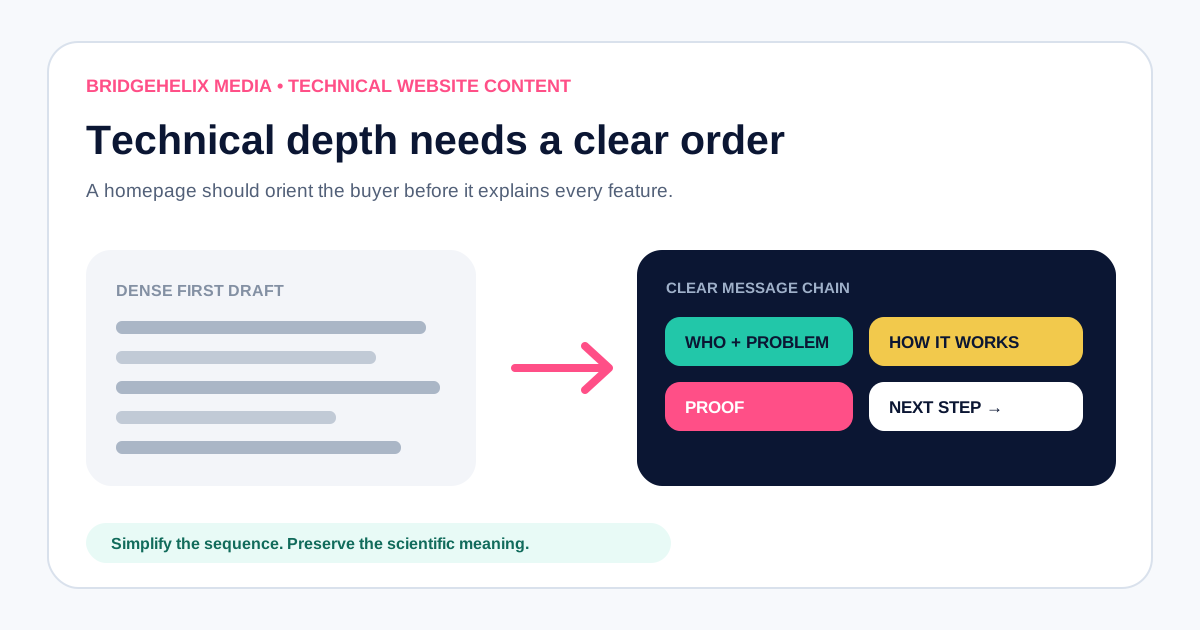
Many technical companies have the opposite structure. The homepage begins with a broad claim such as “innovating a sustainable future,” followed by a list of proprietary platforms, acronyms and capabilities. The scientific content may be accurate, yet a first-time visitor cannot determine whether the offer applies to a laboratory, manufacturer, utility, hospital or research organisation.
The problem is not that buyers dislike technical detail. A technical buyer often needs more evidence than a general consumer. The problem is that detail is presented before the buyer has a reason to interpret it.
What a homepage has to do
A homepage is an orientation page. It must serve visitors who arrive with different levels of awareness:
- a technical specialist checking whether the mechanism is credible;
- a business leader assessing commercial relevance;
- a procurement or compliance stakeholder examining risk;
- a researcher looking for an application or collaboration;
- a candidate, investor or partner trying to understand the company.
One page cannot answer every question in full. It should provide a clear central message and route each serious visitor to the next relevant page.
This is why the homepage should not be treated as a compressed technical brochure. A brochure can assume that the reader already has context. A homepage often has to create that context.
The five-layer technical homepage framework
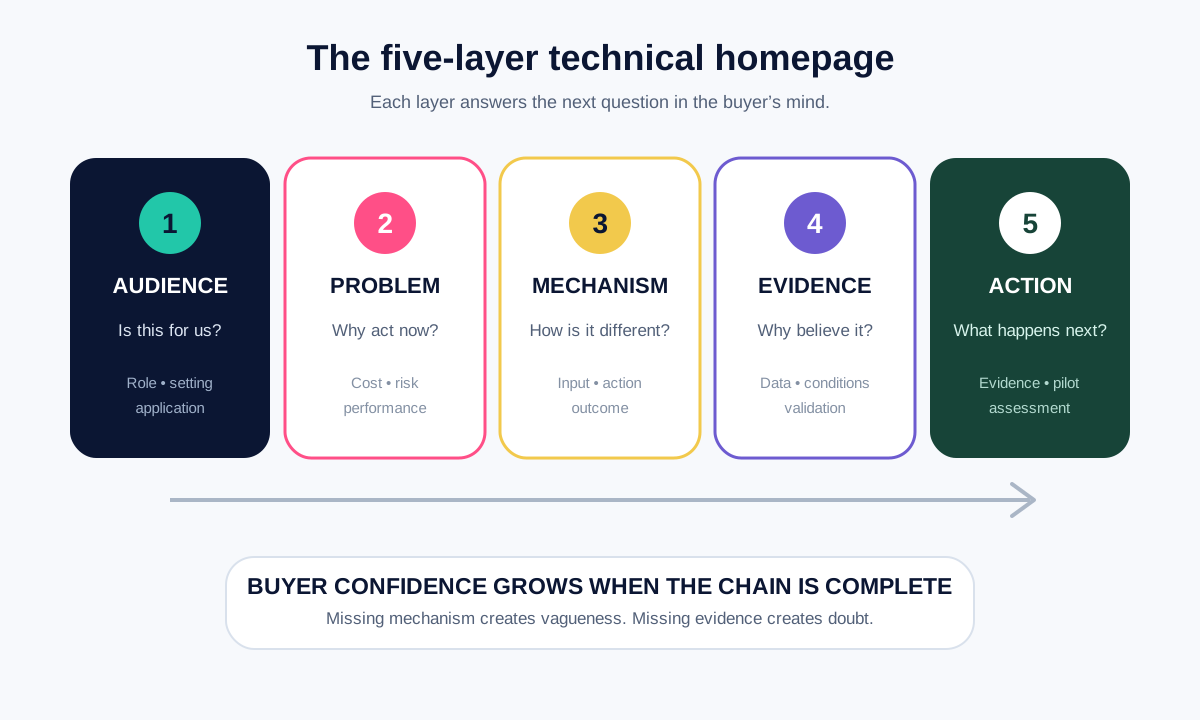
The five layers are audience, problem, mechanism, evidence and action. They form a chain. If one link is missing, buyer confidence falls.
1. Audience: who should recognise themselves?
“We help businesses” is usually too broad. “We help pharmaceutical quality teams reduce manual investigation time” is more useful because it identifies both the reader and the operating context.
Audience does not always need to be expressed as an industry label. It may be defined by:
- process responsibility;
- application;
- stage of development;
- operating environment;
- regulatory burden;
- technical constraint.
For example, an engineering company may serve many industries but address one common situation: high-solids wastewater streams that conventional treatment cannot manage reliably. The situation can be a stronger audience signal than a long industry list.
2. Problem: what is difficult, costly or risky?
The problem should be stated with enough specificity that the right buyer recognises it. Generic statements such as “today’s complex challenges” fail because almost any company could use them.
A technically meaningful problem includes a consequence:
- unstable performance under variable feed conditions;
- slow identification of contamination sources;
- low yield during process scale-up;
- lack of reproducible data across sites;
- excessive energy consumption at required treatment levels;
- manual documentation that delays regulatory review.
The consequence connects the technical issue to time, cost, risk, compliance or performance. This is the point where commercial meaning begins.
3. Mechanism: how does the approach work?
The homepage does not need the complete method, but it must contain enough mechanism to distinguish the offer from a generic promise.
Weak:
Our advanced platform transforms complex data into actionable insights.
Stronger:
Our models combine sensor data with process conditions to identify the variables driving yield loss before the next production run.
The stronger statement explains inputs, action and outcome. It also creates questions that deeper pages can answer: which sensors, what models, how quickly and with what validation?
For a scientific company, mechanism is a credibility signal. Removing it in the name of simplicity can make the message sound less believable.
4. Evidence: why should the visitor believe it?
Evidence should appear close to the claim it supports. Useful proof may include:
- validated performance under stated conditions;
- number and type of deployments;
- comparison with a relevant baseline;
- peer-reviewed or independently assessed results;
- regulatory status;
- named customer evidence, where permitted;
- a case study with operating context and limitations.
“Industry-leading,” “breakthrough” and “revolutionary” are descriptions made by the company. They are not evidence.
A 30% reduction in processing time is stronger, but it still needs context. Was it observed in a controlled test or an operating plant? Compared with which baseline? Across how many runs? Technical buyers do not merely look for a number; they look for the conditions that make the number meaningful.
5. Action: what should the visitor do next?
“Learn more” makes the visitor decide what the link means. A better action reflects the next stage of evaluation:
- review treatment applications;
- examine validation data;
- compare platform capabilities;
- discuss a pilot study;
- request a technical assessment;
- view the case study.
Descriptive link text also helps users and search engines understand the destination. Google recommends concise, relevant anchor text that sets an expectation for the linked page (Google Search Central (opens in a new tab)).
What should appear in the first visible section?
The first visible section should normally contain:
- a clear primary heading;
- a short explanation of audience, problem and approach;
- one primary action;
- one proof signal or a route to evidence;
- a visual that supports the message rather than competing with it.
The main heading does not need to include every keyword or product feature. It needs to identify the page’s central promise. Google’s title guidance similarly recommends making the main title distinctive and prominent so that both users and search systems can understand the primary subject (Google Search Central (opens in a new tab)).
A weak and stronger example
Assume a company produces an electrochemical system for industrial wastewater.
Weak first section:
Transforming water through next-generation innovation
Our proprietary, sustainable and intelligent platform delivers unmatched outcomes for a cleaner tomorrow.
The statement sounds positive but provides almost no decision value.
Stronger first section:
Electrochemical treatment for industrial wastewater that remains difficult after biological processing
Reduce persistent colour and organic load using a modular treatment stage designed for variable industrial effluent. Review operating data or discuss a pilot for your wastewater stream.
The second version is not perfect for every company, but it establishes application, problem, mechanism category and next step. The supporting page can then explain electrodes, energy demand, contaminant range, sludge generation, maintenance and scale-up.
How the homepage should change by sector
The five-layer framework remains consistent, but the evidence and risk emphasis changes.
| Sector | Buyer’s first concern | Mechanism detail needed early | Strong proof signal |
|---|---|---|---|
| Biotech | Scientific validity and development stage | Biological target, platform or workflow | Validation, reproducibility, regulatory or clinical status |
| Engineering | Fit with operating conditions | Process, equipment and integration logic | Performance under relevant load, scale and duration |
| Environmental technology | Treatment boundary and secondary impacts | Removal, separation or destruction mechanism | Mass balance, energy, residuals and real-water evidence |
| Scientific software | Data inputs, model validity and workflow fit | Analysis method and integration | Benchmark, validation dataset and user outcome |
| Technical services | Scope, expertise and deliverable | Method of assessment or execution | Relevant project example and accountable expertise |
This is why copying a software homepage formula onto a biotech or treatment-technology site often fails. The layout may be modern, but the evidence logic is wrong.
Technical depth should be layered, not removed
The homepage can remain concise when it routes readers to deeper content:
- service pages explain what the company does and how work is delivered;
- solution pages connect capabilities to a defined problem or buyer situation;
- application pages show fit with a process, industry or use case;
- technology pages explain mechanism, architecture or scientific basis;
- evidence pages present validation, case studies, publications and limitations;
- resource pages answer longer educational questions.
This layered structure also reduces pressure to place every detail on the homepage.
Google’s current guidance recommends people-first content that demonstrates first-hand expertise and provides a satisfying experience rather than content created primarily to attract search traffic (Google Search Central (opens in a new tab)). For a scientific company, first-hand expertise is often visible through conditions, decision criteria, limitations and evidence, not through repeated claims of innovation.
Common homepage messaging failures
The category is never explained
The company assumes visitors already understand a new technology category. If the category is emerging, define it in one plain sentence before introducing product-specific terminology.
The page describes the company before the buyer’s situation
History, mission and team matter, but they rarely provide the fastest route to relevance. Start with the situation the buyer needs to resolve, then show why the company is qualified.
Features appear without consequences
“Automated sample preparation” is a feature. “Automated sample preparation reduces operator-dependent variation across runs” begins to explain its value. The claim should then be supported with evidence.
Benefits appear without mechanism
“Faster, safer and more sustainable” could describe hundreds of offers. Explain what physically, biologically, chemically or operationally creates the improvement.
Proof is isolated on another page
If the homepage makes an important performance claim, place a proof signal nearby and link to the full evidence. Do not make the visitor search for a reason to believe the message.
Every visitor receives the same call to action
A buyer early in evaluation may not be ready to “book a demo.” Provide a credible lower-commitment route such as viewing validation data, applications or a technical case study.
A practical homepage audit
Read only the homepage heading, opening paragraph, first proof point and primary action. Then answer:
- Can a first-time visitor identify the intended audience?
- Is the problem concrete enough to recognise?
- Is the approach distinguishable from a generic consultancy or platform?
- Does the proof support the specific claim?
- Does the action describe what happens next?
Next, ask a technical specialist and a commercial colleague to repeat the company’s offer in one or two sentences. If their explanations differ substantially, the homepage is creating multiple interpretations.
This is the same confidence problem examined in a technical messaging audit (opens in a new tab). The purpose is not to make every visitor use identical words. It is to ensure that audience, problem, mechanism and value remain consistent.
Practical conclusion
A technical homepage should simplify the order of information, not simplify the science beyond recognition.
Start with the audience and the problem. Explain enough of the mechanism to make the offer distinct. Support the central claim with evidence under meaningful conditions. Then give the visitor a specific next step and route deeper questions to focused pages.
BridgeHelix Media provides technical website content (opens in a new tab) for scientific and engineering companies that need to balance subject depth, search structure and buyer clarity.
Frequently asked questions
How much technical detail should a homepage contain?
Include enough to identify the mechanism and establish credibility. Move specifications, methods, validation data and implementation detail to focused pages, but do not replace the mechanism with vague benefits.
Should a technical homepage target scientists or business buyers?
It should establish one consistent message that both can navigate. The page can then route scientific, operational, commercial and procurement readers to evidence appropriate to their questions.
What is the most important homepage heading?
The H1 should clearly express the page’s central subject or value. It should be distinctive, descriptive and consistent with the title and opening explanation.
Should “Book a demo” be the only call to action?
Usually not for a complex offer. Provide a high-intent action and at least one evidence-led route, such as viewing validation data, applications or a case study.

About the author
Dr. Prakash Kumar Singh
Founder & Technical Content Strategist
PhD in Chemical Engineering from MNIT Jaipur, with M.Tech and B.Tech qualifications in Biotechnology. His work connects technical evidence with clear B2B communication and ethical research support.