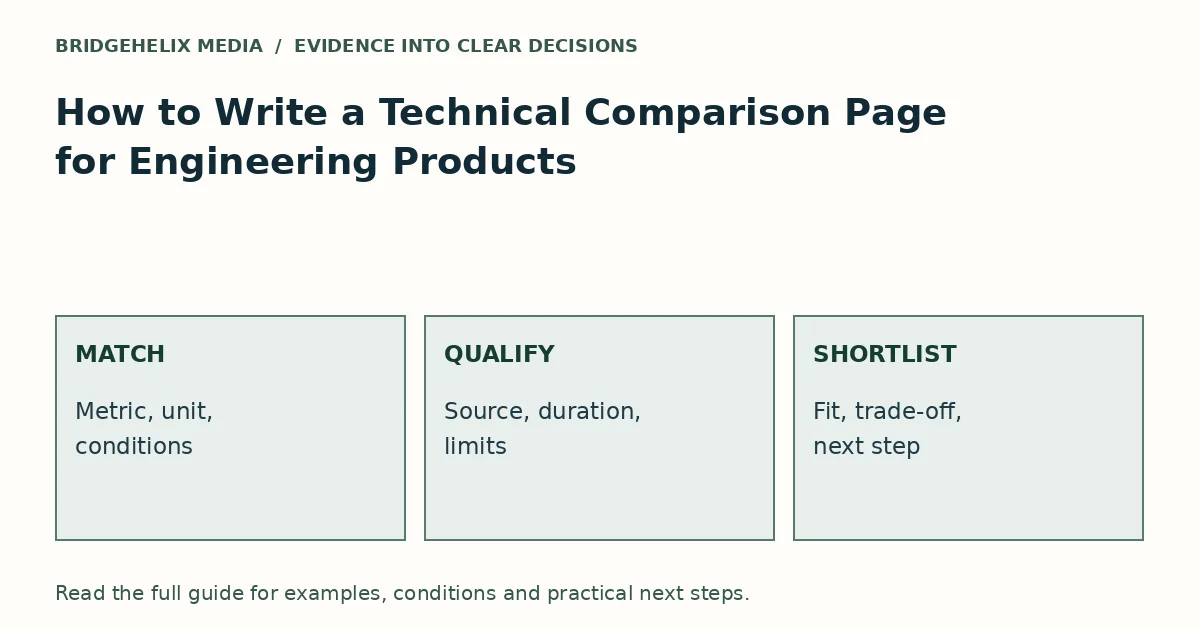
The difficulty is that product evidence is rarely collected on an identical basis. One supplier reports a maximum capacity, another reports a typical operating value, and a third publishes only a laboratory result. Putting those figures in neighbouring cells does not make them comparable. The page needs to explain the basis before offering a recommendation.
Choose a real decision to compare
Start with the application rather than the list of specifications. A comparison between two separation technologies might focus on a particular feed, desired outlet condition, throughput range and maintenance constraint. A comparison between instruments might focus on the measurement task, sample preparation and the skills available to the operator.
This does not require claiming that one approach is universally better. Often the most useful outcome is a clear statement that different conditions favour different choices. A technically knowledgeable buyer will recognise that distinction and can use it to decide what information to request next.
If the page is mainly about selecting an approach for a problem, it may belong within a solution journey. If it describes the work a provider offers, a service page may be more appropriate. Our service page versus solution page guide explains how to keep those purposes clear.
Set the comparison boundary in the introduction
Give the reader a short description of the intended use and the factors that change the answer. For example: “This comparison considers continuous operation with a variable industrial feed. It focuses on evidence requirements, operating inputs and maintenance access.” That boundary prevents a reader from applying the conclusion to an unrelated setting.
State what the page does not have enough evidence to compare. If verified cost data are unavailable, explain the cost components a buyer should request. An empty evidence field is a research task, not permission to insert an attractive number.
For named competing products, identify the exact model or version, source date and source document. A specification from an older model should not silently describe the current product. When the source changes, update the affected comparison and record the review date.
Build the table around questions buyers ask
A good comparison table groups genuinely equivalent information. It also distinguishes reported specifications from independently demonstrated performance. Both can be useful, but they should not be presented as the same kind of evidence.
| Buyer question | Information needed | What to avoid |
|---|---|---|
| Will it handle our process? | Feed, range, throughput and exclusions | Comparing only maximum capacity |
| How strong is the evidence? | Test method, setting and source | Treating laboratory and field results as equivalent |
| What does operation require? | Utilities, consumables and operator tasks | Calling a system low-maintenance without a basis |
| What happens when conditions change? | Operating limits and documented response | Implying untested flexibility |
| What does ownership cost? | Common period, scope and assumptions | Comparing purchase price with total operating cost |
Keep the table short enough to scan. Explain the important qualifications in the surrounding paragraphs. If every cell becomes a paragraph, split the comparison into application fit, evidence and operation rather than shrinking the text until nobody can comfortably read it.
Use a claim-matching check before choosing a winner
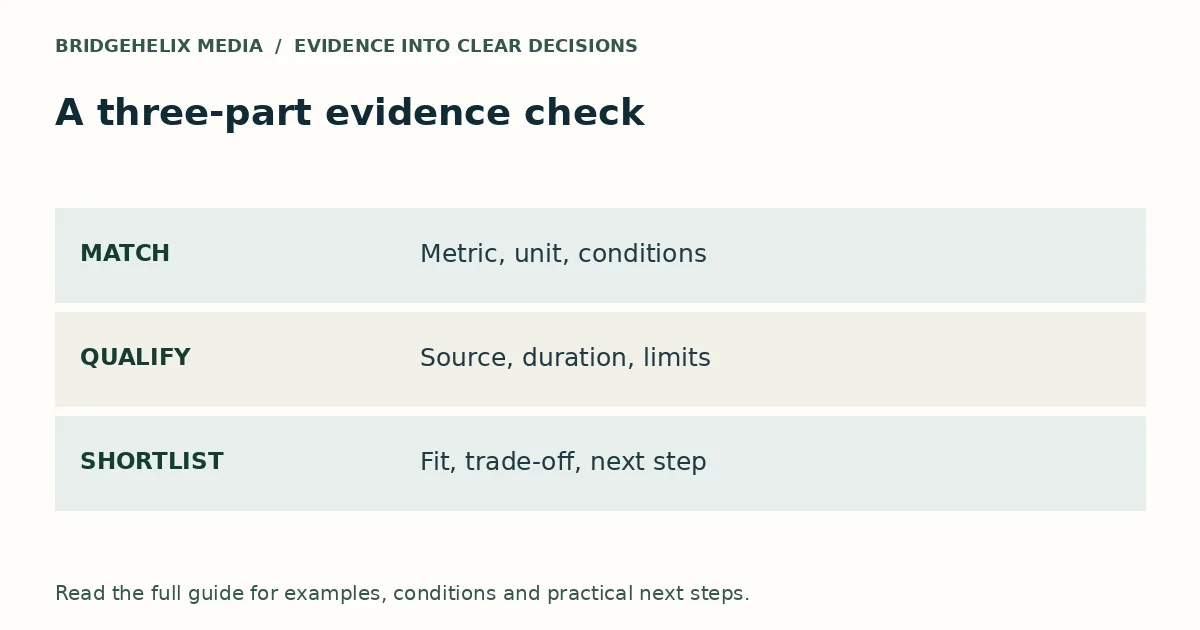
For each numerical comparison, check the metric, unit, conditions, duration and evidence source. If any of those differ materially, decide whether the difference can be reconciled. Sometimes a conversion is straightforward; sometimes the underlying tests answer different questions.
Consider an illustrative comparison in which Product A reports 95% removal in prepared water while Product B reports 88% in a variable industrial stream. The page cannot conclude that A is more effective for the industrial application. The result may reflect the technology, the feed, operating settings or several factors together.
The useful next sentence is a request for comparable evidence: ask both suppliers for data using an agreed feed range and outlet target. Explain what the currently available figures establish and leave the ranking open. These percentages are invented examples, not product evaluations.
The same discipline applies to claims about scale. A successful small test does not automatically establish full-scale operating performance. Our guide to scale-up evidence can help decide which qualifications belong beside a technical claim.
Explain trade-offs in plain language
A specification becomes commercially useful when the page explains its consequence. A smaller footprint might help where installation space is constrained, but only if access for operation and maintenance remains adequate. A lower purchase price may be attractive while still leaving an unresolved question about consumable replacement.
Use conditional statements when the answer depends on the buyer's situation. “This option may suit sites with limited installation space, subject to access requirements” is more informative than “the ideal compact solution.” The qualification is part of the guidance.
Avoid inventing weaknesses in competing approaches to make the preferred product look stronger. Where an alternative has a documented advantage, explain the condition under which that advantage matters. A comparison earns trust by helping the buyer make a defensible choice, including when the choice is to request more evidence.
Make the evidence easy to follow
Link a material claim to its supporting document near the claim itself. Provide a document title and enough context to distinguish a supplier specification, an independent test and an internal demonstration. If a document cannot be shared, say what evidence can be reviewed during a technical discussion without implying public verification.
Define abbreviations when they first appear and use the same terms throughout the page. Keep units visible in table headings. If a value is estimated, label it where it appears, not only in a general note at the bottom.
Before publication, ask an engineer to review the comparability of the evidence and ask a colleague unfamiliar with the product to explain the main trade-off. If the first person finds a mismatched test and the second cannot identify a next step, the page still needs work.
Give the buyer a proportionate next step
End by asking for the information needed to narrow the choice: feed characteristics, desired output, available utilities or installation constraints. A request to share process requirements is often more useful than an immediate purchase-oriented call to action for a complex system.
A comparison page is successful when it reduces uncertainty without hiding what remains unknown. BridgeHelix's technical website content service helps engineering teams turn scattered specifications and evidence into pages that support that decision.

About the author
Dr. Prakash Kumar Singh
Founder & Technical Content Strategist
PhD in Chemical Engineering from MNIT Jaipur, with M.Tech and B.Tech qualifications in Biotechnology. His work connects technical evidence with clear B2B communication and ethical research support.