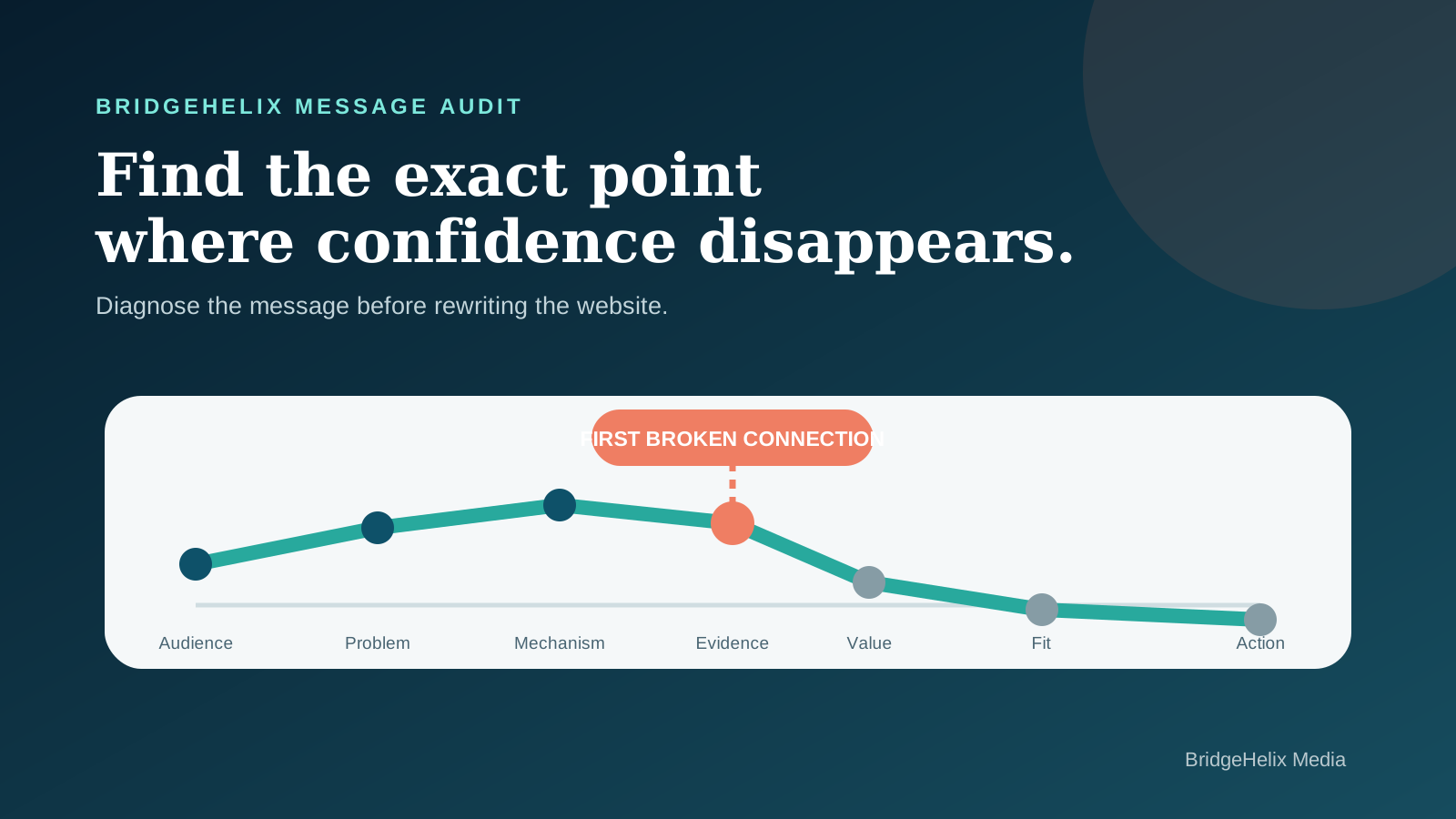
A technically strong website can still fail in the first thirty seconds.
The science may be valid. The engineering team may have solved a difficult problem. The product page may contain specifications, diagrams and performance figures. Yet the buyer leaves without requesting a conversation.
It is tempting to call this a conversion problem and change the button colour. Often, the loss happened much earlier.
This distinction is important because a website rewrite can make unclear positioning sound smoother without making it more useful.
Why technical companies describe products from the inside out
Teams close to a technology naturally begin with what took the most effort to build.
They mention the proprietary architecture, specialised material, algorithm, reactor configuration or analytical method. These details matter. They may be the reason the product performs differently.
But they are not always the first information a buyer needs.
A buyer normally enters through a practical question:
- Can this solve the problem under my operating conditions?
- Is it suitable for my application or industry?
- What changes in cost, risk, time, quality or compliance?
- What evidence is relevant to my situation?
- What would implementation require?
If the page begins with mechanism before establishing context, the buyer has to translate the technology into commercial meaning. Some technical readers will do that work. Many will not.
Current B2B research makes this more serious. Gartner reported in March 2026 that 67% of surveyed B2B buyers preferred a rep-free experience, based on a survey of 646 buyers conducted in 2025. This does not mean buyers never want human guidance. It means the website must carry more of the early explanation without a salesperson present.
The same research noted that buyers use AI during purchases. Whether the visitor arrives through conventional search, an AI-generated answer, a referral or LinkedIn, the underlying requirement remains the same: the public information has to be internally consistent and decision-useful.
A messaging audit is not a grammar check
Grammar can be correct while the message is still weak.
A technical messaging audit examines relationships:
- audience and problem;
- problem and mechanism;
- mechanism and claimed outcome;
- outcome and evidence;
- evidence and operating conditions;
- page promise and next action.
The audit asks whether each relationship is visible, defensible and placed in the right order.
This is why BridgeHelix defines a technical messaging audit (opens in a new tab) as a diagnosis of positioning, audience clarity, problem framing, value communication, evidence, terminology, page hierarchy and calls to action. The result should be a prioritised decision document, not a list of stylistic preferences.
The buyer-confidence chain
A useful audit can be built around six links.
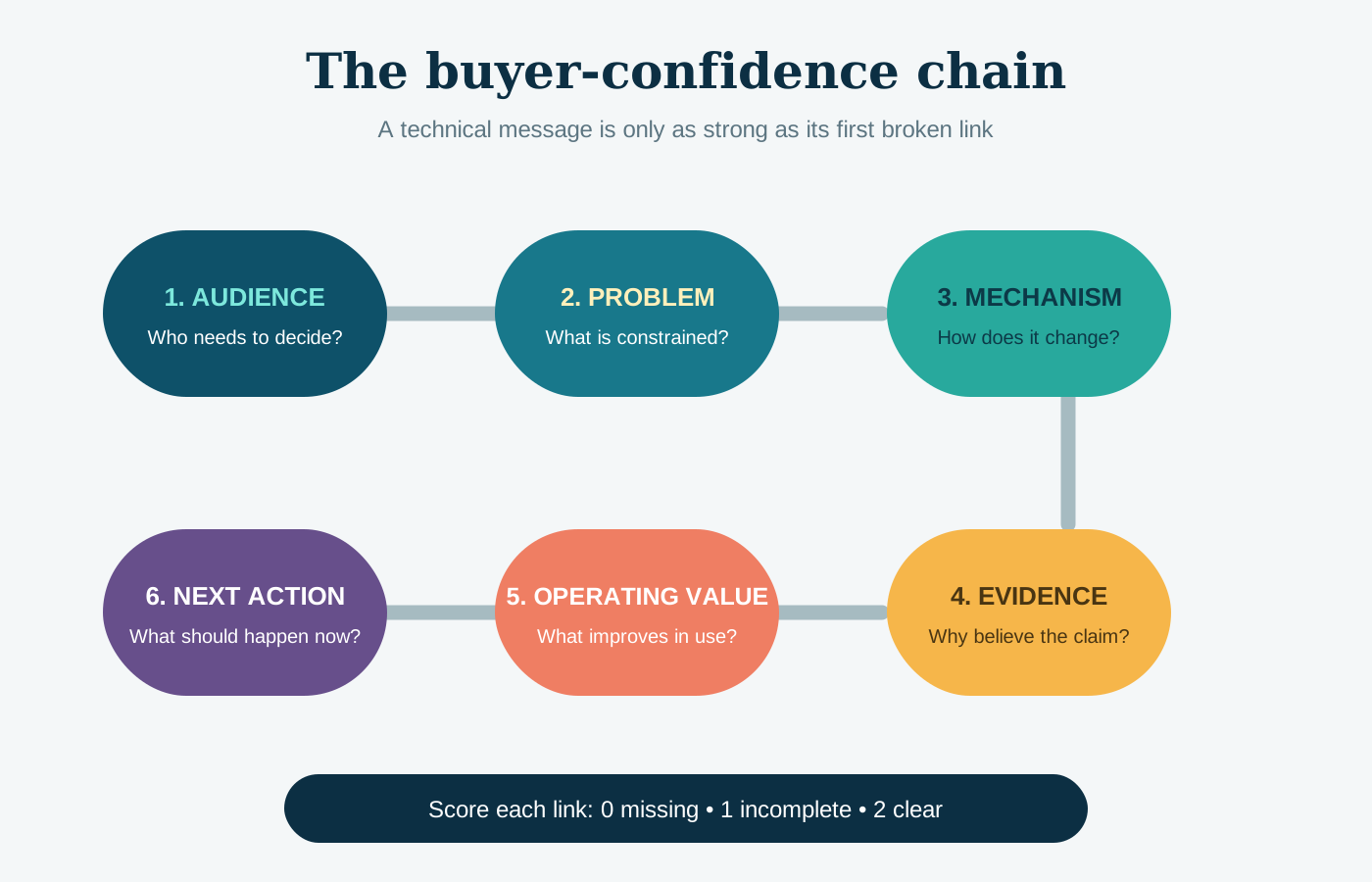
1. Audience
Can the right reader recognise themselves?
“Advanced solutions for modern industries” includes almost everyone and therefore speaks clearly to no one. A biotechnology platform may need separate context for scientists, business-development teams, investors and procurement, even when the underlying technical truth remains the same.
Audit questions:
- Is the primary audience named or strongly implied?
- Does the page assume the correct level of technical knowledge?
- Are different buyers forced through one undifferentiated explanation?
2. Problem
Is the operational or scientific problem specific?
“Improve efficiency” is not a problem statement. Which process is inefficient? What constraint creates the loss? Is the issue throughput, detection limit, fouling, manual interpretation, scale-up uncertainty or approval risk?
The problem should be recognisable before the product is introduced.
3. Mechanism
Does the page explain how the offer changes the situation?
Removing all technical detail is not the answer. A buyer needs enough mechanism to judge plausibility and fit. The error is either beginning too deep or hiding behind phrases such as “AI-powered,” “next-generation” and “innovative platform.”
A good mechanism statement names the relevant action without requiring the visitor to read an internal technical report.
4. Evidence
Is the proof connected to the claim?
A website may contain impressive numbers that do not answer the buyer's question. “Up to 99% removal” is incomplete without contaminant concentration, water matrix, pH, dose, contact time and endpoint. “Three times faster” requires a baseline and test conditions.
Evidence should clarify:
- what was measured;
- against which comparison;
- under what conditions;
- using which method; and
- with what limitation.
The audit also looks for the opposite problem: a page overloaded with evidence before the reader knows why the data matters.
5. Operating value
Can the reader connect the technical result to a practical consequence?
Higher surface area is a property. Increased adsorption capacity may be a performance outcome. Lower material requirement, longer bed life or fewer changeouts may be operating value.
The relationship must be defensible. A technical feature should not be converted into a financial promise unless cost and operating evidence support it.
6. Next action
Does the page ask for a step proportionate to the buyer's readiness?
A visitor learning about a complex platform may not be ready to “Buy now.” They may be ready to review application data, compare requirements, request an assessment or discuss a specific use case.
The call to action should complete the explanation, not interrupt it.
Score the chain to find the first break
A simple scoring system keeps the audit from becoming subjective.
Score each link from 0 to 2:
| Score | Meaning |
|---|---|
| 0 | Missing, contradictory or unsupported |
| 1 | Present but vague, misplaced or incomplete |
| 2 | Clear, relevant and defensible |
The total score is useful, but the first low score matters more.
Suppose a homepage scores:
| Link | Score |
|---|---|
| Audience | 2 |
| Problem | 1 |
| Mechanism | 2 |
| Evidence | 2 |
| Operating value | 0 |
| Next action | 1 |
The website contains a credible mechanism and proof, but it never explains why the result changes the buyer's operation. Adding more evidence will not fix the missing value connection. The first priority is to make the problem more specific and then translate the supported outcome into practical meaning.
This is an original diagnostic use of the chain: do not average away a broken link.
Audit pages in the order a buyer experiences them
Do not begin with every page. Follow the most valuable path: homepage, primary product or service page, application page, evidence page and contact page.
For each page, record the first visible promise, audience, problem, mechanism, proof point, practical outcome and requested action. Location matters. A clear statement hidden halfway down a page cannot repair confusion created in the opening screen.
Compare website language with sales conversations
A messaging audit should not treat the website as an isolated object. Compare it with sales decks, proposals and product sheets. Check whether the same offer is described by different names, whether the homepage sells speed while the proposal sells cost, or whether marketing speaks to executives while the product page assumes a specialist engineer.
Ask sales and technical teams what qualified buyers misunderstand, which claim requires the most explanation and what evidence changes confidence. Repeated answers reveal where public messaging is not doing enough work.
Weak and stronger messaging: a technical example
Feature-led version
Our advanced modular platform combines proprietary algorithms with real-time analytics to deliver next-generation optimisation.
The sentence sounds technical but communicates little. The audience, system, problem, evidence and practical result are missing.
Decision-led version
Identify unstable process conditions before they reduce batch quality. The platform analyses live reactor data and flags deviations against validated operating ranges, helping process teams investigate the cause before the next production decision.
The second version is not automatically true. It must be checked against the actual system and evidence. But it gives the reviewer something concrete to verify:
- Does the platform analyse live reactor data?
- Are operating ranges validated?
- Are alerts early enough to support a decision?
- Is the claimed user the process team?
Clearer wording improves technical review because vague claims can hide weak reasoning.
Common audit mistakes
Changing “innovative” to “transformative” does not clarify an offer. Neither does removing all technical depth. Put the decision-relevant meaning first, then give informed readers the mechanism, evidence and limitations.
Do not treat all visitors as one persona. Complex B2B decisions involve visible and hidden buyers, so the website should provide technical proof, commercial meaning and implementation context. Do not rewrite before diagnosing, either: a full rewrite can spread an unresolved positioning problem across more pages.
Finally, traffic is not proof of clarity. Visitors can find a page and still leave confused. Search visibility, engagement, qualified inquiries and sales feedback answer different questions.
Google's guidance also favours helpful, reliable, people-first content with original information and clear authorship. A messaging audit supports that objective when it makes expertise easier to verify, but it should not be presented as a guaranteed ranking tactic.
What should the audit deliver?
A practical technical messaging audit should produce:
- the buyer-confidence chain score for important pages;
- annotated examples of missing, vague or unsupported connections;
- contradictions across pages and sales assets;
- a prioritised list based on impact and implementation effort;
- representative rewritten examples;
- a staged next-step plan.
The audit should distinguish diagnosis from implementation. Some problems need one revised headline. Others require a new application page, better evidence presentation or a decision about positioning.
When implementation is required, technical content writing (opens in a new tab) can translate approved technical material into pages and articles without flattening the underlying subject.
Conclusion: repair the first broken connection
Technical buyers do not lose confidence only when a claim is false. They also lose confidence when they cannot work out who the product is for, why the mechanism matters, whether the proof applies or what implementation involves.
The practical recommendation is to audit the homepage and highest-value product page using the six-link chain. Score each link, find the first 0 or 1, and fix that connection before adding more pages or more traffic.
If your technology is strong but prospects repeatedly misunderstand its value, request a technical messaging audit from BridgeHelix Media (opens in a new tab).
The audit starts at a different point when the company has not yet decided which market it belongs in. In that case, clarify deep-tech positioning and the market category before judging whether the website explains its value consistently.
Sources
- Gartner (2026). Gartner Sales Survey Finds 67% of B2B Buyers Prefer a Rep-Free Experience (opens in a new tab).
- Edelman and LinkedIn (2025). B2B Thought Leadership Impact Report (opens in a new tab).
- Google Search Central. Creating helpful, reliable, people-first content (opens in a new tab).

About the author
Dr. Prakash Kumar Singh
Founder & Technical Content Strategist
PhD in Chemical Engineering from MNIT Jaipur, with M.Tech and B.Tech qualifications in Biotechnology. His work connects technical evidence with clear B2B communication and ethical research support.