
A manuscript is 1,200 words above the journal limit. The deadline is tomorrow. The quickest response is to delete parts of the Methods, combine several Results paragraphs and remove the limitations. The paper becomes shorter, but it also becomes harder to assess and easier to misinterpret.
To reduce a research paper's word count safely, first confirm what the journal counts. Then protect the evidence spine: research question, necessary method, principal result, interpretation and limitation. Remove duplicated results, repeated background, generic transitions and low-value literature summaries before compressing methodological detail. Every cut should improve the ratio of evidence to words, not merely make the document shorter.
The objective is not minimum length. The objective is sufficient information with no avoidable repetition.
Confirm the real word-count rule
Open the target journal’s current instructions and record:
- maximum word count;
- article type;
- whether the abstract is included;
- whether tables, captions and references are included;
- limits for the abstract, references, figures and tables; and
- whether supplementary methods or data are allowed.
Word-count rules vary across journals and article types. Springer Nature advises authors to check the selected journal’s submission guidance and notes that papers should remain concise for reviewers and readers. Some journals exclude references, tables or legends; others count them. Do not remove 500 words before discovering that your reference list was never part of the limit.
Create a section budget from the words that actually count.
| Section | Current words | Target words | Planned reduction |
|---|---|---|---|
| Abstract | 310 | 250 | 60 |
| Introduction | 1,050 | 750 | 300 |
| Methods | 1,600 | 1,500 | 100 |
| Results | 1,700 | 1,450 | 250 |
| Discussion | 2,300 | 1,850 | 450 |
| Conclusion | 340 | 250 | 90 |
The budget prevents the Introduction from remaining overlong while the Methods are cut beyond usefulness.
Protect the evidence spine
Before deleting, write one sentence for each of these elements:
- What problem or gap did the study address?
- What was done to answer it?
- What was the principal result?
- What does that result support?
- What important condition limits the interpretation?
If a proposed cut removes information required to understand one of these five sentences, stop. The wording may be compressible, but the information is necessary.
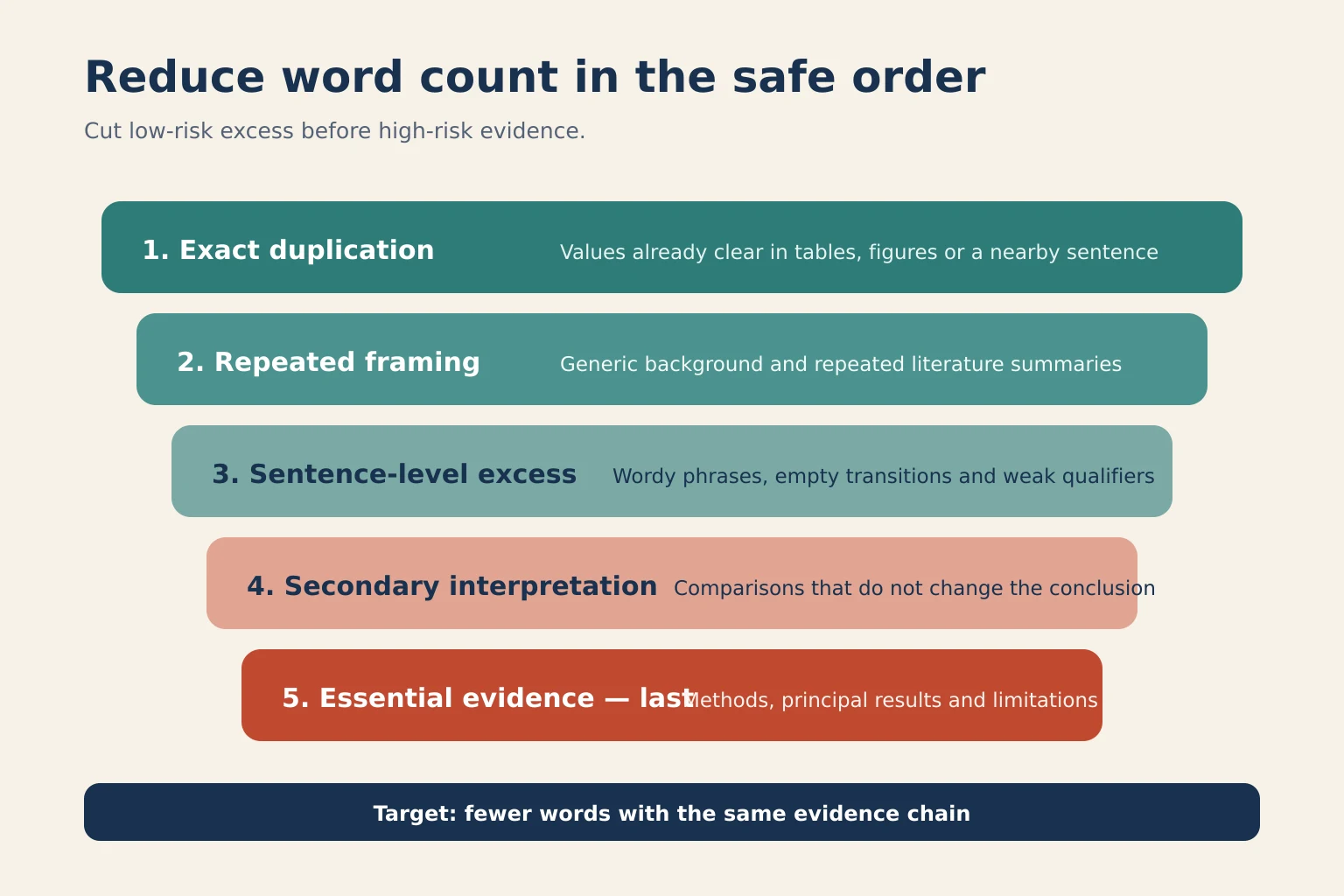
Cut in the correct order
The safest reduction sequence is:
- exact duplication;
- repeated framing;
- generic statements;
- low-value literature detail;
- sentence-level excess;
- secondary interpretation;
- supplementary technical detail where the journal permits; and
- only then, carefully compress essential methods or results.
Methods, principal results and limitations should not become the first source of cuts simply because their paragraphs are long.
Step 1: remove duplication between text, tables and figures
Results sections frequently repeat every table value in prose.
Before:
Fluoride removal was 76.2% at 1 g/L, 88.4% at 2 g/L, 95.1% at 3 g/L, 96.3% at 4 g/L and 98.4% at 5 g/L, as shown in Figure 3.
After:
Removal increased rapidly up to 3 g/L and changed comparatively little at higher doses (Figure 3).
The figure preserves the values. The sentence identifies the pattern and decision point. This is a real reduction, not a loss of evidence.
Check for:
- table titles repeated in the paragraph;
- every category value listed in prose;
- identical interpretation in Results and Discussion;
- conclusion sentences copied from the abstract; and
- the same study limitation stated in several places without a new purpose.
Some repetition is functional. The abstract must stand alone, and a central conclusion may appear in both the abstract and conclusion. Remove mechanical repetition, not necessary orientation.
Step 2: compress the Introduction around the unresolved problem
An overlong Introduction often contains a broad history of the field but does not reach the precise gap quickly.
Use four jobs:
- establish the practical or scientific problem;
- summarise what is known;
- identify what remains unresolved; and
- state what the study did.
Delete paragraphs that provide background but do not help the reader understand the research question, method choice or contribution.
Before:
Water is essential for life and is used by humans for drinking, agriculture, industry and several other purposes. Water pollution is a serious problem across the world, and many pollutants can affect water quality.
After:
Fluoride concentrations above the applicable drinking-water limit remain a groundwater concern in several regions.
The revised version begins at the level of the actual study.
Literature review compression
Do not allocate one sentence to every paper. Group comparable studies by method, result or limitation.
Before: five sequential study summaries.
After:
Calcium-, alumina- and biomass-based adsorbents have shown fluoride uptake under batch conditions, but cross-study comparison remains difficult because initial concentration, pH, dose and equilibrium time vary substantially [4–9].
Retain individual detail only when it establishes the gap, justifies the method or supports the discussion.
Step 3: shorten Methods through structure, not omission
Methods become shorter when repeated conditions are centralised.
Instead of repeating “at 30°C, 180 rpm and pH 6.5” for five experiments, define the common conditions once and state only deviations in each subsection.
Use:
- a materials table for grades, suppliers and identifiers;
- an experimental matrix for factor levels;
- a standard procedure followed by named variations;
- equations instead of wordy calculation descriptions; and
- supplementary material for extended validation detail when allowed.
Do not remove:
- sample selection;
- controls and replicates;
- key materials and instrument settings;
- measurement definitions;
- statistical procedures;
- ethical or consent information; or
- conditions needed to interpret the result.
A shorter Methods section that no longer supports evaluation is not editorial improvement.
Step 4: separate Results from Discussion
When the journal uses separate sections, duplicated interpretation often appears in both.
The Results should answer: What was observed?
The Discussion should answer: What does the observation mean, how does it compare and what limits the inference?
Move long explanations of mechanism, comparison and implication out of the Results. In the Discussion, do not repeat the full result before interpreting it.
Long version:
The adsorption capacity decreased from 3.22 mg/g in the single-ion system to 2.42 mg/g in the binary-ion system. This decrease from 3.22 mg/g to 2.42 mg/g shows that the presence of nitrate reduced fluoride adsorption capacity in the binary-ion system.
Short version:
Fluoride capacity decreased from 3.22 to 2.42 mg/g in the presence of nitrate, consistent with competitive adsorption.
The value, condition and interpretation remain.
Step 5: reduce sentence-level excess
Search for phrases that add length without meaning.
| Wordy form | More direct form |
|---|---|
| due to the fact that | because |
| it is important to note that | delete or state the point |
| a total of 24 samples were collected | 24 samples were collected |
| in order to determine | to determine |
| has the ability to remove | removes, when demonstrated |
| it can be clearly observed from Figure 2 that | Figure 2 shows |
| at this point in time | currently or delete |
| in the case of the treated samples | in treated samples |
Also combine sentences that repeat the same subject, but do not create a 60-word sentence merely to reduce connecting words.
Step 6: reduce the Discussion without hiding uncertainty
Keep one paragraph for each principal finding:
- state the finding;
- explain the likely interpretation;
- compare it with relevant evidence;
- identify an alternative explanation or limitation; and
- state the bounded implication.
Remove literature comparisons that do not change interpretation. Avoid repeating broad background from the Introduction. Do not remove limitations to save space; integrate each limitation beside the affected claim.
Weakly shortened:
The system performed well and may be suitable for large-scale use.
Concise and supportable:
The column maintained the target effluent concentration for the reported bed depth and flow rate; longer operation and real-water validation are required before scale-up.
The second sentence is only slightly longer, but it carries evidence and boundary conditions.
Use a deletion ledger for high-risk cuts
When reducing several hundred words, track removed content.
| Cut ID | Location | Content removed | Reason | Evidence effect | Destination |
|---|---|---|---|---|---|
| C-01 | Introduction | Generic global background | Not needed for gap | None | Deleted |
| C-02 | Methods | Instrument calibration detail | Too detailed for main text | Preserved | Supplement |
| C-03 | Results | Values repeated from Table 2 | Duplication | None | Table retained |
| C-04 | Discussion | Third similar comparison | Low interpretive value | None | Deleted |
The ledger is useful when co-authors disagree or a later reviewer asks for omitted detail.
Final word-count safety check
After reaching the target, verify:
- the abstract still reports the main method, result and conclusion;
- every objective has a corresponding result;
- every result has a sufficient method;
- all tables and figures are cited and interpreted;
- key operating or experimental conditions remain;
- limitations have not disappeared;
- abbreviations were not introduced merely to save a few words;
- supplementary material is cited and will be submitted; and
- the manuscript satisfies the relevant reporting guideline.
Ask a co-author to read only the shortened version. If the reader repeatedly needs the older manuscript to understand what happened, the reduction removed necessary information.
Practical conclusion
To shorten a research paper, remove repetition before evidence and framing before reproducibility. Use a section budget, protect the evidence spine and record high-risk deletions. Concision should make the scientific argument easier to verify.
BridgeHelix Media provides PhD-led research manuscript editing (opens in a new tab) for researchers who need to reduce length while preserving methods, results, limitations and their natural author voice. We can also complete a broader pre-submission manuscript review (opens in a new tab) when word count is only one part of the problem.
Sources
- Springer Nature: Is there a word limit for journal articles? (opens in a new tab)
- Springer Nature: Structuring your manuscript (opens in a new tab)
- Springer Nature: Preparing a manuscript for submission (opens in a new tab)
- ICMJE: Preparing a Manuscript for Submission (opens in a new tab)
- EQUATOR Network: Reporting guidelines (opens in a new tab)
For the shortest submission summaries, see research highlights with worked examples. The same principle applies: compress wording before removing essential conditions.

About the author
Dr. Prakash Kumar Singh
Founder & Technical Content Strategist
PhD in Chemical Engineering from MNIT Jaipur, with M.Tech and B.Tech qualifications in Biotechnology. His work connects technical evidence with clear B2B communication and ethical research support.