
An engineering company has a twelve-page datasheet containing pressure limits, flow curves, materials, dimensions, certifications and test conditions. The website product page contains four lines: “high performance,” “advanced design,” “easy integration” and “contact us.”
The technical evidence exists, but the buyer cannot use it.
To turn a technical datasheet into a product page, keep the datasheet as the controlled factual source. Extract specifications, test conditions, limitations and approval status into a claim ledger. Then organise the page around buyer decisions: application fit, performance conditions, integration, compliance, procurement and next step. Translate a specification into practical meaning only when the connection is defensible and keep the operating boundary beside the benefit.
A product page is not a shortened datasheet. It is a decision layer built from the same evidence.
Understand the different jobs
The datasheet and product page should agree, but they solve different reading problems.
| Datasheet job | Product-page job |
|---|---|
| Record controlled specifications | Help the buyer assess fit quickly |
| Provide detailed technical reference | Explain why selected specifications matter |
| Support engineering verification | Route different readers to relevant detail |
| Preserve versioned product data | Create a clear, evidence-based next step |
Do not paste the complete datasheet into the page. Do not replace it with promotional claims either. Keep the downloadable datasheet and build an accurate HTML path toward it.
Start with a controlled source pack
Before writing, collect:
- current approved datasheet and revision number;
- product drawings and dimensional files;
- test reports and performance curves;
- certifications and their scope;
- installation and operating manual;
- material compatibility information;
- approved product images;
- standard and optional configurations;
- procurement information;
- warranty or support terms; and
- technical owner for each specification.
If two files disagree, do not choose the number that looks better. Record the conflict and obtain an approved source.
Create a fact and claim ledger
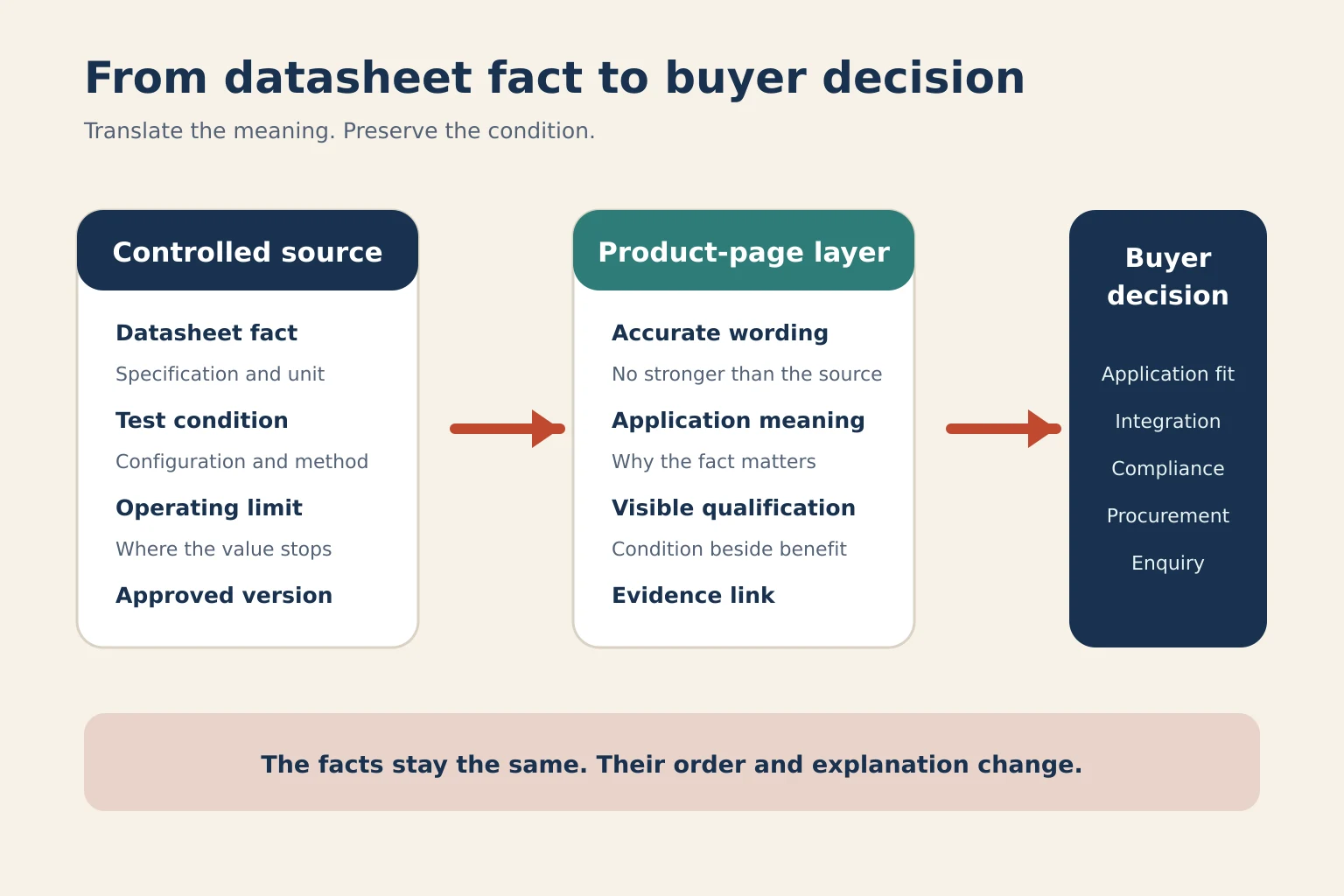
For every page statement that could affect selection, record:
| Field | Example |
|---|---|
| Source fact | Maximum operating pressure: 10 bar |
| Source and version | Datasheet DS-14, Rev 6, Table 2 |
| Conditions | 20°C; specified housing and seal configuration |
| Proposed page wording | Rated for operation up to 10 bar under the specified configuration |
| Buyer meaning | Can be screened against the line’s operating-pressure requirement |
| Limitation | Temperature derating and transient conditions require review |
| Owner | Product engineering |
| Status | Approved / query / rejected |
The ledger prevents an editor from converting “tested at 10 bar” into “reliable in any high-pressure application.”
The FTC states that objective product and service claims, including implied claims, require a reasonable basis. Requirements vary by jurisdiction and product category, but the practical content rule is broader: do not publish a benefit that the source material does not support.
Convert specifications into decision meaning
Technical buyers need the value, not only the number. However, value translation must preserve conditions.
Use this pattern:
Specification + condition + application meaning + boundary
Example: pressure rating
Datasheet fact: Maximum working pressure 10 bar at 20°C.
Weak copy: Built for demanding high-pressure environments.
Stronger copy: Rated for working pressures up to 10 bar at 20°C, allowing engineers to screen the standard configuration for compatible process lines. Confirm temperature derating, seal selection and transient pressure with the technical team.
Example: particle retention
Datasheet fact: Nominal retention 5 µm under the stated test method.
Weak copy: Removes all particles for ultra-clean output.
Stronger copy: Available with a nominal 5 µm retention option measured using the stated test method. Selection should consider particle distribution, required capture efficiency, fluid properties and allowable pressure drop.
“Nominal,” “absolute” and “tested at” are not decorative qualifiers. They change the meaning.
Example: material
Datasheet fact: 316L stainless-steel wetted housing.
Weak copy: Corrosion-proof construction.
Stronger copy: The standard wetted housing uses 316L stainless steel. Chemical compatibility depends on fluid composition, concentration, temperature, exposure time, weld condition and seal material.
The stronger version helps application screening without creating a universal corrosion claim.
Build the page in decision layers
Different readers enter with different questions. The page should let each reader go deeper without forcing everyone through the entire specification table.
Layer 1: identify the product and use case
The opening should answer:
- What is it?
- Which process or application problem does it address?
- For which systems is it designed?
- What is the principal evidence-backed differentiator?
Avoid “revolutionary solution” language. A useful H1 names the product category and application.
Sanitary In-Line Filter Housing for Low-Volume Process and Pilot Systems
Layer 2: state fit boundaries early
Add a compact “Designed for / Check before selection” block.
Designed for: stated fluid type, flow range, connection standard and operating mode.
Check before selection: pressure-temperature combination, material compatibility, cleanability, required retention and local certification.
This reduces poor-fit enquiries and signals technical credibility.
Layer 3: connect features to consequences
Use three to five evidence-backed feature blocks.
| Feature | Technical consequence | Buyer question answered |
|---|---|---|
| Tool-free clamp access | Housing can be opened without specified hand tools after safe isolation | What does routine access involve? |
| Replaceable seal options | Configuration can be selected for documented compatibility requirements | Can it suit our process fluid? |
| Published pressure-drop curve | Engineers can screen expected hydraulic effect under stated test conditions | What will it do to the line? |
Do not add a benefit merely because a competitor uses it. If the consequence is not supported, keep the statement as a feature.
Layer 4: provide a readable specification table
Group specifications by decision:
- performance;
- operating limits;
- materials;
- dimensions and connections;
- utilities;
- compliance; and
- ordering options.
W3C accessibility guidance recommends using correct header and data-cell relationships in tables. Keep tables simple, use real HTML headings and avoid presenting the only version of important data inside an image.
For variable specifications, show the configuration to which each value applies. A single “maximum” column can become misleading when pressure, temperature, material and connection size interact.
Layer 5: explain evidence and test conditions
Place curves, test summaries and method notes near the related claim.
For a performance curve, identify:
- medium;
- temperature;
- product configuration;
- clean or loaded condition;
- instrument or method where relevant;
- number of tests or source report; and
- whether the curve is typical, guaranteed or illustrative.
If the page claims “30% lower pressure drop,” the comparator and test basis must be visible.
Layer 6: answer integration and procurement questions
Include:
- available connections and sizes;
- installation orientation;
- footprint or drawing link;
- standard versus optional components;
- maintenance and consumables;
- documentation supplied;
- lead-time or quotation process, if approved; and
- support contact.
A procurement reader should not have to infer whether the illustrated configuration is standard.
Layer 7: use a specific CTA
“Learn more” does not tell a technical buyer what happens next.
Better CTAs include:
- Check This Product Against My Operating Conditions
- Request the Datasheet and Selection Review
- Discuss Material and Seal Compatibility
- Ask for a Configuration Quote
The form should request only information needed for routing: application, fluid or sample, target flow, pressure, temperature, connection and relevant compliance requirement.
A worked page outline
H1: Product category + application
Opening answer: what it does, for whom, under which main boundary
Primary CTA: request an application-fit review

Designed for / check before selection

Three evidence-backed differentiators

How the product fits the process
[simple process or installation visual]

Performance under stated test conditions
[curve, result summary and limitation]

Technical specifications
[accessible grouped table]

Materials, compatibility and operating limits

Options, documentation and ordering

Downloads
[datasheet, drawing, certificate or manual]

Application enquiry
[structured form]
This structure keeps decision-critical information on the page while preserving the datasheet as the controlled reference.
Keep the HTML and datasheet aligned
Assign a product-content owner and revision process.
When a datasheet changes:
- identify every affected web claim;
- update tables, body copy, metadata and downloads;
- recheck product images and configuration captions;
- record the web-review date;
- obtain technical approval; and
- remove superseded downloads from public access where appropriate.
Do not display the new PDF beside old HTML specifications.
Support search and AI retrieval without changing facts
Google recommends helpful, reliable, people-first content and says product structured data can help it understand product information. For a technical product page:
- use the actual product category in the title and H1;
- define technical terms in plain language;
- keep specification values visible in HTML;
- use descriptive headings that answer buyer questions;
- add meaningful alt text to product and process images;
- link to related application, service and industry pages;
- apply accurate Product structured data only when the page and business model meet the applicable requirements; and
- ensure structured data matches visible content.
Structured data does not compensate for a vague or inaccurate page.
Final technical and content review
Before publication, verify:
- every number matches the approved source and version;
- maximum, typical, nominal and guaranteed values are labelled correctly;
- operating conditions are close to the affected claim;
- test results identify their method and configuration;
- comparative claims name the comparator;
- certifications are described within their real scope;
- materials are not converted into universal compatibility claims;
- standard and optional configurations are distinguished;
- the product image matches the described version;
- the datasheet, HTML and structured data agree;
- specification tables remain usable on mobile and by assistive technology; and
- the CTA requests a review rather than guaranteeing fit.
Practical conclusion
A strong technical product page does not simplify by deleting engineering meaning. It simplifies the buyer’s path through that meaning. Keep the datasheet as the source, create a claim ledger, translate specifications carefully and arrange the page around real selection decisions.
BridgeHelix Media provides PhD-led technical website content (opens in a new tab) for science, engineering and process-driven companies. We can work with your approved datasheets, test reports and subject-matter experts to build product pages that are clear to buyers and reviewable by engineering teams. Final product claims remain subject to the client’s technical and legal approval.
Sources
- U.S. FTC: Policy Statement Regarding Advertising Substantiation (opens in a new tab)
- U.S. FTC: Advertising and Marketing Basics (opens in a new tab)
- W3C Web Accessibility Initiative: Tables Tutorial (opens in a new tab)
- Google Search Central: Product structured data (opens in a new tab)
- Google Search Central: Creating helpful, reliable, people-first content (opens in a new tab)

About the author
Dr. Prakash Kumar Singh
Founder & Technical Content Strategist
PhD in Chemical Engineering from MNIT Jaipur, with M.Tech and B.Tech qualifications in Biotechnology. His work connects technical evidence with clear B2B communication and ethical research support.