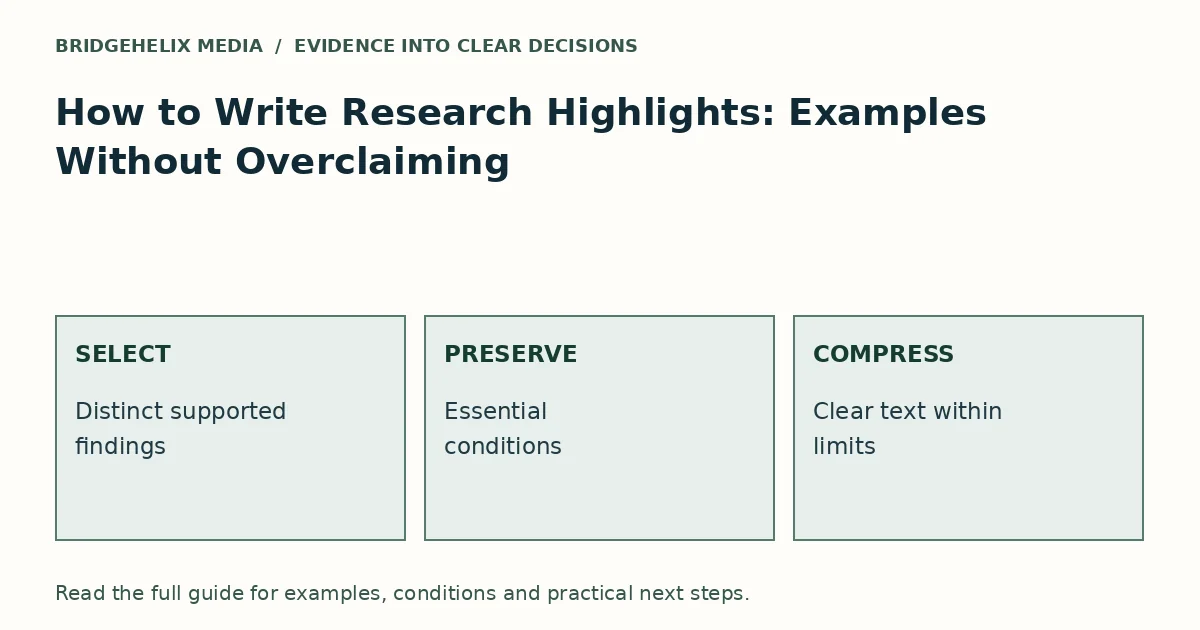
The useful approach is to select the contribution first, write an accurate sentence and then compress it. Starting with a character counter often produces vague lines such as “A novel and efficient method was developed.” That fits many papers, which is exactly why it tells a reader very little about yours.
Check whether the journal asks for highlights
Do not assume every journal uses the same format. Check the current guide for authors and the submission system. A journal may request highlights, key points, a significance statement or none of these, and the requirements can differ.
Elsevier's highlight instructions (opens in a new tab) specify three to five highlights, with a maximum of 85 characters each, including spaces. Treat this as guidance for the relevant Elsevier workflow, not a universal rule for every publisher. Where a journal provides more specific instructions, follow those instructions.
Count the final text after punctuation and formatting changes. A small edit can push a line over the limit. Also check whether the system requires a separate file and which file type it accepts. A correct set of sentences can still be uploaded in the wrong place.
Separate highlights from the abstract
The abstract provides a compact account of the study: context, approach, results and conclusion as appropriate to the journal. Highlights are a small set of distinct points that help a reader recognise the contribution quickly. They should not be the abstract chopped into several fragments.
Background statements usually spend the available space poorly. “Water pollution is a major global challenge” does not distinguish the manuscript. A line about the observed effect of feed variability is more informative if that is one of the study's actual findings.
Avoid describing routine activities as contributions. “Samples were analysed using standard methods” tells the reader that work was performed. It does not identify what the work established. An unusual or consequential methodological contribution may deserve a highlight, but explain what makes it relevant.
Select findings before editing sentences
Open the results and conclusion and identify three candidate contributions. For each candidate, note the supporting result and the condition that would change its meaning. Then check whether the candidates are genuinely different or simply repeat the same message.
A useful set might cover the principal finding, an explanation of when it changes, and a methodological insight. It does not need to include an optimistic application claim. Sometimes the most valuable contribution is a limit on where an apparently promising approach works.
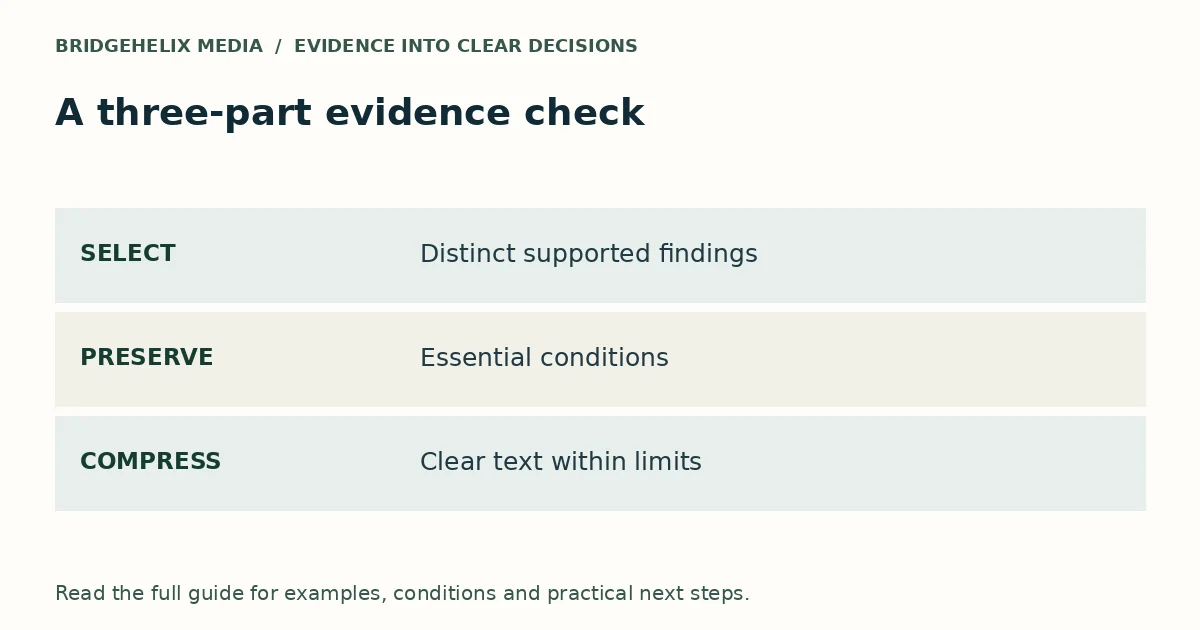
Use this short review before spending time on character counts:
| Candidate sentence | Question to ask | Revision direction |
|---|---|---|
| Broad claim of improvement | Improved relative to what? | Name the comparison if essential |
| Statement of high performance | Under which tested conditions? | Preserve the decisive condition |
| Claim of practical readiness | Was implementation actually tested? | Limit the sentence to observed evidence |
| Description of a method | What did this method make possible? | State the methodological contribution |
This small evidence check is also useful when co-authors disagree. Instead of debating which sentence sounds more impressive, locate the result that supports each version and decide which meaning the paper can defend.
Before-and-after examples
The following examples are fictional wording exercises, not findings from a BridgeHelix study. Use the structure only if your own evidence supports it. The revised lines are deliberately short enough for an 85-character limit, but brevity is not the only criterion.
Weak: “A highly efficient and novel adsorbent was successfully developed.”
More informative: “Adsorption performance declines in the tested mixed-contaminant feed.”
The revision reports a specific pattern rather than praising the material. It would be appropriate only if the paper actually compares the relevant feed conditions and establishes that pattern. It should not be used simply because it sounds cautious.
Weak: “The technology is ready for large-scale industrial application.”
More defensible: “Pilot operation identifies feed variability as a scale-up constraint.”
This version could describe a demonstrated operational insight without claiming commercial readiness. If the work is entirely laboratory based, even the word “pilot” would be inaccurate and must be changed. The sentence must follow the experiment, not the author's preferred future application.
Weak: “The proposed method gave better and more reliable results.”
More specific: “The revised sampling protocol reduces variation between replicate measurements.”
This statement identifies the intervention and outcome. It still requires appropriate evidence. Lower observed variation does not automatically establish improved accuracy, so do not substitute “more accurate” unless the study supports that different claim.
Shorten language before removing evidence
Delete empty introductions such as “The results of this study clearly demonstrate that.” Replace “was found to lead to a reduction in” with a direct verb when the meaning is unchanged. Remove repeated references to “the present study.” These edits save space without changing the scientific boundary.
Be more careful with words such as tested, within, under and relative to. They may look expendable, but they often carry the conditions that prevent overgeneralisation. A statement about the tested samples is not necessarily a statement about an entire material class.
Our guide to reducing a research paper's word count uses the same principle at manuscript scale: remove repetition and unnecessary phrasing before removing information that determines what the result means.
Use numbers only when they remain interpretable
A numerical highlight can be useful, but a number without its comparison or unit may mislead. “Performance improved by 40%” leaves the reader asking which measure changed and what the reference was. If the essential context cannot fit, select another result or express the finding qualitatively and accurately.
Do not combine several outcomes into one crowded bullet simply to include every attractive number. Each highlight should do one clear job. A short set that communicates distinct contributions is more useful than a dense set of compressed clauses.
Check that rounding agrees with the manuscript and that a percentage is not confused with percentage points. If the manuscript reports uncertainty or limited replication, do not let the highlight imply a certainty the full paper does not support.
Run a final consistency check
Read the highlights beside the title, abstract and conclusion. Are they describing the same study at the same level of confidence? The manuscript coherence test helps identify cases where a careful paper acquires an exaggerated summary during the final editing stage.
Then verify character counts, journal requirements and file placement. Ask a co-author to read the highlights without the abstract and explain what they think was demonstrated. If that interpretation exceeds the evidence, revise the wording before submission.
BridgeHelix's research manuscript editing service can help make these short statements clearer and more consistent with the paper. The aim is to present the contribution accurately enough that a reader knows why the study deserves closer attention.

About the author
Dr. Prakash Kumar Singh
Founder & Technical Content Strategist
PhD in Chemical Engineering from MNIT Jaipur, with M.Tech and B.Tech qualifications in Biotechnology. His work connects technical evidence with clear B2B communication and ethical research support.