
Many engineering case studies begin with the company, describe the technology and end with an impressive percentage. The document may look professional, but a technical buyer still cannot judge the result. The baseline is unclear. The operating conditions are missing. The measurement method is reduced to one sentence. A result obtained at one site is presented as if it will occur everywhere.
A strong technical case study defines the starting condition, the engineering problem, the intervention, the measurement method and the verified result under stated operating conditions. It also identifies limitations and transfer conditions. This structure allows engineers to inspect the evidence, procurement teams to understand implementation risk and business leaders to see practical value without turning a site-specific outcome into a universal performance promise.
The purpose is not to make the project sound more complex. It is to make the evidence traceable from the original problem to the final conclusion.
What a technical case study must prove
A marketing case study often asks, “Did the customer obtain a positive outcome?” An engineering case study must answer a more difficult set of questions:
- What was happening before the intervention?
- Which part of the system created the problem?
- What exactly was changed?
- Which variables were held constant and which were not?
- How was performance measured?
- Was the result sustained for long enough to matter?
- Which other sites or applications are reasonably comparable?
These questions are important because an engineering result depends on conditions. A membrane may show lower fouling with one feed composition but behave differently when suspended solids increase. A pump modification may reduce electricity consumption at a specified flow rate but provide no saving when the system operates far from that point. A new adsorbent may perform well in a controlled solution and show a lower capacity in real water containing competing ions.
Therefore, the case study must connect claim, evidence, condition and implication. Removing any one of these elements makes the result harder to evaluate.
The eight-part technical case study template
The following structure can be used for process equipment, environmental projects, manufacturing improvements, materials, energy systems, laboratory platforms and other technical B2B applications.
1. Decision context
Begin with the decision the reader is trying to make. Do not start with a long company history.
For example: an industrial site needed to reduce unplanned pump maintenance without compromising the required flow and discharge pressure. This is clearer than saying that the customer wanted to “improve operational efficiency.”
The context should identify the system, application and consequence of the problem. If downtime affected production, state how it affected production. If the issue involved compliance, quality, energy or safety, name the relevant outcome without exaggerating it.
2. Baseline
The baseline is the starting condition against which change is assessed. It should use the same measurement basis as the reported result.
Record:
- equipment or process configuration;
- feed, load or production conditions;
- measurement period;
- normal operating range;
- relevant quality or reliability indicator;
- maintenance or resource requirement; and
- known disturbances during the period.
Baseline data does not need to be perfect, but its limitations should be visible. The UK Government's Theory of Change guidance (opens in a new tab) similarly treats baseline information as the starting point needed to assess progress.
3. Engineering problem and cause
Separate the observed symptom from the proposed cause. High energy consumption is a symptom. A throttled control valve, oversized motor, variable feed viscosity or worn impeller may be the cause.
If the cause was confirmed through inspection, sampling, modelling or trend analysis, state that method. If it remained a working hypothesis, label it accordingly. A case study should not rewrite an assumption as a diagnosis after the result is known.
4. Intervention
Explain what changed in enough detail for a technical reader to understand the comparison. The required depth depends on confidentiality, but the document should normally identify:
- modified component or operating step;
- control strategy;
- installation or implementation boundary;
- commissioning approach;
- training or procedural change; and
- changes made at the same time that could influence the result.
Do not attribute the whole improvement to one product if maintenance, controls and operator practice changed together. State the complete intervention, then explain which contribution can be isolated.
5. Measurement method
A result becomes credible when the reader can see how it was produced. Identify the measurand, instrument or data source, sampling frequency, test duration, calculation basis and comparison method.
Where measurement uncertainty is material, report it or explain how it was treated. NIST guidance on reporting uncertainty (opens in a new tab) emphasises describing the uncertainty components and how they were evaluated. A commercial case study may not need a metrology paper, but it should not present normal variation as a precise improvement.
6. Measured result
Present the result using the same basis as the baseline. Give both the change and the actual values when possible.
“Energy use fell by 18%” is useful, but “specific electricity consumption fell from 0.62 to 0.51 kWh per cubic metre at comparable flow and discharge-pressure ranges over a 12-week period” is much easier to evaluate.
Also state whether product quality, throughput, emissions, safety or another important variable changed. An improvement in one indicator can create a burden elsewhere.
7. Limitations and boundary conditions
Every case study has boundaries. They may involve feed composition, temperature, capacity, climate, operator involvement, test duration or the absence of a direct control.
Stating these conditions does not weaken the case study. It tells the reader that the company understands where the evidence stops. This is particularly important when a pilot result is being used to support a commercial discussion.
8. Transferability and next step
End by explaining who can reasonably use the result. A second site does not need to be identical, but the variables that control performance should be comparable.
The next step may be a site assessment, sample test, engineering review or pilot. It should follow from the unresolved risk. A useful CTA is not “contact us to learn more.” It is “compare your feed conditions and operating range with the conditions tested here.”
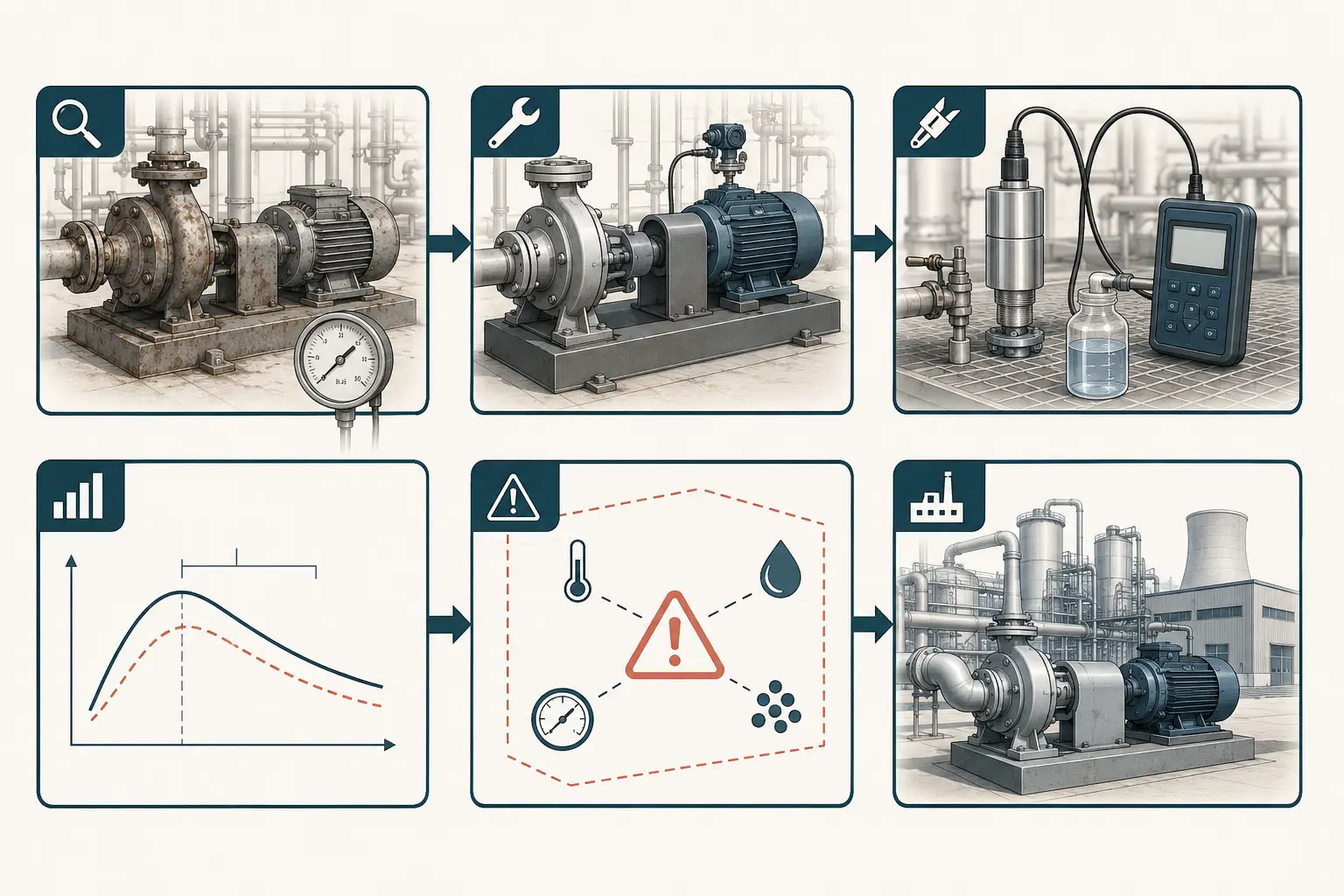
Copy-and-use engineering case study structure
| Section | Information to include | Question it answers |
|---|---|---|
| Project context | Site type, application, system boundary and decision | Why did this project matter? |
| Baseline | Starting values, duration and operating range | What was happening before the change? |
| Problem | Symptom, confirmed cause and consequence | What needed to be solved? |
| Intervention | Equipment, process, control or procedure changed | What was actually done? |
| Measurement | Instruments, sampling, duration and calculation | How was the result established? |
| Result | Before and after values with conditions | What changed and by how much? |
| Limitations | Uncertainty, disturbances and untested conditions | Where does the conclusion stop? |
| Transferability | Comparable applications and next validation step | Can another reader use this evidence? |
This table is short enough to guide an interview with an engineer or customer. It also prevents the writer from asking only for a testimonial and a favourable number.
Build a baseline-to-result evidence table
A second table should bring the comparison into one place.
| Performance factor | Baseline | After intervention | Comparison condition | Qualification |
|---|---|---|---|---|
| Specific energy use | 0.62 kWh/m³ | 0.51 kWh/m³ | Comparable flow and pressure range | Illustrative values |
| Unplanned stoppages | 4 in 12 weeks | 1 in 12 weeks | Same production area | Observation period remains limited |
| Product quality | Within target | Within target | Same quality specification | No quality trade-off observed |
| Maintenance time | 18 hours | 9 hours | Corrective work only | Planned maintenance excluded |
These are hypothetical values used to demonstrate the structure. A published case study should use source records approved by the customer and should define exclusions beside the relevant metric.
Weak result versus strong result
Weak:
The solution improved plant efficiency by 18% and reduced downtime.
This sentence does not identify the metric, period, conditions or source of the percentage.
Stronger:
During the 12 weeks after commissioning, specific electricity consumption decreased from 0.62 to 0.51 kWh/m³ within the agreed flow and discharge-pressure range. Unplanned stoppages decreased from four to one compared with the preceding 12-week baseline. Product quality remained within the existing specification. Seasonal performance and long-term maintenance effects were not evaluated during this period.
The stronger version is longer, but it is also more useful. It separates what was measured from what still requires observation.
Common mistakes in technical case study writing
Starting with the supplier rather than the problem
The reader first needs to recognise the operating problem. The technology becomes relevant after that context is established.
Using percentages without denominators
“50% longer life” can mean 10 days instead of 5, or 10 years instead of 5. State the actual values and the percentage where possible.
Mixing laboratory, pilot and commercial evidence
A laboratory result can support a mechanism or comparative performance under controlled conditions. It cannot automatically support site reliability or operating cost. The evidence scale must be named beside the claim.
Hiding an unfavourable indicator
If throughput improved while energy, waste or maintenance increased, the reader needs the complete trade-off. Selective reporting may create a stronger headline but a weaker buying document.
Turning correlation into attribution
When several changes occur together, the case study should avoid claiming that one component caused the complete result unless the study design supports that conclusion.
Make one case study useful to several readers
The evidence remains the same, but different readers need different entry points.
- Engineers need operating conditions, system boundaries and measurement details.
- Environmental or quality teams need compliance basis, sampling and exceptions.
- Procurement needs implementation scope, dependencies and supplier responsibility.
- Management needs the operational consequence, risk and realistic next step.
Do not create four contradictory stories. Create one evidence chain, then provide different layers of explanation. Our guide to moving from a technical feature to commercial meaning (opens in a new tab) explains how to connect performance with value without inventing a claim.
Practical conclusion
A technical case study is not a project summary with a testimonial added at the end. It is a compact evidence document. Start with the baseline, define the engineering problem, explain the intervention, show how the result was measured and state the operating conditions that govern the conclusion.
The most persuasive case study is not the one with the largest percentage. It is the one in which the buyer can see exactly what happened and decide whether the evidence is relevant to another application.
BridgeHelix Media provides PhD-led technical report writing (opens in a new tab) and technical content writing (opens in a new tab) for engineering and science-driven companies that need to convert project records into credible buyer-facing evidence.
Sources

About the author
Dr. Prakash Kumar Singh
Founder & Technical Content Strategist
PhD in Chemical Engineering from MNIT Jaipur, with M.Tech and B.Tech qualifications in Biotechnology. His work connects technical evidence with clear B2B communication and ethical research support.