A white paper needs a job beyond looking authoritative
Technical companies often decide to create a white paper because competitors have one, a campaign needs a downloadable asset or the website needs something that looks substantial. These are distribution reasons. They are not yet a reason for a technical reader to spend time with the document.
A useful white paper helps a defined reader examine a difficult problem or decision. It may explain why an existing process fails under certain conditions, compare credible approaches or show which evidence should be requested before a technology is selected.
The difference is similar to the difference between a product brochure and an engineering evaluation. A brochure presents the offer. An evaluation establishes the criteria needed to judge it. Effective technical white paper writing may support a commercial goal, but it earns trust by doing the second job first.
Choose a problem narrow enough to examine properly
Topics such as “the future of water treatment” or “the importance of biotechnology” are too broad to create a useful decision document. The paper may collect many facts, yet still leave the reader without a clear conclusion.
A stronger topic asks how a specific treatment class performs under difficult feed conditions, which evidence procurement teams should request before evaluating a biotech platform or why a scale-up claim needs different proof from a laboratory claim.
A narrow problem does not make the asset less valuable. It makes the evidence, comparison and conclusion more defensible. It also gives the intended reader a clear reason to download or share the document.
Define the reader and the decision
“Technical audience” is not a complete reader definition. A process engineer, research director, procurement lead and investor may all be technically informed, but they use the document for different decisions.
The process engineer may examine operating conditions and integration. Procurement may compare risk, validation and support. A research director may focus on mechanism and evidence maturity. The central argument can remain consistent, but the depth and order should reflect the primary decision.
Before outlining, write one sentence: “After reading this paper, the intended reader should be able to evaluate…” If the sentence cannot be completed precisely, the paper is not ready to be planned.
Build an evidence map before the outline
The evidence map records the important claims, their sources, their strength and any limitation that affects use. Sources may include published research, standards, internal test data, technical interviews, market evidence and case records.
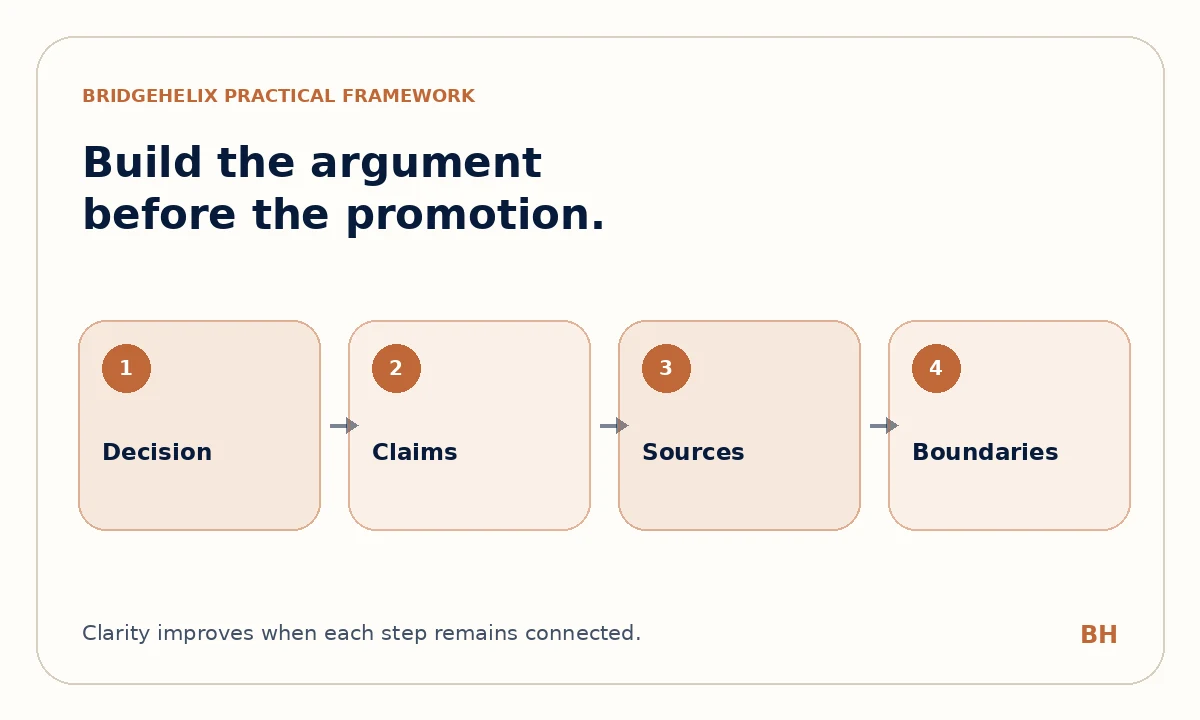
This step often reveals that the planned argument is stronger than the available proof. A pilot result may support operating feasibility but not long-term economics. A modelling study may explain mechanism without demonstrating field performance. An internal test may be useful, but the method and comparison still need to be described.
Only after the evidence is visible should the outline be finalised. Otherwise the document may be structured around a promotional conclusion and use research merely to decorate it.
Compare alternatives using the same criteria
Technical buyers rarely evaluate a solution in isolation. They compare it with an existing process, a competing technology, internal development or the cost of doing nothing. A white paper becomes more credible when it acknowledges these alternatives.
Comparison must use consistent criteria. Performance measured at different concentrations, temperatures or test durations should not be placed in a simple ranking without explanation. Capital cost should not be compared with operating cost as if both describe the same issue. A laboratory result should not be presented beside commercial data without stating the difference in evidence maturity.
Where direct comparison is not possible, say so. The limitation itself helps the reader understand what can and cannot be concluded.
Separate fact, interpretation and recommendation
The paper becomes easier to trust when the reader can see which statements come from evidence and which represent the company's interpretation.
A fact may report that a material retained a defined performance level under stated test conditions. Interpretation may explain why that result matters for a particular application. A recommendation may suggest which validation should happen next. These three statements can support one another, but they should not be blended into a single claim.
This is especially important in sensitive fields. Our guide to pharmaceutical white papers shows how easily evidence and promotion can become blurred when the boundary is not planned.
Introduce the company's solution at the right time
The organisation does not need to disappear from its own white paper. It should appear after the reader understands the problem, evaluation criteria and available evidence.
The solution can then be positioned against an established need. Its features have context. Its data has a question to answer. Its limitations can be stated without making the entire document feel weak.
This order is often more persuasive than starting with the product because the reader can see why the product details matter. It also prevents the paper from becoming a brochure with citations.
Use subject-matter review as part of the writing process
Technical review should not happen only after the design is complete. Review the problem definition, evidence map and outline before full drafting. This allows engineers or scientists to correct the direction while changes are still easy.
During drafting, reviewers should be asked focused questions. “Is this accurate?” often produces a quick approval. “Does this paragraph distinguish pilot evidence from commercial evidence?” gives the reviewer a specific decision.
Keep a record of important claim changes. If stronger language is requested, identify the evidence that supports it. If a limitation is removed, confirm why it no longer affects interpretation.
Design the paper for examination, not decoration
Visual design should make the argument easier to use. Tables can compare defined criteria. Diagrams can explain a mechanism or workflow. Callouts can isolate an important result or evidence boundary. Captions should help the reader interpret the visual rather than repeat its title.
Large decorative graphics and repeated brand statements may make the paper look polished while reducing the space available for substance. The visual system should support hierarchy, legibility and navigation.
The manuscript therefore needs to be written with design in mind. A paragraph containing five different comparisons may be better as a table. A complex mechanism may need a diagram and a shorter explanation. Design begins with content structure.
Plan the next step before publication
The call to action should follow the trust created by the document. A technical reader may be ready to request an evidence discussion, application assessment or sample scope. A vague “contact us” does not explain what the conversation will contain, while an aggressive sales request may feel disproportionate.
The paper can also support related articles, webinars, technical sales conversations and case studies. Each derivative asset should be adapted to its reader instead of copying sections without context. A technical case study may later provide application evidence that the broader white paper could not yet include.
Before commissioning the document, compare an application note, white paper and case study. Each asks the evidence to do a different job. If the reader needs project results rather than a broad argument, the engineering case-study template provides a more suitable structure.
The practical test
Before release, ask whether the white paper helps a serious reader make a better evaluation even if that reader does not immediately choose the company's solution. If the answer is yes, the paper has earned its authority. If the document only repeats why the company is impressive, more pages will not make it more useful.

About the author
Dr. Prakash Kumar Singh
Founder & Technical Content Strategist
PhD in Chemical Engineering from MNIT Jaipur, with M.Tech and B.Tech qualifications in Biotechnology. His work connects technical evidence with clear B2B communication and ethical research support.