
A pharmaceutical white paper often begins with a legitimate educational purpose. The company wants to explain a disease burden, analytical method, formulation challenge, development platform or clinical evidence base. During drafting, however, a careful statement such as “the platform was evaluated in an in-vitro model” can slowly become “the platform improves treatment performance.”
The source has not changed. The claim has.
Safe pharmaceutical white paper writing begins by defining the audience, jurisdiction, product status and intended purpose. Every material statement should then be recorded in a claim ledger that links the exact wording to its evidence, population, endpoint and limitations. Scientific, medical, regulatory and legal review must assess not only whether each sentence has a citation, but whether the complete document creates an accurate and balanced impression.
This guide is a content-development framework, not jurisdiction-specific legal advice. Final requirements depend on the product, market, audience and applicable law or industry code.
First decide what the document is
“White paper” describes a format, not a regulatory category. A document can be educational, scientific, corporate, disease-awareness oriented, product related or promotional depending on its content, audience, distribution and purpose.
Before outlining, record:
- product or platform discussed;
- development or authorisation status;
- intended readers;
- countries or regions of distribution;
- channel and access controls;
- commercial purpose;
- whether product names, claims or calls to action appear; and
- responsible medical, regulatory and legal reviewers.
Do not assume that calling a document “educational” makes it non-promotional. Reviewers may consider the overall impression, not the label placed on the cover.
The Indian Department of Pharmaceuticals describes UCPMP 2024 as a mandatory code for ethical and transparent pharmaceutical marketing practices. In the United States, the FDA’s Office of Prescription Drug Promotion focuses on truthful, balanced and accurate prescription-drug promotion. The UK MHRA maintains detailed guidance on medicine advertising and promotion. These frameworks are not interchangeable, but they illustrate why the communication context must be identified before drafting.
Separate five types of statement
Most claim problems become visible when the writer labels the function of each important sentence.
1. Source fact
A directly verifiable statement from an approved document, published paper, dataset or authoritative source.
Example: “In the reported study, the primary endpoint was measured at week 12.”
2. Interpretation
An explanation of what the fact may mean. Interpretation must remain within the study design and uncertainty.
Example: “The week-12 result suggests that the measured effect was present during the study period.”
3. Context
Background that helps the reader evaluate relevance, such as disease burden, current workflow or an unmet analytical need.
4. Product or performance claim
A statement that attributes a benefit, capability, comparative advantage, safety property or outcome to a product, service or platform.
5. Forward-looking statement
A statement about potential future use, development or impact. These require careful qualification because possibility can easily be read as demonstrated performance.
The writer should not hide categories four and five inside scientific-sounding language. Label them during review so the responsible team can decide whether the wording and evidence are appropriate.
Build a claim ledger before prose expands
A claim ledger is a controlled table for every statement that could affect a technical, clinical or commercial decision.
| Field | What to record |
|---|---|
| Claim ID | Stable reference, such as C-014 |
| Exact wording | The sentence as it will appear |
| Claim type | Factual, comparative, safety, efficacy, process, economic or forward-looking |
| Audience and market | Who will see it and where |
| Evidence source | Approved label, study, report, dataset or policy |
| Evidence boundary | Population, model, endpoint, duration and conditions |
| Qualification | Limitation or context needed beside the claim |
| Owner | Scientific, medical, regulatory, legal or other reviewer |
| Status | Draft, queried, approved, rejected or superseded |
The ledger makes the evidence chain reviewable before visual design and page layout make individual statements harder to trace.
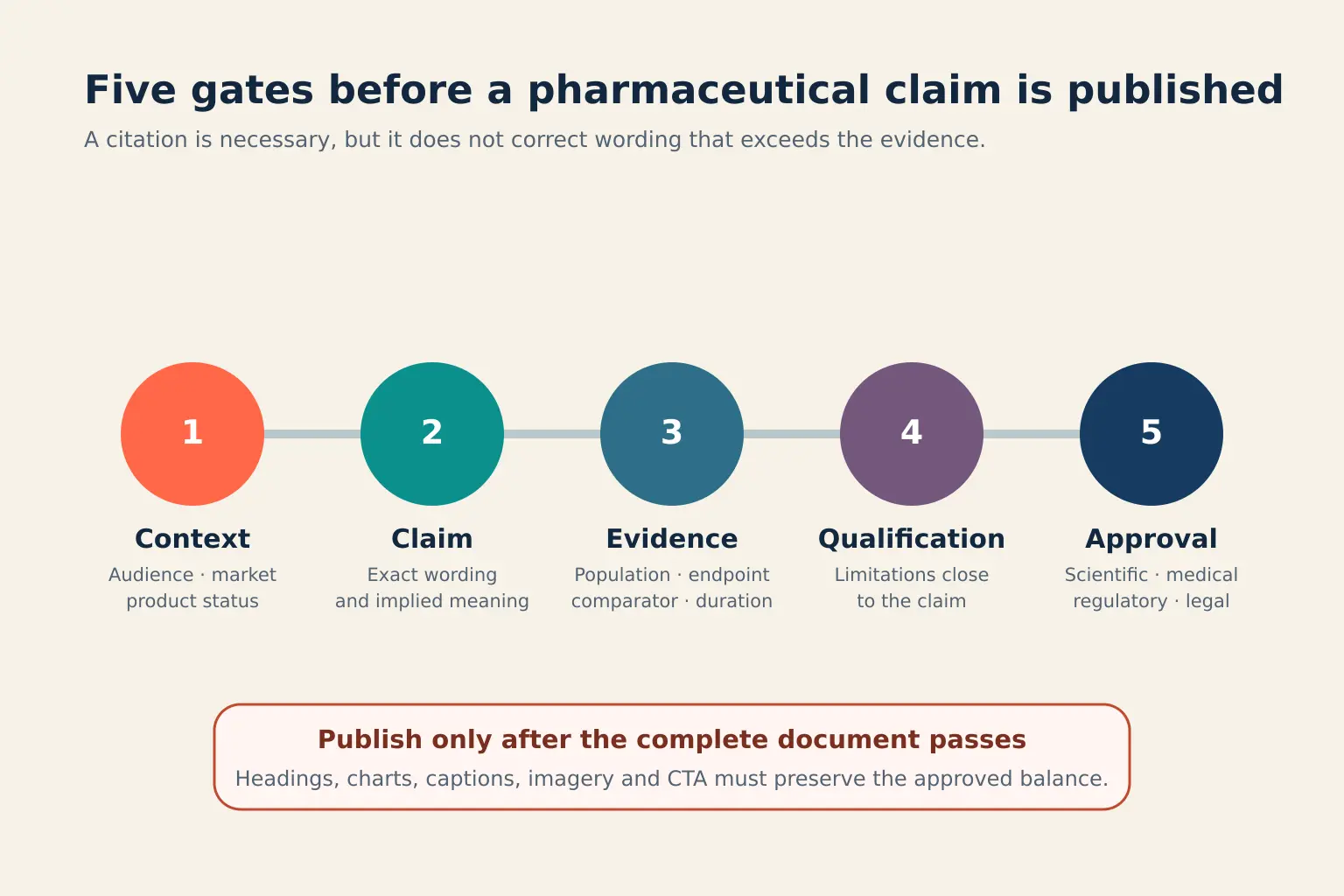
Test whether the wording exceeds the evidence
For every material claim, compare the sentence with the source across six boundaries.
Population or system
Evidence in cells, animals, healthy volunteers, a selected patient population or one manufacturing line should not be silently extended to another population or full commercial operation.
Intervention or product version
Confirm that the evidence concerns the same formulation, dose, device, assay version, process or platform configuration discussed in the white paper.
Comparator
“Better,” “faster,” “safer” and “more accurate” require a defined comparison. A result against baseline is not automatically a result against the current market standard.
Endpoint
A surrogate, analytical or process endpoint should not be rewritten as a clinical or business outcome unless the evidence supports that connection.
Time
A short-duration study cannot establish long-term performance, durability or safety.
Certainty
“Demonstrated,” “associated with,” “supports,” “may” and “is designed to” communicate different levels of evidence. Choose the verb after examining the study, not before.
The FTC’s Health Products Compliance Guidance stresses that health-related benefit and safety claims must be truthful, non-misleading and supported by science. It also examines express and implied claims. This distinction matters because a technically qualified sentence can still contribute to a broader unsupported impression when combined with headings, images and repeated benefit language.
Weak and stronger claim examples
From in-vitro result to clinical implication
Weak:
The formulation provides superior therapeutic delivery.
Why it fails: “Superior” lacks a comparator, and an in-vitro experiment cannot by itself establish therapeutic delivery in patients.
Stronger:
In the reported in-vitro dissolution test, the investigational formulation produced a higher dissolved fraction at 60 minutes than the stated comparator under the tested conditions. Clinical performance was not evaluated.
From workflow observation to universal efficiency
Weak:
The platform dramatically reduces development time.
Stronger:
In the internal pilot, the specified analytical workflow was completed in 8 working days compared with 12 days for the previous workflow. The comparison involved one project type and did not evaluate technology-transfer or scale-up time.
From absence of an event to safety claim
Weak:
The product is proven safe.
Stronger:
No treatment-related serious adverse events were reported in the cited study population during the stated follow-up period. This observation does not establish safety outside that population, dose or duration.
The stronger versions are not automatically approved claims. They simply demonstrate how to preserve the evidence boundary for review.
Design balance at document level
Reviewers should inspect more than body text. The FDA notes that risk information can become inadequate when its prominence or readability is not reasonably comparable with effectiveness information. Typography, layout, contrast, headings and white space can influence emphasis.
Apply a document-level check:
- Is the benefit repeated in the title, pull quote, graphic and conclusion while the limitation appears once in small text?
- Does the executive summary preserve the qualifications used later?
- Do charts show denominators, confidence intervals, study duration and relevant comparators?
- Are adverse or null findings omitted from an otherwise “complete” evidence narrative?
- Does a stock image imply a patient outcome that was not studied?
- Does the CTA change the apparent purpose of an educational document?
A citation at the end of a paragraph cannot correct an unbalanced overall presentation.
Use one controlled review workflow
Multiple reviewers can improve accuracy but also create version chaos. Use one document owner and one claim ledger.
Scientific review
Checks source accuracy, study design, endpoint meaning, statistics, mechanism and limitations.
Medical review
Checks clinical context, benefit–risk communication, relevance to the intended audience and potential misinterpretation.
Regulatory and legal review
Determines whether the content, audience, channel and claims fit applicable requirements. This decision should not be delegated to the writer.
Editorial review
Ensures that approved meaning remains clear, consistent and readable. The editor should not “strengthen” cautious approved wording during final polishing.
Design review
Checks whether hierarchy, captions, graphics and emphasis preserve the approved balance.
Resolve comments inside the controlled file. Do not allow separate email approvals of isolated sentences to replace approval of the complete document.
A pre-publication claim audit
Before release, verify that:
- the document purpose, audience, market and channel are recorded;
- every material claim has an owner and traceable source;
- source versions are current and approved for use;
- wording matches the evidence population, product, endpoint and duration;
- comparisons name the comparator and basis;
- absolute and relative effects are not selectively presented;
- limitations appear close enough to the claim to be understood;
- titles, captions and visuals do not create broader implied claims;
- summaries remain consistent with the full discussion;
- product status is described accurately;
- references support the exact adjacent statements; and
- the approved draft, designed proof and published file are identical in meaning.
Keep the claim ledger and final source pack with the publication record. This makes future updates safer when new evidence, label changes or jurisdictional requirements affect the document.
Practical conclusion
Pharmaceutical white paper writing is not a contest between scientific caution and useful communication. A document can be clear and persuasive when each conclusion is visibly connected to evidence and its boundaries.
Define the context first. Build the claim ledger. Test every extension from study to statement. Then review the complete impression created by copy, design and CTA.
BridgeHelix Media provides PhD-led white paper writing (opens in a new tab) and pharma and life-sciences content support (opens in a new tab) for teams that need to convert approved technical material into clear, evidence-aware documents. Final claim approval remains with the client’s authorised medical, regulatory and legal reviewers.
Sources
- Department of Pharmaceuticals, India: UCPMP 2024 portal (opens in a new tab)
- U.S. FDA: Office of Prescription Drug Promotion (opens in a new tab)
- U.S. FDA: OPDP Frequently Asked Questions (opens in a new tab)
- U.S. FTC: Health Products Compliance Guidance (opens in a new tab)
- UK MHRA: Blue Guide, advertising and promoting medicines (opens in a new tab)

About the author
Dr. Prakash Kumar Singh
Founder & Technical Content Strategist
PhD in Chemical Engineering from MNIT Jaipur, with M.Tech and B.Tech qualifications in Biotechnology. His work connects technical evidence with clear B2B communication and ethical research support.