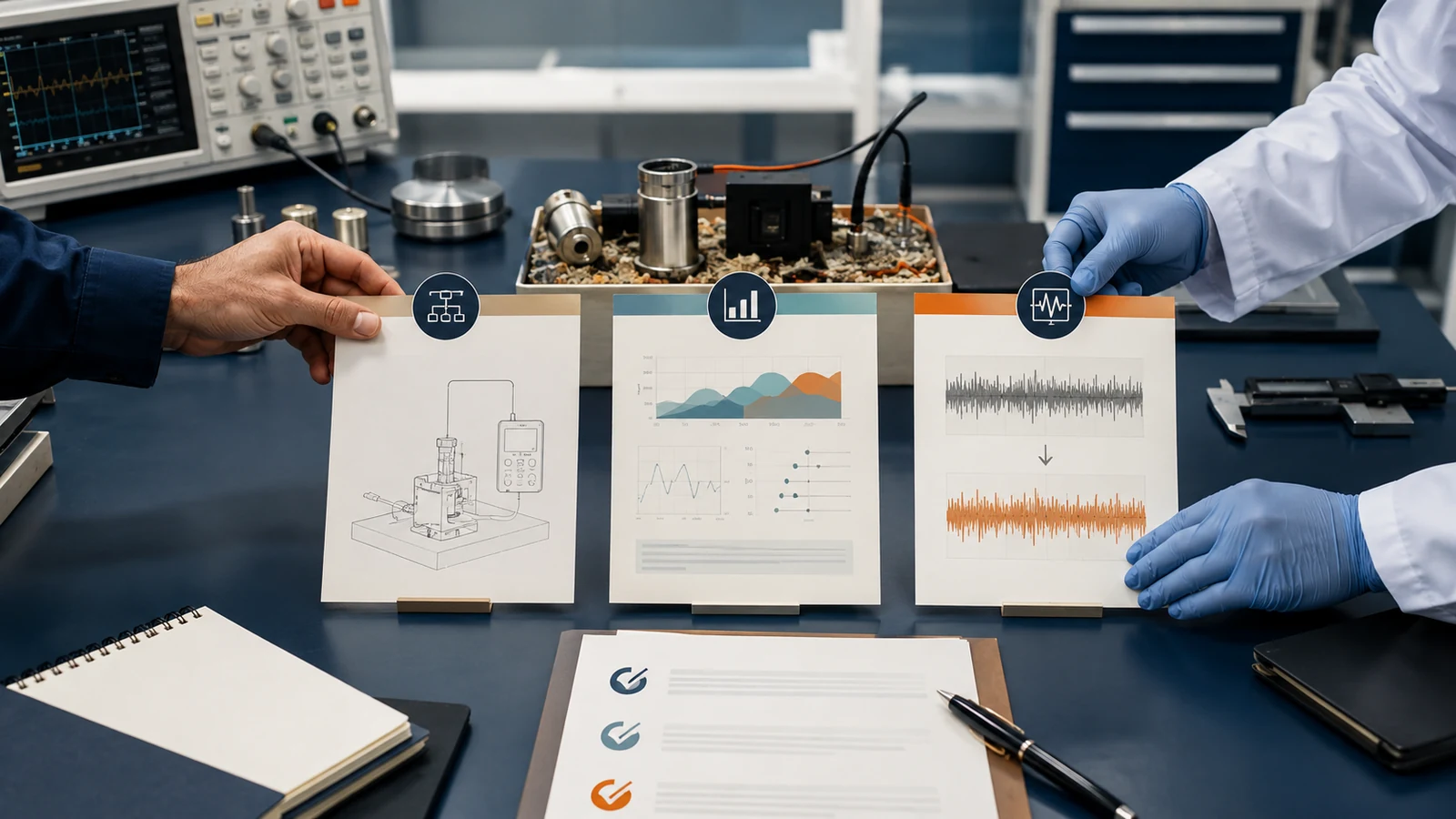
A technical team has laboratory data, expert interviews, a product datasheet and one early customer result. Marketing asks for a white paper. Sales asks for a case study. The application scientist calls the same material an application note. Changing the title does not resolve the underlying question: what does the evidence actually allow the document to do?
Use an application note to explain how a product or method performs in a defined application. Use a white paper to examine a broader problem, compare approaches and guide a decision through evidence. Use a case study to document what happened in a real project from baseline to measured result. Choose the format from the reader’s question and the available evidence, not from which label sounds most authoritative.
The three formats can support the same technical content programme, but they should not make the same promise.
The labels vary, but the reader’s decision is stable
Companies do not use these document names consistently. Some call a five-page product explanation a white paper. Others label a controlled laboratory experiment a case study. An application note may look like a short research paper in one industry and a practical setup guide in another.
Therefore, the title alone is not a reliable definition. A better distinction begins with three questions:
- What decision should the reader make after using the document?
- What is the smallest defensible unit of evidence?
- Which conclusion can that evidence support without extrapolation?
This evidence-first approach prevents a format decision from becoming a branding exercise.
What is a technical application note?
A technical application note explains how a product, instrument, component, material, method or software feature is used in a specific technical context. Its centre of gravity is the application.
The document may contain a setup, sample preparation, operating parameters, workflow, test method, observations, performance data and troubleshooting points. It should give the reader enough detail to understand whether the application is relevant and what conditions control performance.
An application note is appropriate when the main question is:
How can this product or method be used for this defined task, and what happened under the tested conditions?
The evidence may come from an internal laboratory, demonstration rig or application-development team. That source is acceptable when it is identified honestly and the method, conditions and limitations are visible.
An application note should not imply field reliability merely because the controlled test was successful. The distinction between laboratory, pilot and commercial evidence remains important beside every performance claim.
What is a technical white paper?
A technical white paper examines a problem, technology choice, emerging method or decision that requires more than a product explanation. It establishes context and evaluation criteria, interprets available evidence and then shows where a solution fits.
The primary question is broader:
How should a technically informed reader understand this problem and evaluate the available approaches?
A white paper may use published research, standards, internal data, expert interpretation, market or policy context and a transparent comparison framework. The company’s solution can appear, but the document should establish the decision logic before presenting the commercial conclusion.
Our guide to white paper writing for technical companies explains why an evidence map should be completed before the outline. Otherwise, the document may begin with a preferred conclusion and use research only to decorate it.
What is a technical case study?
A technical case study documents a real implementation, customer project or field evaluation. Its centre of gravity is change over a defined context.
The primary question is:
What problem existed, what was changed, how was the result measured and where is the outcome transferable?
A credible case study needs a baseline, intervention, measurement method, result, operating conditions and limitations. A testimonial can support the account, but it cannot replace objective performance evidence when the document makes an objective claim.
The complete technical case study template shows how to move from the original operating condition to a measured result without turning one project into a universal promise.
Compare the three formats by evidence and decision
| Factor | Application note | White paper | Case study |
|---|---|---|---|
| Reader’s main question | How does this work in a specific application? | How should I understand or evaluate this problem? | What happened in a real project? |
| Evidence unit | Defined setup, method and test result | Evidence set, comparison and interpretation | Baseline, intervention and measured outcome |
| Typical source | Application laboratory or technical team | Research, standards, internal evidence and expert analysis | Customer, pilot or operational project records |
| Scope | Narrow and use-specific | Broader and decision-led | Context-specific and outcome-led |
| Strong conclusion | Performance under stated test conditions | Reasoned evaluation of options or criteria | Change observed under stated project conditions |
| Main risk | Presenting a controlled test as field proof | Turning education into a long brochure | Hiding the baseline, conditions or co-interventions |
| Proportionate next step | Reproduce the setup or assess application fit | Evaluate the approach or define requirements | Compare site conditions or plan validation |
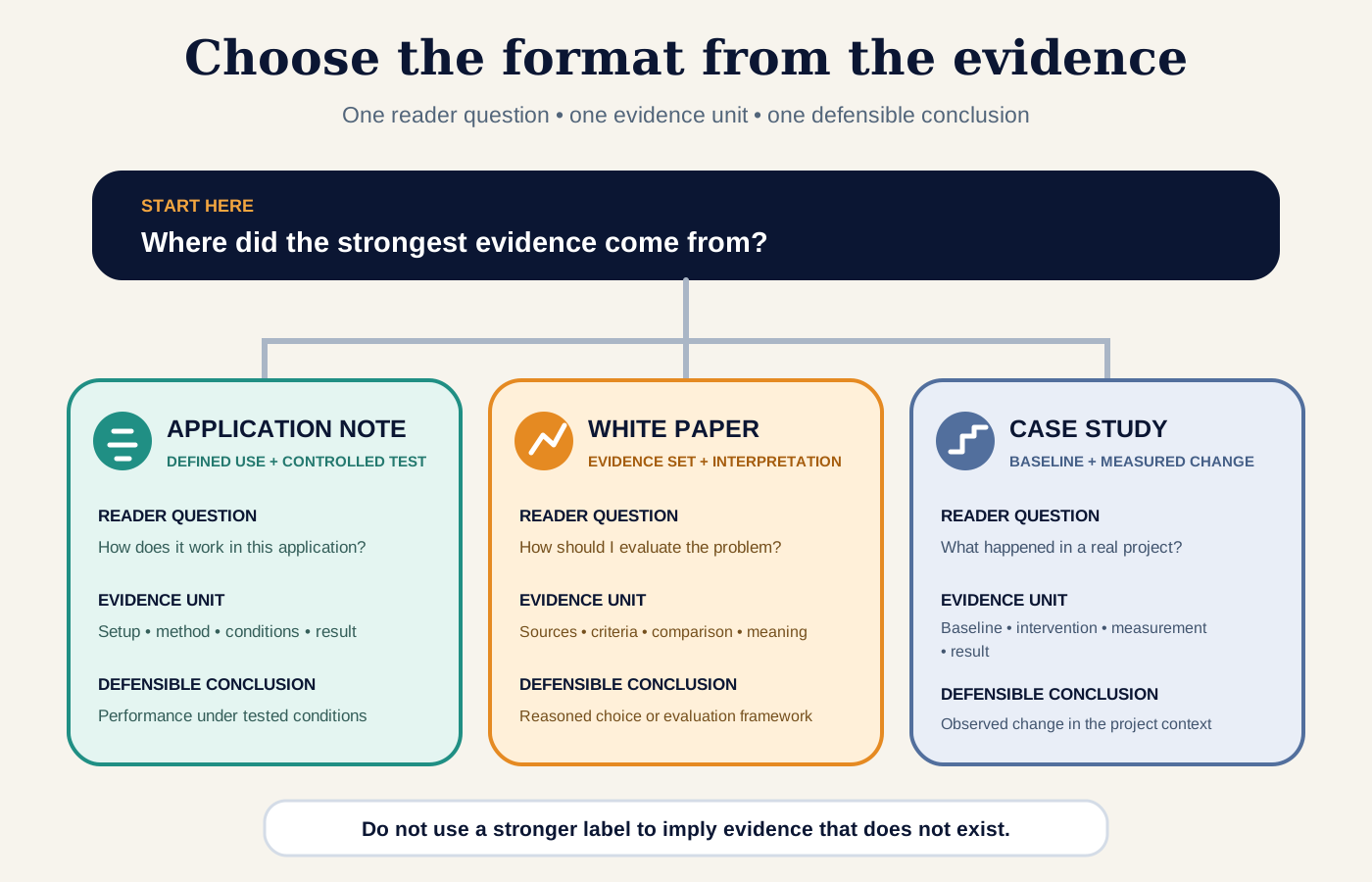
The table shows why the formats are related but not interchangeable. All three require technical review. The difference is the relationship among source evidence, reader question and conclusion.
Use the evidence-origin test
When the team is uncertain, begin with where the strongest evidence came from.
Controlled application data points towards an application note
If the team tested one method with a defined instrument, material, sample or operating range, the natural format is usually an application note. The document can be technically detailed because reproducibility and application fit are central.
The note should report the setup and relevant conditions rather than presenting only a favourable graph. Where measurement uncertainty affects the comparison, the reporting should describe it. NIST guidance on reporting measurement uncertainty emphasises providing enough information to understand how the result and its uncertainty were obtained.
A body of evidence points towards a white paper
If the team has several sources, competing methods, standards and an unresolved buyer decision, a white paper is often the stronger format. Its value comes from synthesis and interpretation, not from extending a product page.
The paper may recommend one approach, but the comparison criteria must be stable. Data produced under different test conditions should not be ranked as if they came from one experiment.
A measured project points towards a case study
If the evidence comes from an implementation with a defined starting condition and follow-up result, use a case study. Customer permission, source records, data definitions and the contribution of other changes must be addressed before writing.
A project without a reliable baseline may still support a technical project summary. It may not support a quantified improvement claim.
Worked example: one water-treatment technology, three documents
Assume a company develops an adsorbent for fluoride removal.
Application note
The team evaluates the adsorbent using synthetic water at defined initial fluoride concentration, pH, dose, temperature and contact time. The document reports the test method, equilibrium behaviour, interference from selected co-ions and the conditions required to reproduce the result.
Defensible conclusion: the adsorbent achieved the reported removal under the stated laboratory conditions.
White paper
The team examines why fluoride-removal technologies must be evaluated through removal efficiency, residuals, regeneration, treated-water quality, operating complexity and cost. It compares adsorption with other treatment routes using published and internal evidence, then positions the company’s approach against those criteria.
Defensible conclusion: the evidence supports a defined evaluation framework and shows where the approach may offer advantages or require further validation.
Case study
The company installs a pilot or field unit treating groundwater with a measured baseline composition. The document reports flow, bed depth, breakthrough definition, run time, treated-water quality, maintenance, regeneration and performance variation. It also states which conditions were not tested.
Defensible conclusion: the system produced the measured outcome during the defined project period and operating range.
The underlying technology is the same. The evidence maturity and reader decision change the correct format.
Do not use a case-study label to upgrade weak evidence
A case study may sound commercially stronger than an application note, but the label does not create a customer, baseline or measured operational change. Similarly, calling a product explanation a white paper does not make the analysis independent or comprehensive.
The U.S. Federal Trade Commission’s advertising-substantiation policy states that objective product and service claims require a reasonable basis before dissemination. The specific legal standard depends on jurisdiction and claim type, but the communication principle is useful across technical B2B markets: the evidence should match the express and implied claim.
If a laboratory graph is the strongest evidence, state the laboratory conditions. If a pilot is still running, describe the work as pilot evidence. If a result is illustrative, label it as illustrative. Credibility grows when the format makes the evidence maturity visible.
A hybrid document still needs one primary job
Some material legitimately overlaps. An application note may contain a short problem overview. A white paper may include a mini case example. A case study may explain the mechanism of the product.
The document can combine supporting elements, but one primary question should control the structure. Otherwise, the reader may receive several introductions, a long product section, disconnected data and no clear decision.
Use this rule:
- If the setup and reproducibility carry the value, lead with the application note.
- If comparison and interpretation carry the value, lead with the white paper.
- If the real implementation and measured change carry the value, lead with the case study.
The other material should support that job rather than compete with it.
Review the format before drafting
Before approving the outline, record:
- intended reader and decision;
- evidence owner and permission status;
- evidence scale and operating context;
- measurement basis and uncertainty;
- strongest defensible claim;
- important boundary or unresolved risk; and
- proportionate next action.
If the team cannot complete these seven fields, the problem is not yet writing. The evidence and purpose need clarification first.
Practical conclusion
The difference between an application note, white paper and case study is not mainly length or design. It is the relationship between the reader’s question and the evidence.
Use an application note for a defined use and test. Use a white paper for a broader evidence-led decision. Use a case study for a real project with a baseline and measured outcome. When the source material does not support the preferred format, change the format or collect the missing evidence rather than stretching the claim.
BridgeHelix Media provides PhD-led technical content writing for scientific and engineering companies that need to turn approved technical material into application notes, evidence-led white papers and credible case studies without losing the conditions and limitations that make the content trustworthy.
Sources
- FTC: Policy Statement Regarding Advertising Substantiation (opens in a new tab)
- NIST Technical Note 1297: Reporting Uncertainty (opens in a new tab)
- U.S. GAO: Technology Readiness Assessment Guide (opens in a new tab)
- U.S. Department of Energy: Adoption Readiness Levels framework (opens in a new tab)

About the author
Dr. Prakash Kumar Singh
Founder & Technical Content Strategist
PhD in Chemical Engineering from MNIT Jaipur, with M.Tech and B.Tech qualifications in Biotechnology. His work connects technical evidence with clear B2B communication and ethical research support.