A messaging problem can look like a traffic problem
A technical website may receive relevant visitors and still produce few useful enquiries. The immediate response is often to increase traffic, publish more articles or redesign the homepage. Those actions can improve the website, but they will not solve a message that the visitor cannot understand.
It is similar to increasing the flow through a treatment system before checking whether the treatment step is working. More input does not repair the process. It can simply make the loss larger.
A technical messaging audit examines the sequence between the reader's question, the company's explanation, the evidence offered and the next action. The following signs show when that examination is likely to be useful.
Sign 1: different pages describe the company differently
The homepage may call the product a platform. A service page may call it a solution. A sales deck may lead with a feature that does not appear on either page. Each statement may be technically defensible, but together they prevent the buyer from forming one stable understanding.
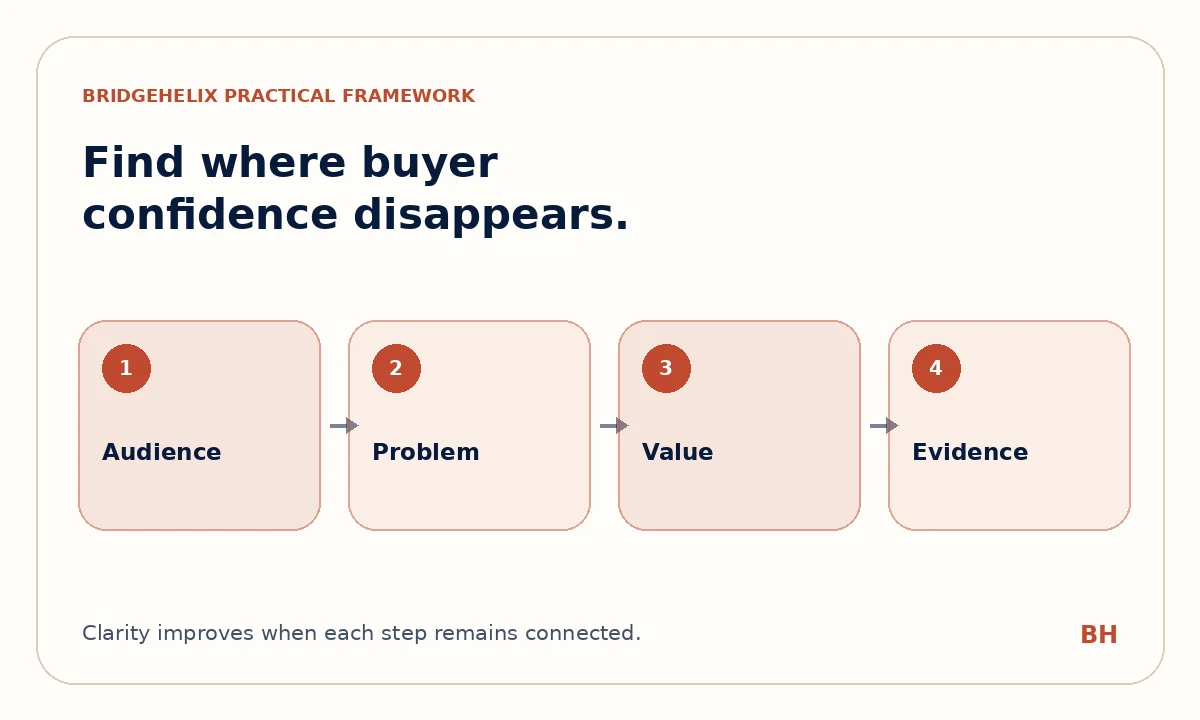
This usually means the organisation has not agreed on a message hierarchy. The hierarchy should identify the audience, the important problem, the category of solution, the practical value and the evidence needed to support it. Individual pages can then extend the same central explanation for different decisions.
Changing isolated sentences will not fix this problem. The relationship between the pages has to be corrected.
Sign 2: your team explains the offer better in conversation
Founders, engineers and salespeople often explain the product clearly when a prospect asks a direct question. They know which example makes the mechanism understandable, which limitation needs to be stated and which result gives the buyer confidence.
If the website cannot do in several pages what the team can do in two minutes, important context is probably trapped in internal knowledge. Interviews can reveal the explanation customers already respond to. The audit then compares that explanation with the public journey and identifies what is missing, buried or written in language customers do not use.
Sign 3: features appear before the customer problem
Technical teams naturally begin with the mechanism, model, formulation or design. The visitor first needs a reason to evaluate it. Without a decision frame, a feature becomes another technical fact the reader must interpret alone.
For example, “modified composite surface” may be important, but a buyer needs to know whether the modification changes contaminant removal, operating range, regeneration or safety. The feature should remain, but it should be connected to the consequence and proof.
Our article on turning a technical feature into commercial meaning explains this connection in more detail.
Sign 4: the claims are either vague or too strong
Words such as innovative, advanced, efficient and sustainable are easy to approve because they sound positive. They are difficult to evaluate because the reader does not know the comparison, boundary or evidence.
The opposite problem is an absolute claim that exceeds the available data. A laboratory result becomes “field proven.” A relative improvement becomes “best in class.” Both vague and exaggerated language reduce trust, although they fail in different ways.
An audit maps each important claim to its support. It identifies what can be stated now, what requires qualification and what needs more evidence before it should appear publicly.
Sign 5: proof is present but the reader cannot tell what it proves
Some technical websites contain many papers, diagrams, certifications and performance numbers. The problem is not a lack of evidence. It is a lack of connection between the evidence and the claim.
A certification may support process compliance but not product performance. A case study may demonstrate one application but not every market listed on the homepage. A diagram may explain how the system works but not whether it works better.
The audit reorganises proof around buyer questions. The most decision-relevant evidence appears close to the claim, while deeper material remains available for technical review.
Sign 6: the site attracts the wrong enquiries
More enquiries are not always better. If most visitors expect a different service, budget, application or level of support, the website may be creating demand for something the company does not offer.
This is often visible in contact messages and sales calls. Prospects repeatedly ask whether the product works in a market that is not supported, or they expect a small transactional service when the offer requires a technical engagement. These patterns should be treated as message evidence.
An audit compares the intended audience with the audience implied by the copy, examples, navigation and call to action. The aim is not to exclude every adjacent reader. It is to make the primary fit unmistakable.
Sign 7: relevant traffic reaches the page but no clear next step follows
Analytics can show that visitors arrive through relevant search terms, read part of a page and leave. It cannot by itself explain whether the reader lacked trust, did not understand the offer or was asked for too much too early.
A first-time visitor may not be ready to book a sales meeting. A technical checklist, evidence note, sample scope or low-commitment review may be a more proportionate next step. A service page can ask for a scoped conversation because the reader now understands what would be discussed.
The call to action should follow the job of the page. It should not be copied across the site without considering the reader's stage.
What a useful audit should deliver
A messaging audit should not end with general comments such as “make the copy clearer.” It should show where the current journey breaks and what should change first.
The deliverable may include the audience and problem definition, message hierarchy, page-level findings, claim-to-evidence map, content gaps, priority revisions and example directions for key sections. Critical positioning gaps should come before cosmetic wording. High-value pages should come before a site-wide rewrite.
The deeper buyer-confidence audit guide explains how to locate the exact transition where a reader stops understanding or trusting the message.
Audit before adding more pages
If the website already contains accurate technical information but visitors cannot explain the value, producing more content may enlarge the same problem. First establish who the reader is, what they need to understand, which evidence supports the message and what action makes sense next.
Once that structure is clear, design, SEO and content production become easier to evaluate. They are no longer separate activities competing for attention. They are parts of one communication system.

About the author
Dr. Prakash Kumar Singh
Founder & Technical Content Strategist
PhD in Chemical Engineering from MNIT Jaipur, with M.Tech and B.Tech qualifications in Biotechnology. His work connects technical evidence with clear B2B communication and ethical research support.