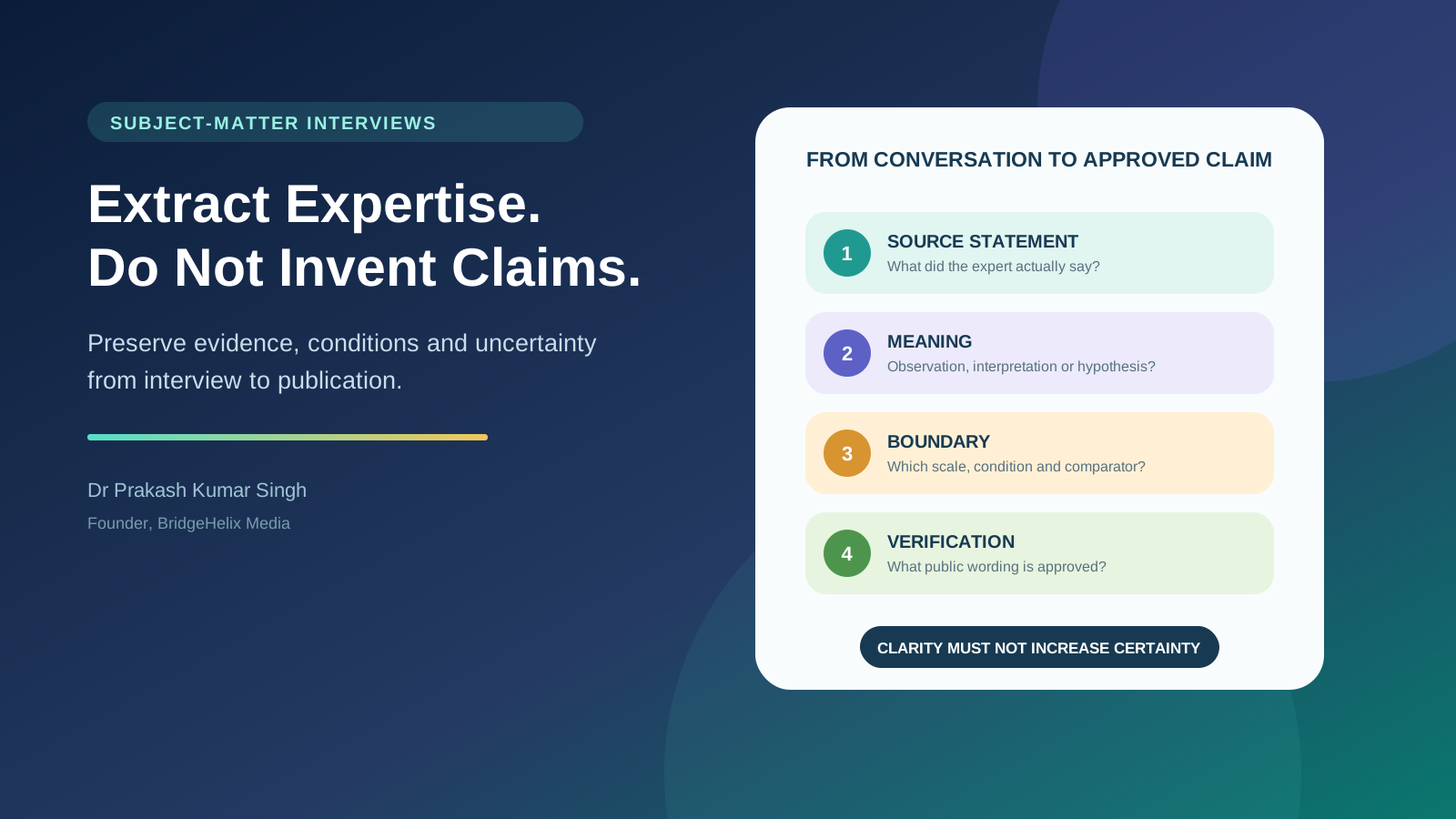
A technical content interview should capture the expert’s meaning, evidence and boundaries separately. Ask for the operating context, mechanism, observation, comparison, uncertainty and approved public wording. Record what is established, what is interpretation and what remains unverified. After drafting, return consequential claims to the named expert for verification instead of treating conversational confidence as publication approval.
Interviewing a technical expert is not ordinary note-taking. Scientists and engineers often speak from years of context. They may shorten a careful explanation because colleagues already understand the conditions. They may describe a working hypothesis as “what is happening” while knowing that it has not been independently demonstrated.
A writer can make the sentence clearer and accidentally make the claim stronger.
The risk increases when the content must also be concise, persuasive and search-friendly.
Where invented claims come from
Most inaccurate technical content is not created through deliberate fabrication. It develops through small transformations.
The expert says:
We normally see lower fouling with this configuration.
The notes become:
The configuration reduces fouling.
The draft becomes:
Our patented configuration eliminates fouling and maintenance.
Each sentence appears related to the one before it, but the final claim adds certainty, exclusivity and an operational outcome that the expert did not state.
Similar changes occur when:
- “in our pilot” becomes “in industrial applications”;
- “consistent with” becomes “proves”;
- “may improve” becomes “improves”;
- “one possible mechanism” becomes “the mechanism”;
- “compared with our previous design” becomes “better than conventional technology”;
- “we are evaluating” becomes “the platform provides.”
The interview process must preserve the qualifiers that control meaning.
Prepare before using the expert’s time
Do not ask an engineer to explain the company from the beginning if internal material already exists.
Before the interview, review:
- the technical content brief;
- product or process documentation;
- approved website claims;
- relevant reports, papers and presentations;
- terminology and confidentiality restrictions;
- the target reader and decision;
- known evidence gaps.
Create a preliminary claim map:
| Claim area | Current wording | Evidence available | Question for expert |
|---|---|---|---|
| Performance | “High removal” | Pilot graph | What outcome, baseline and conditions? |
| Mechanism | “Selective capture” | Laboratory characterisation | What is observed and what is inferred? |
| Scale | “Scalable process” | Bench and pilot units | Which scale-up step has been demonstrated? |
| Cost | “Lower operating cost” | Preliminary model | Which inputs dominate and what comparison was used? |
This turns the interview into evidence clarification rather than an unstructured conversation.
Start with the decision, not the technology history
Experts often begin with how the technology was developed. This can be valuable, but the content may need to help a reader decide whether to request a pilot, compare a method or understand a technical risk.
Open with:
The primary reader is a process engineer deciding whether this technology is suitable for a variable high-salinity stream. What would that engineer need to know before considering a pilot?
This question identifies relevance. It also reveals information that standard marketing prompts miss: input limits, pre-treatment, monitoring, failure conditions, material compatibility and evidence still required.
The technology history can then be used selectively to explain why the approach differs.
The source–meaning–boundary–verification chain
The BridgeHelix interview chain keeps four records for every consequential claim.
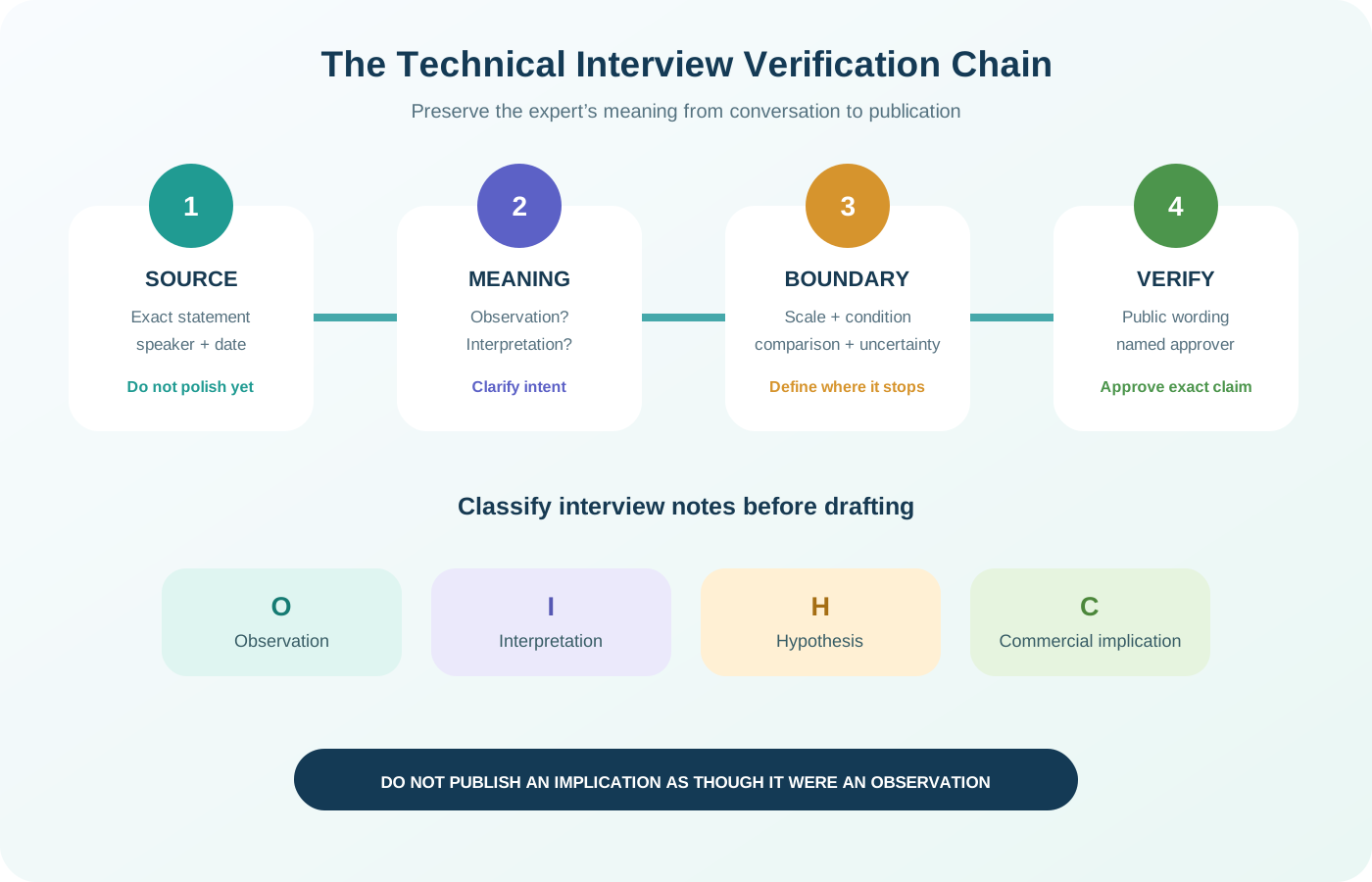
1. Source statement: what did the expert actually say?
Capture the statement accurately. With permission, a recording or reliable transcript can reduce note-taking errors. Record the speaker, date and relevant document or data reference.
Do not immediately rewrite the statement into polished copy. Preserve the original before interpretation.
Example:
In the eight-week pilot, pressure increased more slowly than in our earlier module, but the influent was also more stable.
This sentence contains a result, comparator and confounding condition.
2. Meaning: what does the expert intend the statement to communicate?
Ask:
- What exactly was measured?
- Compared with what?
- Which condition matters?
- Is this a direct observation or an explanation?
- What would make the statement false?
The expert may clarify:
We observed a lower rate of pressure increase relative to our previous module during that pilot. We cannot attribute all of the difference to the new configuration because influent variability was lower.
The clarification is more publishable because it separates observation from attribution.
3. Boundary: where must the claim stop?
Ask the expert to identify the scope.
- Does this apply to one material, formulation or product version?
- Was it demonstrated in laboratory, pilot or full-scale operation?
- Which feed, population or application was tested?
- Over what duration?
- Which comparator was used?
- Which variables were controlled?
- What remains uncertain?
Boundary questions are not an attempt to weaken the message. They allow the writer to state a specific claim confidently.
During the eight-week pilot, the revised module showed a lower rate of pressure increase than the previous module under the recorded influent conditions.
This statement may be narrower than “reduces fouling,” but it contains information a technical reader can evaluate.
4. Verification: what can be approved for public use?
The expert’s spoken explanation may refer to confidential results, preliminary work or information outside their approval authority.
Ask:
- Is the supporting source approved for public use?
- Can the number, customer, location or material be identified?
- Who must approve this claim?
- Should the statement be attributed, anonymised or omitted?
- What wording would accurately reflect the present evidence?
Publication approval should be explicit. Being present in an interview is not the same as approving every possible paraphrase.
Questions that reveal technical value and limitation
Problem and operating context
- What failure or limitation is the reader dealing with?
- Under which conditions does that problem become serious?
- What does the failure affect: quality, yield, time, safety, cost or compliance?
- Which alternatives are normally used?
Mechanism
- What enters the system and what leaves it?
- What does the technology do differently?
- Which part of the mechanism is directly observed?
- Which part is inferred from current evidence?
- Are plausible alternative explanations still open?
Performance
- What was the primary outcome?
- What was the baseline or comparator?
- What value, range or uncertainty was observed?
- Over what duration, scale and number of tests?
- Which operating condition most affects the result?
Application
- What must already be true for this to work?
- What integration or pre-treatment is required?
- Where would you not recommend using it?
- What would a credible pilot need to test?
Evidence
- Which report, dataset or publication supports this statement?
- Is the evidence internal, peer reviewed or independently validated?
- Has the current product version been tested?
- What stronger claim could future evidence support?
Commercial meaning
- Why does this technical difference matter to the target reader?
- Which cost or time consequence has actually been measured?
- Which consequence is only expected?
- What is the fairest next step for a buyer?
These questions produce useful substance without asking the expert to become a copywriter.
Distinguish four types of statement in the notes
Label interview material as:
O: Observation
What was measured or documented.
Effluent concentration remained below X during the reported pilot period.
I: Interpretation
What the expert believes the observation means.
The stable result is consistent with the proposed buffering mechanism.
H: Hypothesis
What may explain the observation but requires further testing.
Surface restructuring may account for the slower decline after regeneration.
C: Commercial implication
What the result could mean for a buyer.
If confirmed across variable influent conditions, the behaviour could reduce intervention frequency.
This classification prevents the commercial implication from being published as though it were an observed outcome.
Listen for dangerous shorthand
During an interview, pause when you hear:
- always;
- never;
- proven;
- safe;
- sustainable;
- non-toxic;
- cost-effective;
- scalable;
- best;
- industry-leading;
- eliminates;
- guarantees.
These words may be correct, but each carries an evidence burden.
Ask:
What evidence and comparison would you use to defend that exact word?
The answer may produce a strong claim. It may also reveal that a more precise phrase is needed.
The same principle appears in the FTC’s advertising substantiation guidance (opens in a new tab): objective express and implied claims need an appropriate basis. The legal details vary by jurisdiction and sector, but a content team should always know what evidence its public wording implies.
Do not make the transcript the article
A transcript preserves sequence, hesitation and repetition. An article needs an argument.
After the interview:
- group material by the reader’s questions;
- connect claims to evidence;
- retain conditions and limitations;
- separate explanation from direct quotation;
- identify unresolved questions;
- build the article around the reader’s decision.
The writer should improve clarity, but not silently resolve uncertainty.
If two experts disagree, record the disagreement. Determine whether it reflects different data, product versions, definitions or interpretations. Do not choose the more convenient statement without checking.
Treat AI transcripts as working records, not verified evidence
Automated transcription can save time, but technical terms, numbers, units, product names and negative constructions are easy to misread. “Did not increase” becoming “did increase” can reverse the meaning of a result.
When transcription is used:
- obtain the required permission and follow the organisation’s confidentiality rules;
- check consequential passages against the recording;
- verify numbers, units, chemical or biological names and model identifiers;
- mark uncertain words instead of guessing;
- keep the named expert responsible for approving the final claim.
A transcript records a conversation. It does not prove the technical statement, establish permission to publish confidential information or replace the supporting report. Use it to preserve context and locate claims, then return to the relevant evidence and approver.
Use a verification table with the draft
Do not ask the expert to review a long article with the instruction “please check.”
Provide a focused table:
| Draft claim | Source | Boundary retained | Reviewer question |
|---|---|---|---|
| Module maintained X during pilot | Pilot report A17 | Eight weeks; stated conditions | Is the value and scope accurate? |
| Mechanism improves selectivity | Characterisation study | Laboratory formulation | Is “supports improved selectivity” more accurate? |
| May reduce intervention frequency | Expert interpretation | Conditional | Can this implication be public? |
Then ask the expert to review the complete draft for context.
This reduces circular comments because the consequential claims are visible.
What writers should never infer without approval
Do not infer:
- regulatory status from technical performance;
- safety from the absence of one measured contaminant;
- sustainability from use of a waste-derived material;
- commercial readiness from laboratory success;
- cost advantage from lower material use alone;
- general superiority from a comparison with one internal version;
- causation from association;
- customer outcomes from a product mechanism.
These may become legitimate claims after appropriate evaluation. They do not automatically follow from the initial technical fact.
Evidence-led water-treatment content marketing offers a good example: removal percentage is only one part of a useful treatment claim. Water matrix, residuals, regeneration, energy, cost and scale may materially change the conclusion.
Practical conclusion
The goal of a technical expert interview is not to collect impressive sentences. It is to transfer knowledge without losing the conditions that make the knowledge true.
Preserve the source statement. Clarify the intended meaning. Record the evidence boundary. Obtain approval for the public claim. Then build clear content around the reader’s decision.
BridgeHelix Media provides scientific content writing that combines structured subject-matter interviews, evidence mapping and expert verification for technical companies that cannot afford attractive but inaccurate claims.
Sources

About the author
Dr. Prakash Kumar Singh
Founder & Technical Content Strategist
PhD in Chemical Engineering from MNIT Jaipur, with M.Tech and B.Tech qualifications in Biotechnology. His work connects technical evidence with clear B2B communication and ethical research support.