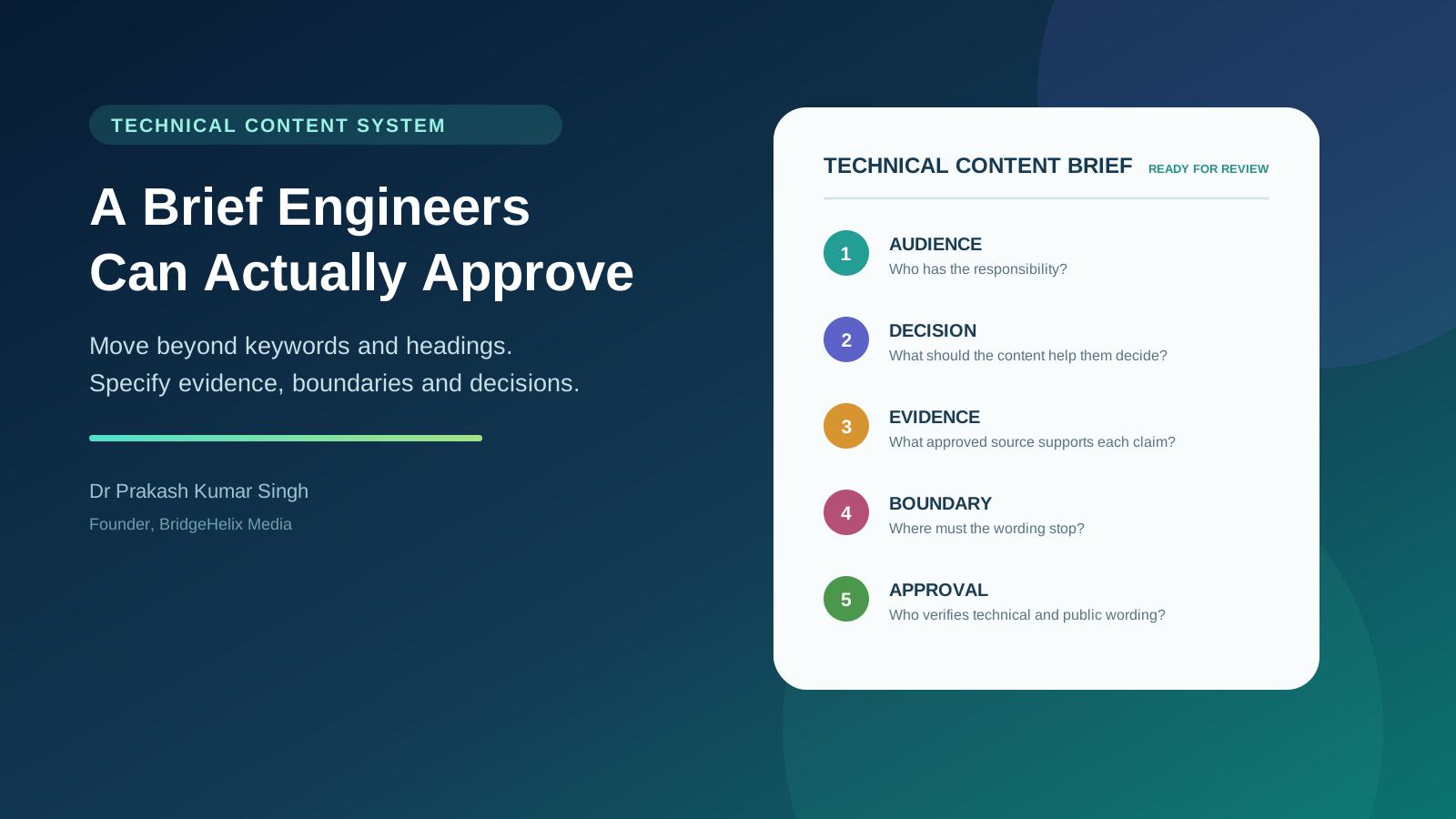
Many content briefs are designed for speed. They contain a target keyword, word count, competitor links and a proposed outline. This may be enough for a general article. It is usually not enough for a page about a membrane, diagnostic platform, reactor, formulation, analytical method or engineering service.
The writer begins drafting with incomplete technical context. The subject-matter expert receives a polished article full of assumptions. Review becomes reconstruction rather than verification.
The problem is not that engineers are difficult reviewers. The brief did not specify the content they were being asked to approve.
Why ordinary SEO briefs fail in technical markets
A conventional brief often answers:
- What keyword should the page target?
- Which headings appear on competing pages?
- How long should the article be?
- Which internal links should be included?
A technical reviewer needs different questions answered:
- Which product, process or application is within scope?
- Under which operating conditions is a performance claim valid?
- What evidence is approved for public use?
- Which comparison is fair?
- What must not be implied?
- Which terms have precise disciplinary meaning?
- Who approves scientific accuracy, product positioning and compliance?
If these questions appear only after the first draft, revision becomes expensive.
The article may also become generic. Without access to first-hand expertise, the writer fills gaps with public summaries. Google’s people-first content guidance (opens in a new tab) asks whether content demonstrates first-hand expertise, provides substantial value and leaves the reader satisfied. For a technical company, that value often comes from operating conditions, decision criteria, limitations and experience that competitor pages do not explain.
A brief is a pre-draft agreement
The strongest technical content briefs are not merely instructions to the writer. They are agreements among marketing, technical, product and compliance stakeholders.
The agreement does not require everyone to write the article together. It establishes:
- the purpose of the content;
- the intended reader and decision;
- the technical scope;
- the evidence that may be used;
- the claims that are allowed or prohibited;
- the review sequence and acceptance criteria.
Once these points are clear, the writer can make editorial decisions without guessing the science or repeatedly returning to the expert.
The BridgeHelix audience–decision–evidence–approval framework
This framework has five connected parts. A weakness in any part usually appears later as an avoidable revision.
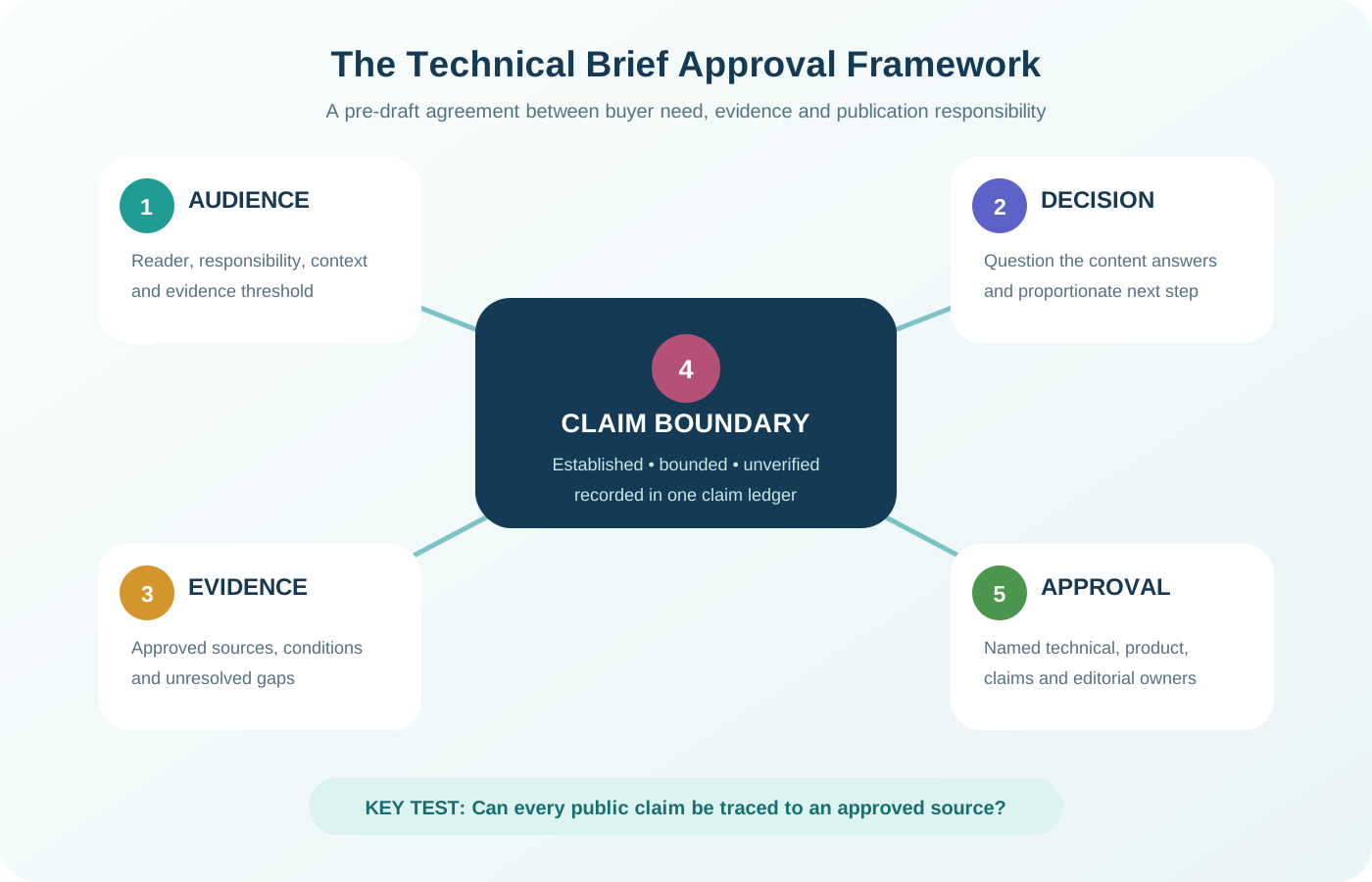
1. Audience: identify a reader with a real responsibility
“Technical decision-makers” is too broad.
For one water-treatment technology, possible readers include:
- a process engineer comparing integration requirements;
- an operations manager worried about downtime and maintenance;
- a municipal buyer checking compliance and lifecycle cost;
- an R&D leader evaluating mechanism and validation;
- an investor assessing technical defensibility and scale risk.
Each reader needs different evidence.
The brief should state:
Primary reader: process engineer at an industrial wastewater facility evaluating whether the treatment can handle variable influent composition before pilot testing.
This is more useful than a demographic profile because it identifies the reader’s context and task.
Secondary readers may be included, but the page should not attempt to give equal priority to five audiences. If necessary, plan separate pages for technical detail, application, validation and procurement.
2. Decision: define what the content should help the reader do
The objective should describe a decision or movement, not a vague communication goal.
Weak:
Educate readers about our innovative platform.
Stronger:
Help laboratory directors determine whether the platform’s sample range, throughput and validation status justify requesting a technical evaluation.
Possible content decisions include:
- decide whether a method fits an application;
- understand why one mechanism performs differently;
- compare alternatives using fair criteria;
- prepare for a pilot or technical call;
- identify evidence still required for adoption;
- decide whether a service provider understands the problem.
The decision determines what information belongs in the content. A buyer preparing a pilot needs conditions, inputs, dependencies and failure modes. A reader learning a new category may first need a clear problem–mechanism explanation.
3. Evidence: create an approved source pack
Do not give the writer a folder containing forty files with no hierarchy.
Create a source table:
| Source | What it can support | Important limitation | Public status | Owner |
|---|---|---|---|---|
| Product specification v3 | Operating range and material compatibility | Not field performance | Public | Product |
| Pilot report A17 | Performance in textile effluent | One site, eight weeks | Approved summary only | Engineering |
| Peer-reviewed mechanism paper | Mechanism and laboratory comparison | Earlier material formulation | Public | R&D |
| Customer presentation | Use case and implementation context | Customer name confidential | Internal | Sales |
The limitation column is essential. Evidence does not support every claim merely because it is credible.
An internal test may support “achieved X under the stated conditions.” It may not support “industry-leading” without a fair comparator. A pilot may support feasibility at one site. It may not establish general performance across all influent conditions.
For commercial content, objective claims should also have an appropriate basis before publication. The US Federal Trade Commission’s advertising substantiation policy (opens in a new tab) is jurisdiction-specific, but its underlying communication lesson is widely useful: express and implied objective claims both require support.
4. Boundary: define what the content may and may not say
Create three claim groups.
Established
Claims directly supported by approved evidence.
In the eight-week pilot, the system maintained effluent concentration below X under the reported flow and influent range.
Bounded interpretation
Claims that connect evidence to meaning but must retain conditions.
The pilot indicates that the system can maintain performance during the tested variation, subject to validation at other sites and operating ranges.
Unverified or prohibited
Claims not supported, not approved or too broad.
Guarantees compliance in any industrial wastewater stream.
This claim classification helps the writer understand not only what is true, but how strongly it may be stated.
Also record terminology rules:
- approved product and process names;
- abbreviations;
- units and notation;
- words that carry regulatory meaning;
- competitor names and comparison restrictions;
- confidentiality boundaries;
- phrases that must remain qualified.
The brief should capture what the expert would otherwise correct repeatedly.
5. Approval: decide who reviews what
“Send to the technical team” is not a workflow.
Assign review authority:
| Review area | Accountable reviewer | Review question |
|---|---|---|
| Technical accuracy | Named engineer or scientist | Are mechanism, conditions and limitations correct? |
| Product truth | Product owner | Does the draft match the current product and roadmap? |
| Claims and compliance | Legal or regulatory reviewer where needed | Are public claims supportable and permissible? |
| Buyer relevance | Sales or customer-facing lead | Does this address actual evaluation questions? |
| Editorial quality | Content owner | Is the argument clear, useful and on brief? |
One person may cover more than one role in a small company. The responsibility should still be explicit.
Review in sequence when possible. Technical and claims approval should occur before final copyediting and design. Otherwise, a late evidence correction can force large layout and messaging changes.
The claim ledger: the most useful part of the brief
A claim ledger turns evidence review into a visible system.
| Draft claim | Evidence | Condition | Allowed strength | Status |
|---|---|---|---|---|
| Reduces treatment time by 30% | Pilot report A17 | One site; defined loading range | “Reduced by 30% in the pilot” | Approved |
| Requires no maintenance | None | Not applicable | Do not use | Rejected |
| Uses lower energy than process B | Internal comparison | Equivalent throughput not tested | Requires new comparison | Pending |
The ledger prevents a familiar cycle:
- marketing writes an attractive claim;
- engineering rejects it;
- marketing weakens it until it becomes vague;
- nobody knows which evidence would have made it acceptable.
With a ledger, the team can choose among three actions: publish a bounded claim, collect stronger evidence or remove the claim.
Build the outline from reader questions, not competitor headings
Competitor pages can reveal search vocabulary and common expectations. They should not determine the entire structure.
Start with the reader’s decision:
Can this technology operate reliably in my process, and what evidence should I examine before a pilot?
Then build an outline:
- the operating problem and why current approaches fail;
- the mechanism of the proposed technology;
- relevant input and operating conditions;
- performance evidence with comparisons;
- integration, monitoring and maintenance;
- limitations and remaining validation;
- next evaluation step.
This structure may still use the target keyword naturally, but it is organised around technical due diligence.
A clear technical value proposition and homepage message can supply approved positioning, while the brief adapts it to one reader and decision.
When the source material is incomplete
A brief should reveal evidence gaps before drafting, not encourage the writer to fill them.
Mark each gap with an action:
- interview: the knowledge exists but has not been documented;
- analysis: existing data require an approved calculation or comparison;
- validation: the claim needs new technical evidence;
- approval: evidence exists but public use is undecided;
- omit: the point is outside the present content scope.
For example, if a page needs to discuss energy demand but the company has only component ratings, do not ask the writer to estimate system consumption. Define the missing measurement and decide whether the article can proceed with a narrower statement.
An incomplete brief is not a failure. It is useful when it identifies the exact information or authority needed before publication.
What the completed brief should contain
Use the following fields.
Strategic core
- content type and working title;
- primary reader and secondary reader;
- reader situation and decision;
- business objective and proportionate CTA;
- primary search intent and keyword cluster.
Technical scope
- product, process, material or application included;
- operating conditions included and excluded;
- key mechanism;
- approved terms, units and definitions;
- comparisons and evaluation criteria.
Evidence
- ranked source pack;
- claim ledger;
- required data or worked examples;
- limitations that must remain visible;
- confidentiality and citation rules.
Structure
- direct answer near the beginning;
- reader-led headings;
- table, figure or decision framework needed;
- internal links;
- source links;
- expected level of technical depth.
Workflow
- subject-matter expert;
- interviewer or writer;
- technical reviewer;
- commercial and compliance reviewers;
- number and order of review rounds;
- definition of approval.
Approval criteria should be testable
“Looks good” is not a useful acceptance criterion.
Use questions:
- Can every performance claim be traced to an approved source?
- Are conditions retained wherever they affect interpretation?
- Is the mechanism accurate at the intended depth?
- Does the page answer the specified reader decision?
- Are comparisons equivalent and fair?
- Are limitations explained without burying the value?
- Are technical terms consistent?
- Is the next step appropriate to the reader’s readiness?
When these criteria are agreed before drafting, review comments become more specific and less personal.
Practical conclusion
A technical content brief should reduce uncertainty before writing. It should tell the writer what the reader needs to decide, what evidence supports the answer, where the claim must stop and who approves each part.
Keywords, word count and headings belong in the brief. They are not the foundation. The foundation is an evidence-controlled agreement between expertise, buyer need and publication responsibility.
BridgeHelix Media provides technical content writing and evidence-led content planning for scientific, engineering and research-driven companies that need useful content without losing technical accuracy.
Sources

About the author
Dr. Prakash Kumar Singh
Founder & Technical Content Strategist
PhD in Chemical Engineering from MNIT Jaipur, with M.Tech and B.Tech qualifications in Biotechnology. His work connects technical evidence with clear B2B communication and ethical research support.