
Researchers have always used tools and assistance. Spellcheckers identify typographical errors. Reference managers organise citations. Statistical software performs calculations. Colleagues and editors suggest clearer structures.
Generative AI makes the boundary more difficult because the same tool can correct one sentence, rewrite a section, propose an interpretation, produce code, create an image or generate a complete manuscript.
The central principle of AI academic editing ethics is human responsibility. AI can assist with language and organisation, but it cannot be an author because it cannot accept responsibility for accuracy, integrity or originality. Ethical use requires researchers to understand what the tool changed, verify every output, protect confidential material, disclose relevant use and retain control over the scientific decisions.
Editing and authorship are not the same activity
The ICMJE authorship criteria require substantial intellectual contribution, involvement in drafting or critical revision, final approval and accountability for the complete work. AI cannot satisfy these conditions because it cannot approve the final manuscript or answer for errors and misconduct.
ICMJE therefore states that chatbots and other AI-assisted tools should not be listed as authors. Humans remain responsible for all submitted material that includes AI-generated content.
ICMJE also identifies writing assistance, technical editing, language editing and proofreading as activities that do not, by themselves, justify authorship for a human contributor. This helps establish a useful distinction: improving expression is not automatically the same as originating the research.
The ethical question is not simply whether AI was used. It is what task it performed, what information it received, how its output was checked, whether the use was disclosed and who remains accountable.
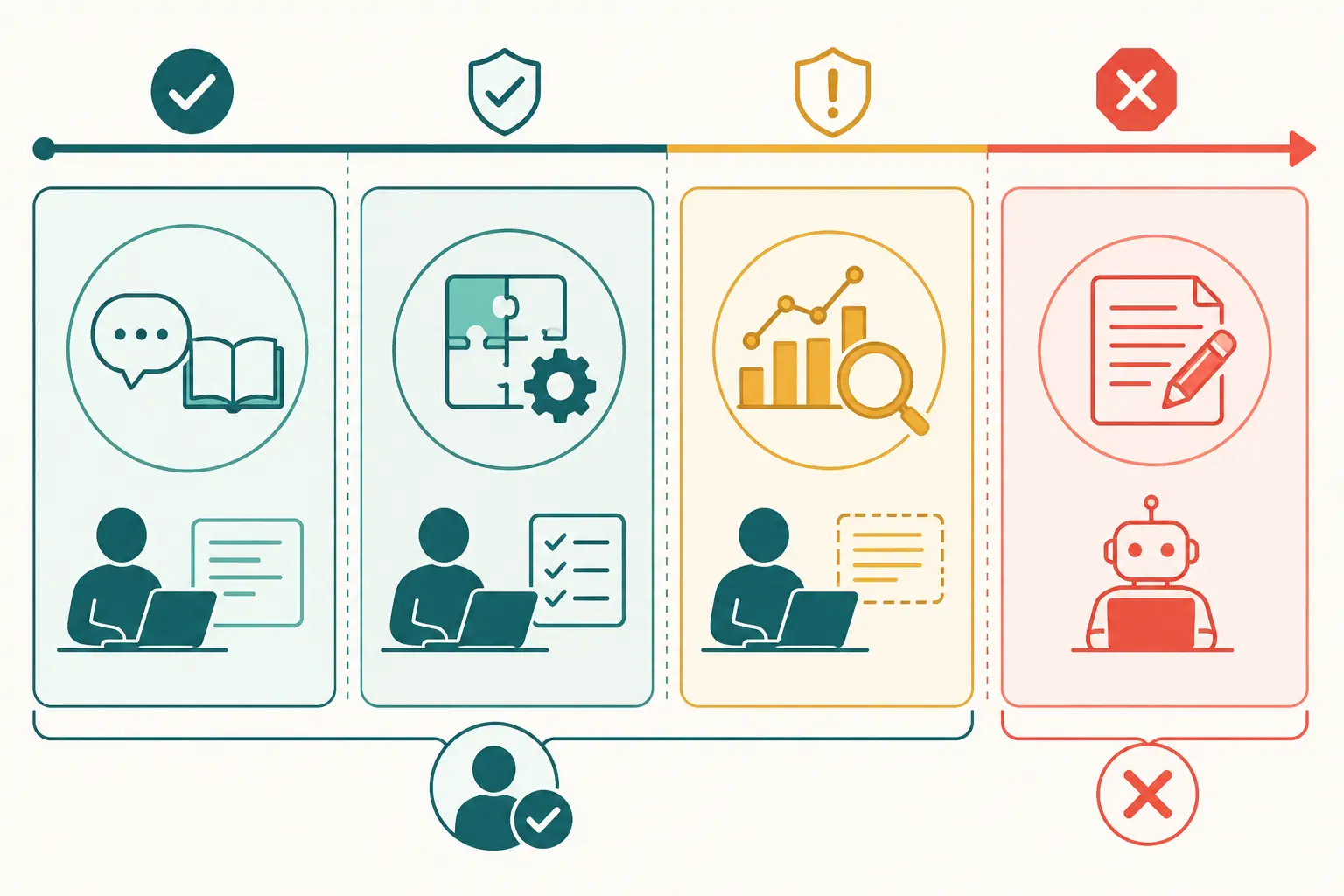
A four-zone model for AI-assisted academic editing
AI use can be examined through four zones rather than one universal yes-or-no rule.
Zone 1: Mechanical language support
Examples include spelling, grammar, punctuation, formatting consistency and identification of repeated words.
Risk is relatively low when the tool preserves meaning and the author reviews every change. Still, technical terms, units, statistical expressions and cautious scientific language can be altered incorrectly. “Associated with” may become “caused,” or “may improve” may become “improves.” A fluent sentence is not necessarily an accurate sentence.
Zone 2: Structural and explanatory support
Examples include suggesting section order, identifying an unclear transition, shortening repetition or asking whether the conclusion answers the stated objective.
This can support editing when the author decides what to accept and the tool does not invent evidence. The researcher should be able to explain why each structural change improves the manuscript.
Zone 3: Intellectual or analytical generation
Examples include proposing the research question, interpreting results, selecting a statistical model, generating code, creating a figure, classifying qualitative data or drafting the discussion from raw findings.
These uses are not automatically prohibited by every journal, but they require much stronger verification and may require detailed disclosure in the methods or another specified section. The output can change the scientific contribution, not only its language.
Zone 4: Authorship substitution or fabrication
Examples include generating a complete paper without accountable human intellectual work, inventing references, producing data that were never collected, hiding AI-generated analysis, creating false images or using AI text that no author can defend.
This is not editing. It replaces or falsifies the work for which authors must take responsibility.
What ICMJE requires from authors using AI
The current ICMJE recommendations state that journals should require disclosure at submission when AI-assisted technologies were used in producing submitted work. Authors should explain the use in the cover letter and in the manuscript's appropriate section.
The location depends on the task. ICMJE indicates that writing assistance may be described in the acknowledgement, while AI used for data collection, analysis or figure generation should be described in the methods.
The guidance also makes several responsibilities explicit:
- AI should not be listed or cited as an author.
- Human authors must review AI output because it may be incorrect, incomplete or biased.
- Authors must ensure that plagiarism has not occurred in AI-produced text or images.
- Quoted material must be attributed and cited properly.
- AI-generated material should not be treated as the primary source.
- Nondisclosure may lead to corrective action and, in some circumstances, may be treated as misconduct.
These requirements create a minimum standard. The target journal may have a stricter policy, so authors must check its current instructions before submission.
Language improvement can still change scientific meaning
The phrase “AI was used only for grammar” sounds safe, but it should be verified through the actual changes.
Consider these examples:
| Original scientific meaning | Risky edited version | Problem introduced |
|---|---|---|
| “Removal increased under the tested conditions.” | “The treatment is more effective.” | Removes the experimental boundary |
| “The model was consistent with the observed trend.” | “The model proved the mechanism.” | Converts fit into proof |
| “No significant difference was detected.” | “The treatments were equivalent.” | Absence of significance is not equivalence |
| “The material may support reuse after validation.” | “The material enables safe reuse.” | Changes possibility into a safety claim |
| “The association remained after adjustment.” | “The factor caused the outcome.” | Converts association into causation |
This is why subject knowledge remains essential. An editor or tool can improve sentence form, but the author must protect the evidence boundary.
Our guide to writing a scientific abstract without exaggeration (opens in a new tab) shows how claim strength should remain connected to design, comparison and uncertainty.
Source verification cannot be delegated blindly
Generative AI may provide plausible titles, authors, journals and DOIs that do not exist or do not support the statement attached to them. Even a real paper may be described incorrectly.
For every AI-suggested source:
- open the DOI or authoritative database record;
- confirm the title, authors, journal and year;
- read the relevant part of the paper;
- check whether it supports the exact claim;
- check whether the paper has been corrected, retracted or questioned;
- add it to the manuscript only after human verification.
Do not cite the AI output as the evidence. Cite the original research, guideline, standard or dataset.
The same rule applies to a summary of an uploaded paper. Compare the summary with the actual methods, results and limitations before using it in a review.
Protect confidential manuscripts and research data
An unpublished manuscript may contain original results, confidential peer-review material, commercial information, participant data or intellectual property. Uploading it to an external AI system can create privacy, confidentiality and contractual risks.
Before using a tool, check:
- whether prompts and files are retained;
- whether content is used for model training;
- who can access stored material;
- whether institutional approval is required;
- whether participant consent and ethics approval permit the use;
- whether a sponsor or journal restricts external processing;
- whether an approved enterprise or local environment is available.
Removing names does not always make a dataset anonymous. Rare characteristics, dates, locations and combinations of variables may still identify a participant.
Editors and peer reviewers face an additional duty. ICMJE states that submitted manuscripts should not be uploaded to AI systems where confidentiality cannot be assured without the authors' explicit permission.
A practical disclosure record
Researchers should keep a simple internal log even when the final journal asks only for a short statement.
Record:
- tool and version;
- date of use;
- manuscript section or task;
- type of input provided;
- purpose of the use;
- whether confidential information was included;
- how the output was verified;
- which author approved the final change;
- where the use will be disclosed.
A disclosure can then be specific rather than vague. For example:
During manuscript preparation, the authors used [tool and version] to identify grammatical inconsistencies in text drafted by the authors. All suggestions were reviewed against the original meaning, and the authors accept full responsibility for the final manuscript.
If AI contributed to analysis, code or figures, the description should be detailed enough for the reader to understand the role and, where relevant, reproduce or audit the process. Always follow the target journal's wording and location requirements.
A pre-submission responsibility test
Before submitting an AI-assisted manuscript, every human author should be able to answer yes to these questions:
- Can I explain every major claim in the manuscript?
- Have I read and verified every cited source?
- Can I defend the analysis and interpretation?
- Have I checked AI-edited language for changes in scientific meaning?
- Are the data, images and references genuine and traceable?
- Was confidential material handled under an approved process?
- Does the disclosure match the actual use?
- Does the use comply with the target journal and institution?
- Have all authors reviewed and approved the final version?
- Can the author group accept responsibility if an error is discovered?
If the answer is no, the manuscript is not ready. More fluent language does not compensate for missing accountability.
Where ethical academic support fits
Ethical support helps a researcher improve clarity, structure, consistency and evidence presentation without claiming authorship of the research or inventing content.
The researcher should remain the owner of the question, methods, data, interpretation and decisions. An editor can identify a gap, ask for clarification, compare a claim with its cited evidence and suggest a clearer structure. The author must supply or approve the scientific answer.
This boundary is central to ethical academic content support (opens in a new tab) and to a responsible academic editing and research support (opens in a new tab) process.
Practical conclusion
AI-assisted academic editing is ethical when it remains transparent, verifiable and under human control. Language correction and structural feedback can be useful, but the authors must protect scientific meaning, verify sources and retain responsibility for every submitted element.
The boundary is crossed when AI replaces accountable intellectual work, produces undisclosed analysis, invents evidence or creates content that no human author can defend.
Use AI as an instrument, not as the responsible researcher. Check the journal's current policy, keep a use record, disclose relevant assistance and ensure that every author can approve the final manuscript with full understanding.
BridgeHelix Media provides PhD-led academic editing that improves clarity and coherence while preserving author ownership, evidence boundaries and publication ethics.
Sources

About the author
Dr. Prakash Kumar Singh
Founder & Technical Content Strategist
PhD in Chemical Engineering from MNIT Jaipur, with M.Tech and B.Tech qualifications in Biotechnology. His work connects technical evidence with clear B2B communication and ethical research support.