A paper and a search article have different entry points
A research paper normally assumes that the reader has already chosen the subject. It can begin with a literature context, define a gap, describe a method and then present the result. A person arriving from search may begin with a practical question and no knowledge of the study.
The evidence can remain the same while the route changes. The article may start with the real-world problem, explain the main relationship and then introduce the study that supports the answer. This is not a weaker version of the paper. It is a different information structure.
Effective technical SEO content writing begins with that structural decision, not with inserting a keyword into the abstract.
Begin with the search question, not the paper title
A paper title is designed to identify a study precisely. A search query often expresses a broader problem: how a treatment works, why performance changes, which method fits a situation or what a buyer should compare.
Suppose a paper examines fluoride adsorption by a modified material at different pH values. A useful article might answer, “Why does pH change adsorption performance?” Another may examine what laboratory adsorption capacity can and cannot tell a treatment buyer. The article should not simply repeat the paper title in simpler words.
The strongest topic is not always the query with the largest estimated search volume. It is the question the organisation can answer with genuine depth and connect to a relevant area of expertise.
Map the evidence before deciding the angle
List the important findings, experimental conditions, comparisons and limitations. Then ask which reader question each item can answer.
This prevents a common problem: choosing a commercially attractive angle and later forcing the evidence to fit it. If the paper reports laboratory performance, it may support an article about mechanism, material comparison or test interpretation. It may not support a claim about full-scale operating cost.
The evidence map also shows when several articles are possible. Each article should have a distinct question rather than dividing one paper into thin fragments merely to create more URLs.
Reorder the material without changing the conclusion
Research often presents background before the main result because the result must be located within an existing field. A web reader usually needs the reason to continue earlier.
A practical sequence is question, short answer, explanation, evidence, conditions, limitation and next implication.
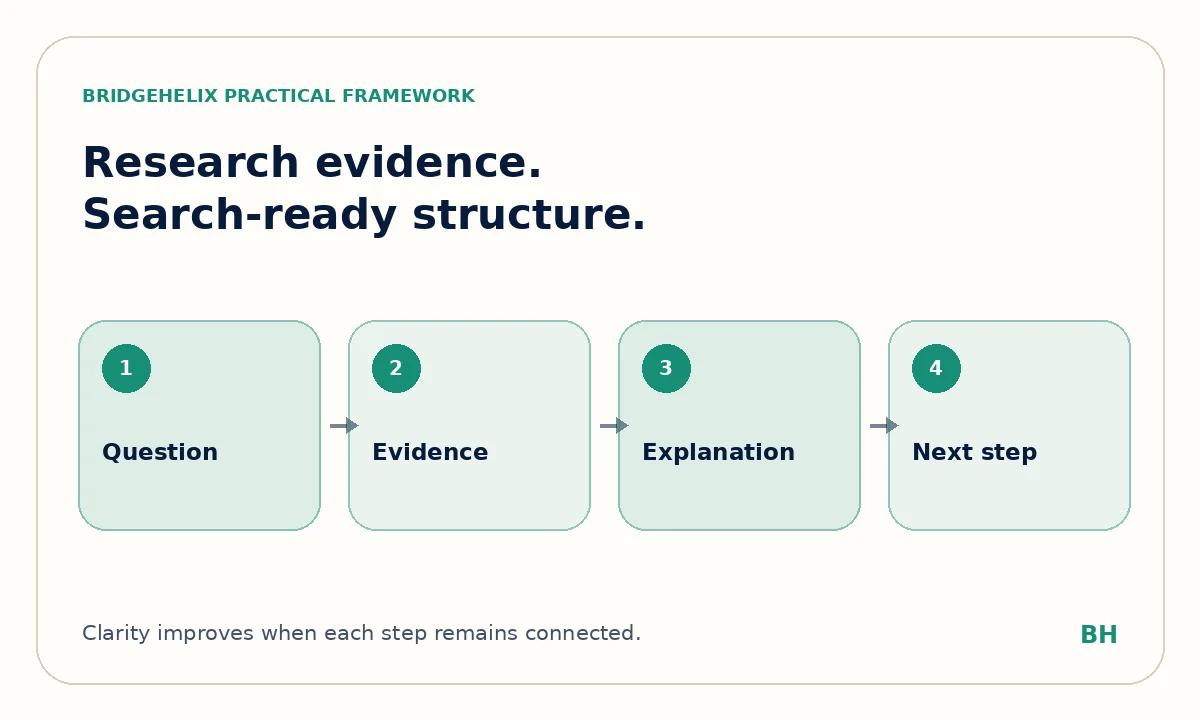
The conclusion should not become stronger when information is reordered. “The material achieved a defined capacity under laboratory conditions” should not become “the material solves the treatment problem.” Clearer order must still preserve evidence strength.
Translate terms by showing relationships
Replacing every technical term with ordinary language can make the article less useful. Specialists search for terms such as breakthrough curve, concentration polarisation or pseudo-second-order kinetics because those distinctions matter.
Introduce the term, explain it in context and show why it influences the decision. For example, a breakthrough curve is not only a graph from a column experiment. It shows how the outlet concentration changes with time or treated volume and helps evaluate when the treatment bed stops meeting the required limit.
This approach makes the subject readable without removing the vocabulary a technical reader needs. Our guide on simplifying science without oversimplifying it provides a deeper meaning-preservation check.
Bring practical interpretation forward
A result becomes useful when the reader understands what it changes. If an experiment shows improved performance at a particular temperature, explain whether that condition is common in the intended application. If a model fits the data well, explain what the model can help estimate and what it cannot prove.
Practical interpretation is not permission to invent business value. It must be connected to the evidence. Where the commercial implication depends on scale-up, durability or integration data that the research did not examine, state that need clearly.
The article can still be valuable. Showing what must be tested next is often more useful to a serious reader than claiming the research already answers everything.
Use the source visibly and proportionately
Link to the original paper, standard or report where readers can access it. Identify whether the source is peer-reviewed, a preprint, internal data or another form of evidence. Important claims should be traceable, but the article does not need a citation after every ordinary sentence.
The source should support the statement beside it. A general industry report should not be used to validate a specific performance number. A review paper can establish context, while the primary study normally supports the measured result.
If the research belongs to the organisation, describe the method well enough that the reader can understand how the result was produced. “Our tests show” is not a useful evidence description by itself.
Build the article into a topic structure
One article rarely answers every adjacent question. Link it to the relevant service or industry page, a deeper mechanism article and a practical comparison where those pages genuinely help the reader.
The links should follow the reader's next question. An article about interpreting pilot data may link to a separate guide on laboratory, pilot and commercial evidence. An industry page may link back to the article as supporting education.
This creates a connected knowledge path rather than an isolated blog archive. The guide to technical topic clusters explains how to plan that structure without manufacturing small keyword variations.
Write metadata after the article is clear
The title and description should accurately represent the page the reader will open. Write them after the central question and conclusion are stable.
The title can use the language readers search while remaining specific. The description should state what the page helps the reader understand, not promise a result the content does not deliver. A strong description may improve the decision to click, but it cannot compensate for a weak page.
The same applies to headings. They should guide the explanation, not exist only to repeat the target phrase.
Review the article as both a scientist and a reader
First check scientific fidelity. Are the numbers, units, conditions, comparisons and limitations correct? Does the explanation preserve the mechanism? Has an association become a cause or a laboratory result become a field guarantee?
Then check reader usefulness. Is the main question answered early? Does each section have a clear job? Can the reader see why the evidence matters? Is there a sensible next resource or action?
Research becomes good SEO content when both checks pass. The page is discoverable because it answers a real question, and it is worth discovering because the answer remains connected to evidence.

About the author
Dr. Prakash Kumar Singh
Founder & Technical Content Strategist
PhD in Chemical Engineering from MNIT Jaipur, with M.Tech and B.Tech qualifications in Biotechnology. His work connects technical evidence with clear B2B communication and ethical research support.