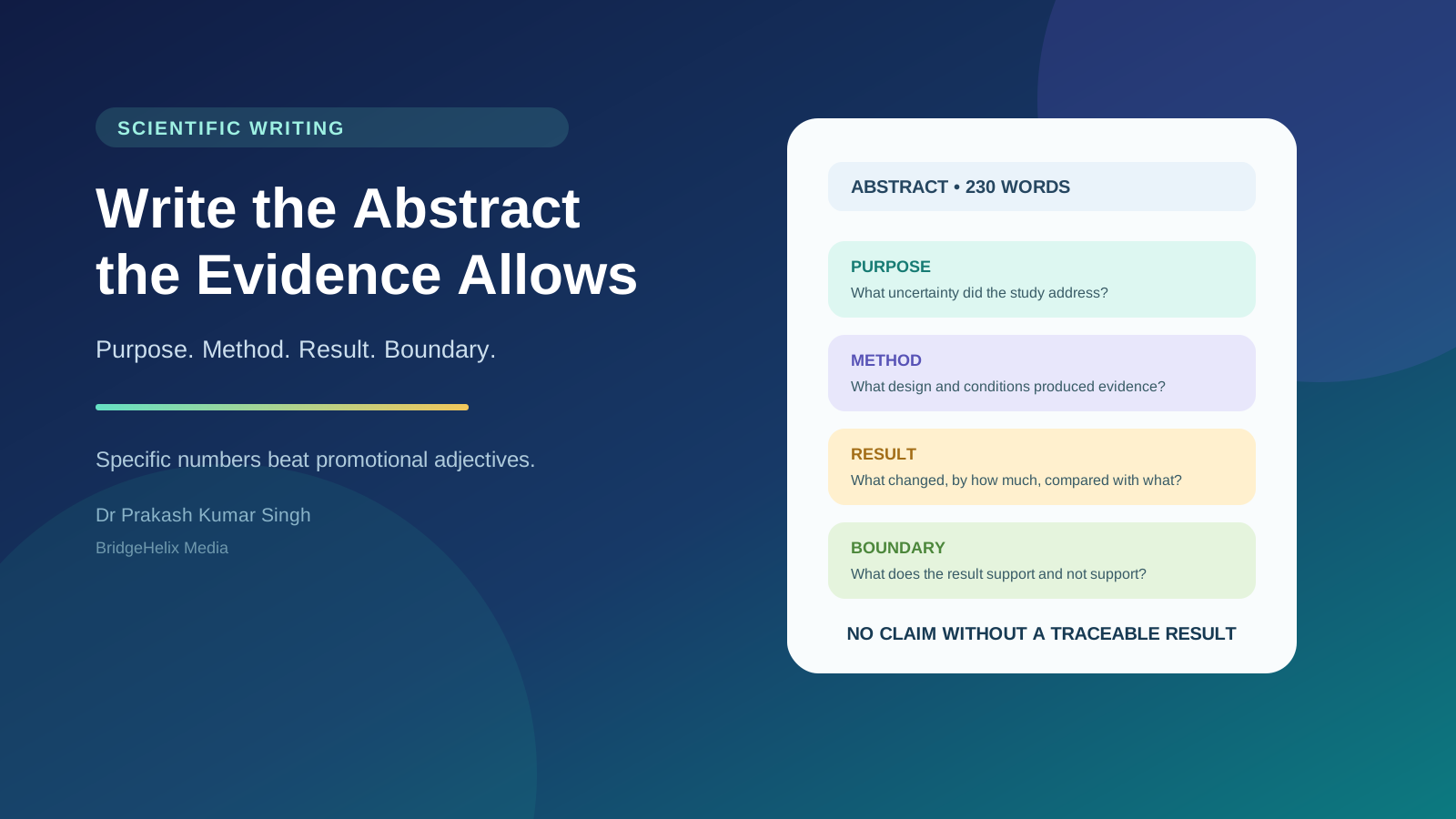
To learn how to write a scientific abstract, begin with the completed evidence. State the problem and purpose, identify the design and essential conditions, report the main result with specific data, and end with a conclusion limited to what the study establishes. Every important abstract claim should be traceable to the manuscript. Remove background that does not affect interpretation and adjectives that substitute for evidence.
An abstract is short, but it performs several tasks. It helps an editor judge fit. It helps a reviewer understand the study before reading the details. It helps databases and search systems represent the paper. For many readers, it determines whether the full article is opened at all.
This pressure can push authors in opposite directions. Some fill the abstract with background and leave only one sentence for the results. Others try to make the study sound important by removing conditions and strengthening the conclusion.
Both approaches reduce information.
A scientific abstract is a compressed evidence trail
The abstract should allow a reader to answer four questions:
- What precise problem did the study address?
- What was done to answer it?
- What was found?
- What does that result support?
The ICMJE recommendations (opens in a new tab) advise authors to follow journal requirements for abstract format and to report context, purpose, basic procedures, main findings and principal conclusions. They also warn that the abstract should accurately reflect the article because many readers see only the title and abstract.
That principle is applicable beyond medical research. The exact headings may change, but the relationship between purpose, method, result and conclusion should remain visible.
An abstract is not a miniature introduction. It is not a list of everything completed. It is the shortest defensible version of the paper.
Begin with the journal, article type and word limit
Before drafting, check:
- maximum word count;
- structured or unstructured format;
- required headings;
- whether trial registration, funding or other details must appear;
- rules for abbreviations, references and numerical reporting;
- study-specific reporting guidance.
The EQUATOR Network abstract collection (opens in a new tab) lists reporting resources for several designs. A clinical trial, systematic review, diagnostic study and conference abstract may require different information.
Do not write a generic 250-word abstract and force it into every journal. Format requirements influence what information the reader expects to find.
Write the abstract after the manuscript is stable
The abstract is often drafted early for a proposal, conference or internal review. That version should not automatically become the journal abstract.
The completed study may differ from the plan:
- the sample size may change;
- a method may be replaced;
- one objective may remain incomplete;
- the primary result may be different from the expected result;
- a limitation may narrow the conclusion.
Use the final tables, figures and discussion as the source. This keeps the summary aligned with what was actually done.
The manuscript coherence test is useful here because an abstract can only be accurate when the full paper tells one consistent story.
The four-part abstract evidence model
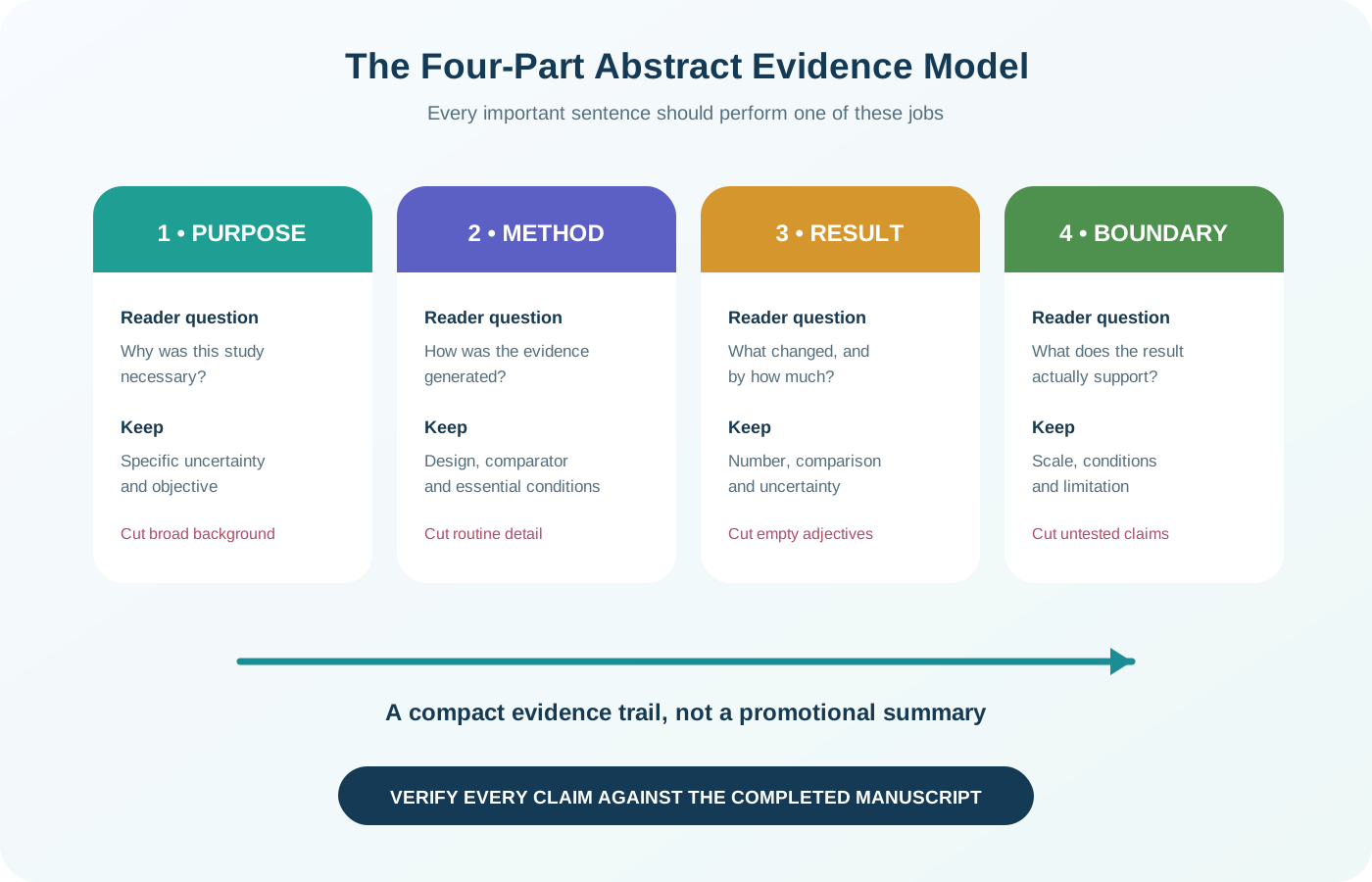
The BridgeHelix model treats an abstract as four connected blocks: purpose, method, result and boundary. Each block answers a different reader question.
Part 1: problem and purpose
Use one or two sentences to establish the specific uncertainty.
Weak:
Water pollution is a serious global problem, and many people lack safe drinking water.
The statement may be true, but it does not identify the study.
Stronger:
Competing anions can reduce fluoride uptake by adsorbents developed in single-solute systems. This study compared fluoride adsorption by a marble-powder composite in single-ion and fluoride–nitrate solutions.
The second version identifies the problem, material, comparison and purpose.
Background belongs only when it changes how the reader understands the question. A familiar problem does not need several sentences of general importance.
Part 2: design and method
The method sentence should make the result interpretable. Include the design and the most important conditions, not every instrument setting.
For experimental research, this may include:
- material or system;
- experimental design;
- comparator or control;
- sample size or number of replicates;
- relevant concentration, duration, temperature or operating range;
- primary analytical method.
For observational research, readers may need the setting, population, sampling, exposure, outcome and analysis. For qualitative work, the approach, participants, data generation and analysis may be essential.
Weak:
Experiments were conducted and the data were analysed.
Stronger:
Equilibrium batch experiments were conducted at 30°C using 10 mg/L initial fluoride, with and without 85 mg/L nitrate; adsorption capacity was estimated from triplicate concentration measurements.
The stronger version does not reproduce the full methods section. It supplies the conditions needed to understand the main result.
Part 3: the main result
This is usually the most valuable part of the abstract, yet it is often the shortest.
Prefer a specific result:
Fluoride adsorption capacity decreased from 3.22 mg/g in the single-ion system to 2.42 mg/g in the binary-ion system.
Avoid replacing evidence with evaluation:
The composite showed excellent adsorption performance.
“Excellent” does not tell the reader what happened, compared with what or under which conditions.
A useful result sentence contains:
outcome + value + comparison + uncertainty or statistical support + essential condition
Not every study can fit every element into one sentence. Include those needed to interpret the primary outcome.
If several outcomes were measured, prioritize the result that answers the main objective. Secondary findings can appear when they materially change interpretation. Do not select only the most favourable number while omitting the prespecified or central outcome.
Part 4: evidence-bounded conclusion
The conclusion should interpret the reported result at the scale of the study.
Overstated:
The composite is a sustainable and economical solution for safe drinking-water treatment.
Bounded:
Nitrate reduced fluoride uptake under the tested batch conditions, indicating that competitive-ion effects should be included when the composite is evaluated in realistic water matrices.
The bounded conclusion identifies what the evidence supports and the next validation need. It does not claim that safety, economics, sustainability or field performance were established when they were not measured.
Match the verb to the strength of evidence
Abstracts become exaggerated through verbs as much as adjectives.
| Evidence situation | More defensible wording | Wording that may overstate |
|---|---|---|
| Observational association | was associated with, correlated with | caused, led to |
| Laboratory mechanism evidence | supports, is consistent with | proves, confirms completely |
| Feasibility study | was feasible under tested conditions | is ready for implementation |
| Preliminary performance | showed potential, achieved X in the tested system | is superior, is a solution |
| One-site study | in this sample or setting | generally, universally |
| Model performance | predicted within the validation dataset | guarantees accurate prediction |
The stronger word is not always wrong. “Caused” may be appropriate in a design that supports causal inference. “Superior” may be justified by a defined, adequately powered comparison. The rule is to earn the verb through design and evidence.
A worked abstract repair
Consider this draft:
Fluoride contamination is a major problem worldwide. In this study, a novel eco-friendly composite was prepared and characterised using advanced techniques. Various parameters were investigated. The material showed excellent removal efficiency and followed the Langmuir model. It can be used as a low-cost sustainable solution for drinking-water treatment.
The draft has five weaknesses:
- broad background occupies limited space;
- “novel,” “eco-friendly,” “advanced” and “excellent” are unsupported evaluations;
- the method is not interpretable;
- no numerical result is reported;
- the conclusion introduces cost, sustainability and application without evidence.
A results-based revision could read:
Competitive ions can alter adsorbent performance observed in single-solute water. A marble-powder composite was evaluated for fluoride adsorption in batch systems containing fluoride alone or fluoride with nitrate at 30°C. Equilibrium fluoride capacity decreased from 3.22 to 2.42 mg/g in the presence of nitrate. The binary data were better represented by a competitive adsorption model than by the single-solute model. These results show that nitrate materially affected fluoride uptake under the tested conditions and should be considered during evaluation in multi-ion water.
The revision is still concise, but now the reader can see the purpose, method, result and boundary.
What to remove when the abstract is too long
Cut information in this order:
- broad statements that do not define the research problem;
- literature-review detail;
- routine methods that do not affect interpretation;
- secondary results that do not change the main conclusion;
- repeated versions of the same conclusion.
Do not begin by removing:
- the study design;
- the population or tested system;
- the main comparator;
- the primary numerical result;
- a condition necessary to interpret that result;
- a limitation that changes the conclusion.
Compression should remove low-value information, not evidence boundaries.
Use a sentence budget before cutting words
For an unstructured abstract, a simple sentence budget can protect the evidence:
- one sentence for the specific problem;
- one sentence for the purpose;
- one or two sentences for design and essential conditions;
- two or three sentences for the primary and decision-changing results;
- one sentence for the bounded conclusion.
This is not a universal template. A qualitative study, modelling paper or systematic review may distribute space differently. The benefit is that the results receive space by design rather than whatever remains after the background.
If the abstract must be shortened, check the function of every sentence. Two sentences that both say the problem is important can usually become one. A method detail can be removed when it does not affect interpretation. The main numerical result should not disappear merely to preserve a broad opening statement.
Abstract consistency checks
Before submission, compare the abstract with the manuscript.
Purpose
- Is the objective identical in meaning to the final objective in the paper?
- Does the abstract omit an important qualifier?
Methods
- Is the design named correctly?
- Do sample size, materials, duration and conditions agree?
- Is an analysis presented as prespecified when it was exploratory?
Results
- Do all numbers match the tables and figures?
- Are units, denominators and directions correct?
- Is “significant” supported by the analysis and used unambiguously?
Conclusion
- Does the conclusion answer the stated purpose?
- Does it add claims about safety, scale, cost or application that were not evaluated?
- Does it distinguish observation from explanation?
Language
- Can the abstract stand alone?
- Are abbreviations necessary and defined?
- Are keywords used naturally?
- Can an informed reader understand what changed and by how much?
Taylor & Francis similarly advises that an abstract should be self-contained, concise and understandable on its own in its guidance on titles and abstracts (opens in a new tab).
Practical conclusion
A useful scientific abstract is not the most impressive description of a study. It is the most informative short description that the evidence allows.
Build it from the completed manuscript. Give space to the primary result. Include the conditions that control interpretation. Choose verbs that match the design. Then verify every sentence against the full paper.
BridgeHelix Media provides research manuscript editing for abstract–manuscript consistency, structural clarity and evidence-bounded scientific language without changing the author’s research contribution.
Sources

About the author
Dr. Prakash Kumar Singh
Founder & Technical Content Strategist
PhD in Chemical Engineering from MNIT Jaipur, with M.Tech and B.Tech qualifications in Biotechnology. His work connects technical evidence with clear B2B communication and ethical research support.