Search is changing, but SEO is not disappearing
For years, the content SEO process was fairly predictable: identify a search question, study the existing results, create a more useful page, add internal links, optimise the title and description, publish it and wait for indexing. Those fundamentals have not disappeared. What has changed is the interface through which people may encounter the information.
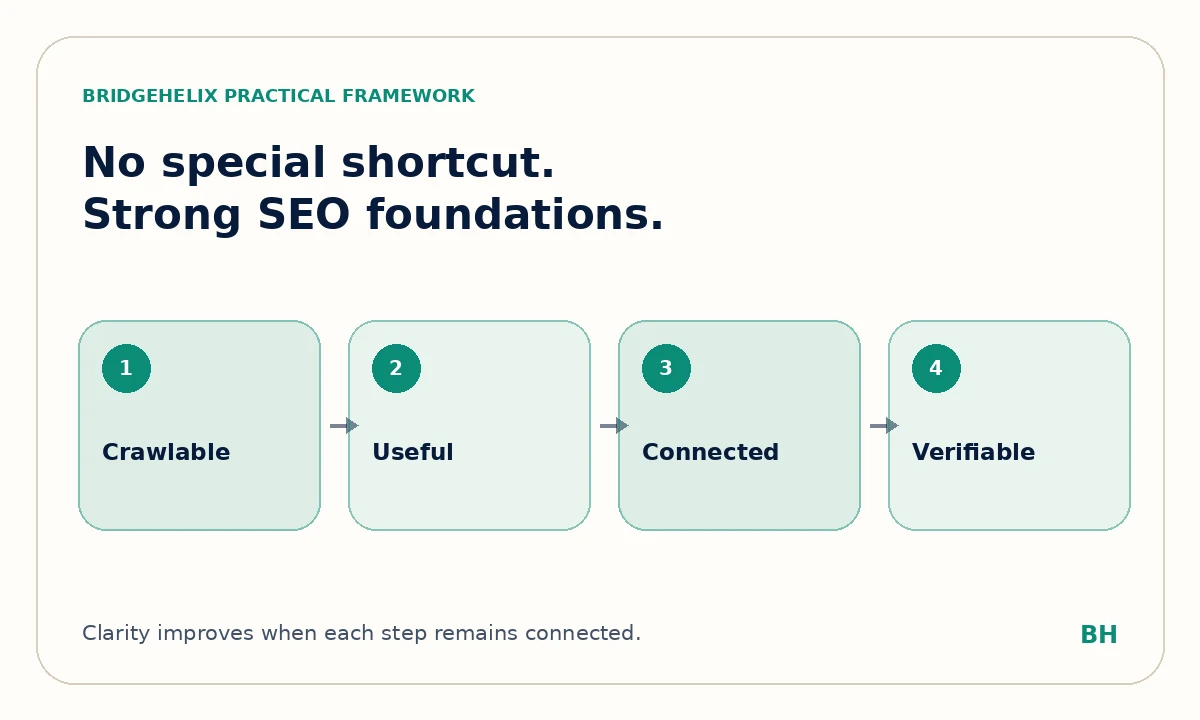
AI Overviews and AI Mode can combine information from multiple sources and present a generated response with supporting links. This creates a reasonable concern for businesses: if the search page provides part of the answer directly, how does a website still earn visibility? Google's current AI features guidance (opens in a new tab) says that the same foundational SEO practices remain relevant. Pages still need to be crawlable, indexable, useful and eligible to appear in normal Search before they can be surfaced as supporting links in these AI experiences.
The practical shift is therefore not from SEO to a completely different discipline. It is from basic keyword-led publishing towards content that is useful enough to deserve retrieval, specific enough to add something distinct and technically structured well enough for both readers and search systems to understand.
Do not write an article only because a keyword exists
Keyword research remains useful because it shows how people describe a problem and what they are trying to understand. The mistake is treating search volume as sufficient reason to publish. When dozens of sites can generate similar summaries within minutes, another generic article adds very little.
Compare a broad article called “Best AI Tools for Businesses in 2026” with a research-led article such as “We Tested 12 AI Research Tools: Where Each One Actually Saves Time.” Both can address similar search demand, but the second can contain first-hand testing, methodology, screenshots, limitations and observations that the publisher actually produced.
Google’s people-first guidance has long encouraged original information, reporting, research and analysis. Its newer generative AI optimisation guidance goes further by emphasising unique, valuable and non-commodity content. The useful editorial question is therefore not only “What keyword can we target?” but also “What can this page contribute that another page cannot easily reproduce?”
- Use search demand to identify questions, not to justify thin pages.
- Add first-hand experience, original data, expert analysis or a genuinely useful point of view.
- Avoid publishing multiple near-duplicate pages for every small variation of the same query.
Answer the main question before expanding the discussion
Many articles still spend several hundred words introducing a topic before answering the question that brought the reader to the page. That is usually an editorial problem rather than an SEO advantage.
If someone searches “Does AI-generated content rank on Google?”, the page should address the question early. A responsible answer is that AI-assisted or AI-generated content is not automatically excluded from Search; the important issue is whether the final content is accurate, useful, original and created to help people rather than produced at scale mainly to manipulate rankings.
Once the main answer is clear, the article can explain the conditions, risks, examples and practical implications. This structure respects the reader’s time and makes each section easier to understand.
There is also no need to stretch every article to an arbitrary length. Google explicitly says it does not have a preferred word count. The page should be long enough to resolve the reader’s question properly, but extra words are not a substitute for extra value.
Structure the article around the reader’s next questions
AI-assisted search is particularly useful for complex and multi-part queries. A person may not search only for “technical content writing”. They may ask how a cybersecurity company can explain a technical product to enterprise buyers without removing the detail that gives the product credibility.
That broader question contains several smaller decisions: what the product does, who the reader is, which technical details matter, which terminology needs explanation, what evidence supports the claim and what the buyer should do next.
A useful article should therefore be divided into sections that answer meaningful sub-questions rather than into arbitrary headings created only to include keywords. Each section should make sense on its own while contributing to the larger explanation.
- Use one clear H1 that states the main subject.
- Use H2 sections to answer major sub-questions in a logical order.
- Keep each section focused on one explanatory job.
- Link to separate articles when an adjacent question deserves a complete treatment of its own.
Experience and original evidence are becoming more valuable
Generic information is becoming easier to produce. Specific knowledge is not. A technical company that says “API security is important because APIs can contain vulnerabilities” is correct, but the statement gives a knowledgeable reader almost nothing new.
A more useful explanation might describe how authorisation failures can appear even when authentication exists, because access-control logic may be applied inconsistently across related endpoints. The second version demonstrates that someone understands the mechanism rather than simply repeating a familiar phrase.
For technical businesses, this kind of depth can come from case studies, experiments, original datasets, implementation examples, benchmarks, technical diagrams, expert commentary, failure analysis or documented lessons from real projects. The article does not need every form of evidence. It needs enough substance to show why the publisher is worth listening to.
Google’s current guidance describes this as creating unique, compelling and non-commodity content. In practice, the more easily a paragraph could have been generated from the first page of search results, the more important it is to ask what first-hand knowledge or analysis can be added.
Make technical content easier to read without making it shallow
Easy-to-read content does not mean removing the technical terms that specialists actually need. It means explaining those terms at the moment they become important.
Consider an engineering article about membrane fouling. Removing terms such as flux decline, concentration polarisation and transmembrane pressure may make the article sound simpler, but it may also make it useless to an engineer. A better explanation keeps the term and then explains the relationship: concentration polarisation occurs when rejected solutes accumulate near the membrane surface, increasing the local concentration and potentially reducing effective membrane performance.
The same principle applies to cybersecurity, biotechnology, SaaS, chemical engineering and other technical fields. Simplify the explanation, not the subject. Readability should reduce unnecessary friction without removing the mechanism, conditions or limitations that determine meaning.
Use evidence where the claim actually needs evidence
Commercial content often makes strong claims that sound plausible but remain unsupported: automation dramatically improves productivity, personalisation increases engagement or a new technology will transform an industry. A technical reader will still ask how much, under which conditions, compared with what and according to whom.
Good content separates fact, interpretation and opinion. A factual claim should be supported by a credible source or a clearly described internal observation. Interpretation explains what the evidence may mean. Opinion makes the author’s professional judgement visible rather than presenting it as measured fact.
This distinction is closely connected to trust. Google’s people-first guidance encourages clear sourcing, visible authorship and evidence of expertise. For a technical company, the goal is not to fill every paragraph with citations. It is to make important claims traceable and to avoid presenting uncertain conclusions as universal truths.
Build topic depth instead of manufacturing keyword variations
A single article can answer one important question, but a strong website usually needs a connected body of content. Suppose a company offers technical content writing. One article explaining the service is useful. A connected cluster can go further by addressing technical writing versus content writing, writing for B2B buyers, collaboration between subject-matter experts and writers, technical SEO, content briefs and performance measurement.
Internal links between these pages help readers move to the next relevant question and help search systems discover the relationship between pages. Google specifically continues to recommend making important content easy to find through internal links.
The distinction is important: topic depth does not mean producing a separate page for every wording variation of a query. Google’s current generative AI guidance warns against overproducing pages around fan-out or query variations primarily to manipulate rankings or AI responses. The goal is a useful knowledge structure, not a larger page count.
Make authorship and expertise visible
Anonymous technical content creates an avoidable trust problem. A reader should be able to see who wrote or reviewed the article, why that person has relevant knowledge and where they can learn more about the author or organisation.
Google’s people-first guidance explicitly encourages accurate authorship information and bylines where readers would expect them. This is one reason the BridgeHelix article template links every article to the founder profile rather than treating the author name as decorative text.
Authorship alone does not make an article authoritative. It provides context for assessing the information. The real value comes when the article itself demonstrates accurate reasoning, useful evidence and appropriate limitations.
SEO fundamentals still matter in AI Overviews and AI Mode
The discussion around generative AI sometimes makes basic SEO sound obsolete. Google’s own documentation says the opposite. To be eligible as a supporting link in AI Overviews or AI Mode, a page must be indexed and eligible to appear in Google Search with a snippet. The site must also be included in Search generative AI features through Search Console. Check the effective setting under Settings → Search generative AI; Google documents inclusion as the default, with inheritance possible from a parent property. See the Search generative AI control documentation (opens in a new tab).
That means crawling, indexing, internal linking, page experience, text availability, descriptive titles and technically correct structured data still matter. A strong article that cannot be crawled or is buried without internal links is still difficult for Search to use.
Google also says site owners do not need a special AI schema, a new machine-readable AI file or another AI-specific markup layer to appear in AI Overviews or AI Mode. Structured data should continue to describe the visible content accurately, but it is not a shortcut that turns weak content into an AI source.
- Keep robots.txt and hosting rules from accidentally blocking important pages.
- Use descriptive titles, headings and internal links.
- Keep important information available in text, not only inside images.
- Use structured data that matches the content users can actually see.
- Keep the sitemap accurate so important pages are discoverable.
Do not chase AEO or GEO tricks that add no user value
AI search has created new terminology around answer engine optimisation and generative engine optimisation. Some of the underlying ideas are sensible because they encourage clear, useful content. The problem starts when the terminology becomes a reason to apply tactics that have no real value to the visitor.
Google's current AI-search documentation says there are no special machine-readable AI files or special schema required for these features. Its recommendation is to prioritise effective SEO, a clear technical structure and useful, expert-led content instead.
This is an important practical filter. Before implementing an AI-search tactic, ask whether it improves discovery, understanding or usefulness for a real reader. If its only purpose is to create a signal that someone claims an AI system might prefer, the strategy deserves much more scrutiny.
AI can support the writing process without becoming the editorial judgement
AI tools can be useful for research organisation, outline development, extraction, language improvement, formatting and repetitive editorial work. They can reduce time spent on low-value mechanical tasks.
The weak workflow is keyword, prompt, article, publish, with no meaningful expertise or verification between those steps. Google’s guidance on AI-generated content focuses on quality and purpose rather than banning a tool. It also makes clear that using automation primarily to manipulate search rankings can violate spam policies.
For technical content, the human contribution remains important because someone has to decide whether the mechanism is represented correctly, whether the evidence supports the conclusion, whether a comparison is fair and whether an important limitation has been removed in the pursuit of simpler copy.
Measure visibility, but also measure whether the traffic is useful
Traditional rankings and organic clicks remain useful metrics, but they should not be the only measures of content performance. A technical article should also be evaluated by what the right reader does after arriving.
Useful questions include whether readers move to the relevant service page, whether they explore related articles, whether qualified visitors stay long enough to use the information, whether the article is referenced by other sites and whether it supports real sales or expert conversations.
Google now provides a Generative AI performance report (opens in a new tab) in Search Console. It shows impressions from AI Overviews and AI Mode, with page, country, date and device views. Google states that the report rolled out worldwide by 31 August 2026, although a site with insufficient AI impressions may not see it.
These impressions are also included in Web search performance, so do not add the two reports together. The generative AI report is not an AI-click or conversion report. Use it alongside organic clicks and completed enquiries; a change in total Web traffic alone does not establish a change in AI visibility.
The final metric is still business relevance. Ten thousand visits from people who will never need the company’s expertise are not automatically more valuable than a much smaller number of visits from the people the organisation is actually trying to reach.
For a practical publishing system, connect each article to a relevant service, industry and follow-up question. The BridgeHelix guide to turning research into SEO content explains how to keep the source evidence visible while changing the reading sequence.
What businesses should do now
The practical response to AI search is less dramatic than the terminology around it. Understand what your audience needs. Publish in areas where your organisation has real knowledge. Answer the main question clearly. Explain difficult points without deleting the technical substance. Support important claims. Make the author and source of expertise visible. Connect related pages logically. Keep the website technically easy to crawl and understand.
AI has changed how information can be presented in Search. It has not changed why someone searches in the first place: they have a problem, a question or a decision and need useful information.
The biggest SEO mistake in 2026 may therefore be less about missing a new AI optimisation technique and more about publishing content that has nothing distinct to contribute. Useful content still begins with a useful answer.
This guide reflects current Google Search Central guidance on AI features, people-first content, internal linking and Search Console reporting as updated on 11 September 2026. Because these systems continue to develop, major technical or reporting changes should be checked against current Google documentation when the article is updated. For sitemap implementation, use Google's current sitemap requirements (opens in a new tab) rather than AI-specific files or unverified shortcuts.

About the author
Dr. Prakash Kumar Singh
Founder & Technical Content Strategist
PhD in Chemical Engineering from MNIT Jaipur, with M.Tech and B.Tech qualifications in Biotechnology. His work connects technical evidence with clear B2B communication and ethical research support.