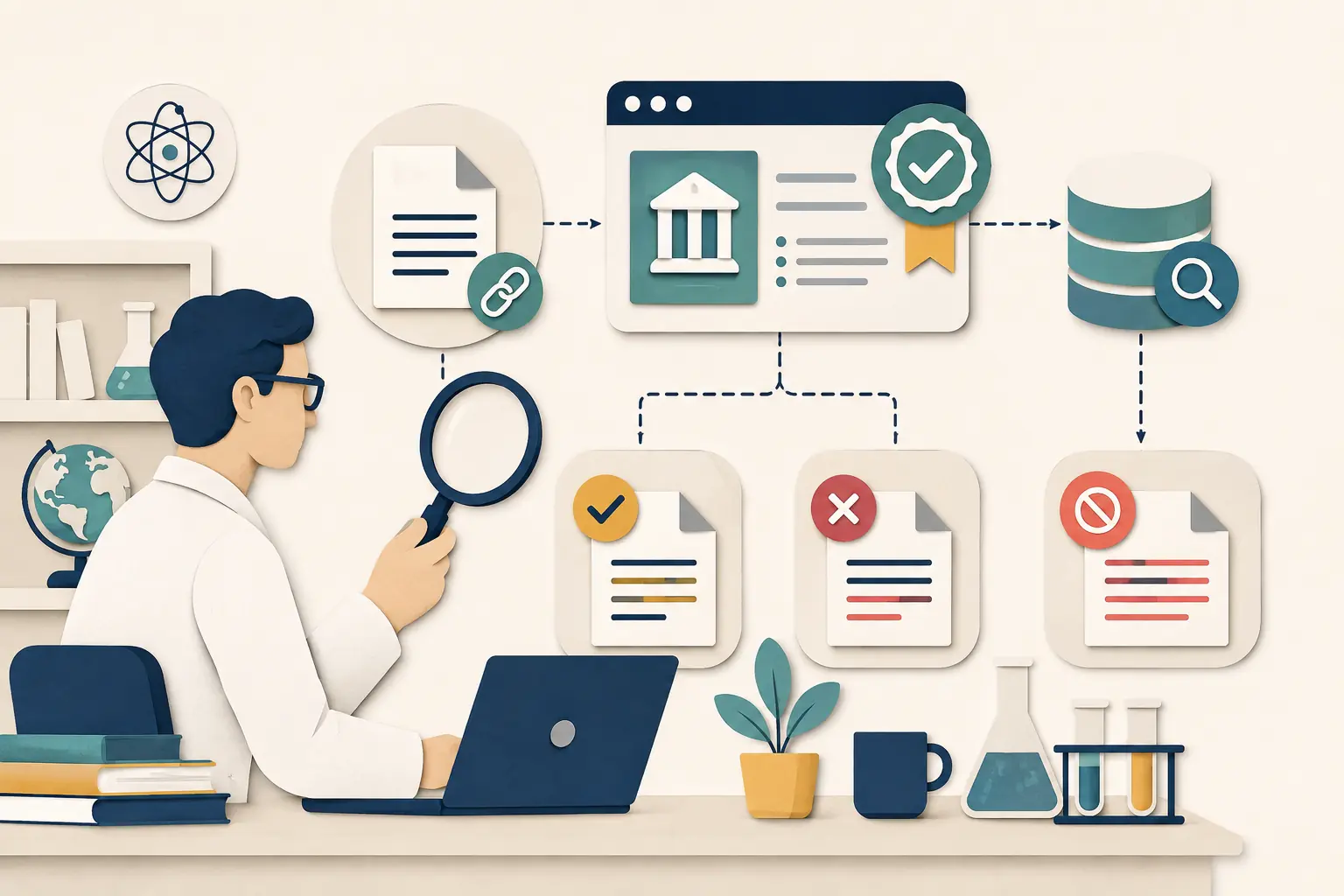
A literature review is often built over several months. Papers are downloaded, renamed and stored in folders. References move into a citation manager. By the time the manuscript is written, the researcher may be working almost entirely from saved PDFs.
The problem is that the scientific record can change after download.
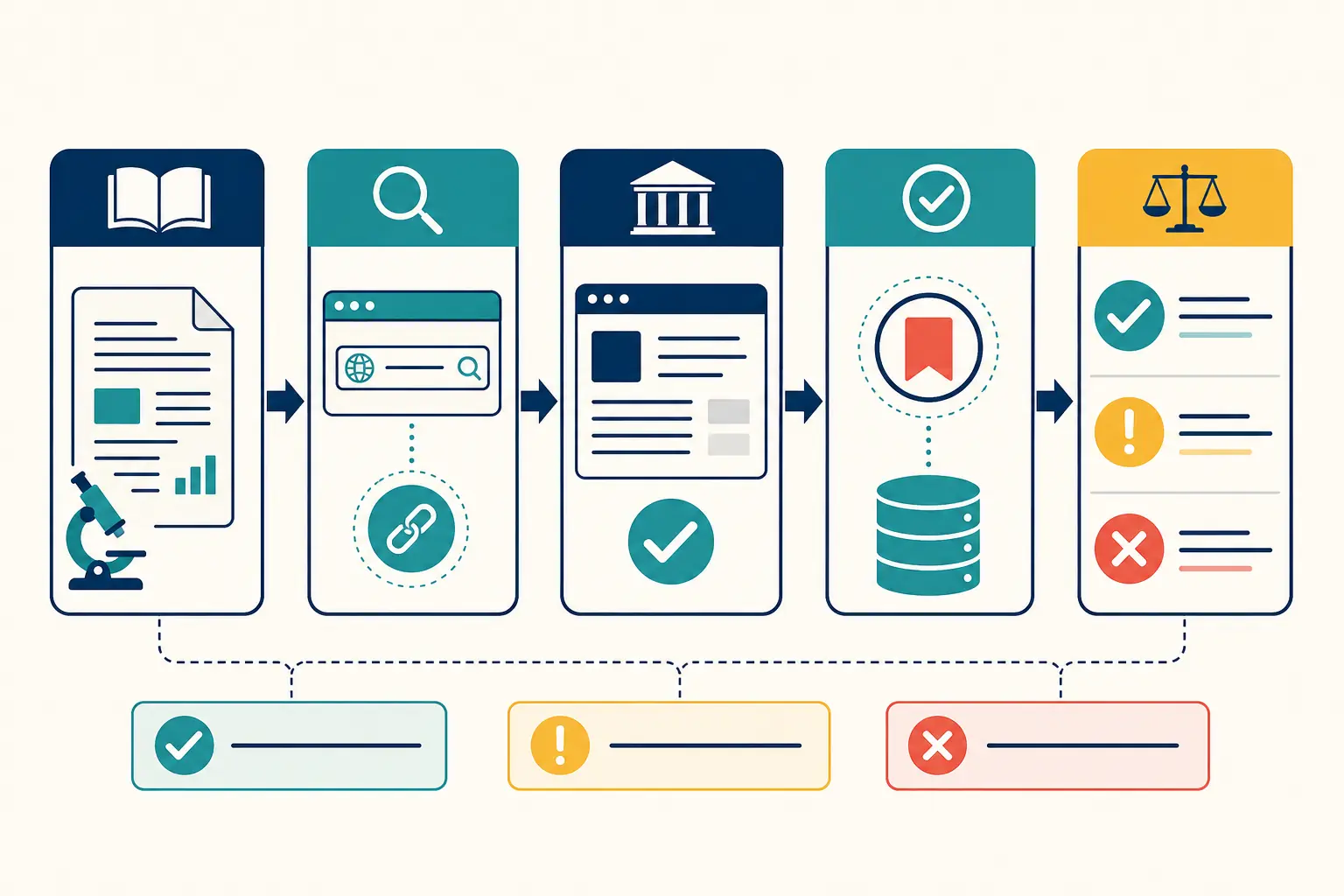
A paper may receive a correction, expression of concern, retraction or reinstatement. The old PDF on a computer may not display that change. Therefore, to check if a paper is retracted, use the DOI to open its current publisher record, inspect Crossmark or other update notices, and verify the relationship through Crossref or the Retraction Watch database before relying on the paper as evidence.
Why the saved PDF is not enough
A PDF is a version of a document obtained at a particular time. It may contain a DOI and publication details, but it is not necessarily connected to later changes when opened offline.
Some publishers update the PDF itself. Others retain the original article and add a linked notice. A retraction may be shown clearly on the HTML page while the copy stored on a researcher's computer remains visually unchanged.
This creates a common failure in literature reviews. The citation is technically accurate: the title, authors, journal and year are correct. However, the evidence status is no longer current.
The solution is not to distrust every paper. It is to make status checking a repeatable part of source management.
Understand the main post-publication notices
The terms correction, expression of concern and retraction do not mean the same thing.
Correction
A correction addresses an error in the published work. The effect may be minor or important. Researchers should read the notice to determine which data, figure, method description or conclusion has changed.
Do not assume that a corrected paper is unusable. Cite the corrected record and interpret the corrected part accurately.
Expression of concern
An expression of concern alerts readers to a potentially serious issue while an investigation or resolution is incomplete. It is not the same as a final retraction, but it is a warning that the evidence requires caution.
Retraction
A retraction indicates that the work should no longer be treated as a reliable part of the literature in its published form. COPE explains that the purpose of retraction is to correct the literature and protect its integrity, not to punish authors.
Retractions can arise for different reasons, including unreliable data, major error, duplication, plagiarism, unethical research or manipulated review. Read the notice. The label alone does not explain which part failed or why.
Reinstatement or updated status
In some cases, a later notice can change the earlier status. This is another reason to check the current record instead of depending on a static list.
A six-step workflow to check a paper's status
Step 1: Find and resolve the DOI
Copy the DOI from the paper or citation record and open it through https://doi.org/. The DOI should lead to the publisher-designated page for the work.
Match the title, authors, journal and year. A DOI typed incorrectly may lead to another record or no result.
If no DOI is available, search the exact title on the publisher website and trusted bibliographic databases. Use author and journal details to avoid matching a similarly titled paper.
Step 2: Inspect the current publisher page
Look near the article title and abstract for labels such as:
- corrected article;
- correction or erratum;
- expression of concern;
- retracted article;
- updated version;
- notice linked to this article.
Open the notice itself. A banner without the notice does not tell you whether the affected issue changes a table, one sentence, the analysis or the complete conclusion.
Step 3: Use Crossmark where available
Crossmark is a Crossref service that allows readers to check the current status of research content. Publishers can place the Crossmark button on HTML pages and inside PDFs. When clicked, it may show whether the item is current and provide links to corrections, retractions or other updates.
This is particularly useful for downloaded PDFs because the button can connect the old file to current metadata.
However, Crossref also states that the presence of Crossmark is not a guarantee. Its value depends on the publisher registering and maintaining update metadata. Absence of an alert should therefore be considered one check, not final proof that no change exists.
Step 4: Check Crossref metadata
Crossref's REST API includes post-publication relationships such as corrections and retractions where the information has been deposited or added from trusted sources. A DOI record may show that the work “has-update” or that another record is an update to it.
For a routine manual check, researchers do not need to build an API system. The important point is that DOI metadata can connect the original work and its notice.
Crossref's 2026 public data file contains nearly 180 million metadata records. Crossref reported that the snapshot included Retraction Watch retractions and that Crossmark-enabled records increased by 27% compared with the preceding snapshot. This improves machine-readable checking, but metadata coverage still depends on deposits and enrichment.
Step 5: Search Retraction Watch data
Crossref acquired the Retraction Watch database in 2023 and makes it publicly available. The database is updated each working day and can be accessed through Crossref's REST API or as a downloadable dataset.
Crossref notes that the database contains a large collection of retractions. It also includes some corrections and expressions of concern, but these other update types are not as comprehensive. Therefore, a “not found” result is not a universal declaration that the paper has never been updated.
Step 6: Record the decision in your evidence matrix
Add a status column to your literature-review evidence matrix:
| Source | DOI | Status checked | Notice found | Effect on use |
|---|---|---|---|---|
| Paper A | DOI recorded | 7 Aug 2026 | Correction | Use corrected value only |
| Paper B | DOI recorded | 7 Aug 2026 | Expression of concern | Do not use as decisive evidence |
| Paper C | DOI recorded | 7 Aug 2026 | Retraction | Exclude from normal synthesis; retain audit note |
| Paper D | DOI recorded | 7 Aug 2026 | No update found | Continue normal critical appraisal |
This creates an audit trail. It also prevents the same retracted paper from returning to the review through another search export.
What should you do when a paper is corrected?
Read the correction beside the original paper. Identify exactly what changed.
If a numerical value was corrected, update your extraction table and any calculation based on it. If a figure label changed but the underlying analysis did not, record the correction without overstating its effect. If the correction changes the conclusion, revise the way the paper is discussed.
Cite according to the journal's guidance. In many cases, the article remains the main citation with the correction linked or additionally cited where relevant.
The key is not only to mention that a correction exists. It is to propagate that change through your own analysis.
What should you do when a paper is retracted?
Do not cite the retracted paper as ordinary support for a scientific claim.
There are limited situations in which the paper may still need to be discussed, for example, a study of publication ethics, the history of a disputed claim or the effect of retracted work on later literature. In that case, label the paper as retracted in the text and citation context and cite the retraction notice.
Do not quietly delete all trace of the source from a systematic workflow. Retain an exclusion or status note so another reviewer can understand why it was not used.
A retraction also requires a citation-chain check. Search papers that relied heavily on the retracted result, especially if your argument depends on the same mechanism, dataset or effect size. Later papers do not automatically become invalid, but their reasoning may need re-examination.
When should status checks be performed?
One check at the beginning is not sufficient for a long project. Use at least three points:
- During source screening: remove or flag known retractions before detailed extraction.
- During synthesis: review corrections and expressions of concern that affect the evidence comparison.
- Before submission: recheck every source supporting a central claim, figure, calculation or recommendation.
For living reviews or regularly updated technical content, schedule periodic checks based on the subject's risk and publication volume.
This process works well with a literature-review evidence matrix (opens in a new tab) because publication status becomes part of evidence quality rather than an afterthought.
Common checking mistakes
Searching only the article title on the open web
Search engines can surface the original PDF before the publisher notice. Begin with the DOI and authoritative record.
Treating “not in Retraction Watch” as proof of no change
The database is valuable, but correction and expression-of-concern coverage is not complete. Check the publisher page and Crossmark as well.
Reading the label without the notice
The notice explains the affected content and reason. Your citation decision depends on that detail.
Removing a retracted source without checking downstream claims
If the paper influenced later work or your own calculation, deletion alone does not repair the evidence chain.
Failing to record the check date
Status can change. A dated record shows when the verification was performed.
Practical conclusion
The reliable way to check whether a scientific paper has been corrected or retracted is to follow the persistent identifier back to the current record. Resolve the DOI, inspect the publisher page, use Crossmark where available, check Crossref and Retraction Watch data, read the linked notice and record how the update changes your use of the source.
The purpose is not to remove every imperfect paper. It is to prevent outdated or unreliable evidence from entering a literature review as though nothing changed.
BridgeHelix Media provides PhD-led literature review support (opens in a new tab) and research manuscript editing (opens in a new tab) that strengthens evidence organisation, source-status checks and the connection between cited literature and defensible conclusions.
Sources

About the author
Dr. Prakash Kumar Singh
Founder & Technical Content Strategist
PhD in Chemical Engineering from MNIT Jaipur, with M.Tech and B.Tech qualifications in Biotechnology. His work connects technical evidence with clear B2B communication and ethical research support.