
The release of Journal Citation Reports 2026 gives researchers updated journal-level evidence, including Journal Impact Factor, category position and other contextual indicators. It is useful information, but it does not answer the complete submission question.
A journal can have a strong impact factor and still be the wrong journal for a manuscript. The topic may sit outside its current scope. The article type may not be accepted. The experimental evidence may be too preliminary or too specialised. The journal's readers may not be the people who will use the work.
Therefore, Journal Citation Reports should be used as one part of journal selection, not as an automatic ranking table in which the first journal becomes the best choice.
What changed in Journal Citation Reports 2026?
Clarivate released the 2026 edition on 17 June 2026. It reports metrics for 22,643 journals across 254 categories. The release also states that 521 journals received a Journal Impact Factor for the first time and that 6,703 Gold Open Access journals were represented.
The figures show the breadth of the database, but the more important point for authors is how Clarivate describes the metrics. Journal-level indicators are intended to support journal evaluation. They are not designed to measure the quality of an individual paper or the performance of a researcher.
The 2026 release continues several earlier changes, including Journal Impact Factor coverage across journals in the Web of Science Core Collection, unified journal rankings and exclusion of citations to and from retracted content in the calculation. It also makes journals with temporarily unavailable current metrics more visible through a “Forthcoming” label where applicable.
These changes improve context and transparency. They do not remove the need to examine the journal itself.
What Journal Impact Factor actually tells you
Journal Impact Factor is a journal-level citation ratio. In simplified terms, it relates citations received in the JCR year to eligible journal content published during the preceding two years, divided by the number of citable items in that period.
The calculation can help indicate how frequently recent content in a journal is cited. It cannot establish that:
- every article in the journal is highly cited;
- your article will receive a similar number of citations;
- the editorial process will be faster or more rigorous;
- the journal is the best disciplinary match;
- a paper with a lower-impact venue has less scientific value.
Citation distributions are usually uneven. A smaller group of highly cited papers may contribute strongly to a journal-level average, while many papers receive fewer citations. This is one reason why a single average should not be transferred to an individual manuscript.
The correct question is not “Which journal has the highest impact factor?” It is “Among journals that genuinely fit this manuscript, what additional context do the metrics provide?”
Why journal quartile ranking needs category context
A quartile divides journals in a category into four ranked groups. Q1 represents the upper quarter, followed by Q2, Q3 and Q4. This appears simple until a journal belongs to more than one category.
The same journal may have a different rank, percentile and quartile in each category because the comparison group changes. A multidisciplinary environmental journal, for example, may sit differently in environmental sciences, water resources and engineering. Saying that it is “a Q1 journal” without naming the category can therefore remove important context.
Category size also matters. Rank 20 in a category of 200 journals does not have the same percentile meaning as rank 20 in a category of 35. When comparing candidates, record the category name, rank denominator, percentile and quartile together.
The Journal Citation Indicator can add another view because it is field normalised. Clarivate explains that a value of 1.0 represents average citation impact for the relevant category context. Still, normalisation does not solve a scope mismatch. It only improves comparison of citation behaviour across fields.
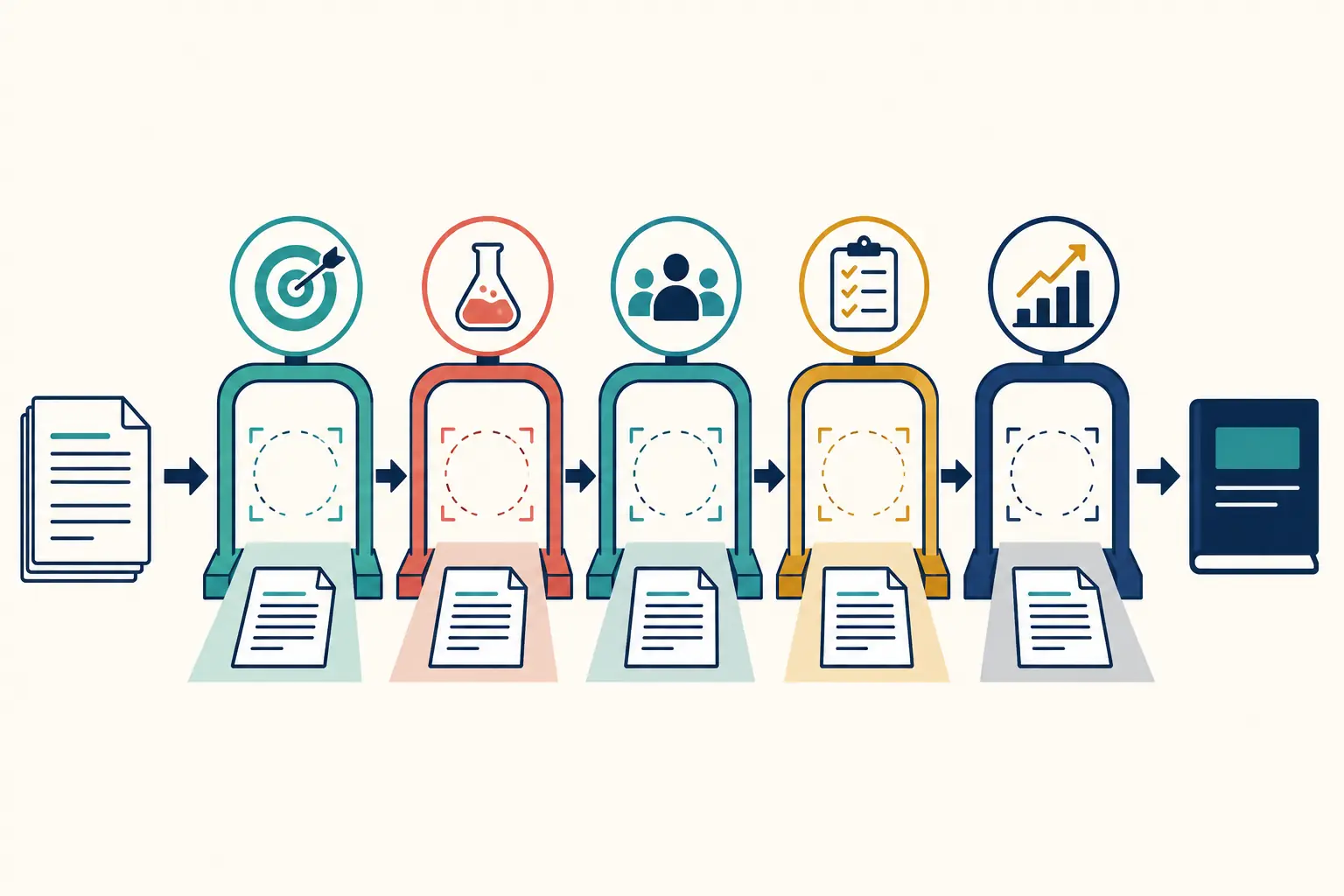
Use five filters before comparing JIF
A practical JCR journal selection should move through five filters. Citation metrics belong in the fifth filter, not the first.
Filter 1: Scope and manuscript question
Read the journal's current aims and scope, then examine recently published articles. Do not depend only on the journal title. A broad title may hide a narrow editorial preference, while a specialised journal may accept a wider range of methods than expected.
Write one sentence defining your manuscript's central question. Compare that sentence with the questions addressed by recent papers. If the connection has to be forced, the journal is probably not a strong match.
Filter 2: Evidence and article type
Check whether the journal publishes your intended article type: original research, short communication, systematic review, methods paper, case study, data paper or perspective.
Then compare evidence maturity. A journal publishing full mechanistic and field-scale studies may not accept a preliminary laboratory observation. Another journal may specifically welcome proof-of-concept work. This is not simply a difference in prestige. It is a difference in editorial purpose.
Filter 3: Reader and disciplinary language
Identify who should use the result. A water-treatment study could be written for environmental engineers, materials scientists, public-health researchers or process designers. The core experiment may remain the same, but the framing, comparison and practical implication will change.
A journal is useful when its readers can recognise the problem and understand why the result matters.
Filter 4: Editorial and publication conditions
Verify indexing status, peer-review model, open-access route, publication charges, data requirements, reporting guidelines and expected timelines. A journal website's promise should be checked against current policy pages and the relevant indexing database.
If funding or institutional rules require a particular access route, include that requirement before making a shortlist. Do not discover it after acceptance.
Filter 5: Citation context
Only after the first four filters pass should JIF, JCI, category rank, quartile, percentile, citation distribution and trend be compared.
Build a journal-selection matrix
A short matrix makes the reasoning visible and prevents one attractive metric from dominating the decision.
| Selection factor | Candidate A | Candidate B | Candidate C |
|---|---|---|---|
| Scope match | Strong | Moderate | Strong |
| Similar recent articles | Several | Few | Several |
| Article type accepted | Yes | Yes | Yes |
| Evidence-level match | Strong | Weak | Moderate |
| Intended readership | Direct | Partial | Direct |
| Current indexing verified | Yes | Yes | Yes |
| Fees and access route | Suitable | Suitable | Requires review |
| JCR category and quartile | Record exact category | Record exact category | Record exact category |
| Main submission risk | None identified | Scope | Cost and evidence depth |
This matrix does not need a complicated numerical score. A “strong” scope match should not be cancelled by a higher impact factor elsewhere. Some factors are thresholds. If the journal does not publish the article type or the manuscript sits outside scope, the journal should normally be removed rather than compensated with points.
Check the manuscript before blaming journal selection
Sometimes a suitable journal rejects a paper because the manuscript does not present its own value clearly. The title may overstate the study. The abstract may omit the comparison. The methods may not support replication. Results and discussion may repeat one another without explaining the contribution.
Before submission, check alignment from research question to conclusion. Our guide to manuscript coherence (opens in a new tab) explains how each section should support the same evidence chain. A focused research manuscript editing (opens in a new tab) review can also identify whether the manuscript is ready for the type of journal being considered.
Common mistakes when using Journal Citation Reports
Treating JIF as a paper-quality score
The metric describes a journal-level citation pattern. It does not evaluate your experiment, analysis or argument.
Comparing unrelated categories directly
Citation practices vary across fields. A raw JIF comparison between disciplines can be misleading. Category position and field-normalised context are more useful.
Using an old quartile screenshot
Metrics and category positions change with each annual release. Record the JCR year and exact category rather than copying an undated claim.
Ignoring journals without the highest metric
A specialist journal with a direct readership may give a paper more meaningful visibility than a broader journal with a higher average citation measure.
Selecting before the manuscript is defined
Journal selection becomes unreliable when the main claim, article type and intended reader are still unclear. First define what the paper actually contributes.
Practical conclusion
Journal Citation Reports 2026 is best used as a contextual comparison tool. Start with manuscript–journal fit, evidence level, article type, readership and publication conditions. Then use JIF, quartile, percentile, JCI and related indicators to compare the journals that remain.
The highest metric does not correct a poor fit. A well-matched journal gives the editor a clear reason to send the paper for review and gives the final article a relevant scientific audience.
BridgeHelix Media provides PhD-led academic editing and research support (opens in a new tab) for researchers who need to strengthen manuscript logic, prepare a realistic journal shortlist and preserve an evidence-based submission strategy.
Sources

About the author
Dr. Prakash Kumar Singh
Founder & Technical Content Strategist
PhD in Chemical Engineering from MNIT Jaipur, with M.Tech and B.Tech qualifications in Biotechnology. His work connects technical evidence with clear B2B communication and ethical research support.