
An email invitation may say that a journal is indexed in Web of Science. The journal website may display a Web of Science logo. A colleague may even have published there when the journal had normal coverage.
Still, the current record may show a different status.
When a journal is On Hold in Web of Science, Clarivate is re-evaluating it against the quality criteria used for the Web of Science Core Collection. The hold is neutral and temporary, not a final presumption of misconduct. However, Clarivate states that new content is not processed for indexing during the re-evaluation. For an author, this creates a real publication risk that must be checked before submission.
What does On Hold mean in Web of Science?
Clarivate continuously monitors journals already included in the Web of Science Core Collection. If concerns arise, a journal may be re-evaluated. During this period, an “On Hold” notice appears in the Master Journal List.
According to Clarivate's April 2026 explanation, the hold allows its editorial team to examine the journal without treating the review itself as a final adverse decision. The outcome may be continued coverage or deselection, depending on the evaluation.
This distinction is important. Authors should not publish accusations merely because a journal is on hold. At the same time, they should not treat the status as an unimportant technical label.
The practical consequence is clear: while the journal is on hold, new content is not processed for indexing. If an author needs the final paper to be indexed in Web of Science for a degree, appointment, promotion, grant or institutional report, the uncertainty matters.
Why might a journal be re-evaluated?
Clarivate does not reduce every case to one public reason. Re-evaluation may involve concerns about whether a journal continues to meet editorial quality and impact criteria. Areas examined can include editorial rigour, peer review, content relevance, publishing behaviour, citation patterns and research-integrity signals.
The correct interpretation is not that every journal on hold has the same problem. A status label tells you that a review is active. It does not give you permission to invent the finding.
Authors should therefore separate three statements:
- Verified fact: the Master Journal List currently shows the journal as On Hold.
- Known process: new content is not processed for indexing during re-evaluation.
- Unknown outcome: the journal may later retain coverage or be deselected.
This separation prevents both unnecessary alarm and false reassurance.
Check the Master Journal List, not the marketing claim
The Web of Science Master Journal List (opens in a new tab) is the current reference for journal coverage. Search using the journal title and ISSN. An ISSN check is important because journal titles can be similar, change over time or be imitated by misleading websites.
Record the following:
- full journal title;
- print and electronic ISSN where available;
- publisher;
- Web of Science collection and index;
- current status or notice;
- coverage details;
- date on which you performed the check.
A screenshot can be retained in your submission records, but it should be dated. It is evidence of the status on that day, not a permanent guarantee.
Old indexing lists, cached search results, social-media posts and acceptance emails do not replace the live record. The phrase “indexed in leading databases” is also too general. Ask which database, which collection and what the present status is.
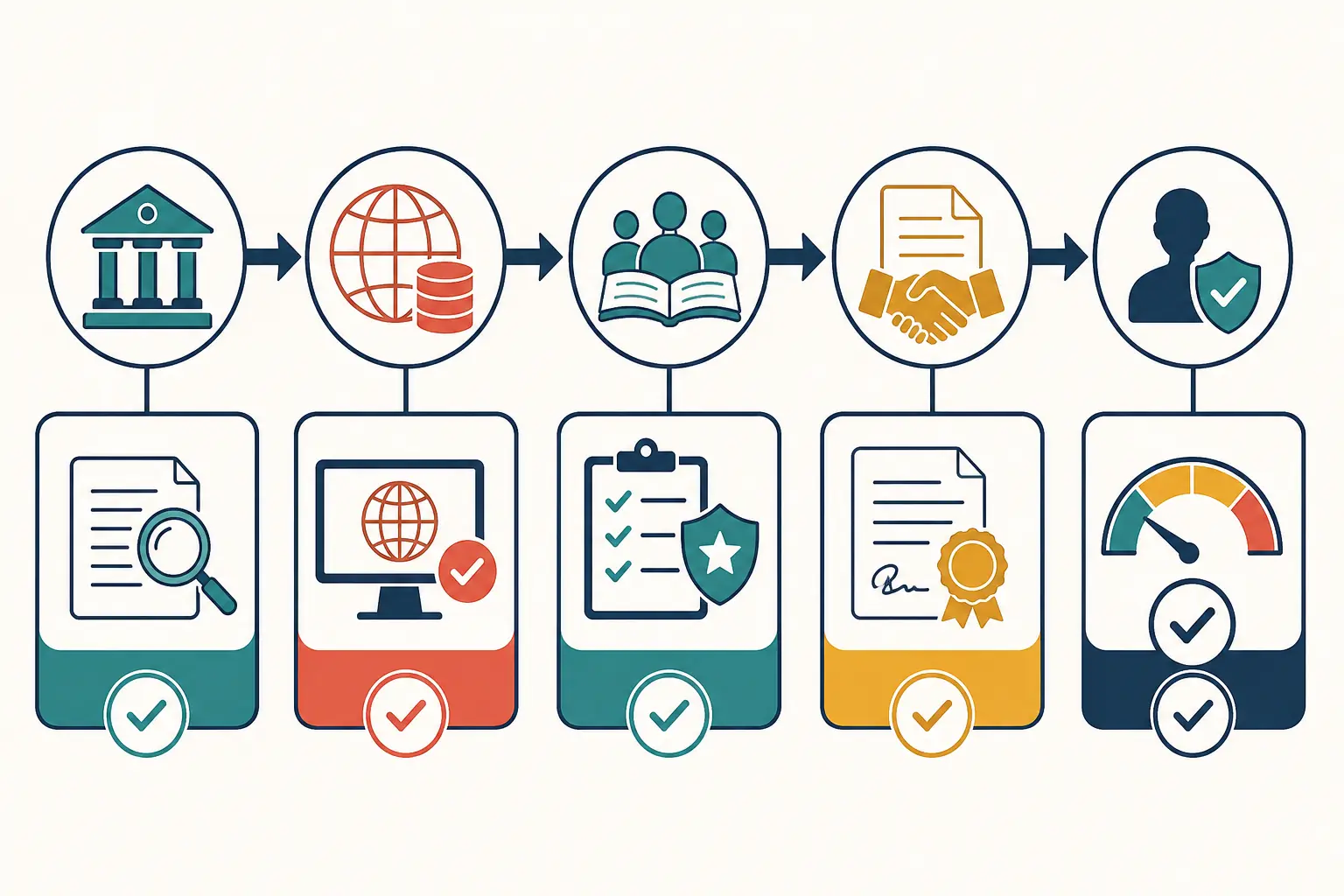
Use a five-checkpoint verification process
Journal verification should go beyond one badge. The following checkpoints create a more complete decision.
1. Confirm the journal's identity
Match the title, ISSN, publisher and official domain. Be cautious if the submission link uses an unrelated domain, the publisher address is unclear or the journal title differs slightly from the indexed record.
2. Confirm live indexing status
Use the Master Journal List for Web of Science. If Scopus or another database is relevant, use that database's current source list separately. Indexing in one database does not automatically mean indexing in another.
3. Examine editorial conduct
Read the peer-review policy, editorial-board information, corrections policy, retraction policy and publication-ethics statement. Check whether named editors have credible affiliations and whether recent articles match the declared scope.
4. Read the publication terms
Verify article-processing charges, waiver rules, copyright, licence, archiving and withdrawal conditions. Charges should be visible before submission, not introduced only after acceptance.
5. Assess your own indexing risk
Determine whether your institution requires a journal to be indexed at submission, acceptance or publication. These are not always treated as the same point. Obtain written clarification where the rule affects a degree or formal evaluation.
What happens to articles during the hold?
Clarivate states that new content will not be processed for indexing while the journal is on hold. This means that publication on the journal's own website does not guarantee that the article will appear in Web of Science.
The eventual treatment of content depends on the outcome and Clarivate's coverage decision. Authors should avoid relying on verbal promises such as “indexing will resume soon” unless the live status has actually changed.
The journal may continue accepting manuscripts, conducting peer review and publishing articles during the hold. These activities are controlled by the journal. Web of Science indexing is controlled by Clarivate. The two processes should not be confused.
Should you submit to a journal that is On Hold?
There is no universal answer, but the risk can be evaluated.
Do not submit when current Web of Science indexing is a non-negotiable institutional condition and you cannot accept uncertainty. The paper may be published while remaining absent from the database required for your evaluation.
Consider waiting when the journal is an unusually strong subject match but no deadline requires immediate submission. Monitoring the live record may be more sensible than moving forward on an assurance from the journal.
Consider another verified journal when several suitable alternatives exist. Journal selection should protect the paper's audience and integrity, not only a metric. Our Journal Citation Reports 2026 guide (opens in a new tab) explains how to compare scope, evidence level, readers and citation context after status is verified.
If you continue despite the hold, document why. Record the status check, institutional requirement, expected benefit and risk accepted by all authors.
Warning signs beyond the On Hold label
On Hold is a Clarivate process status. Other warning signs must be examined independently.
- The journal guarantees acceptance or indexing.
- Peer review is promised within an implausibly short fixed period.
- The scope covers unrelated disciplines without clear editorial structure.
- Fees are difficult to find or change during submission.
- Editorial-board members cannot be verified.
- Contact messages create artificial urgency.
- Published papers fall far outside the declared scope.
- The website displays indexing logos without direct database records.
- Correction, retraction and complaint procedures are absent.
One sign may require clarification rather than immediate rejection. Several signs together indicate that the author should stop and verify before transferring the manuscript or paying a fee.
Do not confuse On Hold, deselected and not indexed
These descriptions are not interchangeable.
On Hold means active re-evaluation. It is temporary, and the final result is not yet known.
Deselected means the journal has been removed from ongoing coverage following an editorial decision. The Master Journal List provides coverage information relevant to that change.
Not indexed may mean the journal has never been included, is listed in another database only or cannot be matched under the searched title or ISSN.
Accurate wording matters. Researchers should state what the database shows rather than using “blacklisted,” “banned” or “fake” as unsupported substitutes.
What to do if you already submitted
First, check the status yourself and save the dated record. Then read the journal's withdrawal policy and your submission agreement.
Ask the editorial office a precise question: how does the current hold affect new content, and what options exist if Web of Science indexing is a formal requirement? Do not ask only whether the journal is “indexed,” because the answer may refer to historical coverage.
If the manuscript is under review, do not submit it simultaneously elsewhere unless the first journal has confirmed withdrawal. Duplicate submission can create a separate ethics problem.
If the article is already accepted or published, speak with your supervisor, research office or institution before taking action. The correct decision depends on the publication stage, contractual terms and the rule that the paper must satisfy.
Practical conclusion
A journal On Hold in Web of Science is being re-evaluated. It has not automatically failed the review, but new content is not processed for indexing during the hold. Authors should therefore treat the status as a real uncertainty, especially when Web of Science coverage is tied to a degree, promotion, grant or institutional requirement.
Check the live Master Journal List by ISSN, verify the journal's identity and editorial conduct, read all publication terms and document your decision. Do not rely on a logo or an old screenshot.
BridgeHelix Media offers evidence-led academic editing and research support (opens in a new tab) for researchers who need help checking journal fit, improving manuscript readiness and preparing an ethical submission without false publication guarantees.
Sources

About the author
Dr. Prakash Kumar Singh
Founder & Technical Content Strategist
PhD in Chemical Engineering from MNIT Jaipur, with M.Tech and B.Tech qualifications in Biotechnology. His work connects technical evidence with clear B2B communication and ethical research support.